
Business
Renewable energy producers say they can generate more power if govt and CEB support

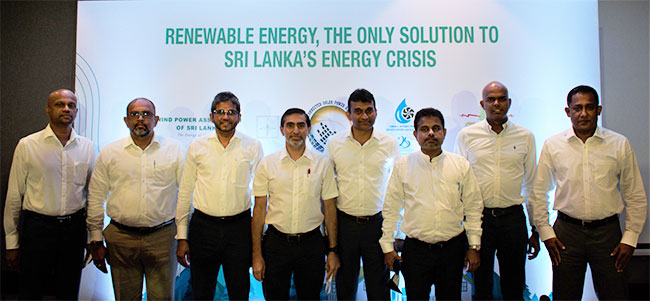
by Sanath Nanayakkare
In the backdrop of dwindling foreign currency reserves and capacity shortages, the only logical solution for Sri Lanka to take is to adopt renewable energy as the primary source of energy production, Manjula Perera, Secretary of the Wind Power Developers Association said in Colombo yesterday.
He said so speaking at a press conference held at the Hilton Colombo Residencies, convened by the associations of local entrepreneurs who have invested in the development of wind power, small hydro power, ground mounted solar power and bio energy.
Notably, the associations reiterated the fact that they want only the policy support and that they can provide themselves with necessary funding for the projects if the government, CEB and related line ministries act together to remove the bottlenecks which are there for no clear purpose.
“Sri Lanka is currently facing an acute energy crisis, primarily due to the country’s reliance on imported fossil fuel. The solution to this is for the country to move on to more renewable sources of energy such as wind, solar, bio-gas, biomass and hydro power. Renewable energy also presents a host of other benefits both socially and economically as well,” Manjula Perera said.
“Renewable energy can be generated using Sri Lanka’s ample natural resources. This would also offer some relief to Sri Lanka’s diminishing foreign reserves as renewable energy does not need to rely on fuel imports,” he noted.
‘However, one of the main issues which the renewable energy sector faces is the government approval process which can take years to complete. This process needs to be streamlined and implemented in an efficient manner as possible. Renewable energy developers also run into a myriad of challenges from the CEB that has delayed approval and grid connections, sometimes attributed to incorrect technical analysis. Bringing correct knowledge and international best practices to the CEB will help sort out these issues,” he pointed out.
Riyaz Sangani, Past President of Hydro Power Developers Association said, “Our goal as the renewable energy sector is to help the government and the people overcome the current energy crisis in the country. We believe that the key to this is to increase co-operation between the government and the private sector. Only then will we be able to successfully overcome all obstacles and make the switch to renewable energy.”
“There are currently a total of 294 private sector renewable energy developer projects which have been commissioned. These projects have combined capacity of 718.334 megawatts (MW). The total number of projects needs to increase drastically, for the country to truly reap the full benefits of renewable energy,” Thusitha Peiris, Small Hydro Power Developers Association President said.
He said that small hydro power projects have been brought to a halt for years now, and today the need is ever more acute for local entrepreneurs to be allowed to restart investing in this sector in a conducive operating environment.
“Another issue that has hampered the success of the renewable energy sector is the importation restrictions imposed on the sector, which has made it difficult to obtain the machinery necessary,” the associations said.
“In addition to the immediate benefits which the country will receive, renewable energy sources also pose less of a risk to the climate and environment. This will help protect the environment and ensure that the country’s development will not be hindered by any environmental issues in the future,” they observed.
“There have been many local and foreign investors who have shown interest in investing in renewable energy for Sri Lanka. These investors need to be shown that it is a worthwhile investment and that hindrances will be minimal. Only then can Sri Lanka overcome its socio-economic woes and continue with development,” they pointed out.





Business
Sri Lanka secures 10% US tariff rate: JAAF thanks the President and government for decisive action


Today’s announcement by USTR of the finality of the Section 301 investigations into countries’ ability to impose and effectively enforce a prohibition on the importation of goods produced with forced labour sees 18 countries placed on a 10% tariff, with the balance of 42 countries facing a 12.5% tariff.
Initial indications were that Sri Lanka would fall into the 12.5% category, a position that would have placed the country at a real disadvantage against a number of key competitor nations.
Following Sri Lanka’s submissions to the USTR earlier this month, JAAF is pleased to see that Sri Lanka is now among the countries placed on the 10% tariff rate, on par with competitors including Bangladesh, Pakistan, India, and Cambodia.
Sri Lanka’s apparel industry competes in a crowded field, and even a 2.5 percentage point difference in tariff treatment can be the difference between winning and losing an order to a rival sourcing destination. Securing parity with Bangladesh, Pakistan, India, and Cambodia protects the competitiveness of an industry that remains the country’s largest export earner and a major source of employment, particularly for women, across the country.
JAAF recognises that this result did not happen by chance. It reflects sustained, coordinated engagement between industry and government at every level, from the submissions made to USTR to the direct representations carried out in Washington. We view this as a strong example of what can be achieved when the private sector and government work in close partnership on issues that directly affect Sri Lanka’s export competitiveness.
We remain committed to continuing this collaboration, both to safeguard the gains secured on Thursday and to ensure Sri Lanka’s apparel and textile industry is well positioned to compete on a level playing field internationally.

Students of the Colombo Academy of Hospitality Management (CAHM) at SLIIT once again demonstrated their talent, creativity, and professional excellence by securing outstanding achievements at two prestigious national hospitality competitions held recently in Sri Lanka.
The Colombo Academy of Hospitality Management (CAHM) is Sri Lanka’s leading private hospitality education institute, established in 2013 and located at the SLIIT Main Campus in Malabe. Renowned for delivering internationally recognised qualifications in partnership with the William Angliss Institute (RTO 3045), Australia—the Australian Government’s specialist hospitality education institute and the country’s leading provider of hospitality, tourism, foods and events education—CAHM offers Australian-standard vocational qualifications that combine international best practices with hands-on practical training and strong industry relevance, enabling graduates to pursue rewarding careers around the world.
At the 31st National Bartenders Competition (NBC), organized by the Sri Lanka Hospitality Graduates Association (SLHGA) in partnership with International Distillers Limited (IDL), CAHM student Anurasi Chandrasoma (Commercial Cookery Batch 22) emerged as the Winner in the highly competitive Hotel School Category. The competition, held on 26 May 2026 at the Sri Lanka Institute of Tourism and Hospitality Management (SLITHM), Colombo, attracted more than 75 participants from hospitality education institutions across the country.
Representing CAHM alongside the winner were Dishala Gunawardhana (Hospitality Management Batch 37), Sunera Sathindu (Commercial Cookery Batch 21), and Devindu Amarasekara (Patisserie Batch 11), all of whom showcased exceptional bartending skills and professionalism. The achievement marks another significant milestone for CAHM, reinforcing its reputation as one of Sri Lanka’s leading hospitality education institutions.
Business
Asia-Pacific business leaders to convene in Sri Lanka for UN Global Compact’s flagship regional event

Asia-Pacific stands at the forefront of one of the defining transitions of our time. Home to many of the world’s fastest-growing economies, the region is also confronting some of the world’s most pressing sustainability challenges—from climate change and biodiversity loss to widening inequalities, geopolitical uncertainty and rapid technological transformation. As these challenges reshape the global business landscape, businesses are increasingly being called upon not only to respond, but to lead.
Against this backdrop, Sri Lanka will host Forward Faster Now | APAC 2026: Driving Business Leadership for Sustainable and Inclusive Growth, the United Nations Global Compact’s flagship regional event for Asia-Pacific. Bringing together more than 200 business leaders, sustainability practitioners, policymakers, representatives from the United Nations and UN Global Compact Country Networks from across the region, the two-day event will provide a platform to strengthen partnerships, exchange practical solutions and mobilize business leadership in support of the Ten Principles of the United Nations Global Compact and the Sustainable Development Goals (SDGs).
Led by the UN Global Compact Asia-Pacific Regional Hub and hosted in collaboration with UN Global Compact Network Sri Lanka, the regional event reflects a shared commitment to advancing responsible business and strengthening regional collaboration at a time when sustainable development depends on collective leadership and cross-sector cooperation.
The event will welcome Sanda Ojiambo, Assistant Secretary-General, CEO & Executive Director of the United Nations Global Compact, whose presence spotlights the strategic importance of the Asia-Pacific region within the United Nations Global Compact. Her first official visit to Sri Lanka signals the growing role of the region in driving responsible business and sustainable development, while offering participating companies a unique opportunity to engage with global leadership, showcase their sustainability journeys, and help shape the next chapter of collective action towards the Sustainable Development Goals.
Alongside Sanda Ojiambo, the Forum will also convene more than 60 global and regional leaders from business, the United Nations and civil society, including Dilhan C. Fernando, Chairman of Dilmah Ceylon Tea Company and Chairman of UN Global Compact Network Sri Lanka, and Sandra Wu, ESG Executive Adviser at Mirait One Corporation, fostering dialogue and collaboration to accelerate business leadership for sustainable and inclusive growth across Asia-Pacific.
Forward Faster Now | APAC 2026 also marks an important milestone in advancing the United Nations Global Compact’s 2026–2030 Strategy, which places renewed emphasis on equipping businesses with the knowledge, tools and partnerships needed to accelerate sustainable business transformation, catalyzing collaboration to address shared global challenges, and advancing responsible business leadership as a cornerstone of sustainable development. As one of the first flagship regional events aligned with this strategic direction, the event will help translate global ambition into regional action by connecting leaders, sharing practical experience and fostering the partnerships needed to create lasting impact.
Register Your Interest
Forward Faster Now | APAC 2026 will take place in Colombo, Sri Lanka, on 11–12 August 2026.
To register your interest or learn more about the event, please contact:
Chamath Kalupahana
Country Focal Point – Forward Faster Now | APAC 2026
Manager – Participant Engagement & Strategic Planning
UN Global Compact Network Sri Lanka
Email: chamath@unglobalcompact.org.lk

ICC prosecutor Karim Khan removed over ‘political’ sex abuse claims

A few showers will occur in the Western, Sabaragamuwa and North-western provinces and in Galle and Matara districts

Govt. urged to withdraw Media Professionals Bill

Fort Magistrate orders arrest of MP Archchuna

Dengue rages with average of 2,391 new cases detected daily

Lanka produces only 43% of daily milk requirement, says Deputy Minister

‘Dates have the highest sugar content to fight Coronavirus’

Sunday Island 27 December – Headlines

#SundayIsland 17th December – Headlines

Sunday Island – 28th March

Sunday Island Headlines – 21 March

Sunday Island – 21st February – Headlines
-

 Features6 days ago
Two memorable excerpts from a former SLAF commander’s memoir
-
 Business6 days ago
‘Giving up was never an option’: The fisherman who fought back after losing millions in SL
-

 Life style6 days ago
Taste of the Swiss Alps comes to Colombo
-

 Features6 days ago
Erdoğan’s New Republic
-
 Midweek Review3 days ago
Three high-profile alleged suicides shaping key investigations
-

 News3 days ago
Customs asked to resume probe or face legal action
-

 Editorial4 days ago
Welcome bid to tackle rolling death traps
-

 Foreign News7 days ago
Iran accuses US of striking critical infrastructure as war intensifies