
News
Welikada killings: HRW opposes death sentence for top ex- prison official

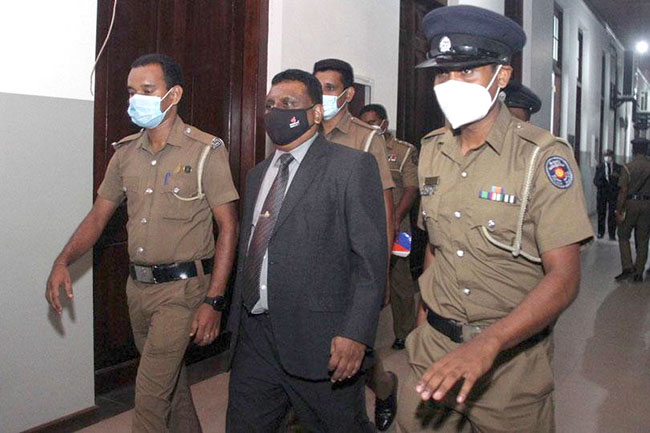
… seek action on prison conditions
(New York, January 18, 2022) – Human Rights Watch on January 18, 2022 joined other organisations in condemning Sri Lanka’s ongoing use of the death penalty after a prison official was sentenced to death on January 12. The groups said that the conviction appeared to be an attempt to avoid addressing the events and dire prison conditions that led to the 2012 incident in which 27 prisoners were killed and about 50 injured at Welikada Prison in Colombo.
Anti-Death Penalty Asia Network (ADPAN), Capital Punishment Justice Project, FIDH (International Federation for Human Rights) and Eleos Justice, Monash University endorsed the statement.
The following is their statement: On 12 January 2022, the Colombo High Court Special Trial-at-Bar sentenced former Welikada Magazine Prison Superintendent Emil Ranjan Lamahewage to death. Mr. Lamahewage was sentenced in relation to the 2012 Welikada Prison incident in which 27 prisoners were killed and approximately 50 were injured. In 2015 a Committee of Inquiry recommended charging a number of senior officials. Ultimately, only two prison officials were charged and only Mr. Lamahewage was convicted.
The undersigned strongly condemn the ongoing use of the death penalty in Sri Lanka. Whilst Sri Lanka has observed a de facto moratorium on executions since 1976, 1,284 people remained on death row as of September 2020. Despite the long-standing moratorium, the courts continue to impose the death sentence in relation to 22 capital offences.
Prison conditions for prisoners on death row in Sri Lanka are particularly harsh; the 2020 Prison Study by the Human Rights Commission of Sri Lanka describes the living conditions as “appalling and poor”, detailing testimony of those living on death row in conditions with severe overcrowding, poor sanitation, very limited access to health care, and being locked in cells for 23 hours a day. These conditions contravene the United Nations’ Standard Minimum Rules for the Treatment of Prisoners (the Nelson Mandela Rules).
Whilst on the surface, the conviction and sentencing of Mr. Lamahewage appears to be holding one prison official to account, scapegoating by sentencing one individual to death does nothing to address the very real concerns regarding the events that led to the 2012 Welikada Prison incident. Holding those responsible to account is an important step towards justice for victims and survivors of the Welikada Prison incident. That said, the imposition of the death penalty does not achieve this and is never an appropriate way to administer justice.
Using the death penalty, a form of state-sanctioned killing, as a punishment for someone convicted of state-enabled killing, highlights the absurdity of the state being empowered to take the lives of individuals. Activists within Sri Lanka have highlighted the need for urgent, fundamental reform of the criminal justice system with a focus on rehabilitation and reintegration to meaningfully address the severe overcrowding and poor prison conditions.
The signatories call for the Government of Sri Lanka to formalise its de facto moratorium and abolish the death penalty. In the interim, all options should be explored for those sentenced to death, including individualised resentencing, taking into consideration each incarcerated person’s mitigating circumstances, the weight of the evidence presented at trial, and the lengthy sentences of imprisonment many have already served, in very difficult conditions.
Consideration should be given to early release options including commutation of sentences, based on the circumstances of each case, including injustices they may have experienced due to structural and systemic factors. Additionally, the issues outlined in relation to the current conditions on death row must be urgently remedied with adequate resourcing and facilities.”

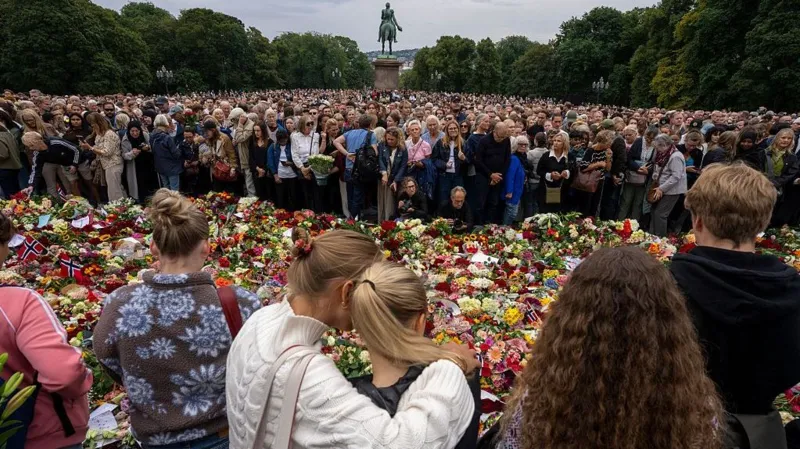
Norwegians are grieving the death of the beloved King Harald V, as a period of national mourning begins and his son Haakon VIII assumes the throne.
After Harald’s death was announced early on Friday, crowds amassed at the royal palace in Oslo, laying flowers and flags, some mourners visibly in tears.
The 53-year-old new king held an extraordinary council of state meeting with government ministers, saying he was taking on the royal family’s motto “All for Norway”.
Harald – who was on the throne for 35 years – died in hospital at 06:35 local time (04:35 GMT) aged 89, after being treated there for a rare blood condition. His coffin was later taken to the palace in a public procession.
Memorials outside the palace included a candle with the word “thanks” written on it (BBC)
An estimated 10,000 people lined the streets in the capital to see the late king go past, Norway’s public broadcaster reported.
The late monarch has been described as an inclusive, transparent and empathetic “people’s king” who modernised the Norwegian monarchy.
European royals, including King Charles III – whose mother Queen Elizabeth II was Harald’s second cousin – as well as political leaders and ordinary citizens, paid tribute to his service and the stability he brought to the country.
Norway’s Prime Minister Jonas Gahr Støre, who laid flowers outside the palace and signed a book of condolences after greeting the new king, said the country was “united in grief and gratitude”.
In a televised memorial address – one of multiple eulogies by ministers – he said the late king’s “legacy lives on” and offered condolences to the royal family and Queen Sonja, who would have celebrated her 58th wedding anniversary with Harald on Saturday. Støre was joined by ministers and a crowd of citizens grieving outside the palace (BBC)
Norway’s superstar footballer Erling Haaland thanked Harald for “everything you meant to Norway” in a post on Instagram, adding that it had been an honour to meet him earlier in the summer at the palace following the Fifa World Cup.
In the country’s capital, Norwegians shared their grief and affection for the late king.
“I personally will say he was everything for us, especially being an immigrant,” Biteya Terfassa, an Oslo resident who was born in Ethiopia, told news agency Reuters outside the palace.
“He made us feel at home and he made us feel loved. So he was like a grandfather that I never had.”
At noon, the Norwegian Armed Forces honoured Harald with a funeral salute of 21 shots from Akershus Fortress in central Oslo.
Later on Friday, a procession left the chapel at Rikshospitalet, where Harald died, taking his coffin in a hearse to the royal palace.
The date of Harald’s funeral is yet to be officially announced. Until then, he will be lying in state in the palace chapel so the public can pay their last respects.
During the national mourning period, flags will be flown at half-mast across the Nordic country, while Harald’s portrait will be displayed, candles lit and moments of silence held at professional events.
All non work-related social events will be cancelled or postponed. Oslo Mayor Anne Lindboe, who was due to get married on Friday, even postponed her wedding,
King Haakon, who is Harald’s younger child, is now the monarch and his wife Mette-Marit queen.
He is due to take an oath before the Norwegian parliament on Tuesday and will later participate in a consecration service – a stripped-down version of a coronation, which Norway no longer has.
His daughter, the 22-year-old Ingrid Alexandra, who joined her father to meet ministers at the palace on Friday, is next in line to the throne as crown princess after the rules of succession changed in 1990 to allow firstborn women to inherit the crown. Crown Princess Ingrid Alexandra, second from right, stood by her father’s side (BBC)
Haakon assumes his new role at a difficult time, as the royal family has faced health challenges and scandals this year.
Now-Queen Mette-Marit came under scrutiny earlier this year when it was revealed that she had a three-year friendship with the late convicted sex offender Jeffrey Epstein, for which she has publicly apologised.
Later in the year, she received a lung transplant, after suffering from pulmonary fibrosis since 2018. Doctors will not declare her stable until next year, meaning her husband must balance his new official duties with her care.
Meanwhile, Mette-Marit’s son from a previous relationship, Marius Borg Høiby, was convicted in June of rape and other offences and sentenced to four years in prison. He is appealing.
Høiby is not a member of the royal family, but was raised with them since he was four years old, when now-King Haakon married his mother.

Although Harald remained popular until his death, a poll for newspaper Aftenposten earlier this year found that support for the monarchy had dropped from 72% in 2024 to 54%.
However, Norwegian royal experts told the BBC that the new king, while facing questions about the turbulence surrounding his family, was respected, hard-working and, they believed, able to move forward despite the challenges.
(BBC)
Latest News
Sun directly overhead Pallawarayankaddu, Akkarayankulam, Ariviyal Nagar, Puthukkudiyiruppu, Ananthapuram at about 12.11 noon today (29)


The sun is going to be directly over the latitudes of Sri Lanka from 28th of August to 07th of September due to its apparent southward relative motion.
The nearest places of Sri Lanka over which the sun is overhead today (29) are Pallawarayankaddu, Akkarayankulam, Ariviyal Nagar, Puthukkudiyiruppu, Ananthapuram about 12.11 noon.


Development officers to launch countrywide protest over pay, unfulfilled Govt. pledge
Development officers in the State and Provincial Public Services are to stage countrywide protests on Monday (31), demanding action on their longstanding salary grievances and the immediate release of a Cabinet paper the Government has repeatedly said was prepared to address their concerns.
The protest, organised by the Trade Union Alliance of Development Officers in the State and Provincial Public Services, will be held from noon to 1 p.m. across the country, alliance General Secretary Dhammmika Munasinghe said yesterday.
The alliance is led by the Frontline Socialist Party (FSP), a political group that emerged as a splinter from the JVP.
Munasinghe said the Government had informed Parliament in June that a Cabinet paper had been prepared to resolve the issues faced by development officers. However, despite several months having passed, the document had not been made public.
“We are asking the Government to make these Cabinet papers public. If the Government wants to stop these protests, it should not put unnecessary labels on us. It should clearly present the measures it intends to take,” he said.
He also challenged Government claims that public servants had already received a significant salary increase, saying the increase being implemented from 2025 to 2027 was insufficient to meet the rising cost of living.
According to Munasinghe, the Government was repeatedly highlighting the salary revision through the Presidential Media Division, Cabinet spokesperson, Ministers and MPs while failing to acknowledge the impact of higher taxes and the rising prices of essential goods.
He said a recent international comparison, based on data from the International Monetary Fund (IMF) and International Labour Organization (ILO), had placed Sri Lanka 120th among 130 countries in terms of wages.
“This makes the real situation behind the claims of a salary increase clear,” he said.
Munasinghe said workers were facing an increasing tax burden, with higher taxes imposed on essential items, including food, medicines and medical equipment. At the same time, the cost of living continued to rise, while fuel prices had been increased six times this year, he claimed.
Against this backdrop, he argued that the salary increases announced by the Government were inadequate in real terms.
He also questioned why public servants and other workers were not being given a mechanism to compensate for rising fuel prices, similar to what he claimed had been provided to Parliamentarians through adjustments to their privileges.
“If fuel adjustments can be given to MPs and Ministers, why can’t the same relief be given to public servants, private-sector employees, fishermen and farmers?” he asked.
Munasinghe said there were mechanisms for adjusting fuel prices and electricity tariffs, but no comparable formula existed to automatically adjust salaries in line with the rising cost of living.
He also pointed to changes in deductions affecting public servants, saying the contribution to the Widows’ and Orphans’ Pension (W&OP) scheme had increased from six to eight percent alongside the salary revisions.
He said such deductions and other costs should also be taken into account when assessing the actual benefit of the salary increases.
“Do not deceive the people. We tell the Government not to lie and not to mislead the public,” Munasinghe said.
Meanwhile, the trade union alliance has also criticised the reported restrictions on social media use by railway employees, describing the move as an attempt to curtail the right of trade unions to express their views.
Munasinghe said the issue arose after the General Secretary of the Sri Lanka Railway Station Masters’ Union publicly stated that train services had declined by around 50%, largely due to problems with railway maintenance.
He said the statement had been made by a recognised trade union as part of its efforts to highlight problems affecting the railway service.
However, Munasinghe claimed that following the statement, disciplinary action had been initiated against the union official.
He questioned the Government’s approach, pointing out that many of its present Ministers and MPs had previously represented trade unions or spoken out in support of workers’ grievances, while in the Opposition.
He said trade unions should not be prevented from raising issues affecting employees and public services.
The Monday protest will, therefore, serve as a broader expression of dissatisfaction over salaries, rising living costs, taxation and what the alliance describes as restrictions on trade union activity.
Munasinghe said the development officers would continue their campaign until the Government clearly sets out its proposals for resolving their grievances and makes the promised Cabinet paper public.

Ex-White House teleprompter operator ordered to pay $172,000 for Trump speech bets

Rescuers on high alert for signs of secondary landslides

More than 600 killed in Nepal flood as search for survivors enters fourth day

Norway mourns King Harald as Haakon VIII ascends throne

Trump announces ‘biggest oil deal in world history’ with Venezuela

Sun directly overhead Pallawarayankaddu, Akkarayankulam, Ariviyal Nagar, Puthukkudiyiruppu, Ananthapuram at about 12.11 noon today (29)

‘Dates have the highest sugar content to fight Coronavirus’

Sunday Island 27 December – Headlines

#SundayIsland 17th December – Headlines

Sunday Island – 28th March

Sunday Island Headlines – 21 March

Sunday Island – 21st February – Headlines
-
 Features6 days ago
My secondary schooling after Royal Primary
-
 Features6 days ago
From the First to the 22nd: A short history of Amendment Politics and Reform Frustrations
-

 News4 days ago
Missing doctor’s body found in Mahiyanganaya
-
 Features6 days ago
How Shelton Kodikara became first Professor of International Relations
-
 Features6 days ago
How St. John’s College Shaped Panadura for 150 Years
-
 News4 days ago
Australia declines to release Finance Secy Suriyapperuma’s citizenship details
-
 News6 days ago
Ex- Atamasthanadhipathi uses Magistrate’s gate to enter court
-
 News4 days ago
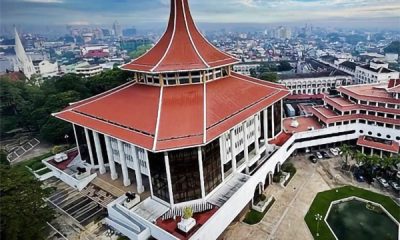
22A: BASL suggests CJ recuse himself from hearing petitions