
Sports
Schoolboy players must come out of their shackles


Western Province Rugby Sevens
by A Special Sports Correspondent
The much looked forward to schools rugby sevens is expected to kick off this weekend in Colombo as scheduled unless the restrictions imposed by the Covid pandemic upsets the applecart.
According to school rugby authorities and news published in newspaper, the inter-school rugby sevens tournament will be commenced with a ‘leg’ for Western Province schools at the Royal College Sports Complex in Colombo on December 18 and 19.
It’s good that the schools’ rugby authorities are having the sevens tournament for schools spread out in the provinces and with no involvement of spectators largely to protect the spectators. Just for the record sevens tournaments for schools have been lined up in Central Province (December 27), North Western Province (December 28), Sabaragamuwa Province (December 30) and Southern Province (December 31). We still don’t know whether the Sri Lanka Schools Rugby Football Association (SLSRFA) would get the winners of each category in these respective provincial tournaments to perform in a final showdown. Even if they don’t this is a good enough start for school rugby because we haven’t seen any rugby with schoolboys in action after March 14, 2020.
Schools produce much talent each year and this helps clubs absorb these products. But over the last two years clubs were severely handicapped because there was no school rugby; hence the feeder system for the clubs was derailed for some time. These sevens events are just what the doctor ordered for domestic rugby. Some schoolboy rugby players, who are hell bent on propping their profiles with sports achievements, had to bid adieu to their schools prematurely and migrate to better their prospects because of the absence of competitive rugby. It’s a small percentage of rugby players who manage both their studies and sports and excel as allround students.
It’s at a time like this that we must mention-despite this achievement being recorded at the Medical College and not in school rugby- how former Royalist Dr Maiya Gunasekera represented Sri Lanka while still being an undergraduate at Medical College. That record still stands; just showing what effort it takes for a player to balance reading for a degree in medical science and balancing sport at the national level.
Coming back to the schools rugby sevens it has been a much looked forward to event. Unlike in club rugby, schools rugby players have often made amends for their disappointments in the 15-a-side version of the game by coming on top when playing this abbreviated form of rugby. One good example came during the 1988 season where the all-conquering Royal College team- led by Lasitha Gunaratne- had to bow out of the semi-finals when they were shown the door by S. Thomas’ in a closely contested semi-final. There have been many memorable moments like that in schools rugby. Once Dharmaraja College, relegated to the B Division, produced thunder at the Royal College Sports Complex in 2012 when they beat Kingswood in the final. Then in 2019 Trinity, under the leadership of Reshan Bandaranayake, played cohesive rugby to down St. Peter’s College in the finals. Trinity hadn’t won this event till 2019 having last won the sevens plum under Ravi Balasuriya in 1977. Two schools which have enjoyed great success in the sevens version of rugby are Isipathana College and St. Peter’s College and both these academic institutes are expected to field teams for the Western Province schools rugby sevens coming up this weekend.
Sevens rugby is dazzling and eye-catching and players who are extremely fit and agile will have a field day. This form of rugby also serves in player identification and finding members for the 15-a-side version of the game.
Rugby Sevens has its own place in rugby union after the expansion of seven-a-side rugby in the world and its inclusion as a discipline at the Olympic Games. Hence schoolboys have everything to play for in the seven-a-side version of rugby union. Let the games begin!


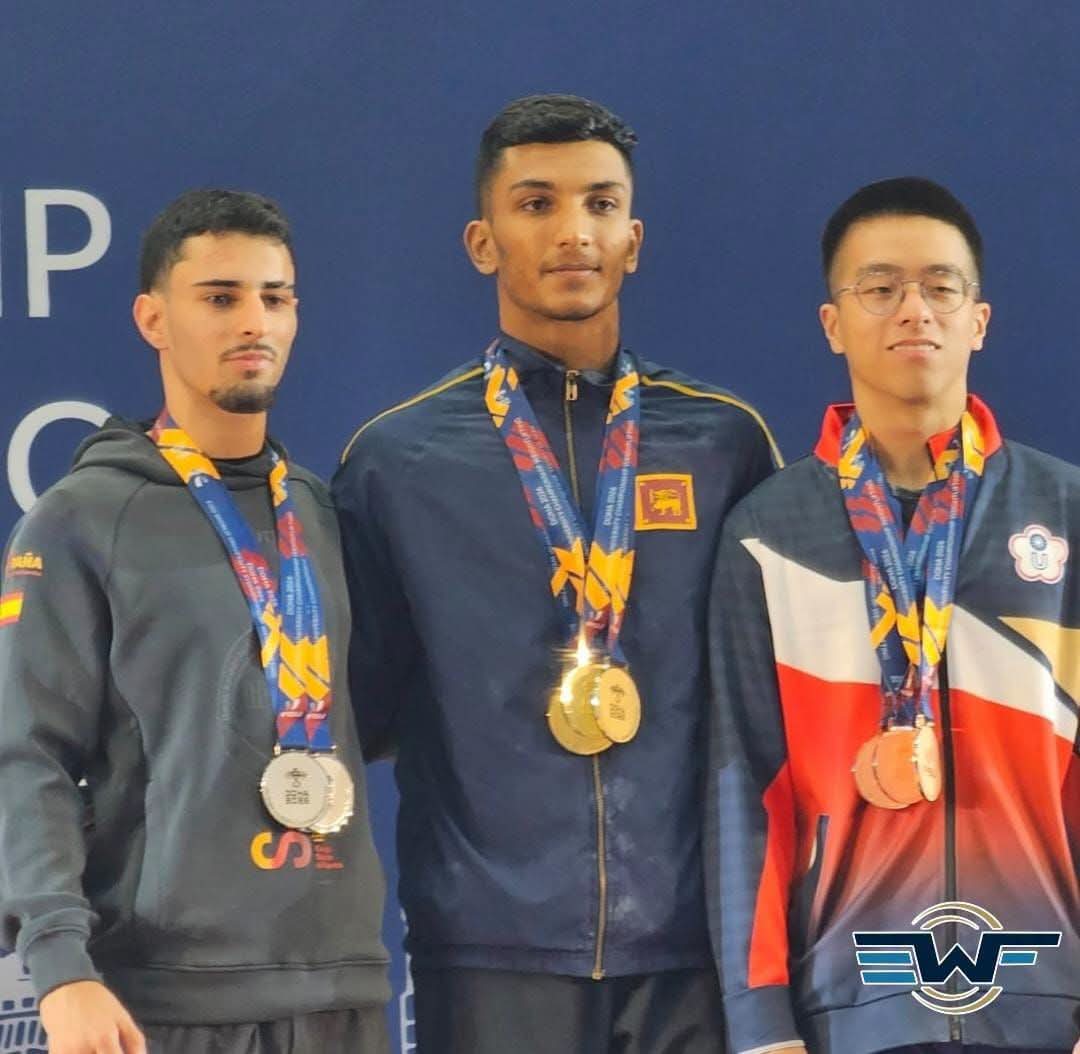
University of Sri Jayewardenepura weightlifter Avindu Liyanagedara made history yesterday by becoming the first Sri Lankan university student to win a gold medal at a World University sports event, as Sri Lanka made a spectacular start to the 2026 World University Weightlifting Championship in Doha, Qatar.
Liyanagedara won the men’s 60kg title, while Sabaragamuwa University’s Nipun Dissanayake added a bronze medal in the 65kg category on the opening day of the championship.
Liyanagedara lifted 105kg in the snatch and 132kg in the clean and jerk for an impressive combined total of 237kg.
Spain’s Gomez Martinez took the silver with 228kg, while Chun-Yen Tang of Chinese Taipei won bronze with 227kg.
Dissanayake also secured a podium finish in the 65kg class with a total of 220kg, comprising a 100kg snatch and a 120kg clean and jerk.
Iran’s Mohhadov Tehran won the gold with 289kg, with Moldova’s Ion Badanev taking silver with 288kg.
Liyanagedara’s achievement represents a landmark breakthrough for Sri Lankan university sport. His gold is the first gold medal won by a Sri Lankan university student at a World University sports event, while Dissanayake’s bronze further strengthened the country’s historic opening-day showing.
The Sri Lanka University Sports Association has entered five male and two female athletes for the championship, with University of Colombo’s Sujan Walgampaya serving as team manager and coach.
The championship continues in Doha until September 12, with Sri Lanka already assured of a memorable place in the history of World University sport through Liyanagedara’s historic gold medal.
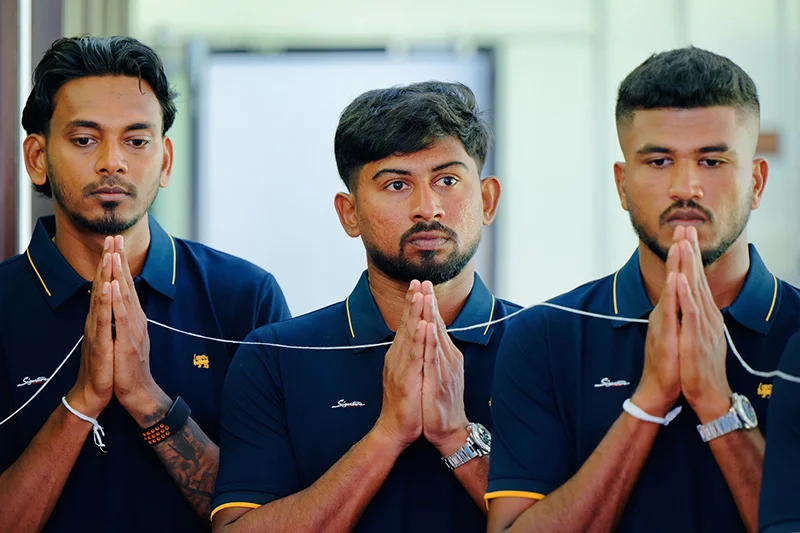
by Rex Clementine
Despite the disappointment over how Sri Lanka’s cricket teams have fared in recent years, there is one format in which they have managed to hold their heads high, ODI cricket. There are a couple of notable feathers in their cap too, having beaten Australia and India, the world’s two top ranked teams and finalists at the last World Cup.
Those impressive performances against the heavyweights have ensured that Sri Lanka are out of the woods this time around. Unlike ahead of the 2023 World Cup, they will not have to endure the indignity of a qualifying tournament to book their ticket to South Africa in 2027.
How they fare once they get there, of course, is another question altogether.
Sri Lanka failed to progress beyond the first round in both 2019 and 2023, a sharp contrast to their impressive run from 2003 to 2015. Across those four World Cups, they twice finished runners-up, reached a semi-final on another occasion and made the quarter-finals in the other.
If Sri Lanka are to make an impact in South Africa, one thing they must do is wrap their fast bowlers in cotton wool. Fast bowling has been one of the brighter areas of Sri Lankan cricket in recent years and there can hardly be a better place to cash in than South Africa, where hard, bouncy surfaces tend to put a spring in the step of any quick worth his salt.
The key man, obviously, is Dushmantha Chameera. The quickest bowler in the country, Chameera is now being used only in white ball cricket and that should make workload management considerably easier. Sri Lanka would be wise to count how many limited overs games they have between now and the World Cup rather than wheel him out for every bilateral contest.
Keep him for the important assignments, such as the Asia Cup. Then there is the IPL, where he will understandably want to ply his trade. Manage him sensibly and by the time the World Cup comes around this time next year, Sri Lanka could have a fresh and firing Chameera rather than one held together by strapping and hope.
Then there is Asitha Fernando, whose progress over the last five years has been remarkable. Currently ranked just outside the top ten among Test bowlers, he has earned admiration for his ability to make things happen, particularly with the older ball. He keeps asking questions even when conditions are against him.
A stint with Glamorgan last year appears to have added a few more tricks to his armoury as well. Asitha is no longer simply a wholehearted fast bowler. He is developing into a clever one.
Lahiru Kumara is another serious weapon. The second quickest bowler in the country behind Chameera, he can be devastating when fully fit. His career should probably have produced far more by now, but, like Chameera, injuries have repeatedly applied the handbrake.
Eshan Malinga, meanwhile, has arguably been the most improved fast bowler in the country over the last 12 months. He has pace, guile and every time you watch him, there seems to be another little trick added to his repertoire. The upcoming series against England should tell us plenty about how far he has come.
Eshan has already become a regular fixture for his IPL franchise. It should only be a matter of time before he establishes himself in similar fashion for Sri Lanka.
Then there is Dilshan Madushanka to provide the left-arm variety. When in full flow, he is a treat to watch. His ability to strike with the new ball makes him particularly valuable and when batters attempt to force the pace against him, he can be deadly. Used aggressively during the Power Play, he should provide plenty of early breakthroughs.
That makes Sri Lanka’s use of their quicks during the upcoming tour of England, particularly in the ODIs, worth watching closely. With the World Cup in mind, there is little sense in flogging the same men game after game. Rotate them, manage them and make sure the main weapons are still firing when the bigger battles arrive.
There are also Matheesha Pathirana and Nuwan Thushara, the two slingers, although that style of bowling increasingly looks as though it is losing some of its novelty as batters become accustomed to it.
One man Sri Lanka should certainly not overlook is Milan Rathnayake. He bowls at a decent pace, bats beautifully and is probably the best fielder among the fast bowlers. That package could prove invaluable in South African conditions.
Sri Lanka have spent years searching for a pace attack with depth. They finally appear to have one. The challenge now is to preserve them. South Africa will reward pace. Sri Lanka’s job over the next year is to make sure their quicks land in Johannesburg fit.
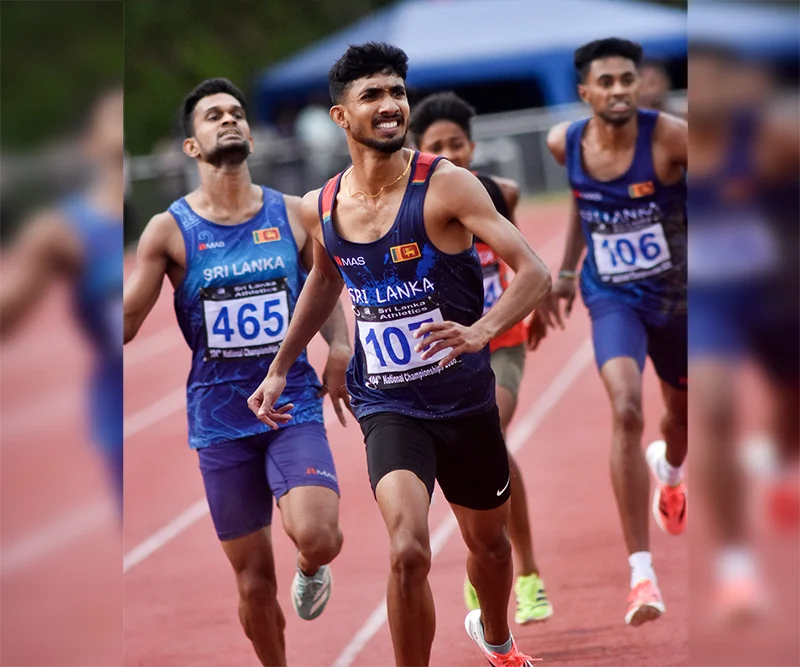
Harsha Karunaratne produced one of the highlights of the 104th National Athletics Championship, clocking 1:47.80 to win the men’s 800 metres on the final day on Sunday. His performance shattered the meet record and became the fastest 800m ever run by a Sri Lankan on home soil.
Trained by veteran middle-distance coach Susantha Fernando, Karunaratne’s run carried an extra edge as he is the only gold medallist from the 2025 South Asian Championship who has not been picked for the Mission Olympic programme. His performance at the Nationals looked very much like a statement to selectors. His training partner, Shehan Dilranga, backed up the effort with a personal best of his own, finishing second in 1:48.43.
Karunaratne is also the brother of Tharushi Karunarathna, the Asian Games gold medallist, keeping the family name prominent in Sri Lankan track and field.
Former Ratnayake Central Walala athlete came almost close to breaking the national record of Indunil Herath.
Indunil Herath, who also emerged from the same school established the national record (1:47.13) at the Kenyan President’s Cup in 2018.
The gap is just 0.67 seconds — a small margin in an event where fractions of a second separate medals. Herath, a Sri Lanka Army athlete, set his mark abroad after trining in Kenya, and it has stood since. Herath was also a two-time South Asian Games gold medallist (2016, 2019) and won silver at the 2017 Asian Indoor and Martial Arts Games, giving context to just how significant that record has been for Sri Lankan middle-distance running.
What makes Karunaratne’s run notable is that his was achieved on home soil, making it the fastest 800m ever recorded by a Sri Lankan athlete within the country — even if the outright national record, set overseas, remains marginally quicker.
With Herath’s mark now under genuine threat and a training partner also running a personal best alongside him, Karunaratne’s performance suggests Sri Lanka’s 800m depth is improving. It also sharpens the debate around his omission from the Mission Olympic programme — a decision that, on the evidence of this race, authorities may be forced to revisit. (RF)

Avindu makes history with first World University gold for Sri Lanka

Establishment of National Trade Negotiation Committee (NTFC) and Trade Policy Consultation Committee.

Showers will occur in the Western and Sabaragamuwa provinces and in Galle and Matara districts

Justice Minister hits back at CLA

First visit by an Indian Defence Minister since IPKF deployment

“I’m not a war criminal, I fought for my country”: Shavendra Silva

‘Dates have the highest sugar content to fight Coronavirus’

Sunday Island 27 December – Headlines

#SundayIsland 17th December – Headlines

Sunday Island – 28th March

Sunday Island Headlines – 21 March

Sunday Island – 21st February – Headlines
-

 News6 days ago
Denied of promotion to SC despite vacancies, justice Gurusinghe retires
-

 Latest News7 days ago
Grade 5 scholarship exam results released
-

 News6 days ago
22A: SC urged to suspend hearing, appoint full bench
-
 News4 days ago
Namal remanded until Sept. 18 over Airbus deal investigation
-

 Latest News3 days ago
Tharanga creates history with Diamond League crown in Brussels
-
 News6 days ago
Govt. seeks NATO assistance
-

 News3 days ago
Dispute which triggered listed company director being detained at BIA resolved
-

 Editorial6 days ago
Strange arithmetic goes unchallenged