
News
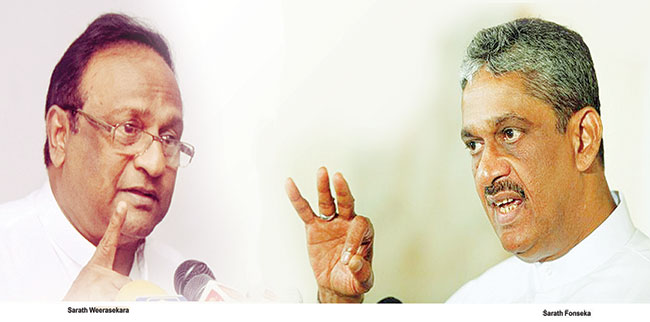
Sarath vs. Sarath continues

By Saman Indrajith
Public Security Minister Rear Admiral (Retd) Dr. Sarath Weerasekara told Parliament on Friday that SJB MP Field Marshal Sarath Fonseka had made use of parliamentary privileges to sling mud at others.
Responding to certain allegations raised by Field Marshal Fonseka in Parliament on Thursday the Minister said Fonseka had criticised him in a very degrading manner and in Parliament on Thursday (09).
“Either he is afraid of me or he is jealous of me. We call this Inferiority complex, your honour, as this jealousy has been developed because I was been given the Ministry of Public Administration by President Gotabaya Rajapaksa and Sarath Fonseka was not given the Ministry when his party was in power,” the Minister said
The Minister said that his goal was to enable the people to live without fear.
Speaker of the Parliament Mahinda Yapa Abeywardane said that he has advised the Secretary of Parliament to expunge certain parts of Thursday’s (09) and Friday’s (10) debate form Hansard.


… alleges NPP trying to implement UPFA, UNP plan
Front-line Socialist Party (FSP) yesterday (24) alleged that the NPP government’s move to amalgamate the Employees’ Trust Fund (ETF) and the Employees’ Provident Fund (EPF), under a unified, tripartite governance framework, would be detrimental to the private sector workers.
Addressing the media at Melder Place, Nugegoda, FSP spokesman Duminda Nagamuwa said that the Cabinet of Ministers approved this proposal on 15 June.
Nagamuwa claimed that the NPP was trying to implement what President Mahinda Rajapaksa had sought to do, in 2011, causing the police to open fire on a group of the Export Processing Zone workers, protesting against the move to create a private pension scheme. A worker, identified as Roshen Chanaka, was shot by police on May 30, 2011, and he succumbed to his injuries.
Pointing out that the EPF and the ETF had been established for the benefit of private sector workers but with different objectives, Nagamuwa warned that amalgamation of the two funds could cause unnecessary complications.
The FSP spokesman said that Ravi Karunanayake, in his capacity as the Finance Minister of the Yahapalana government, in late November 2015 had declared their intention to amalgamate the ETF with the EPF.
FSP’s Pubudu Jayagoda told The Island that they expected all political parties, other than the NPP, to disclose their stand on the vital issue. Jayagoda urged the Opposition to take a stand on the vital issue .
By Shamindra Ferdinando
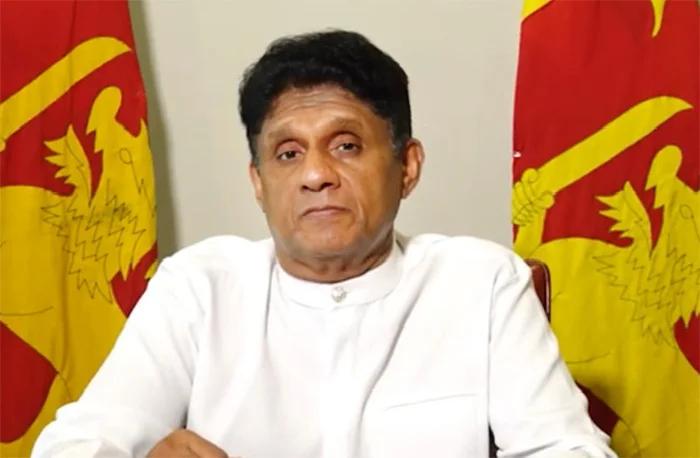
The Opposition yesterday argued in Parliament that the National Environment Amendment Bill was unconstitutional. The Opposition said that it violated the 13th Amendment.
SJB and Opposition Leader Sajith Premadasa argued that the approval of the Provincial Councils was required for the Bill to go ahead, as it was a subject in the Concurrent List of powers as per the 13th Amendment to the Constitution.
The MP also said that the clause which enables the Central Government to file legal actions against Local Government bodies was unconditional as well, since local bodies are included in the Provincial Councils list.
“How can you go ahead at a time when the Provincial Councils do not function properly,” Premadasa questioned.
ITAK MP P. Sathyalingam also raised the issue, but Speaker Jagath Wickramaratne, who responded, said the MPs could raise the relevant matters during the debate.
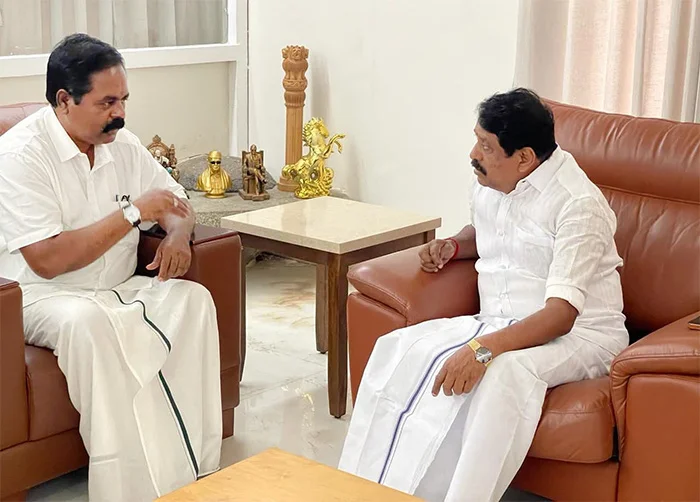
The leader of the Ilankai Tamil Arasu Kachchi (ITAK) and parliamentarian Sivagnanam Shritharan recently met the Bharatiya Janata Party’s Tamil Nadu state president, Nainar Nagenthran in India during a three-day visit in which discussions centred on the political and livelihood challenges facing Tamils in the North-East of Sri Lanka.
According to a statement issued by MP Shritharan, the talks ranged across a number of contemporary issues confronting the Tamil people among them the demolition of ancestral Tamil Hindu temples and the construction of Buddhist viharas in their place, the skeletal remains being exhumed at the Chemmani mass grave, and efforts to secure justice for the alleged genocide committed against the Tamil people.
The statement said the two sides had also discussed a lasting settlement to the Tamil national question.
“There was an extensive exchange of views between both sides on a permanent political solution for the Eelam Tamils and the political aspirations of the Tamil people.”
The two had agreed to continue such meetings and consultations in future, the statement added, and Shritharan was hosted for lunch during the visit.
Also present was the veteran Tamil political figure K. S. Radhakrishnan, described in the statement as having more than fifty years of experience in Tamil political affairs, along with the BJP’s Tamil Nadu state secretary and several senior party representatives.
Nagenthran, a former Tamil Nadu state minister, has headed the BJP’s Tamil Nadu unit since April 2025 and is leading the party’s bid to unseat the governing DMK in the state.

Morocco come back after historic Haiti goals to reach World Cup last 32

Strong earthquake strikes northern Japan

Vinicius nets twice and Neymar returns as Brazil ease by Scotland

Two powerful quakes shake Venezuela

Showers will occur in the Western, Sabaragamuwa and North-western provinces and in Galle, Matara, Kandy and Nuwara-Eliya districts

Proposed EPF-ETF merger harmful to private sector workers – FSP

‘Dates have the highest sugar content to fight Coronavirus’

Sunday Island 27 December – Headlines

#SundayIsland 17th December – Headlines

Sunday Island – 28th March

Sunday Island Headlines – 21 March

Sunday Island – 21st February – Headlines
-

 News6 days ago
Creditor receives USD 2.5 mn as Lankan public bears loss from theft of Treasury funds
-

 News5 days ago
Creditor not yet paid
-
 News5 days ago
Consumers bearing 22% tax burden despite 18% VAT claim: Dr. Harsha de Silva
-

 Features4 days ago
Nanda Pethiyagoda Wanasundara as three generations of family saw her
-

 Features3 days ago
Sri Lanka developing independent hydrographic capabilities
-

 Opinion6 days ago
SriLankan Airbus struck by lightning
-

 Latest News3 days ago
Sooryavanshi thumps fastest List A fifty as India A win tri-series
-

 Editorial4 days ago
Fuel crisis: Beyond price debate