
Features
Reconstructing the SLFP

By Uditha Devapriya
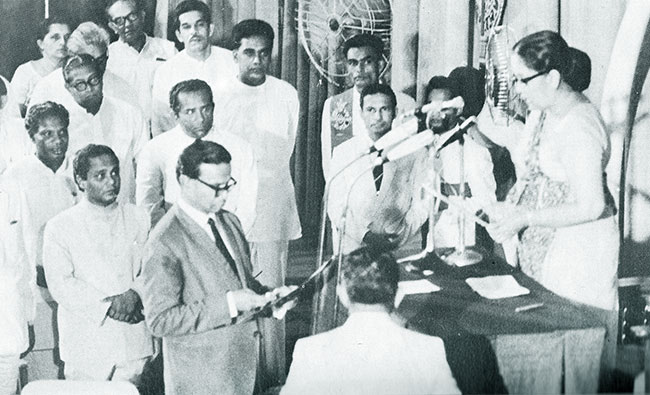
In my very brief essay on the history of the SLFP, I pointed out that several events preceded and laid the groundwork for the 1956 election. I noted that many of these events involved the UNP, even under John Kotelawala’s stewardship. I also observed that, unlikely as it may seem now, it was Dudley Senanayake, not Bandaranaike, who the Buddhist clergy wanted to lead the revival, and it was to him that they went. Yet, in the final analysis, it was the SLFP and not the UNP that headed the movement. And incongruous as he seems to us today, it was Bandaranaike who became its voice, through the SLFP.
Sinhala nationalists and propagandists link the SLFP’s win to the anti-colonial struggle, and depict the party as the successor to the martyrs of the Uva Wellassa Rebellion, Weera Puran Appu, and Anagarika Dharmapala. The nationalists’ explanation of what went wrong after 1956 is that Bandaranaike imbibed too many liberal ideas to take the struggle to its logical conclusion. In the same vein, his widow cohabited with Marxists, who apparently destroyed local entrepreneurship and proceeded to enforce measures that, in the words of Gunadasa Amarasekara, “made life impossible for the middle class, and the poor.”
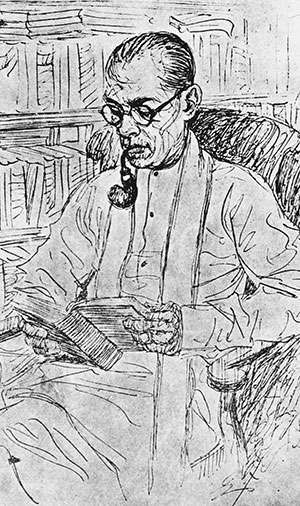 The conventional reading of the SLFP, accordingly, is that it used to be a nationalist party, but has since become a captive of foreign interests. What this assumes that the rank and file of the party were progressive in their views and it was with the advent of the Marxists, and later the NGO-cracy, that they went downhill. In the words of Gunadasa Amarasekara, “[t]he UNP was founded on the liberal ideology of the West, the Socialist parties were founded on Marxism, which once again was a product of the West.” The implication there, of course, is that the SLFP could become a party “of the soil” only by steering clear of both.
Amarasekara traces the SLFP’s origins to the Buddhist revival, and in doing so he links it to the two institutions set up at the turn of the 19th century by the stalwarts of the revival, Vidyodaya and Vidyalankara. Profoundly influenced by the work done at these institutions, Anagarika Dharmapala sought to take their message “to the masses.” It was that message which became a catalyst for the formation of the Party.
Amarasekara considers Dharmapala as embodying a progressive ideology, one which S. W. R. D. Bandaranaike became heir to when he set up the Sinhala Maha Sabha and the SLFP. A wide array of social forces rallied around these outfits, resulting in a conjunction of sangha, vedha, guru, govi, and kamkaru. Amarasekara notes that, to Bandaranaike’s credit, he was the only member of the colonial elite who took stock of these developments.
Fairly accurate as this account of the SLFP’s is, it omits certain points. First and foremost, anti-nationalist as the Marxists may be in Amarasekara’s book, they nevertheless found common cause with the clergy. This is not an omission made by nationalists only: I have with me a collection of 19 essays on Buddhism in Sri Lanka published by an avowedly secular civil society institution in the country, and none of them as much as mentions monks who joined the Old Marxist Left, among them Udakendawala Sri Saranankara.
Such an omission is not hard to explain, striking though it is. In most liberal and non-Marxist accounts, Buddhist monks overreached themselves and went beyond their call of duty by involving themselves in politics, whatever their ideology may have been. Indeed, very few scholars, including Regi Siriwardena and Kumari Jayawardena, noted that their forays into the Left helped them to break away from their conservative roots. Such a rupture held the promise of a radical role for the Buddhist clergy, a prospect denied by the more parochial among them as well as by the elite’s opposition to their involvement in politics.
Unfortunate as it is, then, liberal opprobrium against nationalism and nationalist hostility to Marxism have compelled both sides to neglect the potential the clergy possessed at the turn of the century, when they joined hands with the only anti-imperialist political formation in the country. Accordingly, in liberal narratives as in nationalist ones, Sinhala nationalists have been insulated from progressive politics and viewed in isolation. When one accounts for this omission, one realises that a very different account of the country’s political parties is called for. That is where we need to revisit the SLFP’s history.
The SLFP was the logical heir and successor to the Sinhala Maha Sabha, which S. W. R. D. Bandaranaike chose to make a part of the UNP. Gunadasa Amarasekara is correct when he criticises the view of the Sabha as a chauvinistic outfit as unjust and unfair. Both the Sabha and the SLFP gave vent to the cultural aspirations of a community that had been tied to 400 years of colonial rule. Insofar as it spoke to this group, the SLFP possessed an emancipatory potential, which could well have made it a fellow traveller of the Old Left.
However, subsequent events proved that this was not to be. Yes, the SLFP did possess a progressive potential, but then this was not the same as being a progressive party. At its inception it was composed of a myriad interests, some progressive in their outlook, others not so, and still others conservative and no different to the comprador elites in the UNP that they considered to be their foes. Not surprisingly, the party’s victory in 1956 did not usher in a triumph for all these class elements; only a certain bloc therein.
Various writers describe this bloc as a national or even nationalist bourgeoisie, forgetting that, as Andre Gunder Frank would say of the Latin American middle-class, they were more bourgeois than nationalist. Their conservative inclinations came out quite palpably in their opposition to the more radical policies of the Bandaranaike government, particularly Philip Gunawardena’s land-to-the-tiller programme: a point that James Manor underscores in his account of S. W. R. D. Bandaranaike’s political career.
The lack of any difference between the Westernised elite’s and the Sinhala middle-class’s attitude to radical reform led stalwarts of the Old Left, particularly Hector Abhayavardhana, to class the SLFP as the alternative party of the bourgeoisie and later the party of the petty bourgeoisie. Judging by the political choices and interventions of this milieu over the last 50 years, one can hardly call their ideology progressive. That is why the Marxists’ view of them as being no different to the comprador elite holds much ground.
In any case, the political trajectory of the Sinhala middle-class does not bear out revisionist accounts of them. None less than some of the ideologues of the 1956 revolution turned the other way after the election win, shifting to the UNP. More than a decade later, in 1977, an overwhelming majority of the Sinhala middle-class voted for the United National Party, on the grounds that the SLFP’s policies were strangling their economic prospects.
Sixteen years of UNP rule de-industrialised the country and facilitated the sell-out of crucial sectors to private interests. Yet despite contributing to such a state of affairs, what these bred among nationalist ranks was not so much a political critique as a cultural critique of the UNP regime, a critique which evolved into a political movement when, as per Amarasekara, the SLFP abandoned its cultural moorings and embraced an amorphous “multi-ethnic, multi-racial, multireligious, multi-cultural” identity under Chandrika Kumaratunga.
However intriguing as it might be, this cultural critique misses certain points: in particular, the SLFP’s turnaround from a left-of-centre to a more neoliberal agenda in the Kumaratunga regime. For nationalists, the SLFP’s turnaround remains reducible to the de-culturalisation of its leader. In my opinion, such a view neglects certain other considerations.
To Amarasekara’s credit he does not ignore these other points: he admits that “the greatest harm inflicted on the SLFP” was its volte-face from “anti-imperialist, pro nationalist and pro socialist” policies. But this was a turnaround that was not necessarily opposed by nationalist elements, as I have contended in my two-part essay on Jathika Chintanaya: by now the most fervent Sinhala ideologues had accepted the rationale for such a shift, i.e. that globalisation could not be held back and socialist politics were no longer tenable.
Many of these ideologues consider the Sirimavo Bandaranaike government as a disaster because it destroyed Sinhalese capitalists. But the question can validly be asked as to what Sinhalese capitalists, especially under this administration, have done to further the aims of anti-imperialist nationalism. The truth is that most of them remain as beholden to foreign capital as their “Westernised” counterparts. Unlike certain commentators, hence, I see no real difference between the SLFP leaning “national-minded” petty bourgeoisie and the UNP leaning “liberal-minded” bourgeoisie. Each is as compradorist as the other.
Where does the SLFP figure in all this? Strange as it seems, I find Gunadasa Amarasekara’s metaphor to be an apt summing up of its dilemma: it has become a kavandaya, a headless corpse, trying to find its way out and abysmally failing to do so. That is perhaps its biggest legacy from the Kumaratunga regime, which single-handedly axed the Left and turned the party into a Third Way outfit, a front for comprador interests.
I agree with Amarasekara’s point that the blame for that lies, not so much with those who denied the children of 1956 an opportunity to realise their aspirations, as those children themselves. In turning away from the more radical ideals of 1956, they paved the way for the denial of their own aspirations. And yet, stunted though they are, they remain a force to reckon with, even today. It is this, more than anything else, that keeps the SLFP relevant – as much to the country’s political consciousness as to its cultural inheritance.
The writer can be reached at udakdev1@gmail.com

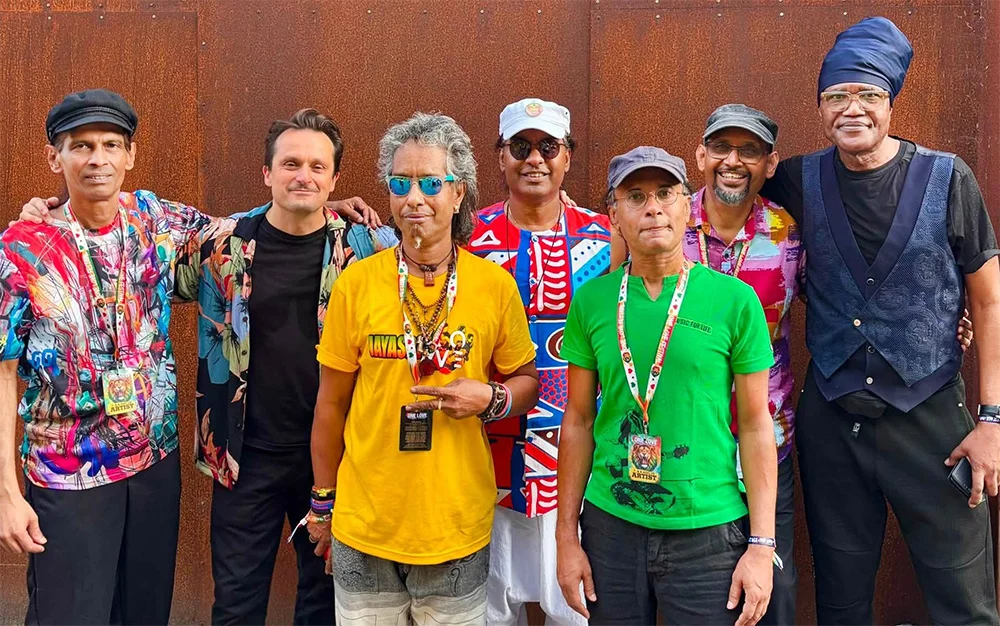
 Last month, Sri Lankan’s reggae stars, Rohitha and Rohan, along with the band JAYASRI, took Austria by storm at the One Love Festival — Austria’s biggest reggae event and one of Europe’s most iconic.
Set against the stunning natural backdrop of Wiesen in Burgenland province, the two-day festival drew thousands of fans and featured a lineup that read like a reggae hall of fame.
And right there, on stage, before the headliners, were Rohitha and Rohan with JAYASRI.
Then came the legends Alpha Blondy and the Solar System, The Wailers, Dawn Penn, Alborosie, Queen Omega, The Congos, Culture, and more. It was, by all accounts, a beautiful night under the stars — and JAYASRI made sure Sri Lanka’s flag flew high.
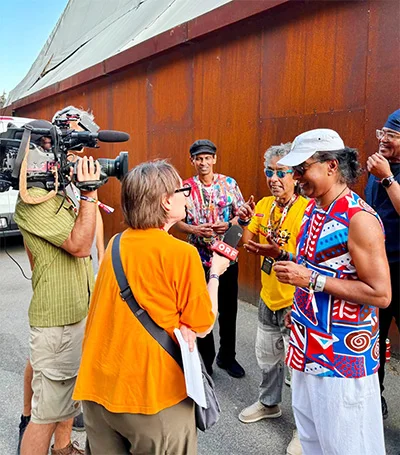
TV interview with the members of JAYASRI … at the
Festival
On stage were: Rohitha on vocals, rhythm guitar and percussion, Rohan on vocals and bass, Bidu on keyboards, Moses on percussion, Milosz on lead guitar, Chiran on drums, and Ruwan on keyboards.
They delivered a powerful set of originals in both English and Sinhala — but with a JAYASRI twist no one else has.
“From Roots Reggae moving to Asian Dub, Ska, Rocksteady, Dancehall and Afro Beat, Funky — it was a unique mixture of our own, and people loved it,” Rohitha said.
Friends and fans flew in from Italy, Switzerland, Hungary and Germany just to join JAYASRI’s ever-growing “Vienna Family” of reggae lovers and cheer them on.
But the real magic happened backstage, according to Rohitha.
“It was great to meet and share the stage with some of the biggest world legends from our genre,” said Rohitha, adding that it was doubly exciting chatting with Alpha Blondy and The Wailers, backstage.
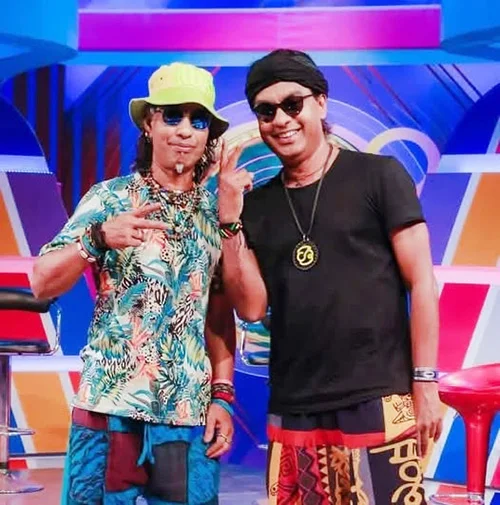
Sri Lankan reggae twins – Rohan and Rohitha
“It was heartening to have their blessings and respect towards our unique style, and to hear them say ‘You people have done some great things to our music’ — that meant everything.”
As the European summer fades, the twins Rohitha and Rohan will be back, in familiar surroundings … yes, Colombo, for the season; and they also have concerts lined up in Japan, Australia, New Zealand, the Middle East, and beyond.
“It’s always great to be back in Colombo for the season,” Rohitha emphasised.
From Wiesen to Colombo, from local roots to global stages — JAYASRI are proving that Sri Lankan reggae has a sound, a soul, and a place in the world. And the world is listening.

One can’t imagine how the months keep flying and, before long, we will be looking forward to the lead up, and the dawning, of another New Year!
Indications are that this year’s New Year’s Eve scene will be extra bright with all the leading venues, in the city, and island-wide, creating the kind of atmosphere (hopefully) that goes to make New Year’s Eve nostalgic.
One only hopes the baila will not reign supreme at these events!
It happened at a recent dance, held in the city, connected with a leading school, and guests, who had arrived from Australia, were heard complaining as it was baila music most of the time!
Let’s also hope El Nino will not create any major problems, in the scene here, over the next few months!
Last year, the talk-of-the town was ‘Dancing thru the Decades’ held at the famous City of Dreams.
It was a blockbuster happening, with guests from around the globe, being a part of the action, to usher in 2026.
This year, too, they are working on another 31st night special.
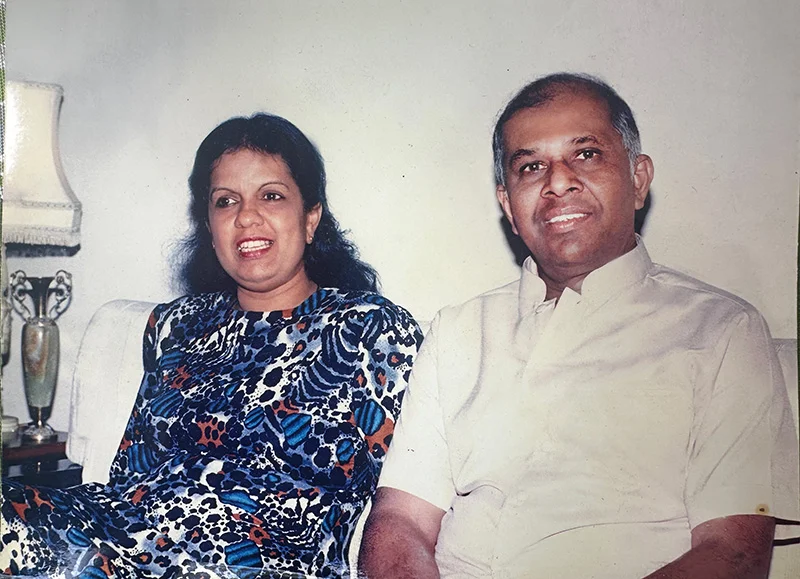
The 8th of September this year is the 15th death anniversary of Deshamanya Cyril Herath, former Inspector General of Police, Defence Secretary, and Chairman of the National Savings Bank. He was also a distinguished alumnus of the University of Ceylon, Peradeniya.
He resigned as IGP on a matter of principle over a disagreement with the then President of Sri Lanka JR Jayewardene. He did so though he had many more years to serve as IGP. Knowing Mr Herath’s principles, the President knew it was futile to try to persuade him to change his mind. Instead, he offered him the position as a High Commissioner, which Mr Herath respectfully declined.
When Chandrika Kumaratunga became President, she appointed him Chairman of the National Savings Bank.
After he took over as Chairman, a new era dawned for the NSB. Most people do not know that until the late 1990s the viability of the NSB depended on a subsidy given by the Treasury. It is an interesting coincidence that the subsidy was withdrawn by the government, a few years after Mr Herath was appointed Chairman, but the NSB began to make profits, without any support from the government.
The most important feature of his management was that he understood that the philosophy of a savings bank is totally different from that of a commercial bank and, throughout the world, savings banks follow a philosophy which is prudent, simple, philanthropic and unostentatious This was its founder Dr NM Perera’s philosophy as well.
Mr Herath was every inch a leader with a strong character, scrupulously honest, brave and charismatic.
He was sensitive to the needs of the poor and the result was that the NSB increased the interest paid to Post Office savings account holders by 1%.
He provided strong and effective leadership for many years with the support of the Trade Unions; they venerated him which is something very rare in this country.
He was approachable and any employee could meet him in his room on Wednesdays, without an appointment, to have their grievances redressed.
At bank parties, he mixed closely with the staff and engaged in banter, and sang and danced with them.
He was cost conscious and frugal. His official vehicle was an ordinary car. When travelling abroad he and other senior officers travelled economy class, unless it was upgraded by the airline itself at no extra cost. When members of the senior management travelled outside Colombo, they travelled by a van to cut costs.
He reinstated a large number of staff employees who had been unfairly dismissed by the previous management.
He never raised his voice when speaking to subordinates and was conscious of their self-respect.
Believe it or not, he queued up with the other employees to enter the lift every morning and waited for his turn to proceed to his room, on the 6th floor.
I believe it is sheer ingratitude if the staff, Board and the people of this country forget the unique contribution made by him to the NSB and the country.
If our country had been blessed with a few more officers like him, in top positions, our country would have been among the most developed countries of the world.
His beloved wife Mrs Rani Herath, who passed away one year after his death, was a gracious and virtuous lady who made it possible for Mr Herath to fully concentrate on coping with the challenges of running the bank.
Beloved Sir, on behalf of all the employees of the NSB, past and present, I wish you and Mrs Rani Herath peace and serenity in your sojourn in Samsara!
NBSB Balalle
(former General Manager NSB)

Big scene for JAYASRI at One Love Festival

Australia’s MDF and Thema Collection convene industry to explore way forward for wellness tourism

Govt. MP accuses state of seizing people’s lands in N&E

New Year’s Eve hotting up …

Siyapatha Finance records ‘exceptional financial performance for 1H2026’

Further evidence on 5 Oct

‘Dates have the highest sugar content to fight Coronavirus’

Sunday Island 27 December – Headlines

#SundayIsland 17th December – Headlines

Sunday Island – 28th March

Sunday Island Headlines – 21 March

Sunday Island – 21st February – Headlines
-

 News5 days ago
Denied of promotion to SC despite vacancies, justice Gurusinghe retires
-

 Latest News6 days ago
Grade 5 scholarship exam results released
-

 News5 days ago
22A: SC urged to suspend hearing, appoint full bench
-

 Midweek Review6 days ago
The local and global dynamics of Sri Lanka’s 22nd Amendment
-

 News3 days ago
Namal remanded until Sept. 18 over Airbus deal investigation
-

 News5 days ago
Govt. seeks NATO assistance
-

 Latest News2 days ago
Tharanga creates history with Diamond League crown in Brussels
-

 News6 days ago
40 professional organisations and TU oppose proposed 22A