
News
Rampant consumption of illicit liquor reflected in decrease in health indicators

By Saman Indrajith
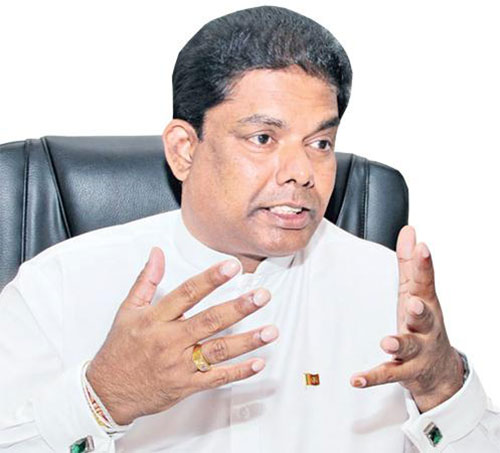
SJB Galle District MP Gayantha Karunatilleka told Parliament Tuesday that the main reason for the country’s health indicators going down was the increase in consumption of illicit liquor.
Participating in the third reading debate on Budget 2022 under the expenditure heads of the Ministry of Health, MP Karunatilleka observed that there was a correlation between the increases in the public consumption of illicit liquor and the decrease in health indicators.
The MP said that the consumption of illicit liquor by Sri Lankans had increased by 300 percent during the recent past. The World Health Organisation’s recent statistics prepared on the basis of sales records and other statistical records available to them from authoritative channels indicated that there was a 95 percent increase in liquor consumption annually by Sri Lankans. Compared to that 95 percent, other countries, which had been recognised as high liquor consuming nations, had recorded only a 55 percent annual increase. The comparison showed that the country was in a serious situation and the government should take action to arrest that trend immediately, the MP said.
The MP pointed out that “the illicit liquor had not only been the cause of making people ill but also the reason for the government losing its tax revenue. With the intention of regulating and preparing national policies against the illicit liquor industry, the National Tobacco and Alcohol Authority was set up in 2006, but there hasn’t yet been a comprehensive national level survey or census on liquor consumption been done, covering the entire country,” MP Karunatilleka said.


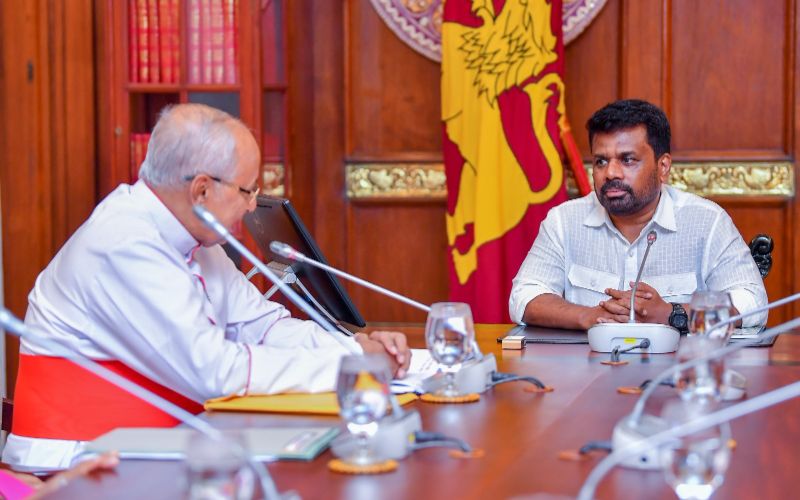
A meeting between President Anura Kumara Dissanayake and Catholic religious leaders, led by His Eminence Malcolm Cardinal Ranjith, Archbishop of Colombo, was held at the Presidential Secretariat on Thursday (10).
Special attention was given to the Government’s programme to strengthen coexistence, peace and reconciliation among all communities in the country and to ensure national unity by preventing any form of racist or religiously motivated hate activity.
The progress of investigations into the Easter Sunday attacks was also discussed.
Lengthy discussions were held on measures that could be taken to prevent environmental damage and destruction affecting the lives of the people.
The Catholic religious leaders commended the measures taken by the Government to safeguard trust among all communities and expressed their fullest support for these efforts.
The issues faced by Catholic communities, including infrastructure development in areas where Catholic people reside, as well as measures that should be taken to address these issues, were also discussed at length.
Rev. Fr. Cyril Gamini, Rev. Fr. Julian Patrick and other priests, as well as Deputy Minister of Religious and Cultural Affairs Muneer Mulaffer, President’s Senior Additional Secretary Roshan Gamage and others, were also present at the meeting.
President’s Media Division (PMD)

BY IfhAm NIzAm
Sri Lanka could soon face a new electricity-grid challenge—not from too little power, but from having too much solar generation in the wrong places and at the wrong times, a former Ceylon Electricity Board (CEB) General Manager told The Island.
The former CEB GM who insisted not to be named warned that the rapid growth of rooftop and utility-scale solar could place increasing pressure on CEB and LECO distribution feeders, substations and the national grid unless transmission, storage and grid-management systems are upgraded at the same pace.
“The issue is no longer simply how much solar we can install. The question is whether the grid can absorb those electrons when and where they are produced,” he told The Island.
He said Sri Lanka should learn from China and India, where the enormous expansion of renewable generation is now forcing policymakers to focus increasingly on storage, transmission capacity, intelligent dispatch and grid flexibility.
“China has already exceeded 1.28 TW of installed solar, while India’s grid-connected installed solar capacity stood at around 162.15 GW as of June 30, 2026. The difficult question now is what you actually do with so much solar when everyone is generating at almost the same time,” he said.
For Sri Lanka, he said, the warning is particularly relevant to the distribution network.
A feeder carrying a high concentration of rooftop solar can, during periods of strong sunshine and low local demand, move from the traditional one-way flow of electricity towards consumers to reverse power flow back towards the transformer and upstream network.
“That means the feeder is no longer simply a one-way road for electricity. At certain times of the day, it becomes a two-way road,” he said.
This can create voltage-rise, protection-coordination and transformer-loading issues and could eventually limit the amount of additional rooftop solar that can safely be connected to particular feeders.
“What matters is where those megawatts are connected,” he told The Island.
He said Sri Lanka therefore needs to begin looking at solar hosting capacity feeder by feeder and substation by substation, rather than treating the national grid as having unlimited capacity to absorb new distributed generation.
The problem is compounded by the evening transition, when solar generation falls rapidly just as electricity demand can increase.
“If the system has a lot of solar in the middle of the day and then loses that generation rapidly in the evening, something else has to respond. That is a flexibility problem,” he said.
This is where battery energy storage systems (BESS) are likely to become increasingly important—but the former CEB chief cautioned against allowing cheap imported battery hardware to drive the market.
“Sri Lanka could soon have huge BESS demand, very cheap battery hardware and everyone suddenly becoming a BESS pundit. What could possibly go wrong?” he said.
He cited fire safety, degradation, poor integration, weak energy-management systems, questionable warranties, incorrect sizing, inappropriate grid locations and poor thermal management as major risks.
“A system can look fantastic in Excel on Day One but perform very differently in Year Two,” he told The Island.
He said the future BESS market would therefore be determined less by who could supply the cheapest container and more by who understood the complete system.
“The future BESS business will not be about who can assemble the cheapest container. It will be about who understands battery, PCS, EMS, grid, safety, degradation and dispatch economics as one system,” he said.
For Sri Lanka, storage should also be considered as a distribution-grid asset, rather than solely as a large transmission-level installation.
Strategically located batteries could absorb excess rooftop solar on constrained feeders during the middle of the day and release electricity later when local demand rises, potentially reducing network congestion and improving the value of distributed generation.
“The question is not simply, ‘How many megawatt-hours of batteries do we need?’ The question is, ‘Where does the battery create the greatest system value?’” he said.
He said China’s and India’s experience could broadly be viewed as three stages: Phase One—build solar and wind; Phase Two—build storage; and Phase Three—redesign the grid around renewables.
Sri Lanka, he said, should learn from that progression before renewable penetration makes grid problems significantly more expensive to solve.
“Installing another large amount of solar is one thing. Absorbing those electrons when the sun is shining everywhere at once is quite another,” he said.
“Solar taught us how to generate cheap electrons. BESS and the grid will decide whether those cheap electrons are actually useful when they are needed.”
“That is perhaps the biggest lesson Sri Lanka should take from China and India’s energy transition right now,” he added.
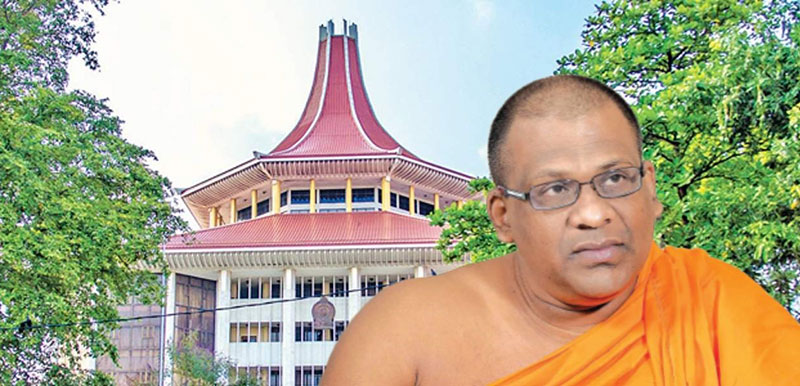
The Supreme Court yesterday ruled that former President Maithripala Sirisena’s decision to grant a presidential pardon to Bodu Bala Sena (BBS) General Secretary Ven. Galagoda Atte Gnanasara Thera was arbitrary and invalid in law.
A three-judge bench headed by Justice Janak de Silva delivered the judgment in response to fundamental rights petitions filed by the Centre for Policy Alternatives (CPA) and Sandhya Ekneligoda, challenging the former President’s decision to release the monk from prison.
Gnanasara Thera had been sentenced by the Court of Appeal in August 2018 to 19 years’ rigorous imprisonment, to run concurrently as six years, after being found guilty of contempt of court over his conduct inside the Homagama Magistrate’s Court on January 25, 2016, during proceedings related to the disappearance of Prageeth Ekneligoda.
The Supreme Court subsequently upheld the Court of Appeal’s finding of guilt on October 5, 2018.
However, Gnanasara Thera was released from Welikada Prison on May 23, 2019, after the then President Sirisena granted him a presidential pardon.
The petitioners challenged the legality of the pardon, prompting the Supreme Court to examine the exercise of the President’s constitutional power of clemency.
The Court’s ruling yesterday effectively nullifies the pardon granted to the BBS leader.
Viran Corea, PC, with Luwie Ganeshathasan and Khyati Wikramanayake appeared for the CPA, while Counsel Asthika Devendra, with Pulasthi Hewamanne, instructed by Manjula Balasuriya, appeared for Sandhya Ekneligoda.Counsel Thishya Weragoda, with Sanjaya Marambe and Iresh Senevirathne, appeared for Gnanasara Thera. Faiszer Musthapha, PC, with Pulasthi Rupesinghe, appeared for former President Sirisena.

Putin lands in India for BRICs summit, shadowed by Iran and Ukraine wars

Meeting between Catholic religious leaders and President

Shafali, Deepti power India into sixth T20 Asia Cup final

Showers will occur in the Western and Sabaragamuwa provinces and in Kandy, Nuwara-Eliya, Galle and Matara districts.

Sri Lanka faces new grid challenge as rooftop solar surges: former CEB GM

SC rules President Sirisena’s pardon of Gnanasara thera invalid

‘Dates have the highest sugar content to fight Coronavirus’

Sunday Island 27 December – Headlines

#SundayIsland 17th December – Headlines

Sunday Island – 28th March

Sunday Island Headlines – 21 March

Sunday Island – 21st February – Headlines
-

 News6 days ago
Namal remanded until Sept. 18 over Airbus deal investigation
-

 Latest News5 days ago
Tharanga creates history with Diamond League crown in Brussels
-

 News5 days ago
Dispute which triggered listed company director being detained at BIA resolved
-

 Features4 days ago
After the parade: What a traffic OIC’s walk-out tells us
-

 Editorial6 days ago
Power vs Equality
-
Editorial4 days ago
Arrests as theatre
-

 Latest News4 days ago
Harshitha’s composed knock seals Sri Lanka’s semi-final berth
-
 Latest News7 days ago
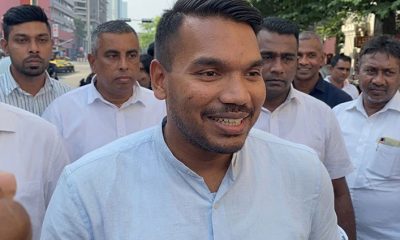
SLPP MP Namal Rajapaksa arrested by CIABOC