
Business
XAMPLE – revolutionizing the virtual educational landscape of Sri Lanka


Novelwall Sri Lanka recently developed Xample – a virtual learning environment with powerful learning tools for children striving to achieve top grades at their GCE O/L and A/L examinations. Understanding that a well-rounded and thorough education is paramount to guiding the next generation to a better future, Novelwall launched Xample under the guidance of its founder, Thunku Ousmand.
Xample is an exciting initiative that aims to inculcate perseverance among students while nurturing a positive attitude towards challenges. This virtual learning environment provides students with an effective ‘Testing & Revision Tool,’ designed with many important features for students, parents and teachers on the journey towards achieving exam success. Xample further encourages students to challenge themselves, cultivating self-confidence and resilience, while simultaneously easing the burden of teachers and parents alike.
The onset of the COVID-19 pandemic brought to the surface the shortfalls of the existing education system in the country. Students were lacking engagement in their studies, as remote learning enhanced a disconnect between students and the classroom. In addition, the evaluation process for students with regard to their studies was hindered by the difficulties associated with monitoring in-class behaviour and activity. Students are unable to ask as many questions from teachers and are therefore unable to clarify their doubts, while teachers have lost their class control owing to the virtual environments and are unable to truly motivate students. These failings have been perceived by parents who have taken note of the lack of individual attention and detailed guidance required by students, especially those about to sit for the O/L and A/L examinations. This is, in part, due to the lack of understanding of examination and learning standards from the perspectives of teachers and students alike.
Xample, the brainchild of Thunku Ousmand was developed with these concerns in mind. As such, Xample consists of features that aim at improving and streamlining the online learning experience. Xample offers a testing and learning environment – unifying the process of studying, testing and revision, into one holistic seamless and enjoyable online experience that can bring students to the highest levels of proficiency for the GCE OL/AL examinations. Through its student-friendly online platform, and based on the four steps of learning (preparation, presentation, practice and performance), Xample allows any student to test his or her knowledge of the relevant subjects, with access to relevant past papers and model papers, and simultaneously learn from each mistake via the comprehensive study notes provided with every question. With access to over 25 years of exercises and questions from the best model papers in Sri Lanka, students are provided with a truly immersive experience of continuous testing and learning, as they work towards mastering their subjects. The platform recognizes areas in which students show significant errors and if a student selects subjects where they require improvement, the system will continue to revise the aforementioned areas by consistently testing the student on those areas until sufficient improvement is noticed.
Recognizing that practice makes perfect, this virtual learning environment encourages students to keep trying while familiarizing themselves with the protocol of real-time examinations. Following students’ attempts at each section, a complete analytical report is provided. With this advanced analytical reporting system, the platform can calculate how proficient the student is in every topic of any given subject so that the student, parent or teacher can see if the student has a grasp of the subject matter, and how well the student has performed in a testing environment. This advanced reporting system enables further insight into the likely possibilities of a student’s exam results based on their performance. As Xample can be accessed at any time, parents can track the activities of the student in real-time remotely without distracting the user. Furthermore, the absence of external ads and links in the platform ensures that students’ focus will not be diverted within the learning environment.
Speaking to Thunku Ousmand, the founder of Xample on the pioneering technology that has been introduced to the Sri Lankan educational landscape, “Without a shadow of a doubt, our younger generation, with the exposure to the world of education, has reached out beyond imagination on par with and quite often exceeding the skills of others across global landscapes. The progression of digital education in a global context has signified a gap between education in the developed world and under-developed countries. I believe that our nation too is ready to accept the inevitable transition towards the digitalisation of the education system and bridge this educational gap.”
“As one of the high-tech organisations in the UK which has the DNA of education and with prior partnerships with India to build digital platforms, we have a host of experience. Our Virtual Learning platform is not just a run-of-the-mill, multiple-choice platform for learning, but a dynamic environment that can gauge the level of a student’s competency in any subject. This is not an easy task to achieve. We encourage those that have the same vision to join us on our journey towards improving the overall education landscape in Sri Lanka, providing a way for future generations to be among the best in the world”, added Ousmand.
The educational landscape of Sri Lanka has far to go. Novelwall hopes that with the introduction of Xample, the overall standards of education might be uplifted. Students are the future. By providing them with the necessary steppingstones to unlocking their potential, they will likely grow from strength to strength, soaring beyond the boundaries of average education and exceeding expectations.



AFP –The International Monetary Fund’s (IMF) board approved two reviews of Sri Lanka’s loan programme, making USD695 million in additional loans immediately available to the island nation.
It is the latest tranche in the country’s four-year USD3 billion bailout, with the Fund warning of further risks due to the economic impact of the Middle East conflict.
Surging oil prices due to the conflict have heavily impacted many import-dependent Asian countries.
“Sri Lanka’s strong implementation under the EFF arrangement has continued despite challenging circumstances,” said the IMF’s Deputy Managing Director and Acting Chair Kenji Okamura.
“Gains from the economic reform programme helped preserve economic resilience and provided room to respond to cyclone Ditwah and the Middle East conflict. The latter, however, has significantly worsened Sri Lanka’s economic outlook and tilted risks to the downside.”
The IMF projects 2026 growth to slow to three per cent, with higher oil prices increasing inflation and weighing on the current account balance.
The board’s approval was contingent on Sri Lanka adjusting certain energy market subsidies issued in the wake of the conflict.
The statement said the Sri Lankan authorities had met the Fund’s requirements on fuel and electricity prices meeting cost-recovery criteria.
Criteria on ensuring no new external debts and on not imposing or intensifying import restrictions “were not observed”, however.
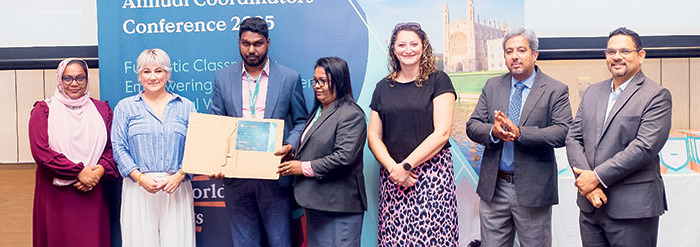
The Cambridge College of English Language Training recently held a certificate and medal awarding ceremony to recognize the academic achievements of students who successfully completed Cambridge English examinations.
The ceremony was held at the Hindu Cultural Hall in Kandy with the Vice Chancellor of the University of Peradeniya, Prof. W.M.T. Madhujith, attending as the Chief Guest, while Kandy Mayor Chandrasiri Wijenayake participated as the Guest of Honour.
Founded on March 1, 2024, by English tutor, author and Cambridge TKT lecturer T. Ravichandran, the institution has emerged as a leading centre for Cambridge English examination preparation in Kandy.
Beginning with an initial intake of 30 students, the college has expanded rapidly and currently serves more than 300 students.
The institution’s achievements were further recognized when it received the “Emerging Star Award 2025” at the Annual Coordinators Conference 2025 (South Asia).
The college provides training for students between the ages of seven and 18 across six stages of Cambridge English examinations, including Young Learners English (YLE) Starters, Movers and Flyers, as well as KET, PET and FCE examinations.
Cambridge English qualifications are internationally recognized and are designed to assess language proficiency in line with the Common European Framework of Reference for Languages (CEFR).
The ceremony concluded with the presentation of certificates and medals to students in recognition of their academic performance and commitment.
Text and Pic by SK Samaranayake

The Australian Broadcasting Corporation (ABC Australia) has signed a Memorandum of Understanding with Sri Lanka’s Maharaja Media Network (MMN), marking a significant expansion of media cooperation aimed at strengthening content exchange, co-productions and professional collaboration across the Indo-Pacific.
The agreement builds on an initial broadcast partnership established in 2022 and an expanded licensing arrangement in 2023, under which ABC programming was made available free-to-air to Sri Lankan audiences through MTV Channel (Private) Limited, part of the Capital Maharaja Group.
Under the new framework, the two organisations will collaborate across television, radio and digital platforms, with a focus on co-produced content, editorial exchange, training opportunities and joint storytelling initiatives.
MMN, Sri Lanka’s largest media network, operates across television, radio, digital media, music and film, including MTV Channel (Private) Limited and MBC Networks (Private) Limited.
Australian High Commission officials described the agreement as a deepening of regional media ties. “This will cover co-production, content sharing and broader cooperation across the Asia-Pacific in telling stories that speak to both countries,” said Matthew Duckworth.
ABC International Head Claire M. Gorman said the partnership reflected a shared commitment to public-interest media and stronger regional storytelling.
Capital Maharaja Group Director Chevaan Daniel said the relationship, which began during Sri Lanka’s economic crisis in 2022, had grown through continued collaboration, including during the 2025 Ditwah cyclone response.

Oscar-winning Star Wars editor Marcia Lucas dies aged 80

Hundreds arrested in France after wild Champions League celebrations

‘Disappointing’ – Sangakkara on Sam Curran turning out for Surrey with IPL still on

Truck carrying Afghan returnees from Pakistan flips on highway, killing 18

PSG beat Arsenal to win back-to-back Champions League titles after shootout

What Hegseth’s comments at Shangri-La Dialogue say about US foreign policy

‘Dates have the highest sugar content to fight Coronavirus’

Sunday Island 27 December – Headlines

#SundayIsland 17th December – Headlines

Sunday Island – 28th March

Sunday Island Headlines – 21 March

Sunday Island – 21st February – Headlines
-

 News7 days ago
Police probe underway to ascertain links between criminals deported from UAE and local politicians
-

 News2 days ago
IMF urges Lanka not to meddle with exchange rate
-

 News6 days ago
Easter Sunday carnage: Court told Maulana’s statement cannot be accepted without cross-examination
-

 News6 days ago
UK passport holder hiding here wants to have deportation order rescinded to leave without blemish
-

 Opinion6 days ago
Undermining the democratic political framework
-

 Features3 days ago
The Division Bell Mystery
-

 News7 days ago
Dickoya double murder suspect arrested
-
 Midweek Review5 days ago
Israeli-US aggression won’t go unanswered -Iranian Ambassador