
News
New Kelani Bridge to be declared open today by President and PM


Chief Government whip and Highways Minister Johnston Fernando yesterday said that the New Kelani Bridge, constructed with advanced technology culminating in several milestones in transport technology, in Sri Lanka, would be declared open by President Gotabaya Rajapaksa and Prime Minister Mahinda Rajapaksa at 6 pm today.
The bridge itself consists of two sections – the extradosed bridge section over the river, and the steel box girder viaduct section over the existing roadway. Both technologies are used for the first time in Sri Lanka. The extradosed design enabled the bridge to have the widest span without piers in any bridge in Sri Lanka. As no piers needed to be constructed on the river bed, there is no impact to the water flow or ecology of the river itself. The steel box girder technology enabled the viaduct section to be constructed with narrower curves to optimize space, and quicker construction to optimize resources with minimum disruption to traffic.
The six-lane bridge extends southwards from Colombo-Katunayake Expressway, and divides towards Port Access Road ending at Ingurukade Intersection and Baseline Road ending at Orugodawatte Intersection.
Following the understanding the need of a new bridge that could cater to the increased volume of traffic with the opening of Colombo-Katunayake expressway, the bridge was designed in 2012 and its feasibility study was conducted in 2013 and agreements were signed in 2014 when Mahinda Rajapaksa was the President and the Minister of Highways.
The bridge has six lanes from the end of the Colombo – Katunayake Expressway to the Bandaranaike Roundabout and will be four lanes from there on to the Orugodawatta, Ingurukade Junction and the Port entrance.
The length of the bridge section across the Kelani River is 380 meters. The bridge is being constructed in two stages. The first package, the steel output bridge section, is at a cost of Rs. 31,593 million, while the second stage, the concrete suspension bridge section, is at a cost of Rs. 9,896 million.
Minister Fernando said that his ministry officials had planted trees that could absorb particulate matter, black carbon and dust, while tolerating heat, along the new bridge and connecting roads including the Kelanitissa circular road and the road to the bridge from the Orugodawatte junction which is considered a highly populated urban area. Officials of the Department of National Botanical Gardens have recommended that trees that could work as “lungs” of an ecosystem because they absorb carbon dioxide and emit oxygen should be selected for the purpose. Accordingly they have selected trees such as Koboneela (Bauhinia purpurea), the Golden shower or Ehala (Cassia fistula), May Mara (Delonix regia), Robarosiya (Tabebuia Rosea), Kaha Mara (Poinciana regia) Rat Mal (Rhododendron arboretum), Mee (Madhuca longifolia), Kumbuk (Terminalia arjuna), Na tree (Mesua ferrea) the Ceylon ironwood, Araliya (Plumeria) Magul Karanda (Pongamia pinnata), Nuga (Ficus benghalensis) and Murutha (the queen of flower tree -Lagerstroemia speciosa).
An underground pipe system has been laid down to provide water to the trees continuously.
Minister Fernando said that the new bridge would be a main attraction that would amplify the beauty of the commercial capital of the country and also the exquisiteness of the Kelani River. Engineers have illuminated the new bridge using new technologies of lighting systems from other countries to make it a local and foreign tourist attraction.

Latest News
Heat Index at Caution level’ in the Northern, North-central, North-western, Western and Southern provinces and in Trincomalee district.


Warm Weather Advisory
Issued by the Natural Hazards Early Warning Centre
Issued at 3.30 p.m. on 12 April 2026, valid for 13 April 2026.
Heat index, the temperature felt on human body is likely to increase up to ‘Caution level’ at some places in the Northern, North-central, North-western, Western and Southern provinces and in Trincomalee district.
The Heat Index Forecast is calculated by using relative humidity and maximum temperature and this is the condition that is felt on your body. This is not the forecast of maximum temperature. It is generated by the Department of Meteorology for the next day period and prepared by using global numerical weather prediction model data.

Effect of the heat index on human body is mentioned in the above table and it is prepared on the advice of the Ministry of Health and Indigenous Medical Services.
ACTION REQUIRED
Job sites: Stay hydrated and takes breaks in the shade as often as possible.
Indoors: Check up on the elderly and the sick.
Vehicles: Never leave children unattended.
Outdoors: Limit strenuous outdoor activities, find shade and stay hydrated.
Dress: Wear lightweight and white or light-colored clothing.
Note:
In addition, please refer to advisories issued by the Disaster Preparedness & Response Division, Ministry of Health in this regard as well. For further clarifications please contact 011-7446491.

On the apparent northward relative motion of the sun, it is going to be directly over the latitudes of Sri Lanka from 05th to 15th of April in this year.
The nearest areas of Sri Lanka over which the sun is overhead today (13th) are Pesalai, Mankulam and Nedunkerny about 12:11 noon.
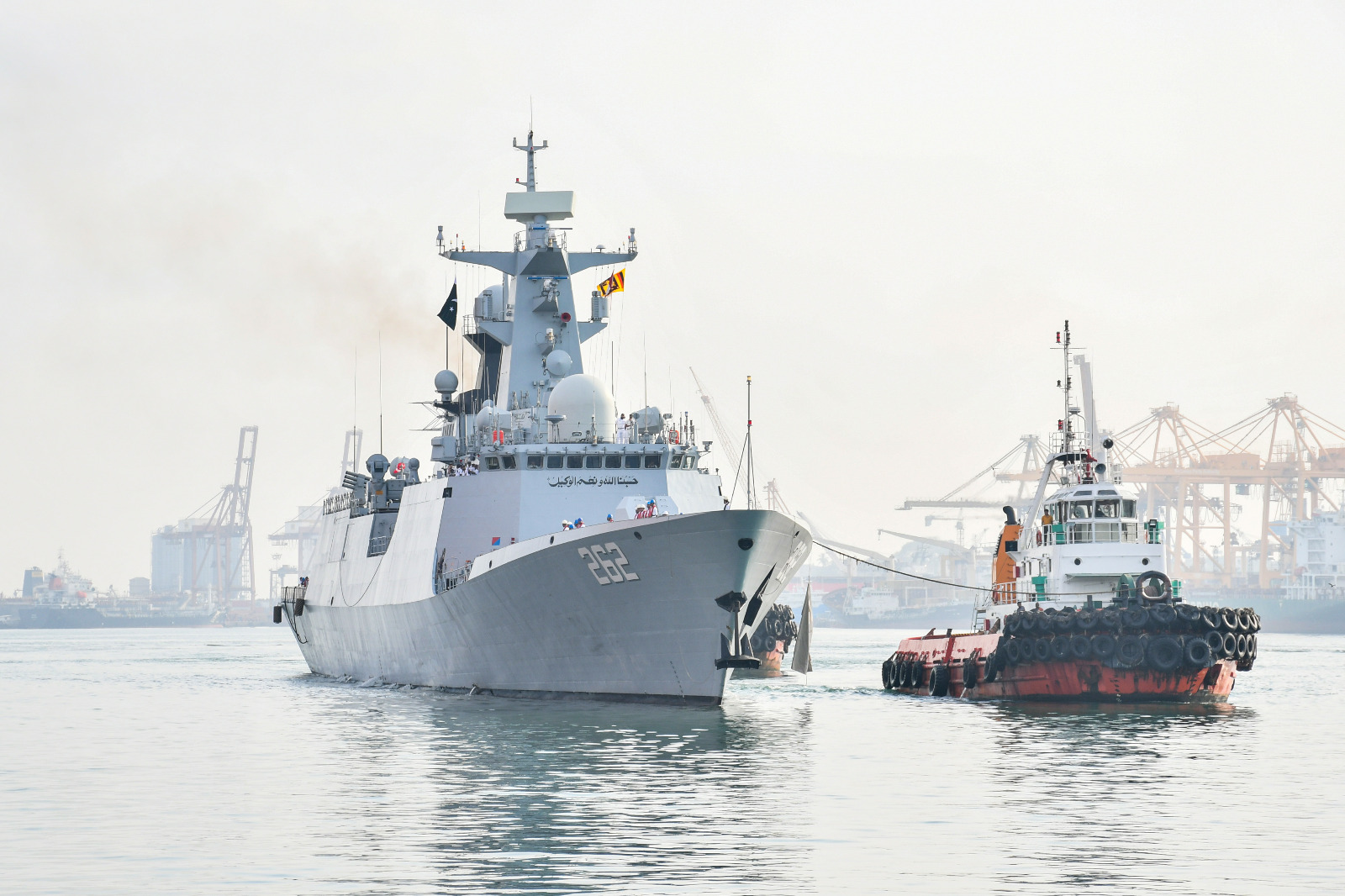
The Pakistan Navy Ship (PNS) TAIMUR and ASLAT arrived at the Port of Colombo on a goodwill visit on 12 Apr 26.
The visiting ships were welcomed by the Sri Lanka Navy in
compliance with naval traditions.
The duo of ships is commanded by Captain NIAMAT SAEED KHAN (PNS TAIMUR) and Captain NADIR MATEEN AFRIDI (PNS ASLAT).
Meanwhile, the ships are expected to conduct a Bilateral Naval Exercise LION STAR V with the Sri Lanka Navy in Colombo seas.

Salt and Patidar power RCB past Mumbai Indians

Prasidh, Buttler set up comfortable win for Gujarat Titans

Heat Index at Caution level’ in the Northern, North-central, North-western, Western and Southern provinces and in Trincomalee district.

Showers above 75 mm are likely at some places in the Western, Sabaragamuwa, Central, Southern and North-western provinces.

Sun directly overhead Pesalai, Mankulam and Nedunkerny about 12:11 noon

PNS TAIMUR & ASLAT arrive in Colombo

‘Dates have the highest sugar content to fight Coronavirus’

Sunday Island 27 December – Headlines

#SundayIsland 17th December – Headlines

Sunday Island – 28th March

Sunday Island Headlines – 21 March

Sunday Island – 21st February – Headlines
-

 News7 days ago
Lankan-origin actress Subashini found dead in India
-

 News2 days ago
CEB orders temporary shutdown of large rooftop solar systems
-

 News5 days ago
AG: Coal procurement full of irregularities
-

 Business4 days ago
Israeli attack on Lebanon triggers local stock market volatility
-

 Business5 days ago
Hayleys Mobility introduces Premium OMODA C9 PHEV
-

 News7 days ago
UN Regional Director launches SL’s first Country Gender Equality Profile during official visit
-

 News7 days ago
Dialog Launches ‘GanuDenu QR’, Making Cashless Transfers Free for All with eZ Cash and Dialog Finance
-

 Business4 days ago
HNB Assurance marks 25 years with strategic transformation to ‘HNB Life’