
Opinion
On casteist violence in jaffna


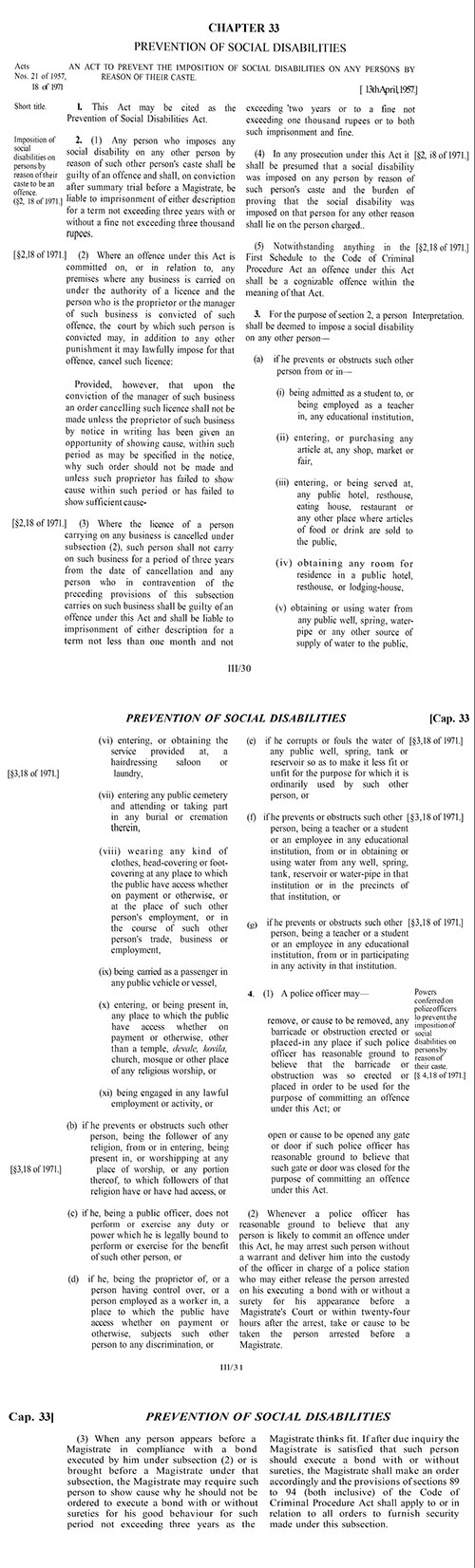
The article, on the above topic by the Jaffna People Forum appeared in The Island of 27.10. 2021.This act passed by the late Prime Minister S. W. R. D. Bandaranaike, in 1957, clearly deals with all the aspects of violence, mentioned in that article. It will be interesting to find out why NGO pundits are not pressing the govt. to implement this act.
Dr. Lal Ratnasiri

Opinion
Handcuffs without consequences: Why Sri Lanka’s anti-corruption drive keeps missing the target
By Mahil Dole, SSP (Retd.)
Senior Security Analyst | Former Head of Counter-Terrorism, State Intelligence Service | Managing Director, Smart Security Solutions Pvt. Ltd.
The daily procession of arrests has become one of the most familiar rituals of public life in Sri Lanka. Politicians, senior officials, state enterprise executives and private-sector figures are regularly produced in court. Some are remanded. Others walk free on bail. A number simply disappear beyond effective reach. The pattern is so constant that many now regard it as evidence of a deeper national failure. One recent comment captured the prevailing mood: corruption has become mind-boggling, damaging the country’s image and sending damaging signals to investors, international financial institutions and those who still provide aid.
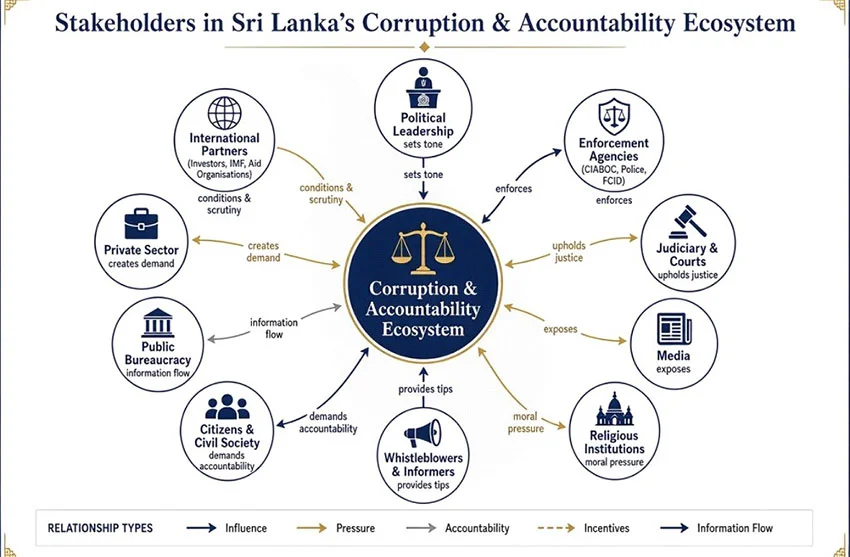
That observation is not unfair. Visibility of wrongdoing is high. Yet Sri Lanka is not without formal safeguards. Stringent laws exist. Specialised agencies operate. Disciplinary procedures are written down. An often aggressive media continues to expose scandals. Religious and cultural traditions across communities teach honesty, selflessness and restraint of greed. Places of worship are numerous, and large numbers of citizens participate actively in religious life.
At this very moment, Parliament is engaged with further legislative efforts to strengthen the anti-corruption framework. The Anti-Corruption (Amendment) Bill, already gazetted, seeks to tighten the 2023 Act by introducing heavier financial penalties (including a mandatory additional penalty of not less than three times the value of property gained through corruption), fuller recovery of losses caused to the State, and stricter bail provisions for serious offences. These moves are timely. They also make the questions raised in this discussion more urgent: will stronger laws on paper finally change outcomes, or will the same incentive problems and selective application continue to blunt their effect?
Why, then, does the country continue to be widely regarded, both at home and abroad, as significantly corrupt?
The answer does not lie in the absence of rules or moral instruction. It lies in the gap between formal architecture and lived outcomes.
As Lord Acton observed more than a century ago, “Power tends to corrupt, and absolute power corrupts absolutely.” When power is weakly constrained by institutions, and when the practical incentives facing those who wield it reward extraction rather than stewardship, even the best-written laws struggle to hold.
The Limits of Formal Safeguards
Laws and procedures create the possibility of accountability. They do not automatically produce it. Enforcement is carried out by people and organisations that respond to the rewards, risks and constraints they actually face. When the expected benefit of corrupt behaviour remains high and the expected cost, legal, career, social or material, is low or selectively applied, formal rules lose force.
Detection and prosecution are frequently reactive. Media exposés and agency raids often occur after significant damage has already been done. Prevention, the reduction of opportunities and the raising of risks before the act, remains weaker. Court processes are slow. Asset recovery is incomplete. Absconding continues to be possible. The result is a cycle of arrest theatre that generates temporary political credit while leaving the underlying incentive structure largely intact.
It is essential, however, to state a foundational principle with clarity. Every person accused of wrongdoing is presumed innocent until proven guilty through a proper judicial process. Sri Lanka maintains this position with utmost confidence. The presumption of innocence is not a technicality; it is a cornerstone of the rule of law. Any anti-corruption effort that abandons this principle, or appears to do so, risks transforming a legal process into something closer to political retribution. Transparency, not opacity, is therefore indispensable. The public must be able to see that investigations and prosecutions are conducted according to law, applied equally to every alleged wrongdoer, and free from the taint of selective targeting or “witch-hunting.” The new legislative proposals now before or approaching Parliament will be judged by precisely this standard: whether they strengthen genuine legal accountability or merely add new tools that can still be applied unevenly.
Religious and cultural values are sincerely held by many. Yet they are frequently compartmentalised. Ethical teachings against greed can coexist with different standards of behaviour in political and bureaucratic life. When public office is widely perceived as a platform for resource allocation rather than stewardship, personal devotion does not automatically translate into institutional integrity.
How Incentives Shape Enforcement
Enforcement agencies and the individuals within them operate under multiple, often conflicting, incentives.
Career progression in many public institutions has historically depended more on political reliability or bureaucratic loyalty than on the successful pursuit of complex, high-value cases. Investigating powerful figures can bring transfer, sidelining or delayed promotion. Pursuing lower-level or politically convenient targets is safer and still produces visible statistics. Performance metrics that prioritise the number of arrests or cases filed over the quality of convictions and the recovery of proceeds encourage quantity over substance.
Political incentives cut both ways
Governments gain short-term popularity from high-profile actions, especially against previous regimes or opponents. The same governments face strong incentives to shield their own networks. Selective enforcement therefore becomes rational from a political-survival perspective. Long-term institutional credibility is a public good that individual political actors may undervalue when their time horizon is short.
As the saying reminds us, “Laws are like cobwebs: they catch the weak and small, but the strong and powerful break through.” When the powerful face different practical consequences from ordinary citizens, the deterrent effect of even the most severe punishments collapses. The same danger arises when enforcement appears driven by political convenience rather than consistent application of the law. Opacity in process fuels precisely this suspicion. Transparency in investigation, charging decisions and court proceedings is the surest way to demonstrate that the system is engaged in a legal anti-corruption effort, not a campaign of selective persecution.
Personal risk also matters. Investigators and judges who pursue well-connected targets can face threats, legal harassment or professional isolation. Where institutional protection is weak, rational self-preservation leads to caution. Material conditions reinforce the problem: relatively modest public-sector salaries alongside large discretionary powers create opportunities for compromise.
The Critical Role of Whistleblowers
In this environment, whistleblowers become especially important. Most serious corruption is not visible from the outside. It occurs inside procurement processes, regulatory decisions, financial flows and internal communications. Insiders who see the documents, attend the meetings or handle the payments are often the only people positioned to raise the alarm early enough for evidence to be preserved.
Whistleblowers supply leads and evidence that agencies may lack the incentive or capacity to generate independently. Credible tips can shorten investigations, strengthen cases and raise the political cost of inaction. The mere possibility that an insider may speak alters the risk calculation of potential wrongdoers.
Sri Lanka’s Anti-Corruption Act contains explicit protections for informers, whistleblowers and witnesses. These include confidentiality of identity, immunity from civil and criminal liability when information is provided in good faith, protection from disciplinary action and reprisal, and criminal penalties for those who retaliate. Such provisions are necessary. Their effectiveness depends on consistent implementation: rapid response to threats, genuine confidentiality in practice, accessible reporting channels, and visible consequences for those who punish disclosures.
Without credible protection, the rational calculation for most potential whistleblowers remains silence. Strong protection changes that calculation and thereby improves the information environment in which enforcement agencies operate.
Principal Contributors to Persistent Corruption
Corrupt political leadership is often decisive. When those at the apex of power treat public office as a vehicle for personal or factional enrichment, they set the tone for the system. Leadership that tolerates, participates in or protects corruption signals that rules are optional for the powerful. It also tends to appoint loyalists rather than professionals to sensitive posts, further politicising the institutions charged with enforcement.
Politicisation of government agencies follows. When appointments, transfers, promotions and operational priorities in the police, revenue departments, regulatory bodies, state-owned enterprises and anti-corruption agencies are driven by political loyalty rather than competence and integrity, professional incentives collapse. Officers who resist improper pressure face retaliation; those who comply advance.
Politicisation of the media weakens an important external check. When significant sections of the media become aligned with political or commercial interests, coverage becomes selective. Scandals involving favoured actors are downplayed; those involving opponents are amplified. This distorts public information and reduces the reputational cost of misconduct for the protected.
Politicisation of religious platforms and organisations can compromise their moral authority. Religious traditions teach restraint and honesty. When those platforms become vehicles for political mobilisation or the defence of partisan interests, their capacity to uphold ethical standards against corruption is reduced.
Poverty amplifies vulnerability. Low relative salaries and economic insecurity create material pressure on officials and make ordinary citizens more susceptible to paying bribes for basic services. Competition and demand for scarce opportunities, licences, contracts, regulatory approvals, jobs, land, school places, combined with discretionary decision-making create intense pressure for preferential treatment. Where formal processes are slow or opaque, people and firms compete by offering inducements.
These factors reinforce one another. Corrupt leadership accelerates the politicisation of agencies and media. Politicised institutions reduce the risk of detection and punishment. Poverty and scarcity increase both the supply of and demand for corrupt exchanges. Together they create a self-reinforcing system in which formal laws and ethical teachings struggle to gain traction.
Consequences Beyond Reputation
The costs are not merely reputational. Investor risk perception rises, increasing the cost of capital and deterring higher-quality foreign direct investment. International financial institutions and aid partners attach governance conditions that become harder to meet when enforcement appears selective or incomplete. Public trust in institutions erodes, weakening the social cooperation necessary for effective policing, intelligence and community resilience.
Corruption is also a national-security vulnerability. It hollows out the integrity of the institutions that protect the state and the public. When police, customs, prisons or regulatory bodies become permeable to illicit money, organised crime and narcotics networks gain operational space. Parallel power structures emerge. In a country that has experienced prolonged conflict and remains exposed to hybrid and transnational threats, the loss of institutional legitimacy carries strategic risk.
Prevention
: Changing the Incentive Structure
Arrests and court productions are necessary. They are not sufficient. Lasting progress requires shifting the practical risk-reward calculation that public officials, political actors and private intermediaries face every day.
C.S. Lewis captured an essential truth when he wrote that “Integrity is doing the right thing, even when no one is watching.” Systems that make integrity the safer and more rewarding path are the only ones that endure
First , reduce opportunities. Transparent digital procurement systems with automatic red flags, real-time beneficial-ownership verification, meaningful sanctions for non-declaration of assets, and clearer limits on discretionary power lower the returns to corruption. The expansion of digital asset declarations covering a large cadre of officials is a step in this direction; verification and enforcement must follow.
Second , realign incentives inside enforcement agencies. Successful high-quality prosecutions and asset recovery should be the clearest path to career advancement. Institutional independence and protection for investigators must be strengthened so that pursuing powerful targets carries lower personal risk.
Third , protect and encourage whistleblowers in practice, not only on paper. Accessible, confidential reporting channels, rapid response to threats, and visible punishment of retaliators change the calculation for potential insiders.
Fourth , reduce politicisation of key institutions. to anti-corruption bodies, regulatory agencies and senior investigative posts should be insulated from partisan control to the greatest extent possible.
Fifth , address the demand side where feasible. Streamlining and digitalising routine citizen-facing services reduces the points at which ordinary people feel compelled to pay. Greater transparency in the allocation of scarce opportunities narrows the space for preferential treatment.
Sixth , and critically, the entire process must remain transparent and firmly anchored in due process. Every accused person is entitled to the presumption of innocence until guilt is established in a court of law. Sri Lanka upholds this principle with confidence, and it must be seen to do so. Opacity breeds suspicion of political motive. Transparency, clear procedures, reasoned decisions, equal application of the law, and open judicial proceedings, demonstrates that the effort is a genuine legal anti-corruption process applied to wrongdoers regardless of status or affiliation, and not a campaign of selective targeting.
The new amendment proposals now moving through the legislative process will succeed or fail by this measure: whether they reinforce even-handed legal accountability or simply add sharper tools that can still be used selectively.
Sustained political commitment beyond electoral cycles remains indispensable. Short bursts of visible action generate headlines. Durable change requires consistency across governments and a willingness to accept that effective, even-handed enforcement will sometimes inconvenience allies as well as opponents
Conclusion
Sri Lanka possesses many of the formal and cultural instruments that theory suggests should restrain corruption. The persistence of the problem demonstrates that instruments alone are not enough. The decisive variables are the incentives that shape behaviour inside political, bureaucratic and enforcement institutions, the opportunities created by discretionary power and opaque processes, and the degree of politicisation of the bodies meant to uphold the rules.
The current intensity of arrests and investigations, together with the latest legislative efforts to tighten the Anti-Corruption Act, is preferable to previous patterns of near-impunity. It is not yet a sufficient condition for lasting improvement. Moving from reactive enforcement to systemic prevention requires changing the risk-reward calculation that makes corruption rational for too many actors. It also requires that the process itself remain visibly fair, transparent, and faithful to the presumption of innocence. Only then can the public, and the wider world, be confident that what is underway is a serious legal effort against corruption, and not a politicised exercise in selective retribution.
Until these deeper shifts become visible and sustained in outcomes, fewer large-scale leakages, higher rates of asset recovery, reduced absconding, consistent due process, and rising public and investor confidence, the perception that Sri Lanka remains a high-corruption environment will continue to be a reasonable reading of the evidence. The daily drama of arrests will remain a symptom rather than a cure. The harder, quieter work of realigning incentives, protecting institutional integrity, and conducting the fight against corruption with both firmness and fairness is the only reliable path beyond it.
(This analysis is offered in the interest of national security, institutional reform, and public safety)
Writer – Mahil Dole
Senior Superintendent of Police (Retd.)
Former Head of (Counter Terrorism), State Intelligence Service, Former Director, Police Special Branch and former First Secretary (defense) Sri Lanka Embassy – Thailand and former investigation consultant of the Sri Lanka Police Financial Investigation Division.
Handcuffs without consequences: Why Sri Lanka’s corruption fight keeps missing the target
By Mahil Dole, SSP (Retd.)
Senior Security Analyst | Former Head of Counter-Terrorism, State Intelligence Service | Managing Director, Smart Security Solutions Pvt. Ltd.

I venture to make this appeal because I am increasingly concerned about what appears to be an inexplicable silence surrounding one of the most consequential challenges confronting Sri Lanka, the country’s emerging demographic crisis.
Nearly a year has elapsed since the official release of the latest Census population findings by the Department of Census and Statistics. The demographic signals revealed by the Census deserve far greater public scrutiny than they have received. An ageing population, declining fertility and a contraction of the working-age population are not merely statistical observations. Together, they have profound implications for the future economic, social and institutional sustainability of the country.
Yet, remarkably, the subject has not generated the level of informed public debate one would reasonably expect from a matter of such national importance.
What concerns me even more is the apparent reticence of those who are best placed to enlighten the public, the planners, demographers, academics and scholars attached to our universities and other institutions of national importance. Their silence is difficult to understand when the demographic trajectory of a country can influence virtually every aspect of its future: economic growth, labour-force availability, pension obligations, healthcare expenditure, education planning, family structures and the sustainability of social protection systems.
This is not an issue that can safely be postponed until the consequences become unmistakable. Demographic change is notoriously slow to reverse. By the time its consequences become visible in the form of labour shortages, an excessive dependency burden or an unsustainable ageing population, the policy options available to governments may already have narrowed considerably.
The public therefore has a legitimate right to ask some fundamental questions.
Where is the national demographic strategy? What are the projections for the next 20, 30 and 50 years? How rapidly is the working-age population expected to decline? What will be the implications for economic growth and productivity? How will Sri Lanka finance the needs of an ageing population? What measures are contemplated to address declining fertility? And, perhaps most importantly, has the country begun preparing now for a demographic reality that is already taking shape?
These are not questions that should be confined to academic journals or government reports. They deserve to be debated openly in the national press and explained to the ordinary citizen in language that everyone can understand.
At the same time, I would urge our demographers, economists, planners and scholars to come forward with evidence-based assessments rather than remain silent. If my interpretation of the demographic trends is misplaced, I would welcome a scholarly rebuttal. If the situation is more serious than is generally recognized, the public deserves to know that as well.
Silence is not a demographic policy.
Sri Lanka has already experienced the consequences of failing to anticipate several national crises. We should not allow demographic change, which operates quietly but relentlessly, to become another crisis that we recognise only when it is too late to manage.
The time to discuss Sri Lanka’s demographic future is not when the crisis arrives. The time is now.
Athula Ranasinghe

Prof. Ranjith Bandara,
PhD (Qld.,) Emeritus Professor, University of Colombo
Investment promotion has been Colombo’s default strategy for two decades. The real barrier to foreign capital was never Sri Lanka’s pitch — it is Sri Lanka’s paperwork and administrative complexity.
For more than two decades, investment promotion has been one of Sri Lanka’s key development strategies. Successive governments have introduced investment incentives, established export-processing zones, strengthened promotion agencies, and dispatched delegations to road shows and conferences across the world. The message abroad has remained largely unchanged: Sri Lanka is open for business, and the opportunity is real.
That opportunity is not in question. The island sits strategically alongside some of the world’s busiest shipping lanes in the Indian Ocean. It has a relatively well-educated workforce, established commercial institutions, a strong tourism base, natural resources, and direct access to a South Asian market of well over a billion people. On paper, Sri Lanka should be attracting foreign capital on a much larger scale.
It is not. And the reason is not that the world has failed to hear Sri Lanka’s investment pitch. The problem is that promoting an investment opportunity and delivering the conditions promised to investors are two very different things — and Sri Lanka has historically devoted far more energy to the former than to the latter.
A recovery that still falls short
There has been genuine improvement recently. According to UNCTAD figures, inward FDI rose from roughly US$759 million in 2024 to US$1.04 billion in 2025 — the strongest performance since 2022, when inflows reached US$884 million, before falling back to US$713 million in 2023.
That trajectory is welcome. Yet, in the context of what Sri Lanka needs, it remains modest. Set against a GDP exceeding US$100 billion, US$1 billion in FDI represents roughly 1% of national output — only a fraction of what an economy pursuing serious industrialisation, technological upgrading and export expansion requires.
For comparison, Vietnam, a country against which Sri Lanka is often benchmarked, attracted more than US$20 billion in FDI in 2025 alone. Nobody expects Sri Lanka to match that scale overnight. But the gap is instructive: global capital is mobile, and investors have choices. Sri Lanka is not merely competing against its own past performance. It is competing with India, Vietnam, Indonesia, Bangladesh, Malaysia and Thailand, all pursuing the same global pool of investors.
Moreover, the issue is not only the quantity of investment, but also its quality. A country does not simply need short-term capital inflows; it needs investment that brings technology, managerial expertise, links to global markets, skills development, productivity gains and long-term export capacity. FDI policy should therefore move beyond asking, “How much investment came in?” It should also ask: “How much did that investment contribute to productivity, exports, technology transfer and the quality of employment?”
That leads to the question that should sit at the centre of national economic strategy: why, specifically, should an investor choose Sri Lanka over these alternatives?
Real obstacle is cumulative friction, not a single flaw
Investors do not evaluate countries on rhetoric. They compare them, line by line, on production costs, energy prices, logistics, taxation, regulatory predictability, political stability, labour relations, infrastructure quality, and the speed and reliability of approvals.
Sri Lanka is not catastrophically weak in any single one of these areas. The problem is cumulative. Small inefficiencies and delays across multiple fronts eventually add up to a high overall cost of doing business, even when no single obstacle appears decisive on its own.
This cumulative friction can be particularly damaging to small and medium-sized foreign investors. A large multinational may be able to employ legal advisers, consultants and government-relations teams to navigate a complicated administrative system. A medium-sized investor may be unwilling or unable to bear those additional costs. An unnecessarily difficult administrative environment therefore does more than delay investment — it can reduce both the number and diversity of investors willing to enter the country.
Bureaucracy is a central part of that friction. Investors routinely have to navigate multiple agencies with overlapping mandates and, at times, inconsistent rulings. The deeper problem is not regulation itself, but the absence of clear procedures and predictable timelines.
A guaranteed 60-day approval process is workable, even if it is not ideal. A process that may take one month or may take six is not. Investors can price a known delay into a project. What they struggle to price is uncertainty.
And uncertainty has a real financial cost. Every month that a project waits for approval can mean higher financing costs, delayed machinery orders, missed market opportunities and, ultimately, the possibility that the investor relocates the project to another country. Administrative delay is therefore not merely an inconvenience within government offices; it is a national competitiveness problem.
A genuine single-window system — one application, one digital file, one responsible case manager and fixed statutory deadlines — could do more to improve investor confidence than another round of tax incentives.
But a genuine single window must be more than a single desk at which applications are submitted. All relevant agencies should be digitally connected through the same platform. The investor should be able to see where an application stands, which agency or officer is responsible, what requirements remain outstanding, and when a decision is legally due. The investor should not have to become the coordinator of government agencies.
Policy volatility compounds the problem. Investors can plan around relatively high taxes. They cannot plan around taxes, incentives, import rules and foreign-exchange controls that shift unpredictably with every change in government or fiscal circumstance.
Such instability embeds a “policy-risk premium” into every long-term investment decision. That cost may never appear directly in headline statistics, but Sri Lanka pays it through investments that are delayed, scaled down or never made.
The answer is not to freeze every policy permanently. Economic circumstances change and governments must retain the ability to respond. What matters is that changes are introduced with reasonable notice, clear transitional arrangements and predictable implementation periods. Long-term investors do not require a world in which nothing changes; they require a system in which change itself can be anticipated.
Administrative discretion adds another layer of risk. Where licensing and approval outcomes depend more on relationships than on published, rule-based criteria, investors correctly interpret that as exposure — to delay, arbitrariness or worse.
Digitising approvals, publishing statutory timelines, reducing unnecessary discretionary authority and opening public procurement to transparent competition would reduce this risk directly. The governance benefits of such reforms would extend well beyond the investment climate.
None of this is an argument against labour protection. Strong labour standards are entirely compatible with a competitive investment environment, as many advanced and emerging economies demonstrate. The problem arises when industrial relations become unpredictable or politicised. That is a governance problem that can be addressed, not an unavoidable trade-off between worker welfare and competitiveness.
Nor is low labour cost, on its own, a winning strategy. What investors ultimately price is unit labour cost, which reflects productivity as well as wages. A country that competes purely on cheap labour while tolerating high energy prices, logistics delays and regulatory friction is not really offering investors a cost advantage — it is offering a false economy.
Physical infrastructure, too, is only part of the picture. Reliable electricity and serviced industrial land matter, but so does the institutional architecture around them: efficient customs, functioning courts and arbitration mechanisms, digital government services, reliable certification systems and predictable regulatory enforcement.
Investors are not simply buying land and electricity. They are buying access to a functioning business ecosystem.
From announcements to outcomes
Perhaps, the most consequential shift Sri Lanka needs is in how it measures its own success.
For too long, the metric has been approvals granted, memoranda signed and projects announced — announcements rather than outcomes.
What should matter instead is capital that actually enters the country, factories and businesses that actually commence operations, jobs that genuinely materialise, exports that expand, and investors that remain and reinvest.
The gap between approved investment and realised investment is where much of Sri Lanka’s promise has historically evaporated. Closing that gap requires dedicated project management and systematic follow-through, not another press release.
Every major investment project should therefore have clear post-approval responsibility. If a project is stalled because of land, electricity, a licence, customs, infrastructure or financing, the problem should be identified quickly and escalated to the appropriate authority.
The present logic must be reversed. Rather than forcing the investor to move from ministry to ministry and agency to agency searching for solutions, government should have a system that actively identifies and removes obstacles preventing an approved investment from becoming operational.
The performance of investment-promotion institutions should likewise be measured not by the number of MoUs signed or approvals issued, but by capital actually invested, projects implemented, jobs created, exports generated and reinvestment secured. This would begin to close the institutional gap between investment promotion and investment implementation.
Global competition is only intensifying. The sectors now driving some of the largest FDI flows worldwide — semiconductors, artificial-intelligence infrastructure, renewable energy, advanced manufacturing, pharmaceuticals and critical minerals — are increasingly dominated by economies capable of offering subsidies on a scale Sri Lanka cannot realistically match.
That reality should clarify Sri Lanka’s strategy rather than discourage it. If Sri Lanka cannot out-subsidise its competitors, it must out-execute them.
Speed, certainty and administrative efficiency are not consolation prizes. For a country in Sri Lanka’s position, they may be among the most valuable incentives it can offer. Unlike large cash subsidies or tax concessions, they can be delivered at relatively low fiscal cost once the right systems are established.
The policy choice ahead
Sri Lanka’s renewed international engagement — including recent outreach to markets such as Australia — is a reasonable and necessary part of any investment strategy. No country can attract capital it never asks for.
But promotion without domestic reform is ultimately a roadshow with too little behind it. A conference can bring investors to the table; only institutional efficiency determines whether they sign, build, operate, expand and stay.
The government now faces a straightforward choice, and it is one that should be measured in policy rather than rhetoric: continue treating FDI primarily as a promotional challenge, or commit to a genuine Investment Competitiveness Programme.
Such a programme should include a true digital single window, enforceable approval timelines, a stable multi-year tax framework, reduced administrative discretion in licensing, and a public dashboard that tracks actual investment outcomes rather than signed intentions.
That dashboard would also be an important instrument of public accountability. Information such as the value of approved investment, the value actually realised, average approval times, causes of delay and performance by responsible agency should be publicly available. Such transparency would not only strengthen investor confidence; it would also create accountability across government institutions for the speed and quality of implementation.
Most importantly, FDI reform should not be viewed as providing special privileges to foreign investors. Clear rules, faster approvals, efficient public services, transparency and policy stability are equally important to domestic entrepreneurs.
Making Sri Lanka easier for a foreign investor is therefore, in the final analysis, about building a more efficient economic system for every business operating in Sri Lanka.
The question Sri Lanka’s policymakers should now be asking is no longer, “Have reforms been introduced?” Instead, it is this: “Has investing in Sri Lanka actually become easier?”
Once the answer to that question is in the affirmative, the country may find that it needs far fewer roadshows. Because the most persuasive advertisement for Sri Lanka will not be a delegation travelling abroad. It will be an investor already operating in Sri Lanka telling the next investor: “The system worked.”

Showers above 50 mm are likely in the Western, Sabaragamuwa and North-western provinces and in Kandy, Nuwara-Eliya, Galle and Matara districts

Patali alleges NPP conspiring to put off elections indefinitely

August 15 Super Dvora tragedy: Search continues for missing officer’s body

Tripartite MoU to expand free cardiothoracic surgeries at KDU Hospital

Jaffna to mark Int’l Day of the Disappeared

Unfolding El Niño and burning issues

‘Dates have the highest sugar content to fight Coronavirus’

Sunday Island 27 December – Headlines

#SundayIsland 17th December – Headlines

Sunday Island – 28th March

Sunday Island Headlines – 21 March

Sunday Island – 21st February – Headlines
-

 News6 days ago
Country’s first woman Surveyor General appointed
-

 Business5 days ago
SriLankan Airlines makes ShakthiSAT Mission possible for talented Sri Lankan student
-

 Features6 days ago
Medical education in Sri Lanka: Then and now
-
 Latest News6 days ago
Imran Khan moved to private hospital amid deteriorating health
-

 Latest News6 days ago
Government has declared 21, 22 and 23 August 2026 as national days of mourning
-

 Features4 days ago
My secondary schooling after Royal Primary
-

 Latest News5 days ago
Tharanga edges out Chopra in 88m javelin battle
-
 News6 days ago
22A: Opp. demands all available SC judges hear petitions