
News
Time has come for President to delivered on his promises: Karu J

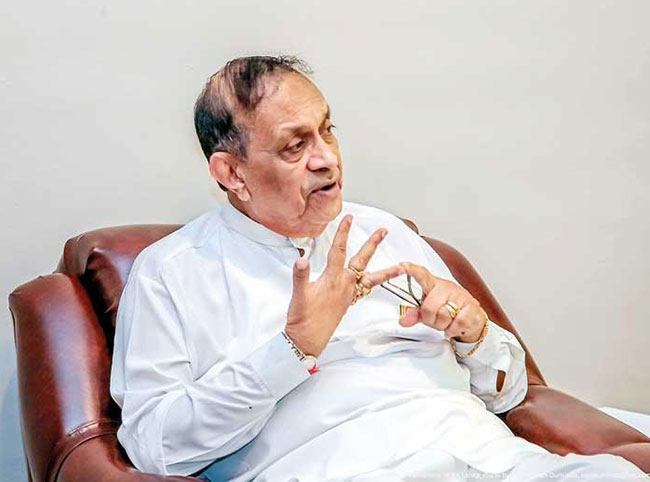
The time has come for the President to deliver on his recent promises, Mr. Karu Jayasuriya, Chairman of the National Movement for Social Justice (NMSJ), said at a news conference last week.
He stressed at the inception that “We are not expressing these views with the intention of either
overthrowing the government or coming into power. Instead, we state these views as it is our duty as citizens and as an organization to intervene in matters that affect the country and are important to the common good.”
In the course of his address Jayasuriya expressed support for a new constitution saying that the legislature needed to be strengthened and there was a need for a new constitution. But the drafting process must be properly done with expert input and respect for constitution making traditions.
Commenting on the speech made by President Rajapaksa at the army’s 72nd anniversary, he said if what was said there are fulfilled, NMSJ believed that he will be able to take the country forward and earn the respect of our society by fulfilling the wishes of the people even if delayed.
It is commendable that the president has admitted that there have been shortcomings in the last two years. During his recent meeting with the UN Secretary-General, Rajapaksa had assured he would not only establish democracy but would also protect human rights in our country.
“Now it is his job to fulfill those promises,” Jayasuriya said.
Commenting on the president’s assurance that a new Constitution and a new electoral system will be introduced to the country within the next year, he described this as “a very important and crucial announcement that will have a profound effect on this country.”
He added: “It is also commendable that he finally understands how democracy in the country has been destroyed by the adoption of the 20th Amendment which further strengthened the executive presidency.”
Saying that the vast majority of the country’s population today do not accept the current Constitution based on the executive presidency, it’s good that the president also now understands the need for a new Constitution.
He further said:
The character of this country, i.e. its sovereignty, the nature of the sovereignty of the people, social freedoms and rights as well as the independence of the judiciary, is determined by the Constitution.
NMSJ has continuously advocated the need for a new Constitution on the basis that the legislature should be strengthened.
Constitutional reform must be undertaken for the common good, with honest intentions and without ulterior motives. Those those who lead the drafting must have a high level of knowledge on legislative and constitutional traditions and these must be safeguarded. Drafting must ensure citizens’ participation and previous wrongs not repeated.
The first thing that needs to be done is to identify the basic principles on which the Constitution is to be drafted and to reach a consensus on those principles. Also, the document containing those principles should be published in advance to make the public aware of what is being proposed and discussions on drafting a new constitution based on those principles should begin only then. The new Constitution proposed must be subject to the approval of the Supreme Court.
Although, the president has once more claimed “One Country, One Law,” at present there appears to be no such policy. Those who destroyed King Buwanekabahu’s royal court are now at large holding responsible positions. Even those sentenced to death by the courts for serious crimes have been pardoned by the president. Ministers are even able to forcefully enter prisons and issue death threats to inmates. These are serious incidents.
The first thing to be done is to set an example to the country by enforcing the law in relation to such incidents and we request the authorities to do so. In a situation where death row inmates are being pardoned, we believe that the future of a popular artist like Ranjan Ramanayake must not be ruined. Justice should be delivered to Ramanayake at least now. These incidents suggested government is following two policies instead of one.
At the same time, there are serious doubts as to how the law is being enforced in relation to the Easter Sunday attack. It is a very dangerous situation. That suspicion will remain until all those who directed and supported the attack are punished. Even the Catholic Church in this country has raised its doubts. We also request the government to fully disclose the report of the Presidential Commission which, we believe, will help to dispel any doubts. Do not let this issue continue further.
We also feel that holding on to the Upali Abeyratne Commission report, which gave malicious decisions that ridicules the judiciary and the country, is a disgrace. These days there is also talk in political circles of holding provincial council and local government elections. Prior to that, the election commission and other commissions must be freed from the rampant politicization.
It is also alleged that a plan is being discussed to distribute state resources to the advantage of the ruling party during the election period. Allegations are leveled regarding an attempt to hand over the national wealth of the country in the name of rural development to political activists who are not representatives of the people. This should not be allowed. The whole country must stand up against it.
According to the reports we have received, it seems that there has been a major collapse in the country’s agriculture sector. If immediate action is not taken in this regard, a famine could occur in the country in the future. Although the use of organic fertilizer is a very valuable decision, no country in the world has done it immediately and successfully. Experts in the field are of the opinion that it should be done according to a five-year plan.
The government should keep in mind that the prices of essential commodities such as flour, sugar, gas and cement severely affects the masses. If immediate steps are not taken to strengthen the country’s economy, improve the living standards of the people and reduce the cost of living, mass protests may take place in the country.
The people of our country often hand over power and appoint rulers with the hope they will work for their welfare. Instead, whenever the government tries to oppress the people by plundering the national wealth of the country, the people who put them in power will eventually rise up against it. This is a universal reality. The fate of the rulers who do not understand this is often unfortunate. Therefore, the rulers of this country need to understand this at least now.
We are pleased that Sri Lanka has made great strides with regard to controlling the Covid-19 pandemic as well as its inoculation drive. We would like to express our gratitude and pay our respect to all those who have dedicated themselves to this cause.
Jayasuriya concluded by saying NMSJ hoped that the views and suggestions that it had made with good intentions will be brought to the attention of the president and the government.

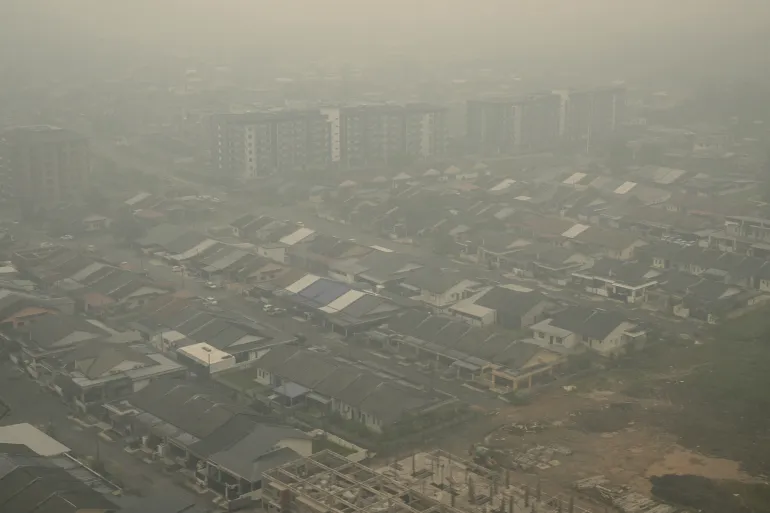
Malaysia has declared a state of emergency in a district in Sarawak state after haze caused by wildfires in neighbouring Indonesia increased air pollution to “hazardous” levels.
King Sultan Ibrahim “has consented to the declaration of emergency throughout Serian Division, Sarawak, following haze conditions that have reached air pollution levels hazardous to public health and safety”, Prime Minister Anwar Ibrahim’s office said in a statement on Thursday.
The declaration followed a formal request from the Sarawak Disaster Management Committee after the region’s Air Pollutant Index reached levels warranting consideration of a local emergency.
Under the order, 647 schools in Serian will close from Monday until at least the end of next week, alongside government and private offices, plantations, construction sites and quarries, with only essential services continuing to operate.
The state’s disaster management authorities said a three-day cloud-seeding operation launched on Thursday would be extended to at least Monday, citing forecasts of “more conducive cloud formations” during that period.
Sarawak State Disaster Management Committee chairman Douglas Uggah Embas, speaking at a news conference in Kuching, stressed that the emergency applied only to Serian, not the entire state, but urged residents there to take the situation seriously.
“Please minimise outdoor activities and avoid strenuous activities outdoors,” he said.
Sarawak, in the northern part of Borneo island, has been heavily affected by haze for weeks, as have the neighbouring states of Sabah and Peninsular Malaysia.
(Aljazeera)
Latest News
Sun directly overhead Moratuwa, Kesbewa, Handapangoda, Idalgashinna, Yudhaganawa, Kotiyagala and Panama about 12.08 noon today (05)


The sun is going to be directly over the latitudes of Sri Lanka from 28th of August to 07th of September due to its apparent southward relative motion.
The nearest places of Sri Lanka over which the sun is
overhead today (05) are Moratuwa, Kesbewa, Handapangoda, Idalgashinna, Yudhaganawa, Kotiyagala and Panama about 12.08 noon

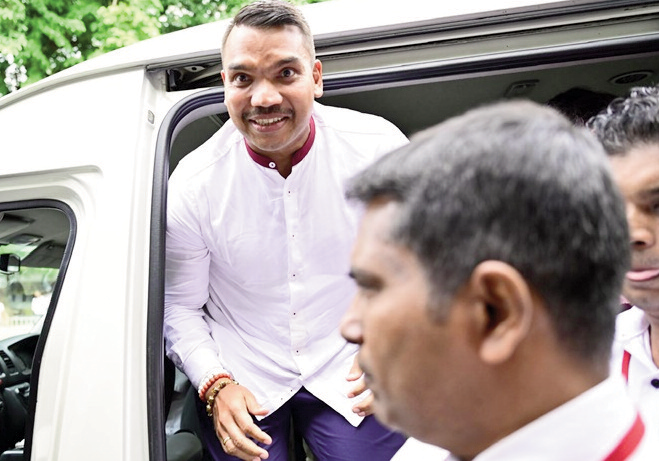
Sri Lanka Podujana Peramuna (SLPP) National Organiser and Parliamentarian Namal Rajapaksa was yesterday remanded until September 18 by the Colombo Chief Magistrate’s Court following his arrest by the Commission to Investigate Allegations of Bribery or Corruption (CIABOC) in connection with an investigation into the controversial SriLankan Airlines Airbus aircraft transaction.
Rajapaksa appeared before the CIABOC at around 9.15 am yesterday to record a statement after being summoned over the transaction. He was taken into custody following several hours of questioning and subsequently produced before the Colombo Chief Magistrate.
The investigation centres on allegations surrounding the acquisition of six Airbus A330 and eight A350 aircraft by SriLankan Airlines in 2013, in connection with an alleged USD 2 million bribe.
Former SriLankan Airlines Chief Executive Officer Kapila Chandrasena and his wife, Priyanka Niyomali Wijenayake, had previously been named in connection with the alleged bribery.
Chandrasena was arrested on March 12 as part of an investigation launched by the CIABOC under the Anti-Corruption Act and was subsequently released on bail. He was later found dead on May 8 while on bail, with police suspecting that his death was a suicide.
Open warrants have been issued for the arrest of Wijenayake, who is named as the second suspect, and Shamindra Rajapaksa, named as the third suspect, in the case pending before the Fort Magistrate’s Court in connection with the Airbus transaction.
The investigation has also received assistance from Airbus, with a delegation from the company’s parent group in France visiting Sri Lanka during the first week of August. The delegation provided statements and other assistance to the CIABOC as part of the ongoing inquiry.
Rajapaksa’s arrest and remand yesterday mark a further development in the widening investigation into the controversial aircraft deal.

Malaysia declares emergency in Sarawak as haze from Indonesia worsens

UAE keep semi-final hopes alive after convincing win over Indonesia

Sun directly overhead Moratuwa, Kesbewa, Handapangoda, Idalgashinna, Yudhaganawa, Kotiyagala and Panama about 12.08 noon today (05)

Showers above 75 mm are likely at some places in the Uva, Central and Eastern provinces and in Polonnaruwa and Mullaittivu districts after 2.00 p.m

Namal remanded until Sept. 18 over Airbus deal investigation

Dengue cases surpass 96,000 this year

‘Dates have the highest sugar content to fight Coronavirus’

Sunday Island 27 December – Headlines

#SundayIsland 17th December – Headlines

Sunday Island – 28th March

Sunday Island Headlines – 21 March

Sunday Island – 21st February – Headlines
-

 Features6 days ago
“Wrap Me Up in My Blazer”— A Gentlemanly Bradby Reminiscence
-

 Features5 days ago
When Sri Lankan stories find their own voice
-
 Features6 days ago
JVP/NPP government as seen from outside by Lionel Bopage now domiciled in Australia
-
 News5 days ago
BASL takes exception to Justice Ganepola being denied a place in SC
-
 Features6 days ago
Prof. Savitri Goonesekere: What has she done?
-

 News2 days ago
Denied of promotion to SC despite vacancies, justice Gurusinghe retires
-
 Latest News3 days ago
Grade 5 scholarship exam results released
-

 Features6 days ago
World Trade Politics: Canada rebuffs Trump’s tariff blackmail