
News
FSP calls on govt. allies not to pretend to oppose adverse deal with US firm

By Anuradha Hiripitiyage
Due to the secret agreement signed with US firm New Fortress Energy, Sri Lanka would soon face a situation akin to the one already faced by Ukraine, the Frontline Socialist Party (FSP) predicted yesterday.
“Sri Lanka is trying to reduce its dependency on coal and switch over to LNG. With this in mind, several coal and diesel power plants are to be converted into LNG in the coming decade. Now, we will entirely depend on the US to provide us with LNG to power these plants. Given that the US intends to control the seas in which Sri Lanka is placed strategically, they will not let us off the hook once they establish their foothold here. We are in deep trouble,” FSP Propaganda Secretary, Duminda Nagamuwa said.
Nagamuwa said that some constituents of the government were pretending that they opposed the transfer of government’s shares in the Yugadanavi Power Plant to New Fortress Energy. “But this is not the time for theatrics but for concrete action”, he said.
Nagamuwa said that the agreement between the government and US Company New Fortress Energy to construct a new offshore liquefied natural gas (LNG) receiving, storage and regasification terminal at Kerawalapitiya as well as the transfer of government’s shares in the Yugadanavi Power Plant had to be scrapped.
“Even government ministers agree that the agreement was not discussed with them. Several affiliates of the government are trying to convince the people that they are fighting this decision from inside. However, past experience has shown that when push comes to shove they will stay with the government. They must show the leaders of the government that they are not puppets,” he said.
Nagamuwa said that if those affiliated to the government were serious in their opposition to undermining Sri Lanka’s energy security they should show their commitment by doing something concrete.
The Yugadanavi Power Station at Kerawalapitiya already produced 300 MWs of energy and there was a plan to build another 350 MW plant there. The US Company had now been allowed to build an offshore LNG receiving, storage, and regasification terminal and to provide LNG to the existing Power Station and the new 350 MW power plant to be built, he said.
“Now we are under the power of the US. We will soon be facing the plight of Ukraine,” he said.


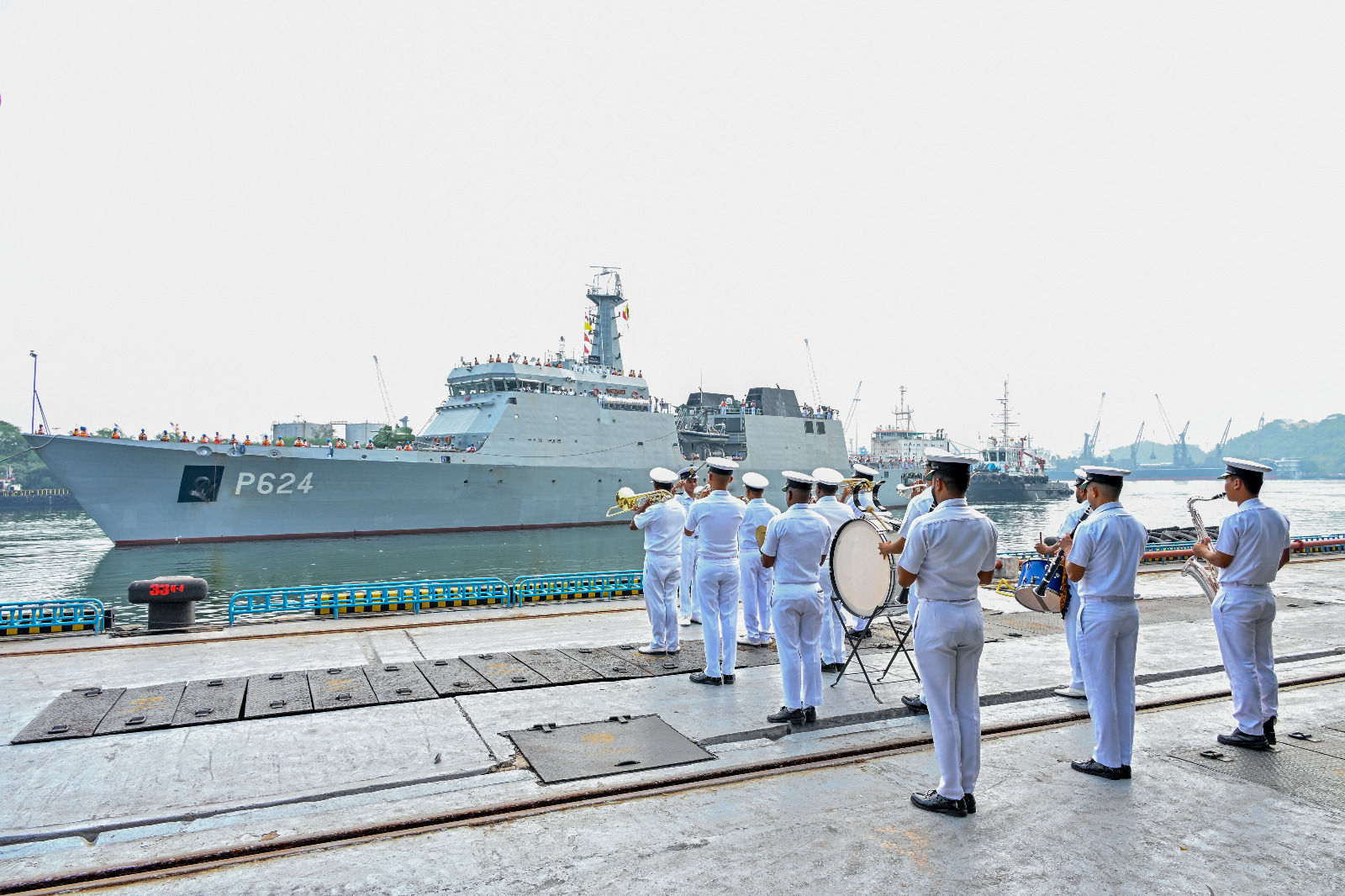
Sri Lanka Naval Ship (SLNS) Sindurala arrived at the port of Visakhapatnam in India on 17 September 2026, to participate in the bilateral naval exercise ‘SLINEX – 2026’.
The Indian Navy formally welcomed the SLN vessel upon its arrival, adhering to naval traditions.
The joint exercise will take place on 20 and 21 September in the seas off the east coast of India. On 18 September, the Commanding Officer SLNS Sindurala, Captain Sunanda Appuhamy, held official discussions with Commander Suraj Aiyappa, Commanding Officer Indian Naval Ship (INS) Kavaratti, aboard both vessels.
The annual exercise aims to enhance cooperation, interoperability, and professional exchange between the two navies. During the exercise, crew members from SLNS Sindurala will also participate in several professional and cultural exchanges organized by the Indian Navy.
Advisory for strong winds and rough seas for Multi-day boats in the Bay of Bengal deep sea areas
Issued by the Natural Hazards Early Warning Centre
Issued at 05.00 p.m. 18 September 2026, valid for the next 24 hours.
PLEASE BE AWARE!
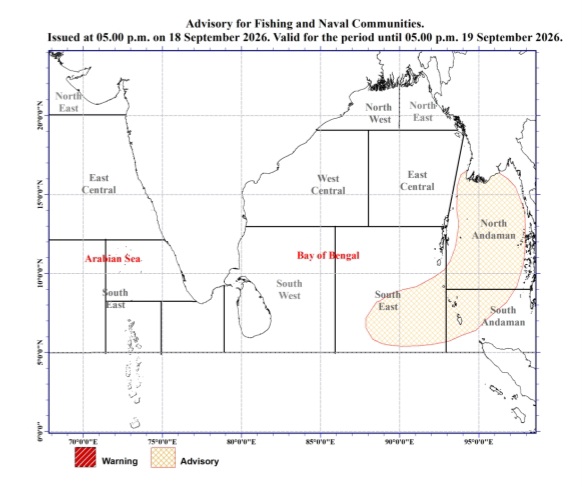
The atmospheric disturbance to the North of the Andaman Islands in the Bay of Bengal, is likely to develop into a low pressure area within the next 24 hours.
Due to its influence, wind speed over the Bay of Bengal sea areas will increase during the next few days starting from
tomorrow (19th).
The wind speed in the sea areas marked under the “Advisory” category on the map below will increase to 55-65 kmph at times and those sea areas will be rough or very rough at times.
Navel and fishing communities engaging the activities over this sea area are advised to be vigilant and be attentive to the future forecasts and bulletins issued by the department of Meteorology in this regards.


Text and Pic by Priyan de Silva
Director General of the Commission to Investigate Allegations of Bribery and Corruption (CIABOC) Ranga Dissanayake has questioned whether some promises contained in the National People’s Power (NPP) manifesto, A Thriving Nation – A Beautiful Life, could be fulfilled even if the government wanted to implement them.
Dissanayake raised the issue during a discussion following the release of the third biannual report on manifesto monitoring by the March 12 Movement, at the BMICH, on Wednesday.
He questioned whether the report had taken into account legal and institutional constraints affecting the implementation of certain pledges.
Citing the proposal to establish Anti-Corruption Investigation Offices in each district, Dissanayake said such offices could be established only with the agreement of CIABOC and that amendments to the Anti-Corruption Act would be necessary.
He also referred to the pledge to abolish the Executive Presidency, noting that successive governments had made similar commitments since 1994. He questioned whether there had been adequate consideration of where the powers vested in the Executive President would be transferred if the system were abolished.
On the proposal to establish a Public Prosecutor, Dissanayake questioned whether the Government intended to maintain the office alongside the Attorney General, who currently performs prosecution-related functions.
Executive Director of the Institute for Democratic Reforms and Electoral Studies (IRES) Manjula Gajanayake said Dissanayake’s remarks should be regarded as his personal views and not as Government policy.
Monitoring and Evaluation Consultants M. Thilakarajah and D.D. Mataharaarachchi presented the third-phase findings, covering January to June 2026.

SLNS Sindurala arrives in Visakhapatnam for SLINEX 2026

Advisory for strong winds and rough seas for Multi-day boats in the Bay of Bengal

Showers in the Western, Sabaragamuwa and North-western provinces and in Galle, Matara, Kandy and Nuwara-Eliya Districts

Some NPP manifesto promises may be difficult to fulfil – CIABOC DG

Yoshitha and ex-Navy chief Karannagoda’s case fixed for PTC

Court orders probe into Wimal’s rally speech

‘Dates have the highest sugar content to fight Coronavirus’

Sunday Island 27 December – Headlines

#SundayIsland 17th December – Headlines

Sunday Island – 28th March

Sunday Island Headlines – 21 March

Sunday Island – 21st February – Headlines
-

 News7 days ago
Gnanasara Thero absconding after SC ruling
-

 Opinion6 days ago
From Galkissa (Mount Lavinia) to Tambuttegama
-

 Business7 days ago
HNB Finance strengthens Board with four independent directors
-

 News3 days ago
US embassy won’t comment on IGP’s probe into joint drug raid
-

 Sports7 days ago
Culture within cricket team worrying authorities
-

 Features6 days ago
Sri Lanka’s university crisis: Brain drain and union action demand urgent reform
-

 Features5 days ago
The emptying university: why are academics leaving?
-

 News7 days ago
House to debate 22A, Judicature Bill next week