
News
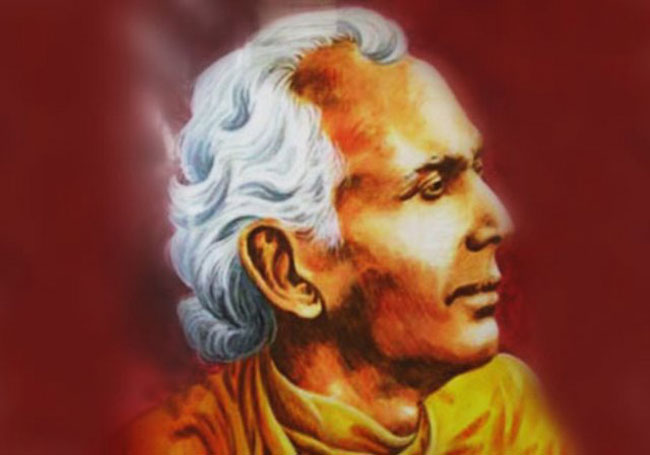
Anagarika Dharmapala: Admirer of ‘Queen Mab’

by Rohana R. Wasala
It may look unfashionable or even indecent to write about Anagarika Dharmapala (1864-1933) in these days of ‘reconciliation’ politics. But that is due to the deliberate distortion of facts by vested interests. So I beg my readers’ indulgence. The Anagarika has been consistently misrepresented by anti-nationalists as a Sinhala supremacist, a Buddhist fanatic, and a propagator of violent nationalism. But the truth was otherwise; he was none of these.
As anthropologist Gananath Obesekera, professor emeritus, Princeton University, mentions in his ‘The Doomed King’ (2017), “Dharmapala was the most passionate defender of Sri Vikrama in colonial times…”; Sri Vikrama Rajasinghe had been demonised by the British in the interest of their imperial scheme to annex the Kandyan kingdom. To the Anagarika, the last king of Lanka was a noble ruler and human being who was betrayed by traitorous chiefs like Ehelepola disava (as he conceived of them). He “defended Sri Vikrama and implored Sinhala people to model themselves on his life and history….” (ibid.) Gananath says Dharmapala was indulging in ‘hyper-glorification’ of the last king. Perhaps, he was; but that doesn’t invalidate the latter’s assessment of the king, whose non-Sinhala ethnicity did not trouble him. At the same time, I don’t share Gananath’s criticism of Dharmapala’s alleged anti-Christian attitudes.
Dharmapala was, first and foremost, an international Buddhist missionary, and only secondarily, a Sinhala Buddhist national revivalist and social reformer. Sri Lankans (native Ceylonese) were in urgent need of the brave leadership and guidance of such a heroic figure at that time. He excelled in both roles. Anagarika Dharmapala assumed robes as a Buddhist samanera at an advanced age in July 1931, after a very industrious and productive life; he received the upasampada or higher ordination under the name of Ven. Siri Devamitta Dhammapala, hardly four months before his death on April 29, 1933.
As was the standard practice among the well-to-do families in those colonial days, he received a good school education in the English medium. During all of his active life, he mostly used English for communication. More than 75% of his writings were in that language; he spoke English even more frequently in the course of his lifelong missionary work. No religious leader of the time, whether Buddhist or non-Buddhist, devoted so much attention as he did to the need for a good modern education for the young that included mastery of languages and science and technology (practical skills).
Anagarika Dharmapala said that he got an insight into Buddhism after reading Sir Edwin Arnold’s poem about the Buddha “Light of Asia” (1879). He treated the latter as his teacher. Arnold received the Anagarika when he visited London. Dharmapala was not an enemy of English or the English people; he was well disposed towards both. But he was a vehement critic and opponent of British imperialism, which though he didn’t challenge politically, as he thought that it was not yet the time for it; he wanted to have favourable relations with the existing imperial government in order that he could get on with his global missionary work without any obstruction. His national endeavour was to lead his people towards freedom from foreign rule through peaceful means, which motivated his work for stimulating social reform and bringing about the moral edification of the masses.
This year marks the 157th birth anniversary of the revered Anagarika Dharmapala, who made an immense contribution towards the restoration of the national dignity and the religious and cultural regeneration of the oppressed Sinhala Buddhists in the heyday of British imperialism in our country. He was born to a wealthy business family in Colombo exactly 157 years ago, that is, on September 17, 1864. The young Don David Hewavitharne, as he was named at birth, despite his strong dislike of British colonialist rule, had a passionate love of English poetry. He particularly liked the poems of John Keats and Percy Bysshe Shelley, both assigned by literary critics and historians to the Romantic tradition of English poetry. Ever since he discovered the latter’s ‘Queen Mab’ in a book in his uncle’s library as a schoolboy, it had remained his favourite English poem.
The basis of his admiration of ‘Queen Mab’ is not difficult to find. He said about the poem: “I never ceased …. .to love its lyric indignation against the tyrannies and injustices that man heaps on himself and its passion for individual freedom” (as quoted in ‘Flame in Darkness – the Life and Sayings of Anagarika Dharmapala’ by the English monk Maha Sthavira Sangharakshita, (1980). There is no doubt that this specimen of Shelly’s juvenilia (i.e. works done in his youth) was nevertheless an important source of inspiration for the Anagarika in his life’s work.
What must have appealed to Don David Hewavitharne in ‘Queen Mab’ was obviously more than just the polemical attack it mounts on “the tyrannies and injustices” that humans inflict on fellow humans. The poem embodies many of the radical ideas that Shelley articulated in his works, and some of these such as his atheism, his criticism of meat eating as a cause of vice, and the implicit advocacy of vegetarianism, his idea of death as something not to be feared, his condemnation of political and religious tyranny, his socialist politics, his scientific attitude to human experience and the external world, his belief in the moral perfectibility of humanity, his nonviolence and antipathy towards war, and his vision of social and political change through intellectual transformation are sure to have struck a chord in the great patriot and Buddhist revivalist that the young David later became.
‘Queen Mab’, a book-length poem in nine parts, was written and privately distributed by Percy Bysshe Shelley (1792-1822) in 1813. It was the poet’s first work of genuine literary merit. His decision to make it available to a select circle suggests the type of audience he wanted to address: the target readers were of the same patrician (aristocratic) background as himself who had the time and the means to get an education, and the leisure to read and enjoy poetry; the mostly illiterate downtrodden masses whose welfare he actually had in mind and who stood to gain most from the revolutionary changes he envisioned were for the most part outside of this circle; the Anagarika belonged to the same higher social class in this country as Shelley did in England.
Structurally, ‘Queen Mab’ is a fairy tale composed in nine cantos (main divisions). A fairy named Queen Mab comes down in her ethereal car to the sleeping Ianthe, a beautiful young maiden. Leaving the girl in her deep slumber the fairy awakens her Soul or Spirit and invites it onboard and transports it to her celestial abode at the uttermost edge of the universe. From that vantage point the Spirit (Ianthe’s Soul) is given a view of the universe stretching below. The fairy promises the Spirit to reveal the state presumably, of humanity’s past and present and the ‘secrets of the future’:
Critics have called this poem a dream vision allegory, a fairy tale, a utopian daydream, a protest- poem etc. The young David Hewavitharne might have identified ‘Queen Mab’ as a protest-poem. In terms of its substance we may call it a philosophical poem as well. In fact, the 1813 title of the poem was ‘Queen Mab: A Philosophical Poem with Notes’. Shelley was a ‘philosopher’ among the Romantics in the sense that while treating the usual ‘Romantic’ themes of beauty, passion, power of the imagination, the natural goodness of humanity, political freedom etc which formed their characteristic subject matter, he discovered and articulated causal connections in them with rare precision and clarity. He was unique in this respect among his contemporaries, with the possible exception of William Wordsworth (1770-1850) as critics have pointed out. Reading ‘Queen Mab’ we feel that it qualifies for all the above labels.
Though it is unselfconsciously melodramatic, coldly polemical, and crudely emotive in much of its versification and though he himself seemed years later to have had second thoughts about its estimation as a poem worthy of publishing for public consumption when he came to know that a pirated edition of the poem had appeared in 1821 (which was just a year before his accidental death by drowning), the ‘philosophy’ that he versifies in it is found to be as mature as it ever got in his case (considering the fact that he died at the young age of 30). The poem has even been described as ‘monumental’ by more sympathetic, and in my opinion more rational-minded and more discerning, readers. Obviously, Anagarika Dharmapala was among this group of readers.
Both Shelley and Dharmapala were revolutionaries, though of different moulds. They agitated for liberty and morality in the political and socio-cultural spheres. They had similar views about how to foster social and political reform (though the political aspect was more subdued in the case of Dharmapala than in the case of Shelley, a difference between the two that points to the Anagarika’s realistic, pragmatic approach as opposed to the dream-visionary impracticality of Shelley’s): Shelley believed in the possibility of perfecting humanity by moral means, which forms the nuclear theme of ‘Queen Mab’; the revolution he envisaged appears to be something to be achieved in this way, but not through armed struggle (despite his probable allusion to the French Revolution in his sonnet ‘England in 1819’ suggested.
As socially conscious young men in their different places and times Shelley and Dharmapala had much in common. They shared the same reformist ambitions. Both, born into wealth and privilege, showed an unusual concern for the welfare of the poor and were totally committed to the social uplift and moral refinement of the society including particularly the traditionally oppressed. Shelley’s relentless criticism of authoritarian institutions in his country is explicitly articulated in his sonnet ‘England in 1819’: The state of Shelley’s England is such that the king is “old, mad, blind, despised, and dying”; the princes are “the dregs of their dull race”; the rulers who are unable to see, feel or know, cling like leeches to their country until they “drop, blind in blood, without a blow”; the ordinary English people are “starved and stabbed in the untilled fields”; the army is corrupt and inept; the laws “tempt and slay”; religion is “Christless – Godless – a book sealed”. (Won’t this sound familiar to readers in many countries of the world even today?)
All these (agents of tyrannous evil) “Are graves, from which a glorious Phantom may – Burst to illumine our tempestuous day” (This could be interpreted as an allusion to the French Revolution, in which a crucial event was the storming of the ancient fortress of the Bastille and the releasing of the wretched prisoners there in 1789, just three years before his birth). Shelley’s diatribes like these preceded, by about three quarters of a century, the Anagarika’s vehement denunciation of the demoralizing British imperialism in our country. Just as Shelley rebelled (ideologically) against what he condemned as the tyranny of the king, priests and statesmen (‘statesmen’ not in its current dignified sense, but in the sense of mere ‘politicians’), Dharmapala adopted a defiant stance towards the occupying foreigners, errant Buddhist monks, and the Westernized local elite that so slavishly pandered to the interests of the colonial rulers.
But he was not an irrational hater of everything Western. He admired the positive aspects of European culture. He possessed a very good knowledge of the English language, which he used to write and edit many English publications in the pursuance of his Buddhist revivalist propaganda. His love of English poetry was consistent with the cosmopolitan Buddhist attitude towards what is admirable in other cultures. He criticized the tyranny and injustice of European colonialism, but he obviously had a high regard for the Western nations’ scientific and inventive genius. In return, he acted in compassion towards them according to his own religious convictions. He wrote in his “My Life Story” already referred to:
It is time that Buddhists of Asia should give the Dhamma to the people of Europe and America. Buddhism is for the scientifically cultured. The discoveries of modern sciences are a help to understand the sublime Dhamma. The mediaeval theology of ecclesiastical tussle may have satisfied the half-civilized consciousness of pre-scientific Europe and the paganized tribes of Europe of a barbarous age. Today the cultured races of Europe require a scientific psychology showing the greatness of human consciousness. The sublime doctrine of the Lord Buddha is a perfect science based on transcendental wisdom. This Dhamma should be freely given to the European races.
The unacceptable reality of our current domestic and international predicament is exactly what the farsighted Anagarika acted to forestall, against many odds, which limited his success. Paradoxically and quite unfairly, leaders like him are held responsible for our present ethnic problems by some individuals. My opinion is that had Anagarika Dharmapala and other patriots that he inspired not been there in that era and after, our plight today would have been worse.

Latest News
“Let’s move forward together in unity to build a country where all labour is valued, rights are protected, and equality prevails” -PM


Prime Minister Dr Harini Amarasuriya in her May Day message called upon the working people in Sri Lanka to move forward together in unity to build a country where all labour is valued, rights are protected, and equality prevails.
The full text of the PM’s message:
The history of the Sri Lankan labour movement is a remarkable journey, shaped over decades by the blood, sweat, and sacrifices made in the pursuit of rights, justice, and dignity.
Beginning with the printers’ strike of 1893, the working people of this country emerged as an organised force. Through the trade union movement led by A. E. Goonesinha and the emergence of the Lanka Sama Samaja Party, the voice of labour gained political strength. The Railway Workers’ Strike of 1923 and the public service strike of 1947 reaffirmed that the true ’driving force’ behind the country’s economic and social transformation was its working people. I respectfully acknowledge the invaluable contributions of workers in the plantation sector, ports, railways, and across both the public and private sectors, whose dedication laid the foundation for many of the labour rights we benefit from today.
As we commemorate International Workers’ Day with dignity once again, we pay tribute to all working people across the world, including the heroic workers who sacrificed their lives in the struggle for an eight-hour workday in Chicago in 1886. This year’s May Day holds special significance as it is being celebrated under a government built through the power of the people, in honour of the entire working community of Sri Lanka.
Granting due respect to labour and safeguarding the rights of all working people are core policy commitments of our government. Accordingly, we remain dedicated to creating a fair and safe working environment by expanding existing services and implementing new programmes aimed at improving the living standards of working people.
Ensuring fair and equal access for all citizens is a fundamental objective of the government. Following that, it is our responsibility to create an environment in which everyone can lead a dignified professional life. Establishing a national social protection system that recognises unpaid labour and guarantees social security for unpaid labours is among the foremost priorities of our government.
On this May Day, we must reaffirm the importance of moving forward together in unity to build a country where all labour is valued, rights are protected, and equality prevails. With the strength and dedication of all working people, may we soon achieve the vision we all share: “A Thriving Nation – A Beautiful Life
Latest News
Heat Index at Caution Level at some places in the Northern, North-central, Eastern, Sabaragamuwa and North-western provinces and in Monaragala district during the day time
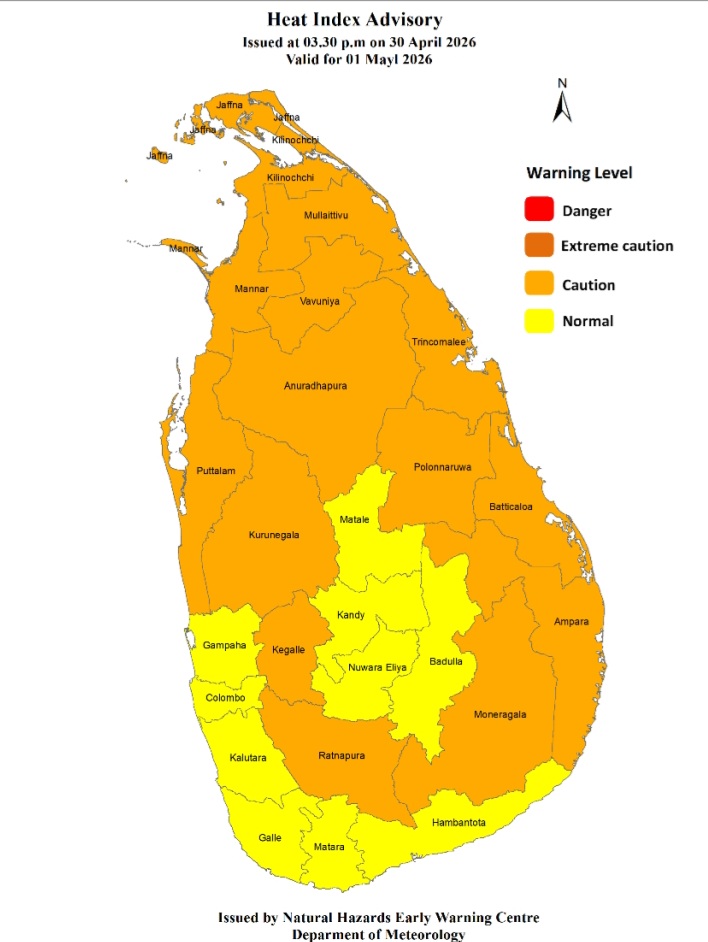
Warm Weather Advisory
Issued by the Natural Hazards Early Warning Centre
Issued at 3.30 p.m. on 30 April 2026, valid for 01 May 2026.
The Heat index, the temperature felt on human body is likely to increase up to ‘Caution level’ at some places in the Northern, North-central, Eastern, Sabaragamuwa, and North-western provinces and in Monaragala district during the day time.
The Heat Index Forecast is calculated by using relative humidity and maximum temperature and this is the condition that is felt on your body. This is not the forecast of maximum temperature. It is generated by the Department of Meteorology for the next day period and prepared by using global numerical weather prediction model data.

Effect of the heat index on human body is mentioned in the above table and it is prepared on the advice of the Ministry of Health and Indigenous Medical Services.
ACTION REQUIRED
Job sites: Stay hydrated and takes breaks in the shade as often as possible.
Indoors: Check up on the elderly and the sick.
Vehicles: Never leave children unattended.
Outdoors: Limit strenuous outdoor activities, find shade and stay hydrated.
Dress: Wear lightweight and white or light-colored clothing.
Note:
In addition, please refer to advisories issued by the Disaster Preparedness & Response Division, Ministry of Health in this regard as well. For further clarifications please contact 011-7446491.


An Assistant Director of the External Resources Department (ERD) of the Ministry of Finance, interdicted pending an investigation into the diversion of US$2.5 million in Treasury funds to a rogue account was found dead at his residence in Kuliyapitiya.
The deceased has been identified as Ranga Nishantha, 50.
Police said the officer had been found in the garden of his house and they believed that the officila had committed suicide. However, investigators have not ruled out other possibilities, and inquiries are continuing.
The official was interdicted along with three other senior Finance Ministry officials over a cyber-enabled financial fraud.
Those interdicted include a Director and an Assistant Director from the ERD, as well as a Director and an Additional Director General from the Public Debt Management Office (PDMO).
Police sources said that the CID had on two occasions asked Nishantha to make a statement in connection with the ongoing investigation, but he had failed to comply.
Police said the CID probe into the alleged cyber fraud is continuing, with investigators examining the circumstances surrounding the diversion of funds through compromised communication channels.Kuliyapitiya Police said further investigations were underway to establish the exact cause of death.

The cost of 76 years of US wars, from Korea to Iran

Myanmar ex-leader Aung San Suu Kyi moved to house arrest, military says

“Let’s move forward together in unity to build a country where all labour is valued, rights are protected, and equality prevails” -PM

Violence in Australian town after arrest of man over girl’s murder

Holder, Rashid and Arshad give Gujarat Titans NRR-boosting win

Showers or thundershowers will occur in most parts of the island after 1.00 pm.

‘Dates have the highest sugar content to fight Coronavirus’

Sunday Island 27 December – Headlines

#SundayIsland 17th December – Headlines

Sunday Island – 28th March

Sunday Island Headlines – 21 March

Sunday Island – 21st February – Headlines
-

 News3 days ago
Treasury chief’s citizenship details sought from Australia
-

 News5 days ago
BIA drug bust: 25 monks including three masterminds arrested
-

 Business6 days ago
Nestlé Lanka Announces Change in Leadership
-
 News6 days ago
Hackers steal $3.2 Mn from Finance Ministry
-

 News5 days ago
Banks alert customers to phishing attacks
-

 News2 days ago
Rooftop Solar at Crossroads as Sri Lanka Shifts to Distributed Energy Future
-
 News4 days ago
Govt. assures UN of readiness to introduce ‘vetting process’ for troops on overseas missions
-

 Business4 days ago
ADB-backed grid upgrade tender signals next phase of Sri Lanka’s energy transition