
News
Susil Sirivardana


I was deeply saddened to hear of the recent death of Susil Sirivardana. He was the kind of person Sri Lanka could hardly afford to lose, especially at a time like this. when the country is reeling under the exponential spread of the Covid, and the economy is collapsing under years of debt and corruption.
Susil was a man from a different world and of a different caliber. Coming from a cultured Southern family, and like many others from similar, relatively affluent groups of the time, he was sent to Oxford for his degree. Being a very good student he graduated with honors in English Literature. There, steeped in the socialist, nationalist, post-colonial discourse of that period, which his sharp mind and wide reading opened up to him, he returned to Sri Lanka, a young man with a mission — to work for his country. Unlike many others of his ilk, Susil sought to follow his deeply people oriented socialist vision, by working in the villages among the people.
His first job was teaching English in a village school in the Anuradhapura area. The white ‘arya-sinhala’ outfit of the post sixties era that he then took on, he never gave up, whatever the social and political circles he moved in. The simple garb, his unostentatious form of transport, his Vespa scooter, and the ‘panmalla’ for his books and files, which had been a part of his life in those early days, became a part of his persona, his identity. It was not for political or public gain, but a part of who he was. It was a statement and reflected his world view and values.
Susil and I have been friends over the years. We shared our interest in literature, and were interested, each in our own way, trying to bring to the monolingual student world of that time, a wider exposure to critical ideas and literatures. Characteristically, Susil took on the challenge frontally. He joined Dr. Amaradasa Virasinha, the original founder and editor of the once popular bilingual critical journal Samskruti, and with Dr. Uswattearachchi, a brilliant bi-lingual economist, together they decided to revive Samskruti, to energize younger writers and readers into critical thinking and writing. Sadly, the growing influence of the commercially weighted media, which today encourages simple uncritical absorption of information, (often biased), undermined the kind of interest in the critical analysis of literary, political or economic issues that scholarly journals such as Samskruti once fostered. With the recent death of Dr.Virasinghe, and now of Susil Sirivardana, Samskruti may have to wait for another rebirth.
Susil’s early education had also exposed him to exciting new movements and perspectives in the fields of art, architecture and environmental issues. It was therefore natural that environmental and conservationist ideas would be central to his vision and policies. In that context he critically observed the ‘Built Environment’, and never failed to express his views on architecture. In recognition of his valuable contributions on the subject, he was invited and served as a visiting lecturer at the City School of Architecture. I am told students still recall the stimulating seminar discussions with Susil, sometimes extending late into the day. He was a teacher who gave of his best to the young. They in turn deeply respected him and admired him.
By the 1980’s, Susil’s abilities and charismatic energy had made its mark both in administrative and political circles. Soon he was drafted into the newly constituted National Housing Development Authority (NHDA) in the capacity of a policy making administrator. He seized this opportunity to initiate a housing strategy for Sri Lanka with his a unique vision of “self- help, appropriate technology, and the utilization of available local materials with available local means and methods of implementation.” The Million House Rural Housing Program, the 30 House Electorate Program, the Urban Low Cost Housing Program, the Rural Accessibility Banking System were all an exceptional and integrated package of Susil’s creative vision for low cost equitable habitat — a realistic urgent need of the country at that time. Susil Sirivardana was blessed also with the rare gift of being an excellent communicator of ideas and concepts. He won the full support of the then Prime Minister, Ranasinghe Premadasa, and ably steered a meaningful housing policy through the resources of the then resourceful National Housing Development Authority.
It is a shame that our land in recent years found little space for men like Susil Sirivardane – men of complete integrity, of enormous capacity to get a job done, and above all, willing and able to take a stand for what they believed in. He worked long and hard on his projects, not for personal profit but for the people and the country of which he saw himself as an integral part.
Today, our political parties tend to box people as belonging to ‘that side’ and ‘not this side’ and so our first rate, experienced, administrators and professionals, who could contribute so much to the country, are instantly marginalized the moment one political group replaces another in the control of the government. As Dr. Anila Dias Bandaranaike, former Assistant Governor of the Central Bank, in a recent, brilliantly researched and well documented analysis published in the Financial Times and the Sunday Island clearly demonstrates, Sri Lanka has no lack of talent, ability, expertise, professionalism, or innovative creativity, in almost any field.
I believe that it is the present political culture of unrestricted personal power on the part of the rulers that leaves space only for abject sycophancy on the part of the ruled. Sadly, it is seen by both, as the means for their personal survival. It is that which deafens rulers to the advice of those many talented and qualified others. It is what has brought this country to this pass.
One can only hope that, sometime in a post- corona era, a younger generation will come forth, washed clean of the years of corruption, personal aggrandizement, ostentatious displays of wealth and uncaring individualism. Perhaps then this land that has survived for millennia will again return to be a humane home for all those who come to these shores, not as conquerors, but as those who choose to make it their home. It is what has enriched this land throughout its history. It is I believe what will enable it to survive.
Ranjini Obeyesekere
Retired Professor, Princeton University, USA
Kandy, August 26, 2021.



The Sri Lanka Navy successfully recovered its Fast Attack Craft P 4447 following a successful salvage operation, bringing a multi-stage emergency response to a close.
The craft, which ran into distress during a routine patrol on 15th August 2026 off Angulana, was brought to the surface on 11th September, from a depth of approximately 80 feet. It was
subsequently towed to the Colombo Dockyard premises.
The initial phase of the operation immediately following the incident focused on search and rescue. A joint effort involving the Navy, Air Force, Police, and local fishermen from Angulana
resulted in the rescue of 11 crew members. The search and rescue phase drew to a close with the recovery of the remains of the Second in Command of the craft, on 4th September.
Following the search and rescue phase, specialized Navy diving and salvage teams launched a dedicated recovery phase against rough sea conditions and underwater challenges, adhering to
strict safety protocols. The Navy’s marine, hull, electrical, and electronic engineering teams utilized specialized technical know-how and equipment to raise the vessel in stages.
Thus, the salvage operation marked an outstanding achievement attained through the professionalism, technical expertise of Navy divers, and coordinated contribution of all
engineering and technical branches of the Sri Lanka Navy. Technical support and specialized expertise were also extended by the Sri Lanka Ports Authority and Colombo Dockyard PLC.


By Shamindra Ferdinando
The Opposition should intensity its focus on the forthcoming selection of a member of the Commission to Investigate Allegations of Bribery or Corruption (CIABOC) and remain vigilant as Speaker Dr. Jagath Wickremaratne, MP, the head of the Constitutional Council (CC) tasked with making the relevant recommendation, is under investigation by the CIABOC, sources familiar with the ongoing inquiry told The Island.
Chethiya Goonasekara, PC, is expected to complete his three-year term on Dec 31, 2026. Sources pointed out that CIABOC Commissioners are appointed by the President on the recommendation made by the 10-member Constitutional Council.
The CIABOC initiated the investigation following a complaint lodged by suspended Chief of Staff and Deputy Secretary General of Parliament Chaminda Kularatne in early February this year. Sources said that as Goonasekera is scheduled to complete his term toward the end of 2026, the CC would have to call applications soon to choose the successor.
Goonasekara received his appointment from President Ranil Wickremesinghe in January 2024. A Justice W. M. N. P. Iddawala was appointed Chairman of the CIABOC. The other commissioner is K. Bernard Rajapakse.
Asked whether Iddawala and Rajapakse, too, would complete their terms soon, sources said that in terms of the Anti-Corruption Act No 09 of 2023, the Chairman of CIABOC would hold office for a period of five years, second commissioner (K. Bernard Rajapakse) for four years and the third commissioner (Chethiya Goonasekara) for a period of three years.
Sources said that the Opposition as well as civil society representatives in the CC should take up the issue of Speaker facing an investigation by the CIABOC taking part in the forthcoming selection process. Responding to queries, sources emphasized that the issue was whether in terms of Section 107 of the Anti-Corruption Act the participation of the Speaker in the selection process amounted to a violation of the Act itself.
The current members of the CC are Dr Jagath Wickramaratne, Speaker and Chairman of the Constitutional Council, Dr. Harini Amarasuriya, Prime Minister, Sajith Premadasa, Leader of the Opposition, Bimal Rathnayake, MP, Aboobucker Athambawa, MP, Ajith P. Perera, MP, Sivagnanam Shritharan, MP, Austin Fernando, Civil society representative, Prof. Wasantha Seneviratne, Civil society representative and Ranjith Ariyaratne, Civil society representative.
Sources pointed out that in spite of the sensitivity of the case, the CIABOC recorded Kularatne’s statement in the second week of August, six months after he lodged the complaint.
The CIABOC on 3, 8 and 10 Sept recorded the statements from the Transport Officer, Deputy Director, Administration and Assistant Director, Finance regarding the use of facilities by the Speaker, those assigned to his staff and other relevant matters.
The NPP named Dr. Wickramaratne as the Speaker after Asoka Ranwala resigned over controversy regarding his higher education qualifications.
SJB lawmaker Dayasiri Jayaskera has repeatedly raised the issues concerning the Speaker with the focus also on the Speaker using two government-managed residences, relevant staff in addition to expenditure on food, transport and fuel provided to the Speaker’s private secretary.
Political sources said that trouble erupted after the Parliamentary Staff Advisory Council in late January sacked Kularatne accusing him of providing false information to secure his appointment. Before being appointed as the Deputy Secretary-General of Parliament in 2023, Kularatne held several high-ranking positions, including Secretary to the Chief Government Whip, Additional Secretary to the President, Additional Secretary to the Prime Minister, and Additional Secretary to the Leader of the Opposition.
The SJB declared in Parliament that Ranwala should be brought back as the Speaker as they have no faith in Wickramaratne. MP Mujibur Rahuman jokingly told parliament that the Opposition wouldn’t raise Ranwala’s educational qualifications.

The Government Medical Officers’ Association (GMOA) has stressed the need to conduct a comprehensive countrywide cadre revision urgently.
GMOA spokesman Dr. Lasitha Dhammika told The Island that the failure on the part of successive governments to conduct cadre revision caused the deterioration of the public sector health services. Due to the absence of required statistics, they hadn’t been able to fully comprehend the situation on the ground and to ascertain the requirements of the public.
Dr. Dhammika pointed out the expansion of the services without supporting statistics and the need to initiate an immediate cadre revision. According to him, the GMOA had raised this issue with successive governments without success. The GMOA spokesman said that they also sought relevant information from the Health Ministry in terms of the Right to Information (RTI) Act two weeks ago but was yet to receive response.
(SF)

Fast Attack Craft P 4447 recovered in successful salvage operation

Showers above 100 mm are likely at some places in the Western, Central, Sabaragamuwa, Southern, North-central and North-western provinces

Shafali, Mandhana power India to eighth Asia Cup title

Tharanga wins Ultimate Javelin title

CIABOC member’s appointment: Controversy over Speaker under probe heading selection process

GMOA: Countrywide cadre revision not done since 2015

‘Dates have the highest sugar content to fight Coronavirus’

Sunday Island 27 December – Headlines

#SundayIsland 17th December – Headlines

Sunday Island – 28th March

Sunday Island Headlines – 21 March

Sunday Island – 21st February – Headlines
-

 Sports4 days ago
DDS set to lose Test captaincy
-
 News7 days ago
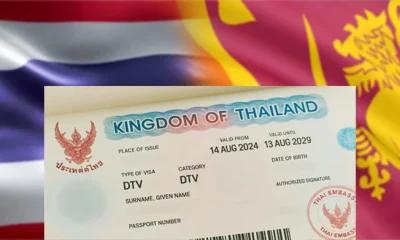
Thailand shuts door on undesirables from Sri Lanka
-

 News4 days ago
Sri Lanka faces new grid challenge as rooftop solar surges: former CEB GM
-

 Latest News3 days ago
Shafali, Deepti power India into sixth T20 Asia Cup final
-
 Business7 days ago
CEB successor company breaks into top three in competitive BESS tender
-
 Opinion6 days ago
Navigating Sri Lanka’s Israeli Dilemma
-

 Latest News3 days ago
Sri Lanka thwart Fatima Sana challenge to secure Asia Cup final spot
-
 Features5 days ago
Lost for 90 years: Rare Goby resurfaces in Jaffna