
News
Medical Specialists urge govt. to defer enactment of KDU Bill to allow time for adequate consultation


The Association of Medical Specialists (AMS) yesterday called on the government to defer the enactment of the proposed Kotelawala Defence University Bill, providing an opportunity for adequate consultations from all the relevant stakeholders.
The AMS has, in a media statement ‘Proposed KNDU Bill – more questions than answers’ signed by AMS President Dr. Lakkumar Fernando and AMS General Secretary Dr. R. Gnanasekeram, requested the government not to repeat the same mistakes as predecessors who set up the North Colombo Medical College (NCMC) and SAITM.
Full text of the AMS statement: “As a responsible professional trade union of medical specialists who are concerned about the higher education in general and the QUALITY medical education in particular in our country, we would like to put forward following observations about the much-talked about proposed KNDU bill.
1. KDU is no more a “university established for a specific purpose” (mainly for military recruits) as it has day scholars following wide variety of courses for a fee. Further, the proposed KNDU bill gives powers to recruit “other persons” to KDU with no clear definition of who these other persons are.
2. Since the KDU is funded by the government (even though under different ministry) apparently with huge amount of tax payers’ money, we believe that the QUALITY of their courses (entry, process and exit) should be on par with UGC standards and other guidelines stipulated by relevant regulatory bodies.
3. By giving legal powers to recognize and affiliate other institutions to KDU under this proposed bill, we are going to establish another parallel institution to UGC in our country, funded by the tax payers’ money.
4. With more civilians planning to be recruited to this institution under “other persons “category, majority of the students here eventually will be civilians. Under these circumstances, we feel that the main governing body of this university should have majority of civilian educationists than military hierarchy who could well be political appointees.
5. If the KDU is empowered to recognize courses conducted by outside institutions to the conferment of their own degrees for civilians without the approval of the UGC, it can create an alternative pathway to civilian population to skip the standards of UGC which will undermine the purpose of the whole universities Act and the UGC.
6. If the UGC is given the authority to scrutinize the courses exclusively offered to the military as announced recently, it can undermine the confidentiality of the sensitive military sciences.
7. The role of the regulators of professional courses (eg: Sri Lanka Medical council) will unfairly be undermined leading to passing out of substandard medical and other professionals. It is pertinent to mention here that the minimum standards of medical education were enacted by the present government after a long delay which gave the necessary legal framework for the SLMC to regulate medical education. Hence, any regulation which can possibly by pass these standards will be detrimental to the medical education in Sri Lanka.
On principle, the AMS is not against QUALITY fee levying medical education in our country, if it is regulated and monitored by the UGC and the Sri Lanka Medical Council. However, lack of proper process and transparency will prevent the establishment of such fee levying institutions in Sri Lanka.
After careful consideration of above issues in the proposed bill, we would like to request the government to defer the enactment of this bill till we get the opportunity for adequate consultations from all the relevant stakeholders.
Further, we earnestly request the President and the government not to repeat the same historical mistakes our rulers did in the case of NCMC and SAITM, a few years back. It’s the responsibility of all of us to establish and protect QUALITY university education in our country.”

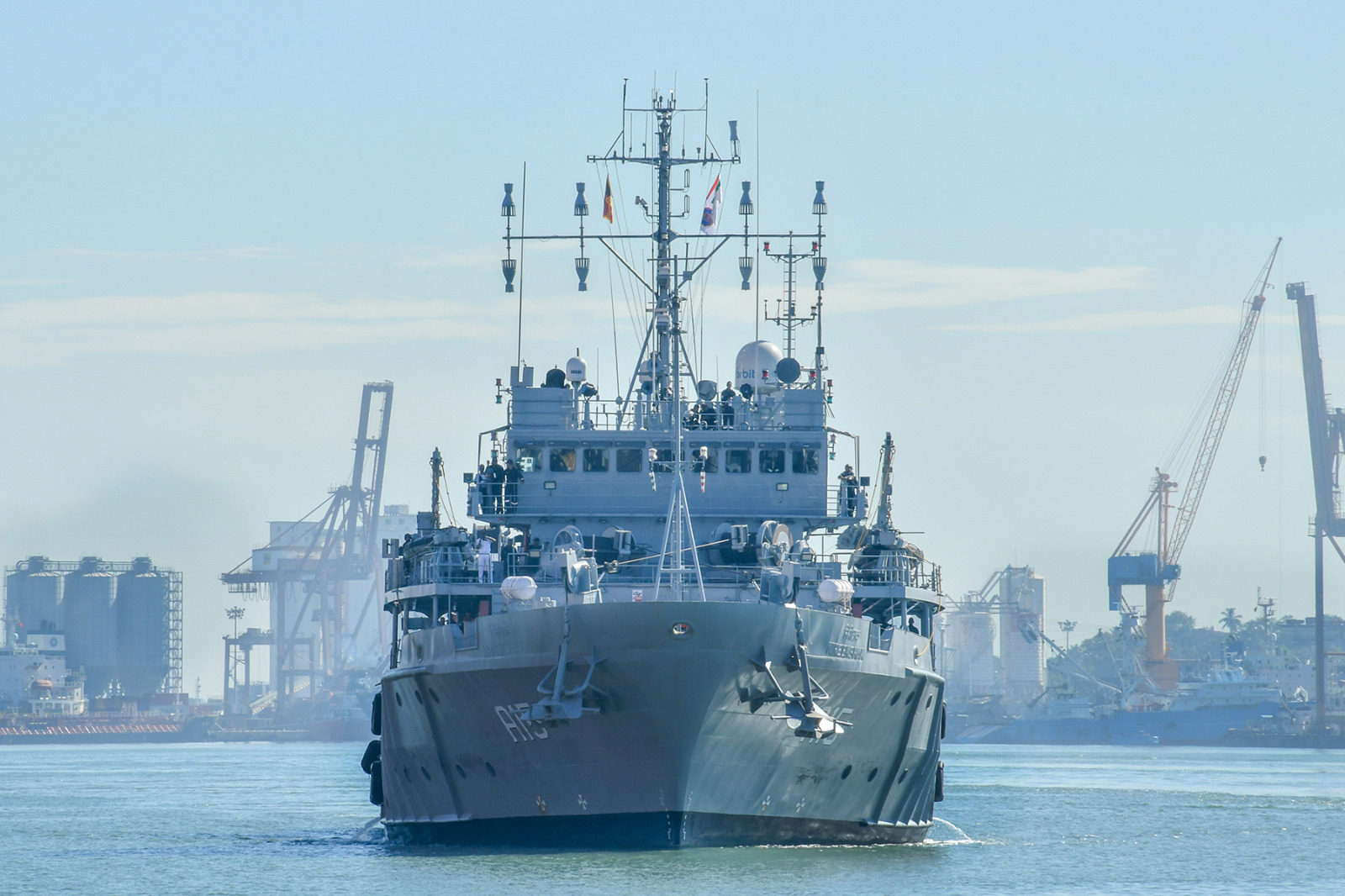
The Indian Navy Ship (INS) NIREEKSHAK arrived in Sri Lanka for Operational Turnaround (OTR) and a training visit on 21 Apr 26.
The Sri Lanka Navy welcomed the visiting ship at the port of Colombo in accordance with time-honoured naval traditions.
Commanded by, Commander Sailesh Kumar Tyagi, this Diving Support Vessel is set to conduct a training programme with the diving professionals of the Sri Lanka Navy.
The crew is also scheduled to participate in several activities organized by the Sri Lanka Navy and visit some tourist attractions within the country.
Latest News
Advisory for Severe Lightning issued to the Western, Sabaragamuwa, Central, North-western, North-central, Southern, Uva provinces, and Mannar, Vavuniya, Ampara, Batticaloa districts

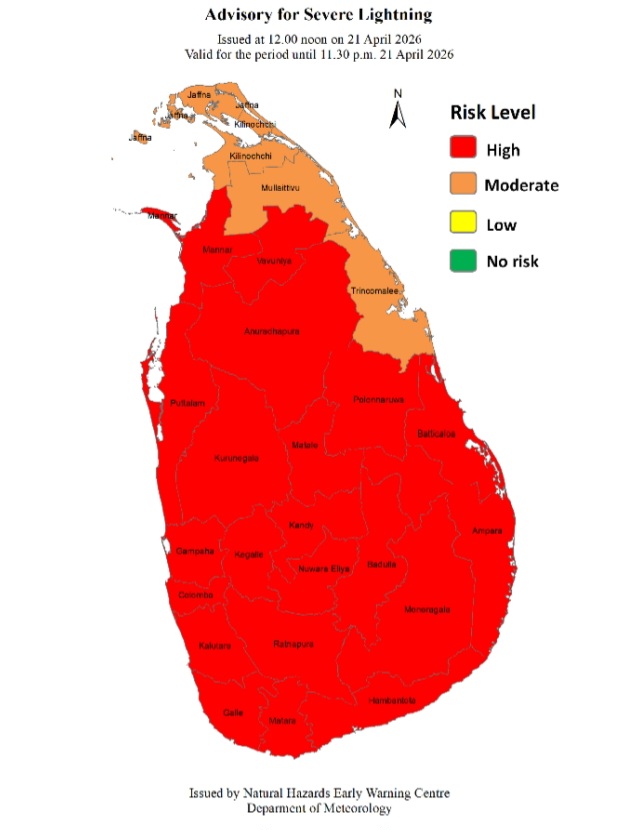
Advisory for Severe Lightning
Issued by the Natural Hazards Early Warning Centre
Issued at 12.00 noon 21 April 2026 valid for the period until 11.30 p.m. 21 April 2026
Thundershowers accompanied with severe lightning are likely to occur in the Western, Sabaragamuwa, Central, North-western, Northcentral, Southern, Uva provinces, and in Mannar, Vavuniya, Ampara, Batticaloa districts after 1.00 p.m.
There may be temporary localized strong winds during thundershowers. General public is kindly requested to take adequate precautions to minimize damages caused by lightning activity.
ACTION REQUIRED:
The Department of Meteorology advises that people should:
Seek shelter, preferably indoors and never under trees.
Avoid open areas such as paddy fields, tea plantations and open water bodies during thunderstorms.
Avoid using wired telephones and connected electric appliances during thunderstorms.
Avoid using open vehicles, such as bicycles, tractors and boats etc.
Beware of fallen trees and power lines.
For emergency assistance contact the local disaster management authorities
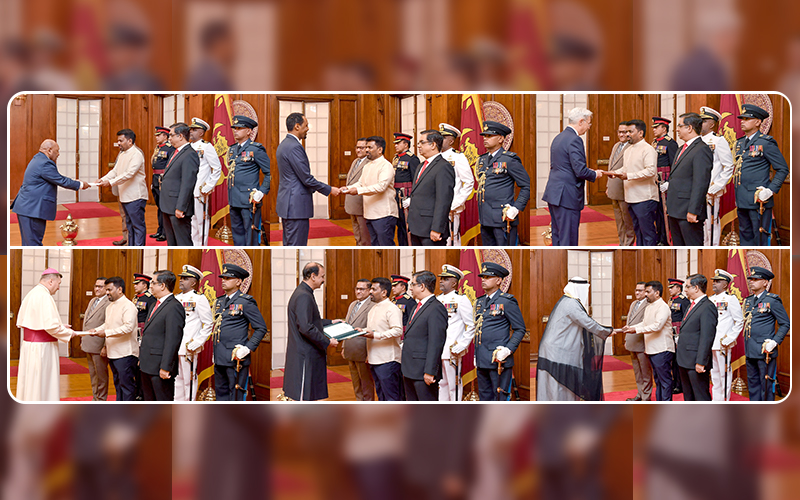
Two High Commissioners, three Ambassadors and an Apostolic Nuncio-designate of the Holy See presented their credentials to President Anura Kumara Dissanayake at the Presidential Secretariat this morning (20).
The ceremony, held at 10.00 a.m., followed the formal order of precedence, with the envoys representing Papua New Guinea, Somalia, Luxembourg, the Holy See, Pakistan and Kuwait.
Accordingly, diplomats who presented their credentials were:
01. Vincent Sumale, High Commissioner-designate of Papua New Guinea (Based in New Delhi)
02. Abdullahi Mohammed Odowa, Ambassador-designate of Somalia (Based in New Delhi)
03. Christian Biever, Ambassador-designate of Luxembourg (Based in New Delhi)
04. Monsignor Andrzej Józwowicz, Apostolic Nuncio-designate of the Holy See
05. Major General (Retd) Nayyar Naseer, High Commissioner-designate of Pakistan
06. Saleh Mubarak Al-Sarawi, Ambassador-designate of Kuwait
Following the presentation of credentials, the President engaged in a cordial discussion with them. The Minister of Foreign Affairs, Foreign Employment and Tourism, Vijitha Herath, and the Secretary to the President, Dr Nandika Sanath Kumanayake, were also in attendance.

INS NIREEKSHAK makes port call in Colombo

Advisory for Severe Lightning issued to the Western, Sabaragamuwa, Central, North-western, North-central, Southern, Uva provinces, and Mannar, Vavuniya, Ampara, Batticaloa districts

US, Iran exchange threats as fragile ceasefire set to expire

Six Foreign Envoys Present Credentials to President Dissanayake

Tilak ends Mumbai Indian’s losing streak with 45-ball century

Showers or thundershowers will occur at most places of the island after 1.00 pm

‘Dates have the highest sugar content to fight Coronavirus’

Sunday Island 27 December – Headlines

#SundayIsland 17th December – Headlines

Sunday Island – 28th March

Sunday Island Headlines – 21 March

Sunday Island – 21st February – Headlines
-

 Business4 days ago
Harnessing nature’s wisdom: Experts highlight “Resist–Align” path to resilience
-

 News6 days ago
PNS TAIMUR & ASLAT set sail from Colombo
-

 News4 days ago
Gratiaen Trust announces longlist for the 33rd Annual Gratiaen Prize
-

 News3 days ago
From Nuwara Eliya to Dubai: Isha Holdings markets Agri products abroad
-
 News22 hours ago
Rs 13 bn NDB fraud: Int’l forensic audit ordered
-

 Opinion2 days ago
Shutting roof top solar panels – a crime
-
 News4 days ago
Heroin haul transported on 50-million-rupee contract
-
 Latest News5 days ago
Singapore Zoo’s first Sri Lankan leopard cubs make their public debut