
News
Sri Lanka in deep crisis: Demands more focused and stronger action


In the context of the deepening global economic crisis, Sri Lanka’s foreign exchange (forex) situation is not improving. The slight increase in exports has been undermined by increased imports, specially aggravated by the need to import vaccines to meet the Covid-19 crisis. Also the decision to restrict import of luxuries and non-essentials is not being enforced effectively. The result is that with more foreign borrowing our foreign debt is increasing.
Annual repayment of debt has reached US$ 4.5 billion, with interest repayment alone amounting to US$ 1.0 billion. Neither the Government nor the people appear to realize the gravity of the forex situation and do not act accordingly. Our import policies need to be tightened. The Government has failed to explain to the people the magnitude of the crisis and the need to tighten the belt at all levels, setting a proper example from the top to conserve our forex. The result is the forex crisis.
But internally too the economic crisis is deepening accompanied by social, political and health crises. The hunger crisis is severe with many people having only one meal a day. The loss of income due to closure of factories and offices and loss of self-employment is a major factor. In addition, many have had pay cuts. Another major cause is the rise in the cost of goods, especially essentials like food. This has led to inability to buy essentials and increasing poverty and hunger.
In fact, studies indicate that 60% of people have incomes below the poverty line. The level of malnutrition has gone up to 18%. Thus, correction of the hunger problem should be given first priority by the Government. I appeal to the new Finance Minister to ascertain the families faced with poverty and hunger and supply dry rations to them as the first priority.
The Covid-19 pandemic is liable to expand with the spread of the more virulent Delta variant in the country. There has to be a country-wide people-based campaign to curb this. Covid committees should be established in every village and slum.
These should detect Covid cases early and institute cluster control measures, and ensure that every person strictly observes the four health guidelines (prevent crowding, ensure social distancing, ensure that masks are worn when out of home, and effective washing of hands).
Covid committees have to be set up in schools as necessary. Ensure that all the vulnerable people in society who are liable to get severe diseases or die (elderly over 60 years and those with serious chronic diseases) are vaccinated.
Imported chemical fertilizer should be continued for this period (kanna) of cultivation so that farmers do not suffer. Organic fertilizer should be produced adequately meanwhile and be introduced country-wide thereafter.
Another major problem is the high cost of food and other essentials. The revival and strengthening of cooperatives, producers and consumers is the only way out. This would prevent profiteering by middlemen. The introduction of the new solidarity concept which ensures that ownership of enterprises is given to the employees alone, would result in successful outcomes e.g. the paddy fields in Kerala, India. The strengthening of the state sector in marketing e.g. the Marketing Department, CWE etc would also help.
Measures like these will help to overcome poverty and hunger and eliminate malnutrition. I urge the Government to think and act on these lines to improve the condition of the people and make the country more productive and the people happier.

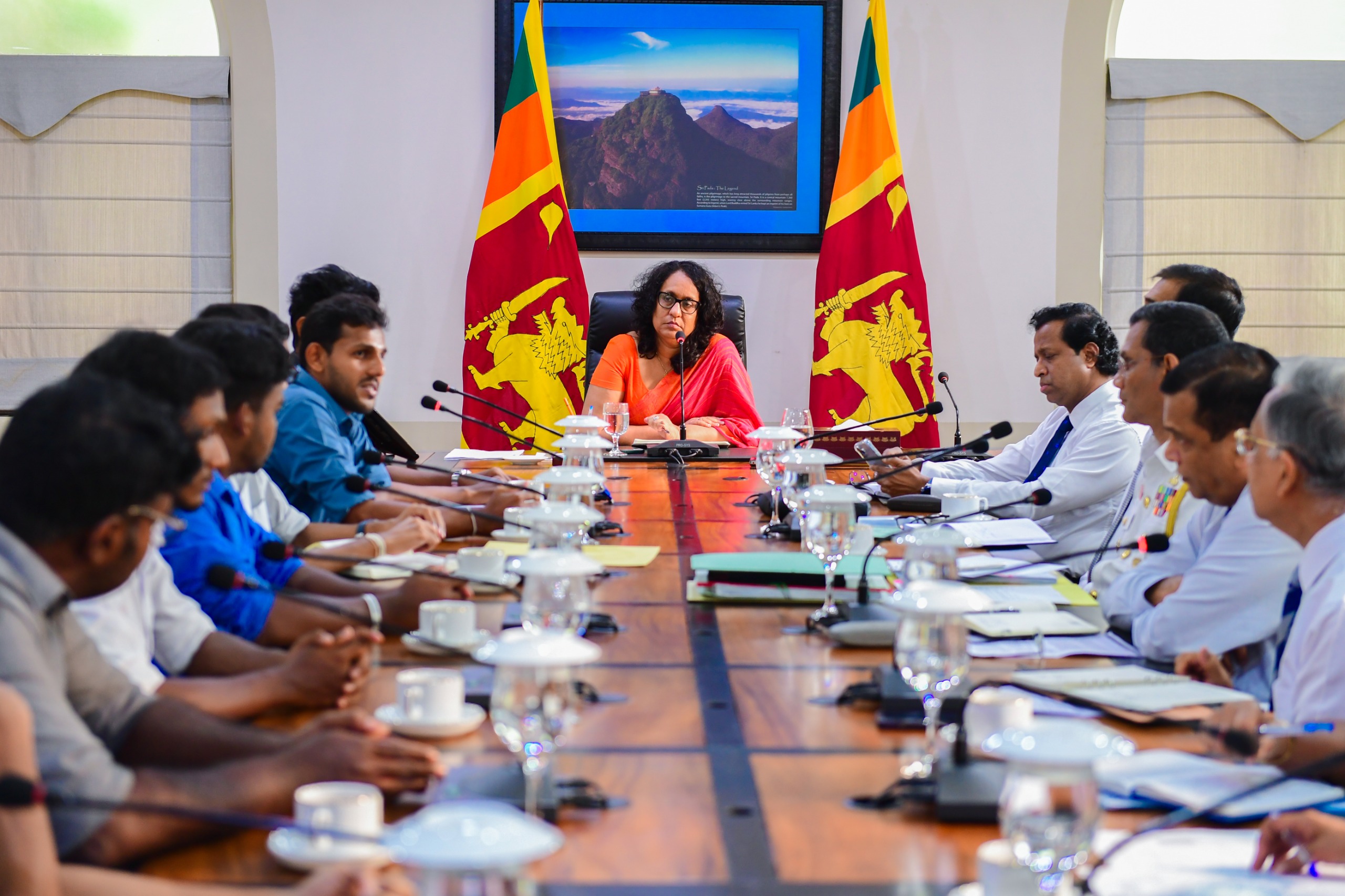
Prime Minister Dr. Harini Amarasuriya stated that a committee will be appointed to formulate a national policy on medical education, following requests by student unions emphasizing the need for such a policy. She also invited student unions to submit their views and proposals toward the formulating of this policy.
The Prime Minister made these remarks during a discussion held on Friday [February 27] at Temple Trees with members of the Medical Faculty Students’ Action Committee.
During the meeting, the Medical Faculty Students’ Action Committee outlined the issues currently faced by university students.
The Prime Minister emphasized that there will be no restriction whatsoever on students’ freedom and noted that discussions would be held with the Vice-Chancellors regarding these matters in the future.
Officials of the Ministry of Health pointed out that delays in providing internship training for medical graduates are primarily due to accommodation issues. They further stated that steps are being taken to address these concerns and that approval has been sought to allocate five additional hospitals to expand internship training opportunities.
Officials from the Ministry of Education, Higher Education and Vocational Education highlighted that funds have already been allocated for the construction of new hostel facilities to resolve accommodation issues at the Universities of Wayamba, Kurunegala, Kuliyapitiya, Sabaragamuwa, and Moratuwa, and construction will commence once land allocation processes are completed. Attention was also drawn to the transportation difficulties faced by medical graduates undergoing training at the Kurunegala and Kuliyapitiya faculties. Discussions will be held with the Sri Lanka Transport Board to provide appropriate solution.
It was further revealed that attention has been given to developing facilities in medical faculties and that no decision has been taken to suspend post-intern appointments.
The discussion was attended by the Secretary to the Prime Minister Pradeep Saputhanthri, Chairman of the University Grants Commission Senior Professor Kapila Senevirathne, officials representing the Ministries of Education and Health, and members of the Medical Faculty Students’ Action Committee, including its convener Navodya Marasinghe.
[Prime Minister’s Media Division]
News
“We welcome investors and tourists visiting Sri Lanka who contribute to strengthening economic and cultural ties”– PM


Prime Minister Dr. Harini Amarasuriya stated that as Sri Lanka moves towards sustainable growth, the country welcomes investors and tourists who contribute to strengthening economic and cultural ties.
She made these remarks while addressing a special celebration and dinner reception organized by the Sri Lanka India Society to commemorate the 77th Republic Day of India and the 78th Independence Day of Sri Lanka, held on Thursday [February 26] at the Taj Samudra Hotel in Colombo.
During the event, the official magazine of the Sri Lanka India Society was launched, and the book “Port of Call” was presented to the Prime Minister and the Indian High Commissioner.
Addressing the gathering, Prime Minister Dr. Harini Amarasuriya noted that the Sri Lanka India Society since its establishment in 1949 has contributed to strengthening relations between the two nations, through cultural engagement, dialogue, and sustained interaction. The Society has supported ties not only between the two governments but also between the peoples of both countries.
She further stated,
“Over the past year, the strength of India–Sri Lanka bilateral relations has been evident. I express gratitude for the support extended by the Indian government in facilitating the exposition of the sacred Devnimori relics in Sri Lanka.
When Cyclone Dithva affected Sri Lanka, India responded promptly through “Operation Sagar Bandhu,” providing assistance in the rescue and relief efforts.
I appreciated the announcement of a long-term relief package amounting to USD 454 million in support of Sri Lanka’s recovery efforts. India continues to work closely with Sri Lanka in its journey towards sustainable development.
The Sri Lanka–India partnership spans multiple sectors, including economic development, energy, connectivity, trade and investment, digital transformation, health, education, maritime security, and people-to-people ties.
As Sri Lanka progresses towards sustainable growth, we welcome increased investments from Indian businesses and greater tourist arrivals from India, while further strengthening our economic and cultural ties”.
She reaffirmed that India is Sri Lanka’s closest neighbour and an important partner, Sri Lanka is committed to advancing cooperation for the benefit of the people of both countries and the wider region.
Speaking at the event, Indian High Commissioner Santosh Jha stated that the relationship between the two countries goes beyond formal diplomacy and is a strong and special partnership. He noted that the introduction of the first international degree offered outside India in Sri Lanka marked a new chapter in educational cooperation. He also highlighted the continued expansion of collaboration in connectivity and people-to-people relations, adding that India–Sri Lanka relations are experiencing significant growth in the current period.
The event was attended by ambassadors, diplomats, officials of the Indian High Commission, and government representatives.
[Prime Minister’s Media Division]

The “Gauravabhinandana” ceremonial felicitation was held in honour of the Chief Sanghanayake of the Sabaragamuwa Province of the Malwathu Maha Vihara Chapter of the Maha Vihara tradition of the Siyamopali Maha Nikaya; former Pirivena Examiner; Rajakiya Pandith; holder of Master; Scholar of classical texts; recipient of the Kala Bhushana title; Vinaya Keerthi Sri Dhammdinna Saranapala; the Most Venerable Kaeligama Vijithananda Nayaka Thero on Wednesday [25th of February] at the auditorium of the Rathnapura District Secretariat
The event was organized under the patronage of the Anunayake of the Malwathu Chapter of the Siyamopali Maha Nikaya, Most Venerable Acharya Agga Maha Panditha Niyangoda Dharmakeerthi Sri Sangharakkhitha Vijithasiri Abhidhana Anunayake Thero.
The presentation of the symbolic casket to the Most Venerable Kaeligama Vijithananda Nayaka Thero took place with the participation of Prime Minister Dr. Harini Amarasuriya and the Governor of Sabaragamuwa Province, Ms. Champa Janaki Rajaratne.
Addressing the gathering, the Prime Minister stated:
“It is a privilege for me to participate in this felicitation ceremony held in appreciation of the religious and social service rendered by the Chief Sanghanayaka of the Sabaragamuwa Province, Most Venerable Kaeligama Vijithananda Nayaka Thera.
When we reflect on his life journey, it serves as a profound inspiration to us all. Having entered monastic life as a disciple of the Sabaragamuwa prelate, the late Most Venerable Kelle Sri Saranananda Thero, the Nayaka Thera has now rendered over five decades of distinguished service following higher ordination.
After obtaining a Bachelor of Arts degree from the Vidyodaya University, he devoted several decades as a Pirivena teacher and examiner, enlightening thousands of students. He has also authored numerous scholarly works. His classical literary contributions, especially for students of Pirivena education, are of exceptional value”.
The Prime Minister further recalled with gratitude the commitment shown by the Nayaka Thera, centred around the Ratnapura Mahawala Sri Dharmayathana, to uplift the spiritual and social well-being of the local community, and extended her wishes for good health and long life for the continuation of his invaluable service to the Buddha Sasana.
The occasion was also graced by the presence of Most Venerable Karagoda Uyangoda Maithreemurthi Thera, Supreme Mahanayaka of the Sri Lanka Amarapura Maha Sangha Sabha; the Anunayaka of the Sri Lanka Ramanna Maha Nikaya, Waleboda Gnanissara Thera; Lecturer of the University of Peradeniya and Deputy Registrar of the Malwathu Chapter, Panditha Mahawela Dhammakkhanda Rathanapala Thera; the Chief Sanghanayaka of Ratnapura and Uva Wellassa and former Vice-Chancellor of Uva Wellassa University, Bethgamuwa Dhammadinna Thera; along with members of the Maha Sangha. The occasion was also attended by the Minister of Buddhasasana, Religious and Cultural Affairs Sunil Senavi, Governor of Sabaragamuwa Province, Ms. Champa Janaki Rajaratne, Member of Parliament Shantha Padmakumara, former Members of Parliament A. A. Wijethunga and Janaka Wakkumbura, Ratnapura District Secretary Chinthana Udaya Nanayakkara, Basnayake Nilame of the Maha Saman Devalaya Ishan Sanka Mapitigama, Mayor of Ratnapura Indrajith Katugampala, and many other distinguished invitees.


[Prime Minister’s Media Division]

In a virtual knockout, a fight of reputation and expectation

Iran launches attacks across Middle East after US and Israel strikes on leadership sites

A committee will be appointed to formulate a national policy on medical education – PM

South Africa vs Zimbabwe, this time for Africa

ICC monitoring Middle East conflict as airspace closure hits travel plans

Sri Lanka make two changes and bowl; Pakistan drop Babar and Ayub

‘Dates have the highest sugar content to fight Coronavirus’

Sunday Island 27 December – Headlines

#SundayIsland 17th December – Headlines

Sunday Island – 28th March

Sunday Island Headlines – 21 March

Sunday Island – 21st February – Headlines
-
 Features7 days ago
Why does the state threaten Its people with yet another anti-terror law?
-
 Features7 days ago
Reconciliation, Mood of the Nation and the NPP Government
-

 Features7 days ago
Victor Melder turns 90: Railwayman and bibliophile extraordinary
-

 Features6 days ago
LOVEABLE BUT LETHAL: When four-legged stars remind us of a silent killer
-
 Features7 days ago
Victor, the Friend of the Foreign Press
-

 Business6 days ago
Bathiya & Santhush make a strategic bet on Colombo
-
 Business6 days ago
Seeing is believing – the silent scale behind SriLankan’s ground operation
-
 Features7 days ago
Barking up the wrong tree