
Features
Flame throwers as deterrent to wild elephant incursions into cultivations?

Much has been written in the news and social media about the sad and continuing Human Elephant Conflict (HEC) . I have read somewhere subject to correction, that most amount of elephant deaths caused by this conflict has been recorded in Sri Lanka, compared to other elephant habitats.
Independent wild life experts and officials of the Wild Life Department have discussed this matter on numerous occasions, but there seems to be no sustainable solution, effective in the long term. In my view the basic problem is that human being have encroached into Elephant Country, in which these mighty animals have lived for generations and taken over the territory, they rightfully occupied for ages. This is another result of the so-called development that every country talks about but that development at the risk of damaging the environment is not sustainable. Many developed countries protect the environment at any cost in preference to so-called development but not in our country.
I am not an expert in resolving the HEC but I have a little experience . When I was Chairman of Pelwatte Sugar Industries Ltd, the Pelwatte Sugar Plantation had been created by replacing forest land to grow sugar. The then government gave some very attractive incentives to bring a Multinational Company to commence sugar cultivation in Sri Lanka. Thousands of acres of forest land were cleared to plant sugar cane. It was a big investment with an extensive infrastructure including bungalows for the top management and also for staff officers.
There were regular incursions by elephants who loved the sugar cane. The Plantation attempted to prevent the elephants destroying the sugar cane by constructing electric fences which they had to maintain, large elephant ditches, which had to be desilted after every monsoon, and so-called elephant drives which were only temporarily effective. I have watched the poor elephants being driven by large number of vehicles, using crackers and other means.
Basically, the above mentioned are the only strategies used in Sri Lanka for human beings to drive away the elephants from their traditional forests after removing the forest and converting it to various types of cultivations. In Africa , it is reported that they rear bees in artificial hives, as surprisingly these huge animals fear the bees which sting them in their eyes . I am not aware of such a strategy being adopted in our country.
The poor elephants are also trapped or fed with “hakapattas” which are devices with an explosive hidden in some morsel of food that elephants love. They try to eat the food resulting the blast inside their mouth, totally dislocating their jaws and ultimately resulting in death.

The Wild Life Department is supposed to be giving the villagers some ” wedillas” . Only one to three are given to a single villager . The elephant is intelligent enough to realize that if they bide their time after the limited wedilla’s are used, they can easily romp in. This is the only protection afforded to the poor villagers.
We have seen TV pictures of many homes of villagers totally destroyed over and over again, as there is no protection against these huge animals. Their stocks of paddy is also devoured and all their crops destroyed repeatedly. These houses have been built by their hard earned money and totally destroyed over a single night. They have to protect their crops by night and also protect their homes and wives and children. They have absolutely no salvation.
The authorities who are experts on Wild Life Conservation, I believe have various plans, but there is no accepted, integrated plan of action, other than for the villagers to suffer without any relief and for elephants to suffer by their injuries and ultimate deaths.
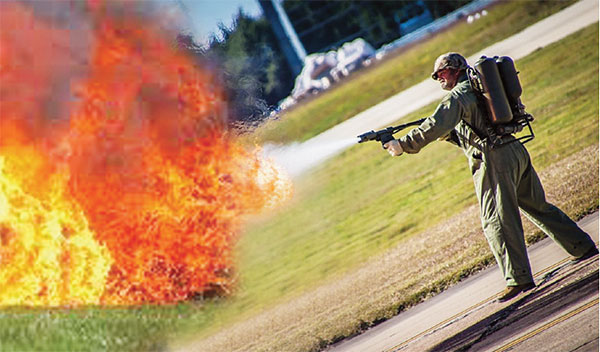
I have been thinking about it for some time and came across of a possible strategy which of course has to be appoved by the department of Wild Life and for the large population of genuine elephant lovers , who have tried their best to solve this problem but failed up to date. I thought of a particular device called a flame thrower. According to Google, (picture attached ), this flame thrower can be purchased in the US without a license and it can be used over and over again, if it is is refueled. I believe it cost around US$500 , plus of course the fuel used for producing the flame. There is possibily one catch and that is I believe sometime after the 1st World War, it was decided to ban armies from using this very potent weapon which can totally destroy small buildings, army camps etc., against individuals.
I do not intend them to be used to kill or maim elephants, but as a very effective deterrent at long range. I would like to have the views of the wild life experts before anyone can consider using this weapon as a deterrent. Mine is only a suggestion, as we continue to have elephant and human deaths, without any action taken to prevent same.
Mahendra Amarasuriya


El Niño – the natural Pacific weather pattern that pushes up global temperatures – has officially begun, US scientists say.
The US National Oceanic and Atmospheric Administration (NOAA) has declared that El Niño conditions are now under way in the tropical Pacific, with sea surface temperatures having risen sharply in recent months.
Many forecasts suggest this could end up as a so-called “super” El Niño, and even be among the strongest ever recorded.
Coming on top of decades of human-caused warming, it could bring another record-hot year – most likely in 2027 – with disruption to weather, food supplies and economies running well into that year.
This announcement by NOAA is not a surprise as forecasters have expected this warming phase, after the cooler “sister” pattern, La Niña, ended earlier this year.
Sea surface temperatures in the central and tropical Pacific have now passed the 0.5C-above-average threshold that US scientists use to define an El Niño event.
“El Niño conditions developed over the past month, as shown by above-average sea surface temperatures (SSTs) across the central to eastern equatorial Pacific Ocean,” the agency said.
NOAA has also seen the winds above the equatorial Pacific begin to shift – a sign that the atmosphere is now responding to the warmer ocean, not just the ocean warming on its own.
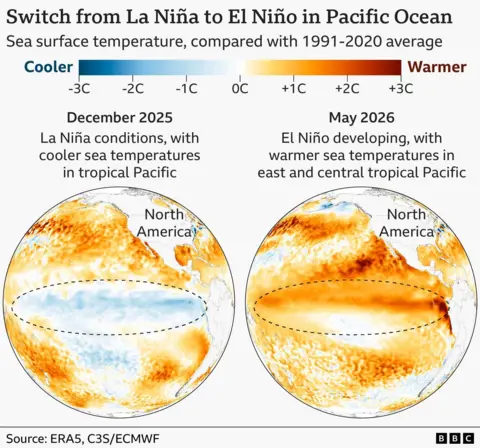
What has surprised the researchers is how confident the computer models already are about its strength.
El Niño‘s intensity is measured by how far sea surface temperatures rise above average in a key zone of the Pacific.
A strong event is defined as more than 1.5C above average; a very strong one above 2C.
According to NOAA’s June outlook, “there is a 63% chance of a very strong El Niño during November-January, that would rank among the largest El Niño events in the historical record going back to 1950,” the agency said.
The three strongest events since then have been in 1982/83, 1997/98 and 2015/16.
Some of the latest US and European (ECMWF) models go further, showing temperatures in the tropical Pacific potentially climbing more than 3C above average by the end of the year.
But the US agency urged some caution on what their strength prediction implies.
“Even very strong El Niño events do not lead to the expected impact everywhere, but stronger events can more significantly tilt the odds in favour of expected outcomes.”
The bigger concern is that all this is happening on an already much hotter planet.
“We do need to worry about the impacts,” said Prof Adam Scaife, head of monthly to decadal prediction at the UK Met Office.
“The current El Niño is… riding on top of a substantial amount of global warming.
“This means that the actual temperatures in affected regions could well be unprecedented, as the warming from El Niño is being topped up by climate change.”
A very strong El Niño typically lifts global air temperatures by around 0.2C, releasing heat stored in the ocean into the atmosphere. That extra blast now lands on a world that is already setting records.
The year 2024 – the warmest on record – was boosted by an El Niño that was not even especially strong.
And despite the cooling drag of a La Niña event, 2025 still came in as the third warmest year on record, hotter even than the super El Niño year of 2016.
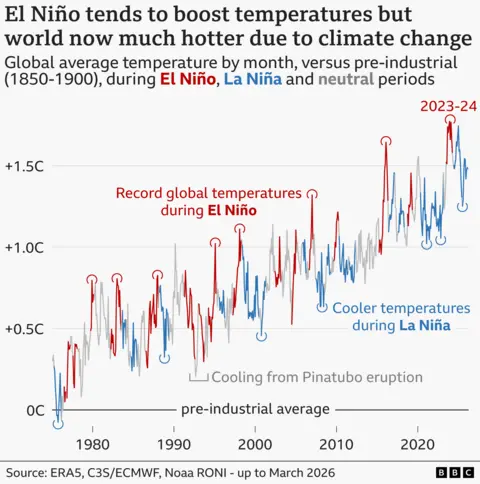
“At the end of this year and into 2027, we’re likely to see very high temperatures globally,” Prof Scaife said.
“In 2027, we’re likely to see excess heat on top of the global warming we’ve already got, and that could easily lead to another year above 1.5 degrees [of warming above late-19th-Century levels].”

No two El Niños are alike, but the disruption is felt most sharply in the tropics.
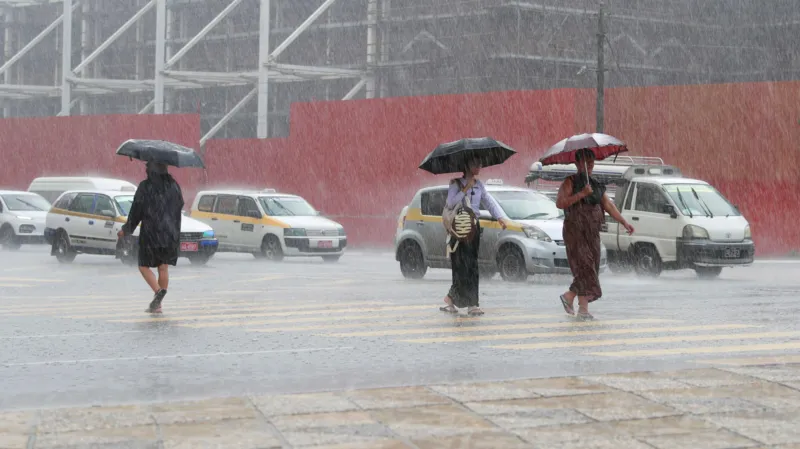
Flooding is common in northern Peru and southern Ecuador, and can reach parts of East Africa, Central Asia and the southern United States.
At the same time, the risk of drought and wildfire rises across much of Australia, Indonesia and northern South America – hitting agriculture and global food stocks.
El Niño also tends to suppress Atlantic hurricanes, and forecasters already expect a quieter-than-average season.
“While that sounds like a good thing, for Central America that leads to a lot less rainfall and potentially drought conditions,” said Liz Stephens, professor of climate risk and resilience at the University of Reading.
Even the UK feels it, if faintly: El Niño can tilt the odds towards a mild start and cold end to winter, though the links are loose.
For many, the forecast is far from abstract.
“An El Niño declaration is not just another weather forecast – for millions of people it is a deadly siren to be feared,” said Mohamed Adow, director of campaign group Power Shift Africa.
“It means failed rains, dying crops, rising food prices, and families pushed to the edge yet again. In East Africa especially, this will land on communities already battered by droughts and floods in recent years.”
Japan’s Meteorological Agency (JMA) takes a similar view to NOAA, judging that El Niño conditions are present. It adds it is all but certain to last into the autumn.
Not every agency is ready to call it, though. Australia’s Bureau of Meteorology (BoM) uses a stricter criterion, requiring sea surface temperatures to exceed 0.8C above average.
This week it said the tropical Pacific was “approaching El Niño conditions”, with central Pacific temperatures already crossing its thresholds, but it stopped short of formally declaring the event had begun.
It expects El Niño to develop later this year, and says it could be strong.
El Niño occurs every two to seven years and usually lasts about a year.
There is still no conclusive proof that climate change is making these events stronger or more frequent – but a warming world can supercharge their effects.
[BBC]


For a considerable length of time in the past, the global war on cancer relied on a strategy similar to carpet-bombing or shooting from the hip in a wider circle. Traditional chemotherapy, while lifesaving for millions, has always been a blunt and aimless instrument. It floods the body with medications that attack any cell that divides rapidly, and because cancer cells divide ever so speedily, they too are destroyed. However, those chemotherapy drugs also attack the healthy multiplying cells all over the body, including those in the hair follicles, stomach, intestinal lining, and bone marrow. It was a kind of an all-encompassing blunderbuss approach. The end result is the all-too-familiar gauntlet of severe nausea, loss of appetite, hair loss, bone marrow depression, as well as profound exhaustion.
But a quiet and profound revolution has been unfolding in the corridors of oncology. Western medicine is rapidly shifting away from this one-size-fits-all assault. Instead, we are entering the era of precision oncology: a paradigm shift where treatments are tailor-made to target the specific genetic and molecular aberrations lurking inside a tumour. In a telling analogy, modern cancer therapy is deploying snipers instead of grenades or carpet bombs. Nowhere is this revolution more visible or more successful than in the fight against blood cancers and lymphomas.
Decoding the Enemy: What are Antigens and Tumour Markers?
To understand how this new generation of medicine works, we have to look at the microscopic histological landscape of a cancer cell. Every cell in the body is covered in unique surface proteins, which act like microscopic identification badges. The immune system scans these badges to differentiate between one’s own healthy tissue and foreign invaders like bacteria or viruses. When any such protein triggers an immune response, it is called an antigen.
When a normal cell transforms or mutates into a cancerous one, its identification badges change. It begins to overexpress certain proteins, display mutated or altered versions of them, or throw out chemical distress signals. Scientists refer to these telltale chemical signatures as tumour markers.
In the past, two patients with the same type of lymphoma would receive exactly the same chemotherapy regimen because their tumour cells looked identical under a standard microscope. Today, molecular testing can reveal that Patient X’s tumour cells are covered in a specific antigen, while Patient Y’s tumour even lacks it entirely. Though the cancer has the same name, the underlying biology is completely different. By identifying these distinct tumour markers, doctors can now select a drug designed specifically to latch onto that exact marker, leaving the neighbouring healthy cells virtually untouched. It is akin even to modern drone technology.
The Breakthrough in Blood Cancers and Lymphomas
While precision medicine is making waves across all of oncology, its most dramatic victories have been won in haematological malignancies; the cancers of the blood, bone marrow, and lymph nodes. Blood cancers are uniquely suited for targeted therapies. Unlike a solid tumour in the lung or colon, which can be a chaotic, structurally complex mass of many different cell types, blood cancers often stem from a single, rogue line of immune cells circulating through the body. This makes it easier for scientists to isolate the specific “glitch” or antigen common to the entire cancerous population and then attack it specifically.
The Story of Rituximab: The First Smart Bomb
Consider the case of a Non-Hodgkin Lymphoma, a cancer of the lymphatic system. A vast majority of these lymphomas arise from cancerous B-cells (a type of lymphocytic white blood cell). Scientists discovered that these malignant cells almost universally carry a specific surface antigen called Cluster of Differentiation or Cluster of Designation, universally known by the abbreviation CD20.
This discovery led to the creation of the medication Rituximab, one of the earliest and most successful monoclonal antibodies. Monoclonal antibodies are laboratory-produced molecules engineered to mimic the body’s natural immune system. They act like guided missiles, designed to seek out and bind to specific proteins or foreign invaders to block disease processes, stop inflammation, or flag infected cells for natural destruction. Engineered in a lab, Rituximab behaves like a heat-seeking missile or a drone, designed to seek out and bind exclusively to the CD20 antigen.
Once it locks onto the cancer cell, it does two things: It delivers a direct blow to the cell’s internal machinery and simultaneously acts as a neon sign, screaming to the patient’s own immune system: “Come and destroy this specific cell.” The introduction of targeted therapies like Rituximab radically transformed the prognosis for lymphoma patients, turning what was once a highly fatal diagnosis into a highly manageable, often curable condition.
Turning the Patient’s Body into the Medicine: CAR-T Cell Therapy
If monoclonal antibodies are smart bombs, the latest frontier in tailored treatment is akin to training an elite, personalised army. CAR-T Cell Therapy (Chimeric Antigen Receptor T-cell therapy) is a highly specialised form of immunotherapy that genetically modifies a patient’s own white blood cells (T-cells) to seek out and destroy cancer cells. The use of the term Chimeric ” indicates a tissue with two or more genetically distinct populations of cells. This is the essence of CAR-T cell therapy, a living drug tailored not just to a type of cancer, but to the individual patient.
The process sounds like science fiction, but it is saving lives today. A patient’s white blood cells (T-cells, the foot soldiers of the immune system) are harvested from their blood. These cells are then genetically re-engineered in a specialised laboratory by using a harmless virus to insert a new gene into these T-cells. This gene instructs the cells to grow a specialised receptor on their surface called a Chimeric Antigen Receptor (CAR). This receptor is custom-built to recognise the exact antigen on the patient’s cancer cells (such as CD19 in acute leukaemia). Then these newly armed “super-cells” are grown by the millions in a laboratory and infused back into the patient.
Once back inside the body, these living weapons hunt down the cancer cells with astonishingly targeted precision. As they are the patient’s own cells, they can persist in the body for years, acting as a vigilant, microscopic security guard against any relapse.
The Benefits: Better Results, Kinder Side-Effects
The most immediate benefit of tailored therapy for the average patient is the reduction in collateral damage. Because these drugs are engineered to ignore cells that do not bear the target antigen, the devastating side effects of traditional chemotherapy are heavily mitigated. Patients generally do not lose their hair, and the severe, debilitating nausea that once defined the cancer experience is significantly lessened.
Furthermore, these treatments work where chemotherapy fails. Cancer cells are notoriously cunning; they often evolve mechanisms to pump chemotherapy drugs out of their system or repair the DNA damage caused by standard drugs. Targeted therapies bypass these defence mechanisms by attacking the cell’s unique structural vulnerabilities or cutting off the specific growth signals the tumour needs to survive.
Challenges on the New Frontier
Despite the immense promise, the transition to fully tailored cancer care is not without its hurdles. At these initial times, these therapies are not panaceas for all ills.
Cancer cells are highly unstable and prone to frequent mutations. A drug may successfully eliminate 99% of tumour cells bearing a specific antigen, but the remaining 1% might mutate, stop producing that antigen, and begin to multiply. This is known as “antigen escape,” leading to drug resistance. To counter this, researchers are now developing therapies that target multiple different markers simultaneously, trapping the cancer in a molecular crossfire.
Tailored treatments are marvels of modern biotechnology, but they are incredibly complex and expensive to manufacture. Designing a unique cellular therapy for a single individual requires highly sophisticated infrastructure, specialised laboratories, and pristine quality control. Lowering the cost of production so these life-saving treatments are accessible to patients worldwide remains one of the greatest challenges of 21st-century medicine.
A targeted drug is only useful if you know exactly what you are targeting. This requires patients to undergo advanced genetic sequencing and biomarker testing at the time of diagnosis. Integrating these sophisticated diagnostic tools into routine medical care globally is essential if we are to realise the full potential of precision oncology.
The Road Ahead: A Future Without “Cancer” perhaps!!!
It is not wishful thinking. We are rapidly approaching a future where the word “cancer” will no longer be treated as a single, terrifying megalith. Instead, a patient’s diagnosis will be defined by its specific molecular profile: a unique combination of antigens, genetic mutations, and tumour markers. The swing towards tailored treatments in Western medicine represents more than just a technological advancement. It perhaps represents a philosophical shift. We are no longer treating the disease in isolation; we are treating the specific, unique manifestation of that disease within an individual person.
While there is still a long winding road ahead to conquer drug resistance and ensure equitable access to these therapies, the future trajectory is quite clear. The era of carpet-bombing is drawing to a close. The age of precision medicine has arrived, bringing with it unprecedented hope, gentler recoveries, and a brighter dawn, especially for cancer patients around the world. Hail Personalised Medicine; Vivat Medicina Ad Personam.
by Dr B. J. C. Perera
MBBS(Cey), DCH(Cey), DCH(Eng), MD(Paediatrics),
MRCP(UK), FRCP(Edin), FRCP(Lond), FRCPCH(UK), FSLCPaed, FCCP, Hony. FRCPCH(UK), Hony. FCGP(SL)
Specialist Consultant Paediatrician and Honorary Senior Fellow,
Postgraduate Institute of Medicine, University of Colombo, Sri Lanka.
An independent freelance correspondent.

The Pilot
Francis Gary Powers was born in Jenkins, Kentucky on August 17, 1929, the only son in a family of six children. His father, Oliver Powers, was a coal miner struggling through the Depression years. At the age of 14, Francis took a joy ride in a light aircraft at a country fair in exchange for $2.50. Immediately bitten by the ‘flying bug’, he decided that he wanted to be a pilot someday, although his father wanted him to be a doctor. By then World War II was on, and Francis planned to join the US Navy after completing high school graduation. But when the time came, the war had ended and Francis missed that opportunity.
However, at his father’s suggestion he enrolled at the Milligan College in Tennessee. In his senior year there he applied to become a US Air Force cadet, and was selected, with the stipulation that only after graduating from Milligan would he be allowed to sign his papers for entry as a cadet. As the Korean war had begun, Powers’ father preferred him to return home after graduation and wait for his draft notice for war service. Powers complied, but after two months he applied again to the US Air Force, was selected and enlisted.
His initial training was in skills other than flying, mainly photography. Eventually, in November 1951 he joined the flight school and commenced training on a North American T-6 Texan. Six months later, he began learning to fly jet aircraft, with Powers desperately wanting to participate in combat over Korea. But he was stricken with appendicitis and missed out on the action.
Subsequently, in October 1953 he was sent to New Mexico to train on aerial nuclear bombardment missions at the Watertown airbase, believed to be the birthplace of the Central Intelligence Agency (CIA) and later dubbed ‘Area 51’. Meanwhile, Powers was planning to enter ‘civvy street’ as an airline pilot after completing his period of military service. However, he discovered that by the time of his release from the USAF he would be overage for selection by the airlines, so now with a wife to support, Powers decided to renew his tour of duty with the USAF.
In late 1955 Francis was approached by the CIA to fly a specialised type of intelligence-gathering airplane. Manufactured by Lockheed and developed in Area 51, the aircraft was dubbed the ‘Utilities 2’ (‘U-2’ for short). However, he would work ostensibly as a civilian pilot for the CIA. While regular pilots in the USAF were earning $400 per month, this job came with a monthly salary of somewhere between $1,500 and $2,000, with the pilot based overseas basing. For Powers it was an attractive proposition, not least because it was an opportunity to do something patriotic in a new type of aircraft.
As for operations in the U-2, because flights were conducted close to outer space, pilots could see the curvature of the earth, and had to wear a proper space suit, like astronauts. As sunlight was reflected from below, at those altitudes when pilots looked up all they saw was darkness. Once a pilot was cocooned inside his partial-pressure space suit, like an astronaut’s, his full-pressurized helmet was ‘hermetically sealed’ to the extent that he couldn’t even scratch his nose! And if the suit failed or was damaged, the pilot’s blood would literally boil.
The Aircraft
After WWII, with the advent of the ‘Cold War’, the USSR put up their ‘Iron Curtain’. US President Dwight Eisenhower realised it was imperative for the US to look over the other side of that invisible wall to see what was happening there. By then the Soviets had also acquired nuclear capability. While the USAF had aircraft such as the Boeing B-52 Stratofortress with sufficient range and capability for intelligence-gathering, unfortunately the bombers could operate only at lower altitudes, within easy reach of Soviet missiles and fighter jet aircraft. What the USAF needed was an aircraft which could fly above 70,000 ft for at least ten hours at a time.
After evaluating many options, Lockheed applied the resources of its legendary top-secret ‘Skunk Works’ development programme to design and produce a single-engine aircraft with a 105 ft wingspan (measured from wing tip to wing tip) capable of meeting the USAF’s latest requirements. Working under the direction of Lockheed’s equally renowned designer, Kelly Johnson, the team built a prototype in only eight months by combining the fuselage of a Lockheed F-104 Starfighter (a type labelled by pilots as the ‘widow maker’) with newly-designed ultra-long wings. As much weight as possible was saved by providing the barest minimum of equipment, without any armaments, except for the high-resolution camera. Even the canopy enclosing the pressurised cockpit wasn’t fitted with an electric motor to open and shut it, as that would have added to the airplane’s weight. With the ‘empty’ aircraft weighing much less than it otherwise would have, a spin-off benefit was greater fuel efficiency by carrying the maximum amount of fuel, in integral tanks in the wings and nose, for the long surveillance flights for which the U-2 was primarily designed.
The U-2’s landing gear (undercarriage) comprised two main wheels mounted in tandem at the nose and tail along the longitudinal axis, not unlike wheels on a bicycle. For stability during taxiing and takeoff, two smaller wheels were attached to outriggers at each wingtip. These wheels were designed to fall away as the aircraft lifted off, then retrieved for reuse by a ground crew. However, the absence of the outrigger, or ‘pogo’, wheels made the U-2 difficult to land and roll along the runway at the end of a mission.
The spy-plane’s long wings were so efficient that they produced lift even with the General Electric turbofan engine on idle power close to the ground (with the aircraft flying in what is called ‘ground effect’), while the landing gear, flaps and spoilers helped to create drag to slow the aircraft down. During the landing process another U-2 pilot in a chase car (called the ‘mobile’) followed the aircraft when it was directly above the runway, giving the pilot of the landing U-2 guidance in flying parallel close to the ground, before he induced an aerodynamic stall to touchdown by raising the nose. Performance-wise the aircraft could take off within less than 1,000 ft of runway and climb quickly to the planned very high altitude.
Pilots called the U-2 the ‘Dragon Lady’. It was relatively slow with a cruise speed of Mach 0.7, i.e. 70% the prevalent speed of sound. (Today’s big commercial jets fly at speeds between Mach 0.80 and 0.85.) For the more technically minded, the difference between the low-speed stall and high-speed stall was only eight knots. (‘Stall’ in this instance refers to an aerodynamic stall, whereby the lift-generating airflow over the wings deteriorates causing the airplane to descend. It is distinct from an engine stopping, or ‘stalling’.) Consequently, U-2 pilots had to be very gentle with the controls.
Another characteristic of the U-2 is that it flew very close to what is known as ‘Coffin Corner’ at high altitude. To explain that term and phenomenon, an aircraft remains airborne as the force of lift, produced by airflow over its wings, is equal to the airplane’s weight, while the thrust generated by its engines is equal to aerodynamic drag, or resistance. Lift is also proportional to the density of the air through which the aircraft flies. As an aircraft reaches higher altitudes, air density reduces, and consequently the ‘lifting power’ deteriorates too. If nothing is done to stabilize the aircraft it will begin descending or literally fall out of the sky from lack of lift. Therefore, to maintain the value of the lift component and keep the airplane aloft at those ultra-high altitudes, the aircraft must fly faster with the engine(s) at full throttle.
Additionally, as the aircraft approaches the speed of sound, the air flowing over the top of the wing, which is usually curved to generate lift, tends to move faster than the speed of sound and creates a shock wave. However, the speed of sound reduces with Absolute Temperature, therefore the aircraft reaches the sound barrier earlier at a lower speed at high altitude. Again, the aircraft could fall out of the sky by going too fast. Those are the problems that must be reckoned with when flying at high altitudes, hence the expression ‘Coffin Corner’.
The Mission
On May 1, 1960 Francis Gary Powers was assigned to a mission code-named ‘Operation Grand Slam’, to fly from Peshawar, Pakistan to Bodø in Norway, taking photos along the way. As the USSR was busy celebrating May Day in its usual grandiose manner, CIA planners thought it would be a good opportunity to launch the covert photo reconnaissance flight on that day. Ater lining up for takeoff, Powers had to await authorisation from Washington. The ‘Go Signal’ would be received on High Frequency (HF) Radio relayed via Turkey by Morse code.
Departing Peshawar at 0626 hours, Powers climbed quickly through 66,000 ft, then clicked his microphone twice to indicate that he was well and operations were normal. That was the last anyone monitoring the flight heard from him. Reaching 70,000 ft, the U-2 entered USSR airspace from over Lake Van in Northeastern Turkey. But the Soviets were monitoring his flight almost from departure point and waiting for him.
As it happened, there had been a similar U-2 flight the day before. But as none of the Russian fighter jets or missiles could reach 70,000 ft, complacency had set in among the Americans. This morning however, when Powers was passing Lake Van, an explosion occurred behind his U2. Three missiles had been launched by the USSR, one of which struck one of their own fighter aircraft in error, with another going astray. But the missile that detonated in close proximity to Powers’ U-2 was more successful. As the spy-plane was relatively ‘flimsy’ for the purpose of saving weight, the explosion’s shock wave was strong enough to tip the aircraft over in a nose-down attitude. The resulting g-forces pushed Gary Powers up in his seat toward the cockpit canopy and out of reach of the self-destructive switch designed to destroy the on-board camera and film. Still in control of the airplane, Powers descended to 30,000 ft but found that he was now too low to eject. Then a second missile struck the aircraft, throwing him out of the cockpit. His parachute deployed automatically and he landed on a Soviet community farm where he was soon apprehended and handed over to the authorities (KGB). Powers did not, however, use the lethal poison-laced pin, hidden in a coin he carried, to kill himself.
Meanwhile, the CIA realised that one of its U-2 spy-planes had gone missing, so they put out a standard cover story from their files saying that it was an unarmed NASA weather observation aircraft that had been shot down. They claimed that the airplane had suffered an oxygen system problem, with the resulting hypoxia possibly disorientating the pilot. The CIA added that almost certainly the pilot would not have survived, and that was the version announced to the world by President Eisenhower.
However, it wasn’t until May 7 when Soviet Prime Minister Nikita Khruschev announced that an American U-2 had been shot down and its pilot captured. Finally, Eisenhower was forced to admit on May 11 that he had lied, and that he had authorised the spy flights over the USSR.
With the Cold War showing signs of thawing slightly (although the Cuban missile crisis was still two years in the future), a high-level summit meeting had already been planned for May 16 between the US, USSR, Great Britain, and France in Paris. The other Communist nations were not pleased with Khrushchev for agreeing to participate. But the U-2 ‘incident’ on May Day now provided him with a convenient excuse not to attend that highly anticipated meeting. Eventually though, he only met French President Charles de Gaulle and British Prime Minister Harold Macmillan individually, then withdrew from the summit in a huff.
Later, on August 31, 1960 – Francis Gary Powers’ 31st birthday – a ‘show trial’ began at the Hall of Columns (Dom Soyuzov) in Moscow. The pilot’s family was present too. But the verdict was preconceived. Although Powers was expected to be executed, as a spy, he was sentenced to ten years’ imprisonment, with a 100 rubles per month of pocket money and permitted to send one letter home each month. But after serving 21 months, on February 10, 1962 Powers was exchanged for a Soviet intelligence officer named Rudolf Abel (born Vilyam Fisher), who had been convicted on espionage charges and incarcerated on a 30-year sentence at the Atlanta Federal Penitentiary in Georgia, USA.
The much-publicised, almost stage-managed exchange took place at the Glienicke Bridge linking West Berlin to East Germany, and later formed the subject of the Steven Spielberg movie ‘Bridge of Spies’ starring Tom Hanks. Significantly, by the time of the prisoner exchange, CIA chief Allen W. Dulles (brother of John Foster Dulles, the former US Secretary of State under President Eisenhower) had been forced to resign over the Bay of Pigs debacle in Cuba and other perceived strategic failures.
Although, after extensive series debriefings the CIA remained ostensibly pleased with Powers’ actions while in captivity in the USSR, President John F. Kennedy cancelled a formal reception to celebrate his return to the USA. Even Powers’ private writings, in the form of a diary he kept during captivity in the USSR, were suppressed by the CIA. However, they were released many years later in the book titled ‘Letters from a Soviet Prison’.
On March 6, 1962, Powers, who had been awarded the CIA Intelligence Star on his return from captivity, fronted an Armed Services Senate Committee who wanted to ensure that he hadn’t divulged state secrets to the Soviet Union. At the end of the sessions the Senate Committee members were so pleased with his conduct whilst in Soviet captivity, they gave him a standing ovation.
Although the media at that time was making things uncomfortable for Powers, he received the back pay that had accrued while he was out of the country, and he resumed flying but as a civilian U-2 test pilot for Lockheed. Over-flights of the USSR were suspended, but surveillance missions continued over countries such as Vietnam, Cuba and Indonesia. Today the U-2 still flies, mainly on weather and communications missions.
Much later, Francis Gary Powers joined Los Angeles TV station KNBC as a helicopter pilot on traffic-reporting duties. But on August 1, 1977, the Bell JetRanger Powers was flying whilst filming brush fires in Santa Barbara County, ran out of fuel and crashed over the San Fernando Valley, killing him and cameraman George Spears.
Frances Gary Powers was only 47 years old at the time of his death. Dick Spangler, President of the Radio and Television News Association of Southern California, lobbied to have Powers buried at Arlington National Cemetery. The request was duly granted by President Jimmy Carter on the basis of Powers having been awarded the CIA Intelligence Star (equivalent to a military Silver Star) for his service as a CIA spy-plane pilot.
Posthumous Awards received by Capt. Francis Gary Powers (in 2000 & 2012):
· Silver Star: Awarded by the US Air Force in 2012 for valor and exceptional loyalty while being held captive.
· Distinguished Flying Cross:
Awarded for actions during his flights.
· Prisoner of War Medal:
Awarded in 2000 for his time imprisoned in the Soviet Union.
· CIA Director’s Award:
Given for extreme fidelity and courage.
· National Defense Service Medal:
Awarded by the Department of Defense.
God Bless America and no one else!
BY GUWAN SEEYA

Landslide Earyly Warnings issued to the districts of Kalutara, Nuwara Eliya and Ratnapura

INS Sharda departs Colombo concluding replenishment visit

Special Dengue Prevention Week declared in Colombo District from June 15 to 21

The leader of the indigenous Vedda community Uru Warige Wannila Aththo Meets Prime Minister Dr. Harini Amarasuriya

SpaceX IPO debuts in US markets, Musk becomes world’s first trillionaire

Fans on concourses instead of in seats, claims FIFA

‘Dates have the highest sugar content to fight Coronavirus’

Sunday Island 27 December – Headlines

#SundayIsland 17th December – Headlines

Sunday Island – 28th March

Sunday Island Headlines – 21 March

Sunday Island – 21st February – Headlines
-
 News7 days ago
Women’s T20 World Cup 2026 warm-up: Chamari Athapaththu’s 94 helps Sri Lanka beat Pakistan
-
 News7 days ago
Lankan-Canadian inducted to Toronto Sports Hall of Fame
-

 Editorial6 days ago
Probe Sallay’s complaint
-

 News4 days ago
Local firms move millions of dollars overseas for phantom imports: Govt.
-
 News2 days ago
CIABOC summons Yoshitha over his participation in British Navy training programme
-

 Editorial7 days ago
Prez in the dock
-

 Features7 days ago
Entering MIT for my Ph.D program, coping with harsh Boston winter and breasting the tape
-
 Midweek Review4 days ago
July 09: An inexcusable overall security failure and exceptional contingency plan