
Business
Sri Lanka looks to export ‘road salt’ used for de-icing roads in developed countries during winter


Road salt being sprinkled to manage snow and ice in Minnesota USA. (Internet photo)
Lanka Salt Ltd. says this could net over US$ 200mn annual income to Sri Lanka
Also says major stakeholder EPF objected to key cost-efficiency proposals
By Hiran H.Senewiratne
Lanka Salt Limited in Hambantota has received several inquiries from European countries for Road salt which is commonly used in many countries including Canada, Europe, Japan, China and even South America to melt snow during the winter season.
“The unpurified rock salt or ‘road salt’ is an affordable and commonly used chemical to de-ice roads in developed countries in the winter. Having identified this opportunity, I spoke to several European Municipal Councils through Lankan embassies and other contacts to explore the market for it which will have a huge business potential for Sri Lanka, Lanka Salt Chairman Nishantha Sandabarana told the Island Financial Review.
“This will be a new addition to the local export basket which will net over US$ 200 million annual income to Sri Lanka. Salt is used along with another chemical to melt ice in winter seasons and there is large scope for demand for the commodity, he said.
“To turn the potential into real business, we need to build a Rs. 300 million worth plant and I have found three private companies excited to invest in it as joint venture partners ensuring that Lanka Salt doesn’t need to invest in the infrastucture.” he said
“Lanka Salt has around 200 acres of salt plains and we have planned a project to solarize the entire Lanka salt facility in Hambantota which will significantly save our monthly electricity bill of Rs. 2.5 million.”
 “Lanka Salt annually spends over Rs. 30 million to cover salt dumps using polythene and cadjan leaves. I planmed to build permanent concrete structures to cover these salt dumps and offer the roof to install solar.”
He said when these two projects along with other development initiatives were put forward to the Board for approval, EPF which owns a 90 percent stake in Lanka Salt objected to them for reasons best known to them.
Lanka Salt Ltd, has posted a Rs. 47 million profit in the year 2020 after having suffered Rs. 200 million loss in the year 2019 under the previous regime which was a dramatic turnaround”, the chairman said.
We are hoping to improve this to around Rs. 70 million by the end of 2021 using several new management tools and cost-cutting measures. To achieve it, we made several viable project proposals in the beginning of last year to increase this profit to a three-figure mark,” Sandabarana said.
Lanka Salt has nearly 600 unused acres of land stretching up near Yala National Park and is planning to launch a eco-tourism projects soon.






By Sanath Nanayakkare
On the surface, the 41st Board Meeting of the India-Sri Lanka Foundation (ISLF) in New Delhi on August 28, 2026, was structured as a routine diplomatic engagement. Co-chaired by Indian High Commissioner Santosh Jha and Sri Lankan High Commissioner Mahishini Colonne, the session formally approved a standard slate of cultural and educational projects.
However, looking closer at the broader macroeconomic and geopolitical landscape, the meeting underscored a much deeper structural alignment between the two nations. Against a backdrop of ongoing economic recovery, bilateral discussions increasingly touch upon critical areas of regional integration, investment, and infrastructure.
Among the key areas attracting attention are post-civil war reconciliation efforts and administrative milestones in the Northern Province.
Discussions in diplomatic circles continue to focus on the progressive release of state-held lands back to civilian inhabitants, alongside the anticipated finalization of provincial council elections to support local governance frameworks.
In the economic sphere, commercial integration remains a central theme as Sri Lanka stabilizes its foreign exchange reserves.
Recent financial dialogues in Colombo were seen exploring mechanisms such as transacting in Indian Rupees (INR), aligning with wider regional efforts to facilitate bilateral trade settlements and mitigate foreign currency pressures. Financial institutions, including the State Bank of India, continue to support these bilateral trade facilitation mechanisms.
Cooperation in the energy sector is also progressing through key joint ventures aimed at harnessing renewable resources. Proposals such as the 200MW solar power project in Sampur, developed via a partnership between NTPC and the Ceylon Electricity Board, highlight ongoing efforts to diversify national power generation. Discussions concerning cross-border grid interconnections further reflect strategies to enhance regional energy security and optimize renewable capacity.
At the same time, ongoing reviews of project tariffs – such as those involving renewable initiatives by firms like Adani Green Energy – demonstrate the government’s focus on balancing capital investments with domestic economic interests.
As the ISLF marks decades of supporting bilateral cultural exchanges through hundreds of initiatives, the overarching partnership between New Delhi and Colombo continues to evolve. Navigating these complex frameworks of trade, energy, and development remains essential as Sri Lanka charts its economic future within the South Asian region.

Sysco LABS, the Global Innovation Center of Sysco, has been named one of Sri Lanka’s Most Outstanding Women-Friendly Workplaces at the Women-Friendly Workplace Awards 2026, marking its highest recognition at the awards to date.
The recognition represents an important milestone in Sysco LABS’ ongoing journey to build a workplace where women are supported not only to enter and participate in the technology industry, but to develop, progress and build meaningful long-term careers.
Held recently, the 2026 awards organized by Satynmag continued a six-year journey of recognizing and encouraging organizations to move beyond intention towards meaningful and measurable progress for women at work. This year’s awards placed particular emphasis on a defining question for women-friendly workplaces: beyond representation, how far are women able to go?
This win also reflects a progression in the company’s recognition journey at the Women Friendly Workplaces Awards. Following an “Honorable Mention” in the 2023 edition of the ceremony while winning a special award for “Best Women in STEM Project” in 2025, 2026 marks the first time Sysco LABS has been recognized as one of Sri Lanka’s Most Outstanding Women-Friendly Workplaces.
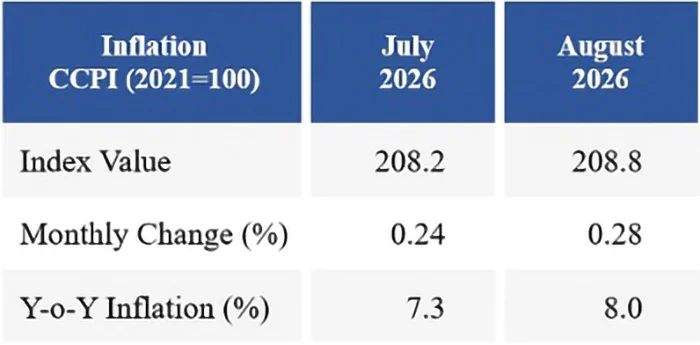
The Colombo Consumer Price Index (CCPI, 2021=100) based headline inflation (year-on-year, Y-o-Y) increased to 8.0% in August 2026 from 7.3% in July 2026, primarily due to the statistical base effect in food inflation. Meanwhile, food inflation (Y-o-Y) increased to 8.5% in August 2026 from 6.3% in July 2026, contributing mainly to the increase in headline inflation, while non-food inflation (Y-o-Y) decelerated to 7.7% in August 2026 from 7.8% in July 2026.
On a month-on-month basis, the CCPI increased by 0.28% in August 2026. This increase was mainly driven by the food category, which contributed 0.20 percentage point, largely owing to the increase in prices of Milk Powder, while the non-food category contributed a marginal 0.07 percentage point.
Meanwhile, core inflation (Y-o-Y) accelerated to 5.1% in August 2026 from 4.4% in July 2026.
According to the inflation projections made at the monetary policy round in July 2026, headline inflation is expected to remain above the target of 5% in the near term, before easing and stabilising around the target over the medium term, supported by appropriate policy measures. These projections are conditional, among other assumptions, on the expectation that the effects of the tensions in the Middle East and their spillovers will be temporary and gradually dissipate.

MoU signed for technology to prevent wild elephant-train collisions

Grade 5 scholarship exam results released

Prime Minister participates in Global Conscious Food Systems Summit in Bhutan

Bouchier century sets England up for record 282-run chase against Ireland

Muneeba, Pakistan’s spinners knock Thailand out of Asia Cup

Showers will occur in the Western and Sabaragamuwa provinces and in Galle, Matara, Kandy and Nuwara-Eliya districts

‘Dates have the highest sugar content to fight Coronavirus’

Sunday Island 27 December – Headlines

#SundayIsland 17th December – Headlines

Sunday Island – 28th March

Sunday Island Headlines – 21 March

Sunday Island – 21st February – Headlines
-

 News6 days ago
Eight politicians in drug kingpin probe
-

 Features4 days ago
“Wrap Me Up in My Blazer”— A Gentlemanly Bradby Reminiscence
-

 Business6 days ago
Sri Lanka opens up: A new season of direct connectivity
-

 Features6 days ago
Redefining ageing in Sri Lanka
-
 Latest News6 days ago
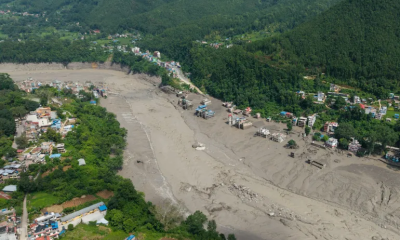
Nepal-Tibet floods: What happened, what caused them and who is missing?
-

 Features3 days ago
When Sri Lankan stories find their own voice
-

 Editorial7 days ago
Unfolding El Niño and burning issues
-

 Editorial6 days ago
The toxic legacy of two lakes