
Sports
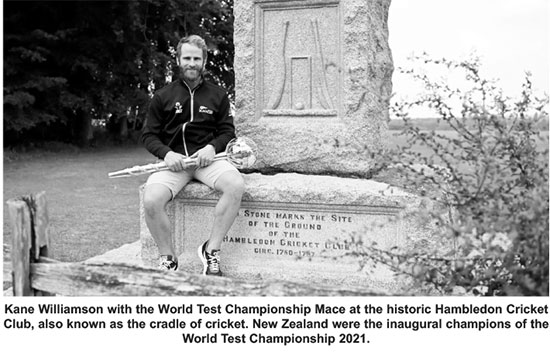
The Mace for Aotearoa

By Rajitha Ratwatte
Two years of Test matches to find the World Test Champions came down to a one-off six-day Test match in Hampshire. The English weather of course playing a part and everything down to the final session of play on the last day.
On a freezing cold winter day in Aotearoa, hunched over the TV, New Zealand needing 100 runs in the last session with the Baharat army in full voice, the drums pounding and New Zealand’s two most experienced batsmen at the crease.
Technically a sixth day wicket although less than four days have been played on it, slowing down, showing uneven bounce, and making shot playing difficult. Ravichandran Ashwin of India in the middle of a brilliant spell of spin bowling backed up solidly by Mohammed Shami. Even the experienced Sunil Gavaskar in the commentary box, rooting for India!
New Zealand with its five million people holds America’s Cup for sailing and is runners-up in the World Cup of Rugby and Cricket in the one-day format. Overachievers some may say and others say the opposite.
Small town boys can’t handle the pressure and choke at vital times is an assessment we have often heard. Kane Williamson the captain and the number two ranked Test batsman in the world in his bubble and fighting hard.
Ross Taylor the most senior batsman showing signs of panic at a minor collapse orchestrated by Ashwin and the resultant inability to get ahead of the run rate required. The best possible combination for NZ but notorious for running each other out under pressure!
Commentators speculating on a change in the batting order for the Kiwis with may be Colin De Grandhomme or even Tim Southee coming in early with a license to hit and break the back of this relatively small target.
A much-hackneyed phase but this is the ultimate form of the game and although it is scoffed at by younger and more populist sports reporters and others, Test cricket will never die in the hearts of the purists and true lovers of the game.
Virat Kohli the Indian skipper playing the crowd and chatting to his bowlers all the time. A marked opposite from the conduct of Ajinkya Rahane his deputy who did such an exceptional job in Australia.
The New Zealand public doesn’t rate cricket very high. It ranks way below rugby union of course and probably below rugby league and netball, with sailing also giving a good fight in the eyes of the sponsors.
India forced to rest the best bowlers and the advent of Ishant Sharma and Ravindra Jadeja to the attack resulted in a few runs and an eerie silence from the Bharat army.
Cheteshwar Pujara dropped Taylor off Jaspreet Bumrah, a sitter at first slip in the 20th over with 60 runs needed! Have theydropped the mace?
Drinks break before the last hour of the game and New Zealand were needing 35 runs in 15 overs to win with eight wickets in hand. Do the Gods of cricket and the “glorious uncertainties of the game” have any more surprises to deliver?
A flurry of runs off a Sharma over forced the Indian skipper to bring back his best bowlers. Williamson pulling Shami imperiously from outside off-stump for two, skipping down the track and driving Jadeja classically through the v and getting a little carried away with a wild swing that goes straight up in the air but eludes Bumrah.
Even Mr. Ice Cool is human after all. The small Kiwi contingent at the ground starts to believe and the chills of winter begin to get less depressing at home. Ross Taylor finishes it off with a regal front flick off his pads through the mid-wicket region to prove that sometimes the nice guys win!
supersubsports@gmail.com


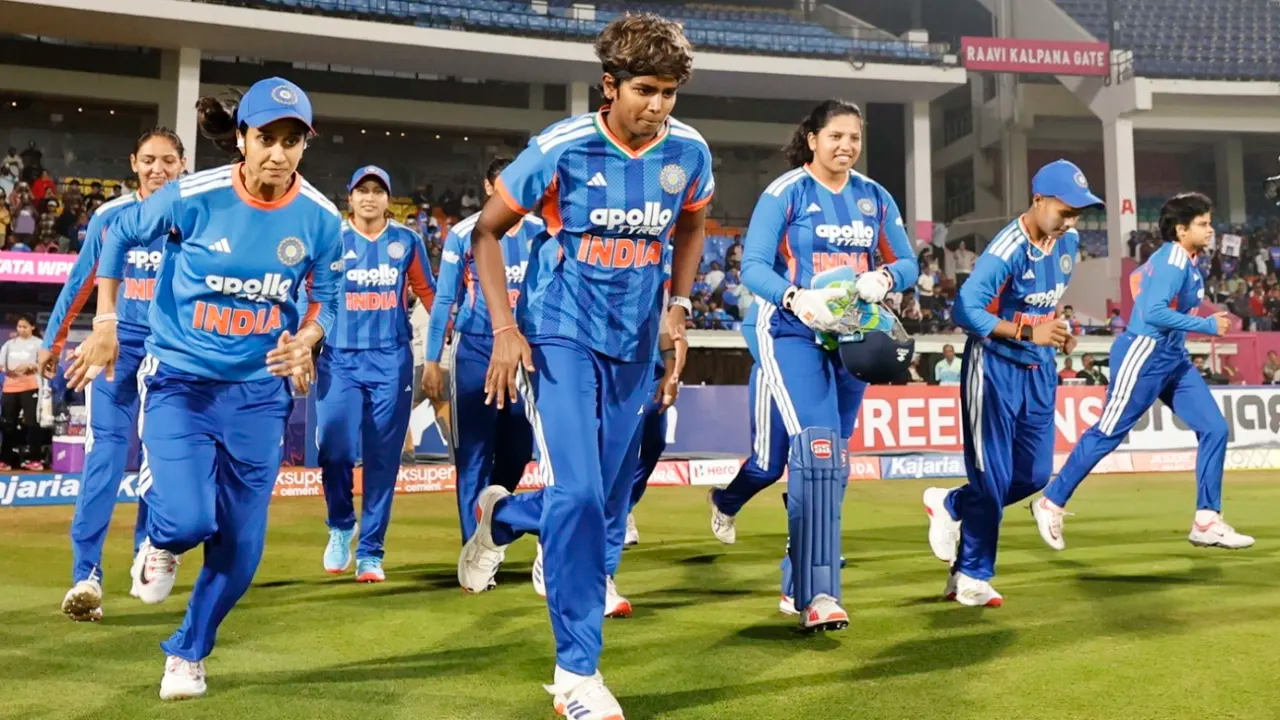
The inaugural six-team Women’s Champions Trophy has been moved from Sri Lanka to India, and will be played in Mumbai and Vadodara from February 14 to 28 next year.
The Brabourne Stadium and the Vadodara International Cricket Stadium will host the T20 tournament. Despite losing the hosting rights because of government interference in their cricket board, Sri Lanka will still be part of the tournament, having qualified after being in the top six of the T20I rankings on the July 6 qualification cut-off date. Australia, England, India, New Zealand and South Africa are the other teams.
According to a media release, the ICC assessed three candidates – Bangladesh, India and South Africa – against its established host evaluation criteria before recommending India as the replacement host on Wednesday.
The Brabourne Stadium hasn’t hosted an international game since December 2022, when India women hosted Australia for a T20I series. It hosted the first-ever season of the WPL in 2023 and also a few matches in 2025. Vadodara, meanwhile, has hosted WPL matches in 2025 and 2026.
The Champions Trophy was due to be Sri Lanka’s second ICC event in two years after they also co-hosted the 2026 men’s T20 World Cup with India. The six participating teams will compete in a round-robin league, with the top two sides advancing to the final on February 28.
The SLC is under interim administration, called the Transformation Committee, which was put in place by the Sri Lankan government and will oversee major board changes including those to its constitution. The ICC does not recognise politically appointed administrations and SLC representatives have not been at ICC board meetings since the Transformation Committee was put in place.
[Cricinfo]
by Rex Clementine
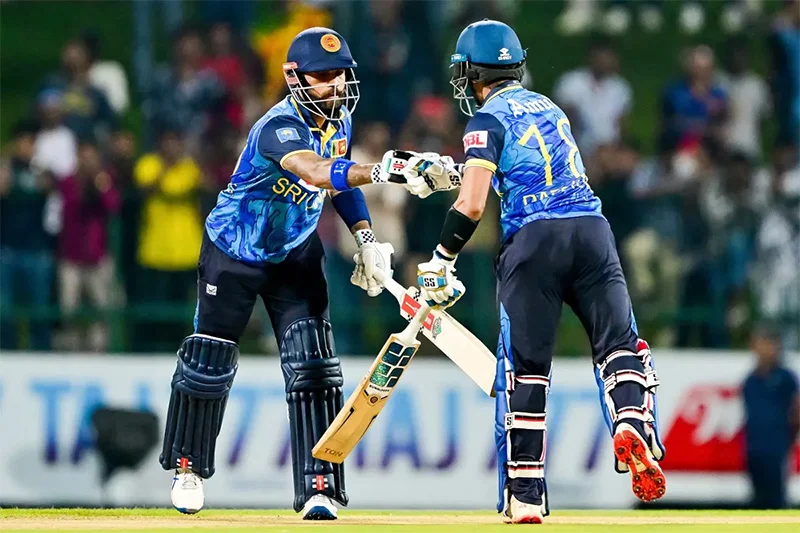
Prolific batsman Pathum Nissanka and white-ball captain Kusal Mendis are back in the fold after being named in Sri Lanka’s ODI and T20 squads for the six-match tour of England later this month.
Both Mendis and Nissanka missed the recent Test series against India through injury. Nissanka was recovering from wrist surgery, while Mendis suffered a hamstring injury during the LPL. It was the first major injury setback for the wicketkeeper batter, who has been a fixture in the Sri Lankan side for more than a decade.
Interestingly, Charith Asalanka has returned to the leadership group as vice-captain. Asalanka was stripped of the captaincy in both white ball formats earlier this year and subsequently fell out of favour with the selectors. His elevation suggests that the experiment of grooming Kamindu Mendis as the all-format vice-captain has, for the moment at least, been shelved.
There are, however, a few concerns heading into the tour. Kusal Mendis and Dushmantha Chameera have not featured in the ongoing domestic tournament, leaving them short of competitive cricket. Chameera’s lack of preparation will be particularly concerning given the fast bowler’s lengthy history of injuries. Pathum Nissanka did turn up for NCC though during this week’s T-20 competition but didn’t make an impact.
The inclusion of 28-year-old leg-spinner Sachindu Colombage in the ODI squad has also raised a few eyebrows.
While Sri Lanka’s T20 game remains a work in progress, their ODI fortunes have taken a significant turn for the better. The side has found consistency and made rapid strides, underlined by automatic qualification for next year’s World Cup in South Africa. It is a marked contrast to the build-up to the 2023 edition, when Sri Lanka were forced to travel to Zimbabwe and negotiate the qualifying tournament to earn their place at the World Cup.
Sri Lanka will begin the tour with the T20 series, with Southampton hosting the opener on September 15. The teams then travel to Cardiff and Manchester before the ODI leg gets underway at Chester-le-Street. Headingley will stage the second ODI, with the tour concluding at The Oval.
The Sri Lankan squad will leave for London on Saturday, September 5, giving them ten days to prepare for the six-match white-ball assignment.
ODI squad: Pathum Nissanka, Kamil Mishara, Kamindu Mendis, Charith Asalanka (vice-captain), Kusal Mendis (captain), Janith Liyanage, Pavan Rathnayake, Dasun Shanaka, Wanindu Hasaranga, Dunith Wellalage, Maheesh Theekshana, Sachindu Colombage, Dushmantha Chameera, Eshan Malinga, Asitha Fernando and Dilshan Madushanka.
T20 squad: Pathum Nissanka, Kamil Mishara, Lahiru Udara, Kusal Mendis (captain), Kamindu Mendis, Charith Asalanka (vice-captain), Janith Liyanage, Dasun Shanaka, Dunith Wellalage, Wanindu Hasaranga, Maheesh Theekshana, Tharindu Rathnayake, Dushmantha Chameera, Eshan Malinga, Nuwan Thushara and Binura Fernando.
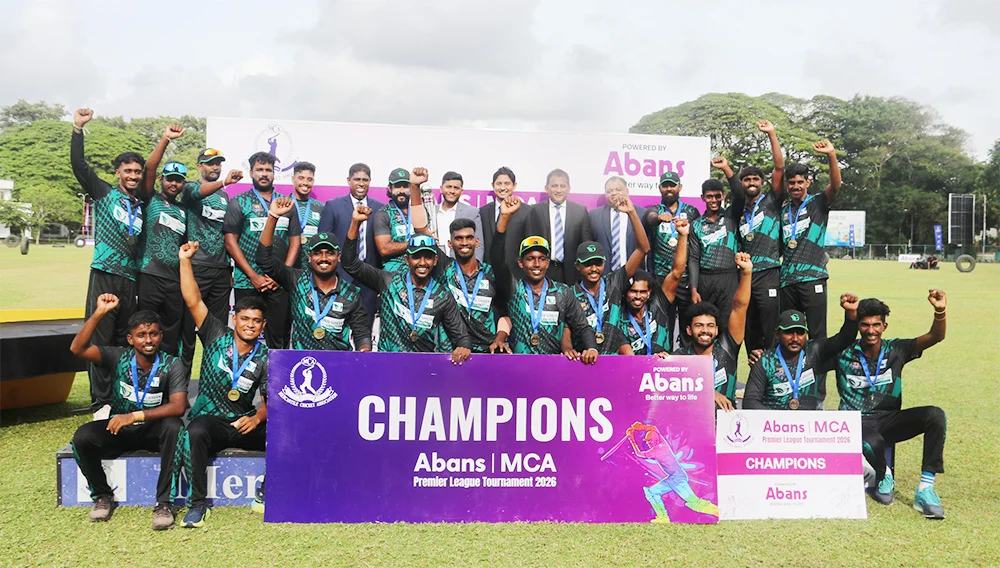
MCA – ABANS PREMIER LEAGUE 2026
A skipper’s innings of 70 runs off 89 balls by T M Sampath and a four fer by Hesham Madushanaka and two wickets by Upul Hettiarachchi helped new comers to the MCA cricket arena Golden Green Plantations defeat David Pieris Group of Companies by four wickets in the final of the MCA-Abans Premier League 2026 and become the first winners of the ‘Abans Challenge Trophy’.
Electing to bat first David Pieris Group of Companies were restricted to 147 runs in 39.3 overs. Santhush Gunathilake who opened innings topped the score card with a fluent 53 off 50 balls with seven fours and a six. Asitha Wanninayake chipped in with 31 off 59 balls. Heshan Madushanka captured four wickets for 11 runs.
Chasing 148 to win, skipper T M Sampath scored 70 runs off 89 balls with seven boundaries and two sixes before being stumped off the bowling of Dilanka Auwardt, with score on 122/5. Shammu Ashan and Mohamed Shamaz shared a 25 run partnership to equal the scores at 147/6 and Shammu Ashan scored the winning runs with a four.
The Golden Green Plantation Team led by T M Samapth comprised, Heshn Madushanka, Malith Mihiranga, Mohamed Shamaz, Randika Mihiranga, Upul Httiarachchi, Dhanuja Induwara, Gimadu Malkam, Sammu Ashan , Vikum Sanjaya and Johan Pathirana
With only four teams entering the prestigious MCA Premier Leaguethis year, DFCC Bank secured third spot having a slightly better run rate over Nawaloka Hospitals and were unlucky that the opportunity for securing a spot in the final was washed away as qualifier 2 was abandoned on two consuecutive days due to rain.
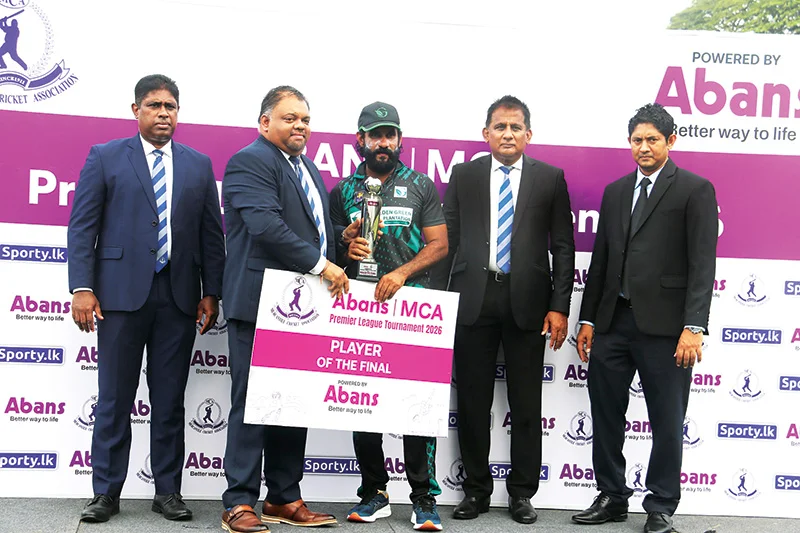
Player of the Final T M Sampath of Golden Green Plantations receives his trophy from Sajith Athapaththu Chairman of the MCA Social, Bar and Restaurant Committee
Special Awards:
Best fielder of the Final :
Dhanuja Induwara of Golden Green Plantations [3 catches and 1 runout]
Best bowler of the Final:
Heshan Madushanka of Golden Green Plantations [4 wickets for 11 runs]
Best batsman of the Final:
Santhush Gunathilake of David Pieris Group of Companies [53 runs off 50 balls]
Player of the Final ;
T M Sampath of Golden Green Plantations [70 runs and 1 wicket]
Best bowler of the Tournament:
Tharinda Nirmal of David Pieris Group of Companies [13 wickets in 4 innings]
Best batsman of the Tournament:
Pavan Pathiraja of DFCC Bank [267 runs in 4 innings]
Player of the Tournament:
Lahiru Samarakone of David Pieris Group of Companies [239runs and 4 wickets]
Scores:
David Pieris Group of Companies 147/10 in 39.1 overs [SanthushGunathilake 53, Asitha Wanninayake 31; Heshan Madushanka 4-11, Upul Hettiarachchi 2-19]
Golden Green Plantations 151/6 in 30.3 overs [T M Sampath 70; Dilanka Auwardt 2-35]

New Court of Appeal Judge Sajeewani Dilka Lakmali Sworn In

India to host inaugural Women’s Champions Trophy in February

Sun directly overhead Madampe, Thorayaya, Thotagamuwa, Rattota and Kalavanchikudy about 12.09 noon today (03)

Afternoon thundershowers in the Northern, North-central, Eastern and Uva provinces in next few days, starting from today (03).

22A: SC urged to suspend hearing, appoint full bench

Govt. seeks NATO assistance

‘Dates have the highest sugar content to fight Coronavirus’

Sunday Island 27 December – Headlines

#SundayIsland 17th December – Headlines

Sunday Island – 28th March

Sunday Island Headlines – 21 March

Sunday Island – 21st February – Headlines
-

 News7 days ago
Eight politicians in drug kingpin probe
-

 Features5 days ago
“Wrap Me Up in My Blazer”— A Gentlemanly Bradby Reminiscence
-

 Business7 days ago
Sri Lanka opens up: A new season of direct connectivity
-

 Features4 days ago
When Sri Lankan stories find their own voice
-

 Features7 days ago
Redefining ageing in Sri Lanka
-

 Editorial7 days ago
The toxic legacy of two lakes
-
 Business7 days ago
Jaffna Teaching Hospital secures lifeline water supply via ADB-funded Thalaiyadi sea water desalination plant
-
 Features5 days ago
JVP/NPP government as seen from outside by Lionel Bopage now domiciled in Australia