
Features
GMOA President Misleading the Public

Dr. Parakrama Waidyanatha
Dr Anurudha Padeniya, President of the GMOA in a LankaCNews presentation overwhelmed this writer with trepidation and fear. What is his mission in public fear-mongering?
The title of his talk (in Sinhala) was “Agrochemical which is a “mass-exterminator” kills ten times more than Corona”. He claims that while the Corona has killed 500 patients per year, the Rajarata Chronic Kidney Disease of Unknown etiology (CKDu) kills ten times more. Incidentally, the etiology of the kidney disease is now known, and the ‘u’ from the acronym, should be removed. He confidently claims that CKD is caused by agrochemicals. Regrettably, he appears to know neither the research nor the statistics on the subject.
 No evidence that the kidney disease is caused by agrochemicals
First, let me present a quick profile of the key research findings.
International Consultation on CKDu in Sri Lanka (2017) concluded that there was NO EVIDENCE that agrochemicals caused CKDu.
Dr. Padeniya is still in 2013, when a WHO study tentatively stated that CkDu patients secreted more trace amounts of cadmium, arsenic and some pesticide residues in their urine, compared to reference limits. However, the Report, for some unknown reason, did not reveal, as shown from subsequent analysis of the raw data, that there were two to four times more subjects in the non-CKD “control” area (Hambantota) with HIGHER cadmium, arsenic and pesticide levels than in the CKD area.
A dramatic study compared two adjacent villages in Girandurukotte, namely, “Badulupura”, on high ground where the people exclusively drank water from dug wells and Sarabhumi in the plain where the people drank water from the river, reservoir or wells dug close to their homes. The Baduluprua people contracted the disease, which affecting virtually none from Sarabhumi. Analysis of the water in the wells in the Badulupura and Sarabhumi revealed that the Badulupura water was hard and heavily contaminated with fluoride, a highly nephrotoxic chemical, while being FREE OF AGROCHEMICALS.
Further evidence for a role for fluoride in the disease is that CKD patients also often have dental fluorosis.
Several independent research groups also have shown that high fluoride and magnesium contents in the hard water of the wells (fed by regolith aquifers) were the causative agents of CKD.
Further, the Medical Faculty, University of Peradeniya and the Institute of Fundamental studies, showed that rats fed with fluoride containing hard water contracted the disease, but not those fed with tap water. This was independently confirmed by Dr. Thammitiyagoda et al using well water from an endemic area (Ceylon Medical Journal 2018).
 University of Tokyo studies on input water (2020) used in reverse-osmosis units in Ginnoruwa also confirmed the link to fluoride and magnesium, and the absence of agrochemicals in the water.
Meanwhile, Badulupura households were provided roof-top tanks for harvesting rainwater. Consequently, with the drinking of rain water, the incidence of CKDu in the village DECLINED over the years.
Now people in the CKDu affected areas are aware of the etiological agent and avoid drinking well water. With all this evidence deleting the ‘u’ from CKDu is justifiable’
Fertilizer and pesticide consumption
Displaying a copy of the “Dinamina”, Dr Padeniya uncritically claimed that Sri Lanka is the world’s highest consumer of agrochemicals as reported in that paper. Regrettably, He has rushed to the microphone without checking authentic sources.
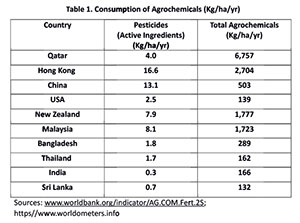
Table 1 gives the World Bank fertilizer and pesticide consumption figures of several countries which shows that Sri Lanka consumes the LEAST amount of agrochemicals in this part of the world, even below India. That is not all. As reported by the Department of Agriculture, from 2006, we have reduced the use of the most toxic, Class 1 and 2 pesticides by 98% and 29% respectively, and increased the least toxic ones of Class 3 and 4 by 91% and 41% respectively.
However, there is rampant overuse of agrochemicals resulting in the presence of phosphates and nitrogen in the runoff water. But, according to chemical analyses by Prof. Chandrajith et al., University of Peradeniya, no heavy metals above reference levels have been detected in the aquatic bodies, confirming the studies by University of Tokyo. So educating the farmers and misinformed “gurus” like Dr. Padeniya is needed. I have, in my The Island article, May 19, 2021, already dealt with the need to educate the farmers for which strengthening the drastically run down agricultural extension service is a critical need.
Returning to old food habits and traditional varieties
The good doctor is recommending a return to old food habits and traditional rice varieties which, he claims, are more nutritious and healthy — another claim unsubstantiated by appropriate research.
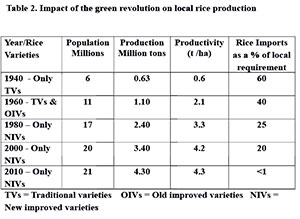
Together with Ven. Ratana and the ‘toxin-free agriculture’ group, during the Yahapalana regime, Dr. Padeniya claims planting traditional varieties (TVs) or rice which yield at best only 30-40% of that of the new improved varieties (NIVs); see Table 2. His claims that although low yielding, the TVs have high nutritious with health benefits. Sadly, he is not aware that, apart from very high yields some of the new varieties have much of those attributes. However, the staple food provides the calories, while the other nutrients are usually obtained from other foods.
If we go back to the TVs, as evident from Table 2, we need at least double the current extent of land under rice to feed the population. And where is the land? Norman Borlaug, Nobel Laureate and the Father of the Green Revolution, addressing the Nobel forum in 2000, reminded the environmentalists and other critics of the Green Revolution technologies, the likes of Dr Padeniya, that had the pre-green revolution of yields of the 1950s remained today the world would need three times more land to feed the population with far more disastrous environmental consequences than we have today with conventional farming.
Re-installing ‘sekkuvas’ in the villages for coconut oil production Another of Dr Padeni
ya’s half-baked recommendations is to make “pure” coconut oil using “sekkuwas” (stone mills worked by oxen), to stop palm oil consumption. Palm oil is the world’s number one vegetable oil with an over 40% global output; and over 50% inclusion in our food etc. It’s as safe as any other saturated fats, and many health benefits have been claimed for it. He is one of the key advisers to the government’s foolish move to ban palm oil and uproot existing oil palm cultivations. However, the palm oil import ban had to be lifted. No country has banned palm oil except Sri Lanka.
The ‘sekkuwa’ proposal is more “pie in the sky” than “going fully organic.” Besides, it carries the high risk of afflotoxin contamination. The villagers usually sun and air-dry the coconut kernel, thus inviting the fungus Aspergillus to produce afflotoxin. According to a Coconut Research Institute food expert, a ‘sekkuwa’ cannot be totally cleaned of bits of poonac, an ideal medium for Aspergillus growth.
Dr Padeniya often quotes the wise words of Hippocrates(460-370 BC), the father of medicine: ‘Let food be thy medicine and medicine be thy food’. And yet, Dr. Padeniya knows that even the “best” food cannot save the world from viral epidemics. Did he not get his vaccine shots? Even if food were the only issue, the massive and increasing global population and the limited land and water, make conventional agriculture the only viable approach, while ever correcting its weaknesses. Organic farming experts like Adrian Mueller agree that its two percent output can never be increased to feed the world. It was abandoned in the 1850s when, even then, it failed to provide food to the increasing population globally.
Dr. Padeniya says we have been eating poison since 1950, but our life expectancy has steadily increased since then. It is far more appropriate in the current context of global agriculture for him to preach the wise words of the father of pharmacology, Bombastus Paracelsus, rather than those of Hippocrates: ‘ All substances are poisons, there is nothing which is not a poison. It is the dosage that differentiates poison and remedy’. The farmers need to judiciously use agrochemicals. Then the poison becomes remedy.
He would also do well to remember the wise words of Lord Buddha: ‘Speak only when you feel that your words are better than your silence.’
Dr Parakrama Waidyanatha
https://dh-web.org/people/CV-PWaidya.pdf



It has become fashionable to criticise the US for its recent conduct toward Iran. This is not an attempt to defend or rationalise the US’s actions. Rather, it seeks to inject perspective into an increasingly a historical debate. What is often missing is institutional memory: An understanding of how the present international order was constructed and the conditions under which it emerged.
The “rules-based order” was forged in the aftermath of two catastrophic wars. Earlier efforts had faltered. Woodrow Wilson’s proposal for a League of Nations after World War I was rejected by the US Senate. Yet, it introduced a lasting premise: International order could be consciously designed, not left solely to shifting power balances. That premise returned after World War II. The Dumbarton Oaks process laid the groundwork for the UN, while Bretton Woods established the global financial architecture.
These frameworks shaped modern norms of security, finance, trade, and governance. The US played the central role in this design, providing leadership even as it engaged selectively- remaining outside certain frameworks while shaping others. This underscored a central reality: Power and principle have always coexisted uneasily within it.
This order most be understood against the destruction that preceded it. Industrial warfare, aerial bombardment, and weapons capable of unprecedented devastation reshaped both the ethics and limits of conflict. The post-war system emerged from this trauma, anchored in a fragile consensus of “never again”, even as authority remained concentrated among five powers.
The rise of China, the re-emergence of India, and the growing assertiveness of Russia and regional powers are reshaping the global balance. Technological disruption and renewed competition over energy and resources are transforming the nature of power. In this environment, some American strategists argue that the US risks strategic drift Iran, in this view, becomes more than a regional issue; it serves as a platform for signalling resolve – not only to Tehran, but to Beijing and beyond. Actions taken in one theatre are intended to shape perceptions of credibility across multiple fronts.
Recent actions suggest that while the US retains unmatched military reach, it has exercised a level of restraint. The avoidance of escalation into the most extreme forms of warfare indicates that certain thresholds in great-power conflict remain intact. If current trends persist-where power increasingly substitutes for principle — this won’t remain a uniquely American dilemma.
Other major powers may face similar choices. As capabilities expand, the temptation to act outside established norms may grow. What begins as a context-specific deviation can harden into accepted practice. This is the paradox of great power transition: What begins as an exception risk becoming a precedent The question now is whether existing systems are capable of renewal. Ad hoc frameworks may stabilise the present, but risk orphaning the future. Without a broader framework, they risk managing disorder rather than designing order. The Dumbarton Oaks process was a structured diplomatic effort shaped by competing visions and compromise. A contemporary equivalent would be more complex, reflecting a more diffuse distribution of power and lower levels of trust Such an effort must include the US, China, India, the EU, Russia, and other key powers.
India could serve as a credible convenor capable of bridging divides. Its position -engaged with multiple powers yet not formally aligned – gives it a degree of convening legitimacy. Nalanda-the world’s first university – offers an appropriate symbolic setting for such dialogue, evoking knowledge exchange across civilisations rather than competition among them.
Milinda Moragoda is a former cabinet minister and diplomat from Sri Lanka and founder of the Pathfinder Foundation, a strategic affairs think tank could be contacted atemail@milinda.org. This article was published in Hindustan Times on 2026.04.19)
By Milinda Moragoda

The combination of father and daughter, Shafi and Jana, as a duo, turned out to be a very rewarding experience, indeed, and now they have advanced to Section 8 – a high-energy, funk-driven, jazz-oriented live band, blending pop, rock, funk, country, and jazz.
Guitar wizard Shafi is a highly accomplished lead guitarist with extensive international experience, having performed across Germany, Australia, the Maldives, Canada, and multiple global destinations.

Shafi: Guitar wizard, at the helm of Section 8

Jana: Dynamic and captivating lead vocalist
He is best known as a lead guitarist of Wildfire, one of Sri Lanka’s most recognised bands, while Jana is a dynamic and captivating lead vocalist with over a decade of professional performing experience.
Jana’s musical journey started early, through choir, laying the foundation for her strong vocal control and confident stage presence.
Having also performed with various local bands, and collaborated with seasoned musicians, Jana has developed a versatile style that blends energy, emotion, and audience connection.
The father and daughter combination performed in the Maldives for two years and then returned home and formed Section 8, combining international stage experience with a sharp understanding of what it takes to move a crowd.
In fact, Shafi and Jana performed together, as a duo, for over seven years, including long-term overseas contracts, building a strong musical partnership and a deep understanding of international audiences and live entertainment standards.
Section 8 is relatively new to the scene – just two years old – but the outfit has already built a strong reputation, performing at private events, weddings, bars, and concerts.
The band is known for its adaptability, professionalism, and engaging stage presence, and consistently delivers a premium live entertainment experience, focused on energy, groove, and audience connection.
Section 8 is also a popular name across Sri Lanka’s live music circuit, regularly performing at venues such as Gatz, Jazzabel, Honey Beach, and The Main Sports Bar, as well as across the southern coast, including Hikkaduwa, Ahangama, Mirissa, and Galle.
What’s more, they performed two consecutive years at Petti Mirissa for their New Year’s gala, captivating international audiences present with high-energy performance, specially designed for large-scale celebrations.
With a strong following among international visitors, the band has become a standout act within the tourist entertainment scene, as well.
Their performances are tailored to diverse audiences, blending international hits with dance-driven sets, while also incorporating strong jazz influences that add depth, musicianship, and versatility to their sound.
The rest of the members of Section 8 are also extremely talented and experienced musicians:
Suresh – Drummer, with over 20 years of international experience.
Dimantha – Keyboardist, with global exposure across multiple countries.
Dilhara – Bassist and multi-instrumentalist, also a composer and producer, with technical expertise.

Rajiv Sebastian could be classified as an innovative performer.
Yes, he certainly has plenty of surprises up his sleeves and that’s what makes him extremely popular with his fans.
Rajiv & The Clan are now 35 years in the showbiz scene and Rajiv says he has plans to celebrate this special occasion … in a unique way!
According to Rajiv, the memories of Clarence, Neville, Baig, Rukmani, Wally and many more, in its original flavour, will be relived on 14th July.
“We will be celebrating our anniversary at the Grand Maitland (in front of the SSC playground) on 14th July, at 7.00pm, and you will feel the inspiration of an amazing night you’ve never seen before,” says Rajiv, adding that all the performers will be dressed up in the beautiful sixties attire, and use musical instruments never seen before.
In fact, Rajiv left for London, last week, and is scheduled to perform at four different venues, and at each venue his outfit is going to be different, he says, with the sarong being very much a part of the scene.

INS NIREEKSHAK makes port call in Colombo

Advisory for Severe Lightning issued to the Western, Sabaragamuwa, Central, North-western, North-central, Southern, Uva provinces, and Mannar, Vavuniya, Ampara, Batticaloa districts

US, Iran exchange threats as fragile ceasefire set to expire

Six Foreign Envoys Present Credentials to President Dissanayake

Tilak ends Mumbai Indian’s losing streak with 45-ball century

Showers or thundershowers will occur at most places of the island after 1.00 pm

‘Dates have the highest sugar content to fight Coronavirus’

Sunday Island 27 December – Headlines

#SundayIsland 17th December – Headlines

Sunday Island – 28th March

Sunday Island Headlines – 21 March

Sunday Island – 21st February – Headlines
-

 Business4 days ago
Harnessing nature’s wisdom: Experts highlight “Resist–Align” path to resilience
-

 News6 days ago
PNS TAIMUR & ASLAT set sail from Colombo
-

 News4 days ago
Gratiaen Trust announces longlist for the 33rd Annual Gratiaen Prize
-

 News23 hours ago
Rs 13 bn NDB fraud: Int’l forensic audit ordered
-

 News3 days ago
From Nuwara Eliya to Dubai: Isha Holdings markets Agri products abroad
-

 Opinion2 days ago
Shutting roof top solar panels – a crime
-
 News4 days ago
Heroin haul transported on 50-million-rupee contract
-

 Latest News5 days ago
Singapore Zoo’s first Sri Lankan leopard cubs make their public debut