
News
Senior UNPer Amaratunga says party did not deserve to be defeated

by Zacki Jabbar
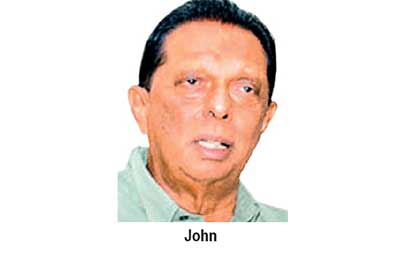
The UNP was a national party with sound policies and through the historic 19th Amendment to the Constitution strengthened democracy in the country, but was defeated in last week’s General Election, mainly because it had shun propogating racism as a means of capturing power, says senior UNPer and former Minister John Amaratunga.
Asked to analyse the UNP’s shocking electoral performance, Amaratunga said that the UNP did not deserve to be defeated in such a manner, considering the extent of work it had done whilst in government between 2015 and March this year, despite droughts, floods and the negative impact on the economy resulting from the April 2019 Easter Sunday suicide bomb explosions by the National Thowheed Jamaat, which had publicly enunciated its policies since 2005.
“Those who defected from the United National Party (UNP) to contest on the Samagi Jana Balawegaya (SJB) ticket, benefitted from the work, we as a UNP government led by Ranil Wickremesinghe did between 2015 and 2019, but the current UNP leadership was left with unfairly taking the blame for not preventing the Easter explosions, when the person who had the power to stop it, slept on the intelligence warnings received well in advance “, he noted, pointing out that the people had been provided substantial relief and public servants given a Rs.10,000 salary increase, despite having to repay the massive high interest commercial dollar loans that President Mahinda Rajapaksa had obtained between 2010 and 2014 – the majority of which were pumped into ego boosting projects that had turned out to be white elephants.
Amaratunga said that the UNP was a party that represented all races in the country and was identified with the birth of an Independent Sri Lanka. Such a grouping he stressed “cannot and will not unashamedly resort to racism to capture power”.
Asked about reports that among the 744,373 spoilt ballots at the General Election, was a sizeable number of UNP votes, due to UNPers being disappointed with the split in the party and not wanting to support either faction as a mark of protest, the seasoned politician said “Yes, that’s possible.”
Asked if the UNP would now opt for a new leader, Amaratunga said that Ranil Wickremesinghe was not keen on hanging on, but to desert the party at the present juncture would also not be advisable. “The future lies with the youth. So, the process of grooming them has to begin now. For that, the seniors have to remain at least in the short term “, he explained stressing that the UNP and the ” Elephant”, which rose majestically after the 1970 debacle to capture a five-sixth majority, would once again re-emerge as a strong force – as certain as the rising Sun in this transient world of politics.
Ameratunga hoped that the UNP and SJB would leave their insignificant differences aside and unite because their policies were similar and most importantly neither propagated racism as a means of capturing power.
Analysing the SJB’s electoral performance, he said it was cock-a-hoop, but in reality had helped the Podujana Peramuna obtain a two-thirds majority, which could have been prevented, if the SJB headed by Sajith Premadasa, had contested as a UNP-led alliance.
The veteran UNPer pointed out that the party winning the Presidential Election, had always gone on to win the Parliamentary polls that followed. “Sajith knew he cannot become the Prime Minister this time. So the next best thing he should have done was to ensure that the Rajapaksas did not get a majority that would enable them to reverse all the democratic gains achieved through the 19th Amendment to the Constitution. The SJB was meant to be a UNP – led alliance with Sajith as its Prime Ministerial candidate, but he made it his alliance and in the process divided the UNP.”
It was evident at the general election that political parties based on policies were overtaken by political movements, Amaratunga noted, warning that it could lead to an unstable political situation in the years to come.

Latest News
Landslide Early Warnings issued to the districts of Kalutara, Nuwara Eliya and Ratnapura


The Landslide Early Warning Centre of the National Building Research Organisation (NBRO) has issued early warnings to the Districts of Kalutara, Nuwara Eliya and Ratnapura from 1600hrs on 13th June 2026 till 1600hrs on 14th June 2026.
Accordingly,
LEVEL I (YELLOW) landslide early warnings have been issued to the Divisional Secretaries Divisions and surounding areas of Palindanuwara and Agalawatta in the Kalutara district, Ambagamuwa in the Nuwara Eliya and Ayagama, Pelmadulla,
Godakawela, Elapatha, Kalawana, Ratnapura and Nivithigala in the Ratnapura district.

The Indian Naval Ship (INS) ‘Sharda’ departed the island today (13 Jun 26), concluding her replenishment purposes.
On departure the vessel was accorded a traditional naval farewell by the Sri Lanka Navy at the Port of Colombo.
The visit also paved the way for vibrant personnel interactions, fostering camaraderie and goodwill. The crew of INS Sharda and personnel from the Sri Lanka Navy participated in a
friendly volleyball match and a joint yoga session. A
dditionally, Sri Lanka Navy personnel had the opportunity to visit the Indian naval vessel, while the visiting crew took time to explore several culturally significant landmarks across the island.
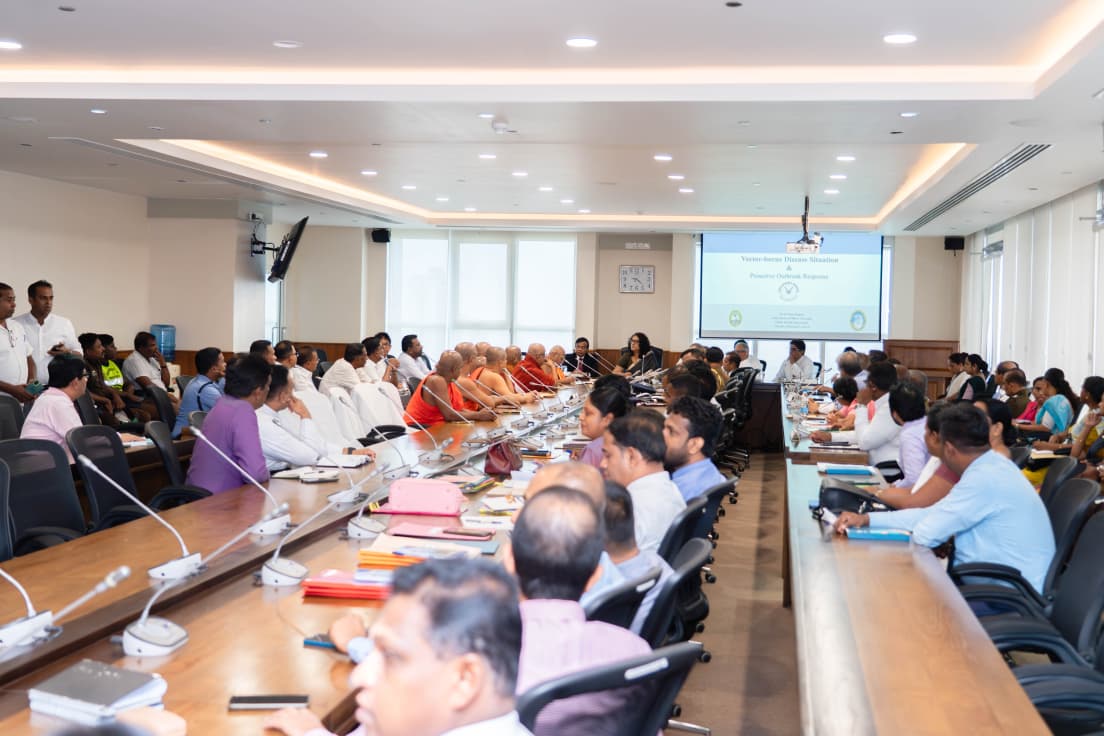
A decision has been taken to declare a Special Dengue Prevention Week from 15 to 21 of June by the Colombo District Dengue Control Committee to curb the spread of the disease in the Colombo District.
This decision was taken at the meeting of the Colombo District Dengue Control Committee held on Friday (12) at the Colombo District Secretariat under the patronage of Prime Minister Dr. Harini Amarasuriya.
Compared to last year, the number of dengue cases reported this year has increased significantly. According to the National Dengue Control Unit, approximately 39,100 dengue cases have been reported island wide to date, of which 25.8% have been recorded in the Colombo District. Following this situation, the Colombo District has been identified as a high-risk district.
Health authorities informed that the increasing spread of the disease has been influenced not only by the nature of circulating virus but also to the lack of sufficient immunity among the population. They further noted that the recent period of heavy rainfall has aggravated the spread of Dengue.
It was also identified that the current outbreak is being reported more frequently from public places such as government institutions, private establishments, schools, and religious venues rather than from residential premises. Observations have identified improperly managed solid waste and drainage systems in offices and other public locations as major breeding grounds for mosquitoes.
Accordingly, during the Dengue Prevention Week from 15 to 21 June, a series of measures will be implemented, including, organising community clean-up campaigns in government and private institutions, schools, residential areas, and other public spaces; Conducting inspections of high-risk premises by Divisional Secretariats and taking legal action, where necessary, followed by awareness programmes; Distributing informational leaflets, displaying banners, and carrying out public awareness campaigns through the media. Health authorities also requested school administrations not to involve students below Grade 10 in school cleaning programmes and to immediately notify the relevant Medical Officer of Health (MOH) office if a student is diagnosed with dengue.
The programme is expected to receive the active support and participation of the district’s political leadership, religious leaders of all faiths, public officials, local government institutions, the tri-forces, the police, and the general public.
The event was attended by the Chairperson of the District Coordination Committee, Members of Parliament, representatives of local government authorities, government secretaries, police officers, and officials representing the education and health sectors, among others.
[Prime Minister’s Media Division]

Mismatch in batting firepower could dictate the outcome again

Landslide Early Warnings issued to the districts of Kalutara, Nuwara Eliya and Ratnapura

INS Sharda departs Colombo concluding replenishment visit

Special Dengue Prevention Week declared in Colombo District from June 15 to 21

The leader of the indigenous Vedda community Uru Warige Wannila Aththo Meets Prime Minister Dr. Harini Amarasuriya

SpaceX IPO debuts in US markets, Musk becomes world’s first trillionaire

‘Dates have the highest sugar content to fight Coronavirus’

Sunday Island 27 December – Headlines

#SundayIsland 17th December – Headlines

Sunday Island – 28th March

Sunday Island Headlines – 21 March

Sunday Island – 21st February – Headlines
-

 News7 days ago
Women’s T20 World Cup 2026 warm-up: Chamari Athapaththu’s 94 helps Sri Lanka beat Pakistan
-

 News7 days ago
Lankan-Canadian inducted to Toronto Sports Hall of Fame
-

 Editorial6 days ago
Probe Sallay’s complaint
-
 News4 days ago
Local firms move millions of dollars overseas for phantom imports: Govt.
-
 News2 days ago
CIABOC summons Yoshitha over his participation in British Navy training programme
-

 Editorial7 days ago
Prez in the dock
-

 Features7 days ago
Entering MIT for my Ph.D program, coping with harsh Boston winter and breasting the tape
-
 Midweek Review4 days ago
July 09: An inexcusable overall security failure and exceptional contingency plan