
News
Chagie picks holes in controversial US resolution

Flabbergasted by LTTE being rechristened as ‘independence group’
By Shamindra Ferdinando
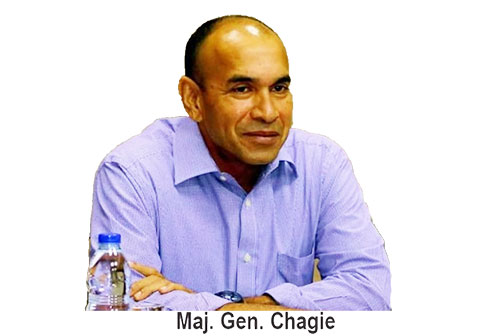
Retired infantry Maj. Gen. Chagie Gallage says the recent US declaration that some sections of traditional Tamil homeland remains so militarized 12 years after the war with ‘up to one soldier for every two civilians in the most war affected regions,’ underscored Sri Lanka’s daunting challenge in countering the high profile propaganda.
The Gajaba veteran insists even during the height of the war there had never been such intense deployment. Over the years, the scale of deployment has been reduced and forces deployed only to meet present-day requirements, he said.
Having served the Army for over three decades in frontline combat roles, military strategist Gallage retired in late August 2018-two years after Australia declined to issue him a visa over unsubstantiated war crimes accusations.
Referring to a resolution dated May 18, 2021 (H.Res.413) moved in the US House of Representatives, Gen. Gallage said that the LTTE had been recognized as a Tamil independence organization in spite of it still being on a list of organizations proscribed by the US, accepted traditional Tamil homeland claim and also acknowledged a merged northeastern region. Gen. Gallage pointed out that the US showed its bias against Sri Lanka by calling predominantly Tamil speaking Northern and Eastern Provinces as ‘historically oppressed northeastern region.’
Obviously, the submission of the House of Representatives resolution that has been subsequently referred to the House Foreign Relations Committee coincided with the 12th anniversary of the end of war was meant to cause further rifts, Gen. Gallage said.
Asked whether the government was taking steps to set the record straight, Foreign Secretary Admiral (retd) Jayanath Colombage said that the Foreign Ministry was in the process of addressing the issue at hand.
Gen. Gallage dismissed much repeated public assertion the US policy had been influenced by the Tamil Diaspora. The outspoken retired officer said that the latest US resolution should be carefully examined against the backdrop of Sri Lanka-China partnership culminating with the Colombo Port City Economic Commission as well as collapsing of talks on MCC (Millennium Challenge Corporation) Compact and SOFA (Status of Forces Agreement) though ACSA (Access and Cross-Servicing Agreement) finalized in Aug 2017 remains intact.
The combat veteran questioned the rationale in the US grouping the LTTE among what the House of Representatives called ‘various armed Tamil independence organizations.’ An irate much decorated infantry officer emphasized that those terrorist groups formed by India in the 80s had been devilishly called independence groups. The US obviously disregarded the well-known fact that except the LTTE, all other groups gave up arms in terms of the Indo-Lanka Accord of July 1987 and entered parliament in 1989 during the tenure of President Ranasinghe Premadasa. Gen. Gallage said that the LTTE couldn’t be under any circumstances promoted as an organization that fought for Tamil independence.
When The Island pointed out that the US resolution strongly criticized Sri Lanka for not repealing the longstanding Prevention of Terrorism Act (PTA) having recently adopted a bipartisan Domestic Terrorism Prevention Act (DTPA) of 2021 to investigate acts of domestic terrorism, Gen. Gallage said the US acted swiftly after the US Department of Justice underscored the need for domestic anti-terrorism law in the wake of the January 6 Capitol attack. There couldn’t be a better example than that to highlight the absurdity of the US stand on the PTA introduced by President JRJ to fight those who have now been rechristened by the US as Tamil independence groups.
Gen. Gallage found fault with the US resolution for not making reference to the origins of terrorism in Sri Lanka. He said that the US needlessly faults Sri Lanka for the deployment of the armed forces to control rampaging Covid-19 epidemic. Did they at least bother to check the actual ground situation here? General asked, pointing out that the armed forces rendered a yeoman service in support of the health sector.
The bottom line is that the civilian establishment and the police couldn’t have coped up with Covid-19 challenge without the combined security forces backing, Gen. Gallage said.
Responding to another query, Gen. Gallage alleged that the US seemed to have quite conveniently forgotten how its wartime Defence Attache Lt. Col. Lawrence Smith cleared Sri Lanka of bogus war crimes accusations at the first Colombo Defence Seminar held in May-June 2011, two years after the successful conclusion of the war. Gen. Gallage, who had been present on that occasion recalled how an embarrassed US State Department claimed that their man hadn’t been there in an official capacity. Thanks to Lord Naseby’s disclosure in the House of Lords in Oct 2017, now the entire world knows Lt. Col. Smith’s British counterpart, Lt. Col. Anthony Gash, who had been in Colombo during the war, too, denied unsubstantiated war crimes accusations.
Gen. Gallage said that having backed war winning Army Chief the then Gen. Sarath Fonseka at the 2010 presidential election, the US now expressed concern over elevation of persons alleged to have implicated in war crimes to senior government positions.
Appreciating the US backing for eradication of the LTTE, Gen. Gallage said that the Super Power accelerated the demise of their conventional military capacity by providing specific intelligence that led to the sinking of four ships carrying millions of dollars’ worth of armaments in the high seas.
Gen. Gallage said that the US should take note of the 2011 UN recommendation (Panel of Experts report) that prevented proper investigation for a 20-year period. The undeniable truth was the accusation of 40,000 civilian deaths (Panel of Experts report/paragraph 137) hadn’t been investigated yet, Gen. Gallage said. But that didn’t prevent UN High Commissioner for Human Rights issuing a report in 2015 (the
OISL Report) that outlined the occurrence of war crimes and crimes against humanity and violations of international humanitarian law during the war in Sri Lanka.
Gen. Gallage urged the political leadership to take tangible measures to counter the continuing politically motivated anti-Sri Lanka campaign. The Gen. said that it was the responsibility of the parties represented in parliament to address the latest attack also taking into consideration Canada recognizing the genocide of Tamils and the display of LTTE flag in the UK Parliament Square. The retired soldier pointed out that in spite of the eradication of the LTTE’s conventional military power, the separatist agenda was alive in foreign parliaments as well as our own. Gallage said so referring to a group of lawmakers in current parliament seeking UN intervention to set up an international war crime probe. Those who wrote that letter had ignored the fact that the TNA recognized the LTTE as the sole representative of the Tamil speaking people in 2001. That status remained until the Army shot and killed Prabhakaran on the banks of the Nanthikadal lagoon, Gen. Gallage said.

The National Business Facilitation Centre (NBFC), which is being established under the Presidential Secretariat with the aim of removing administrative and regulatory barriers that exist among government institutions in relation to investment and industry and expediting these processes, will be opened tomorrow (22).
The centre is being established on the President’s initiative with the aim of bringing about a positive transformation in the industrial sector. The centre will provide solutions to issues that arise in dealing with the government machinery when starting and operating a business, while also coordinating with the relevant government institutions to provide the necessary facilities.
The “ViYASA” National Business Facilitation Centre (NBFC) has been established at Building C-80, Hector Kobbekaduwa Mawatha, Colombo 07, and is headed by Senior Additional( Secretary to the President, Seevali Arukgoda.
The centre will be opened under the patronage of Minister of Labour and Deputy Minister of Finance and Planning Dr Anil Jayantha Fernando and Minister of Industry and Entrepreneurship Development Sunil Handunnetti, with the participation of Secretary to the President Dr Nandika Sanath Kumanayake.
The website https://nbfc.presidentsoffice.gov.lk is also scheduled to be officially launched on the occasion.
President’s Media Division)
Latest News
Court of Appeal Judge M. Sri Mevan Anthony Edirimannasuriya Corea appointed as Acting President of the Court of Appeal

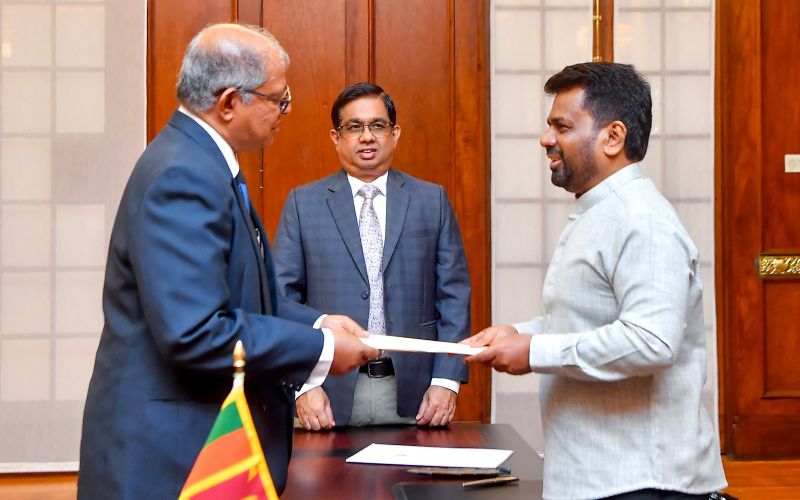
President Anura Kumara Dissanayake has appointed Court of Appeal Judge Mayadunna Sri Mevan Anthony Edirimannasuriya Corea as the Acting President of the Court of Appeal.
The appointment has been made as President’s Counsel Nalin Rohantha Abeysuriya, who currently serves as President of the Court of Appeal, will be overseas until the 24th.
Accordingly Judge Mayadunna Corea was sworn in as Acting President of the Court of Appeal before President Anura Kumara Dissanayake at the Presidential secretariat this morning (21).
Secretary to the President Dr Nandika Sanath Kumanayake was also present at the occasion.
(President’s Media Division)
Latest News
President instructs expediting further measures concerning Sivarasa Anojan, sentenced to death in Saudi Arabia
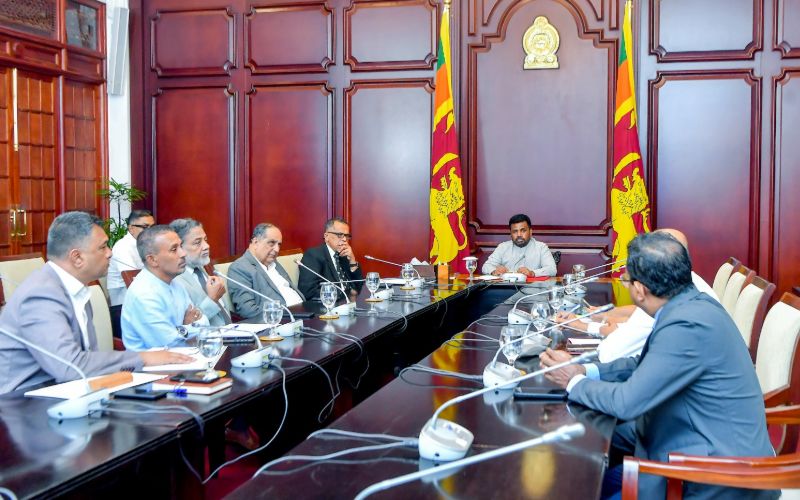
A discussion to review the further measures that could be taken regarding Sivarasa Anojan, a young Sri Lankan national who has been sentenced to death in Saudi Arabia, was held at the Presidential Secretariat this afternoon (21), under the patronage of President Anura Kumara Dissanayake.
The discussion focused on the measures taken to date concerning Sivaraasa Anojan and the further diplomatic and legal steps that could be pursued. Attention was also given to expediting the necessary further measures that could be taken to secure his release.
President Anura Kumara Dissanayake instructed officials to continue the necessary diplomatic engagement with the relevant authorities in Saudi Arabia and to maintain close and continuous involvement in all further measures concerning the case.
Reaffirming the Government’s continued attention to the safety and welfare of Sri Lankans living and working overseas, the President also stressed the need for the relevant ministries and institutions to work in close coordination and pursue all possible measures that could be taken in connection with the case.
Deputy Speaker Rizvie Salih, Deputy Minister of Religious and Cultural Affairs Muneer Mulaffer, Governor of the Western Province Hanif Yusoof, Secretary – Ministry of Foreign Affairs, Foreign Employment and Tourism Aruni Ranaraja, Secretary to the Ministry of Defence Air Vice Marshal Sampath Thuyacontha (Retd), Attorney General Parinda Ranasinghe and officials of the Ministry of Foreign Affairs, Foreign Employment and Tourism were also present at the discussion.
(President’s Media Division)

“ViYASA” National Business Facilitation Centre (NBFC) to be opened tomorrow (22)

Court of Appeal Judge M. Sri Mevan Anthony Edirimannasuriya Corea appointed as Acting President of the Court of Appeal

President instructs expediting further measures concerning Sivarasa Anojan, sentenced to death in Saudi Arabia

It’s Shafali vs Athapaththu as Sri Lanka seek to stop India juggernaut

Trophy row unlikely to repeat in Japan

Powerful explosions at Syrian army site near Aleppo injure at least four

‘Dates have the highest sugar content to fight Coronavirus’

Sunday Island 27 December – Headlines

#SundayIsland 17th December – Headlines

Sunday Island – 28th March

Sunday Island Headlines – 21 March

Sunday Island – 21st February – Headlines
-

 News5 days ago
US embassy won’t comment on IGP’s probe into joint drug raid
-

 News4 days ago
Bid for Basil’s extradition nears final stage: Police
-

 News3 days ago
Shanakiyan urges urgent action over reported death sentence for Lankan in Saudi Arabia
-

 Features7 days ago
The emptying university: why are academics leaving?
-

 Business5 days ago
All-new Bolero MaXX unveiled in Sri Lanka
-
 Opinion7 days ago
Who committed genocide and created mass graves in Sri Lanka?
-

 News2 days ago
Namal Rajapaksa Buddhist gambit fails, bail denied
-

 Opinion5 days ago
A journalist who wrote across the divide