
News
GMOA declares inoculation of family members received necessary approval


… questions journalists’ integrity and exploitation of frequencies
By Shamindra Ferdinando
The Government Medical Officers Association (GMOA) says the inoculation of the family members of doctors against the fast spreading Covid-19 pandemic was done with government approval. The GMOA said so at a media briefing on Tuesday (25) attended by its Secretary Dr. Senal Fernando, Assistant Secretary Dr. Naveen De Zoysa, General Committee member Prasad Kolombage and Media Committee member Dr. Hansamal Weerasuriya at their trade union office.
When the media sought an explanation as to why and how family members of doctors had been given priority in receiving the second dose of Oxford AstraZeneca vaccine, Dr. De Zoysa said that families of nurses as well as other health workers, too, had received the same vaccine.
Dr. De Zoysa emphasised that family members of doctors weren’t the only group benefited by the ongoing vaccination programme. The GMOA Assistant Secretary was referring to the programme launched on Monday (24) to vaccinate families of doctors and others in the health sector.
Dr. De Zoysa said that those who had received the first Oxford AstraZeneca jab four and and a half months ago had been given booster doses. Responding to another query, Dr. De Zoysa said that the inoculation programme had been carried out with all necessary approvals and an investigation could be conducted in that regard.
The GMOA Spokesperson faulted the media for pursuing an agenda seriously inimical to the overall effort to bring the situation under control. At the onset of the question and answer session, Dr. De Zoysa alleged that a section of the media raised issues in a manner that gave the wrong impression to the public.
Pointing out that the reportage of the issues at hand related to the Covid-19 situation undermined their efforts, Dr. De Zoysa said all segments of the society, including the media, were at risk. The GMOA official told the journalist who raised the issue that he, too, was in danger due to the rampaging Covid-19 virus.
At the onset of the briefing, Dr. Zoysa warned of dire consequences if the two-week long travel restrictions, imposed till June 7 failed to produce the desired results. Underscoring their role in the overall efforts to convince the government to declare a two-week closure of the country, Dr. De Zoysa said that a section of the media seemed hell-bent on sabotaging ongoing efforts.
Dr. De Zoysa reminded television channels frequencies that had been allocated to them belonged to the people therefore they couldn’t cause turmoil at the time of what he called a national calamity.
Responding to another query over the continuing controversy over doctors’ families being given special status, Dr. De Zoysa asked the media whether the GMOA objected to journalists being given vaccines ahead of others?
Dr. De Zoysa questioned the attitude of the media and how they approached the issue at a time politicians and others were criticised. Asserting that a section of the media had been utterly irresponsible and in some instances sought financial benefit at the expense of much needed stability, Dr. Zoysa emphasised that he was prepared to answer any question. The GMOA official revealed that one of his media contacts, who had showed some symptoms of Covid-19 in spite of being repeatedly advised by him to seek treatment, stayed at home.
Alleging that how those who advised the country responded to the life threatening situation, Dr. De Zoysa said that the journalist was tested positive for Covid-19 on Tuesday. Dr. De Zoysa said that there was another journalist at the media briefing who caused trouble and acted in a manner that undermined their anti-Corona project.
Dr. De Zoysa said that the GMOA strongly believed that the entire population should be inoculated. The media could discuss disputed matters some other time but the immediate requirement was to educate the public of ways and means to meet the daunting Covid-19 challenge.
Dr. De Zoysa said that he would be able to reveal the identities of those trade union leaders who received the vaccination along with their families as well as activists assigned to offices. The GMOA official in no uncertain terms questioned the honesty and the integrity of the media and their institutions. The GMOA spokesperson said that some of those causing mayhem over the vaccination of doctors’ families hadn’t at least prepared lists necessary to carry out such a project.
Addressing the media on Monday (24), Dr. De Zoysa said that the plan to inoculate their family members were taken at a much higher level and some persons in the health administration could be unaware of the development.

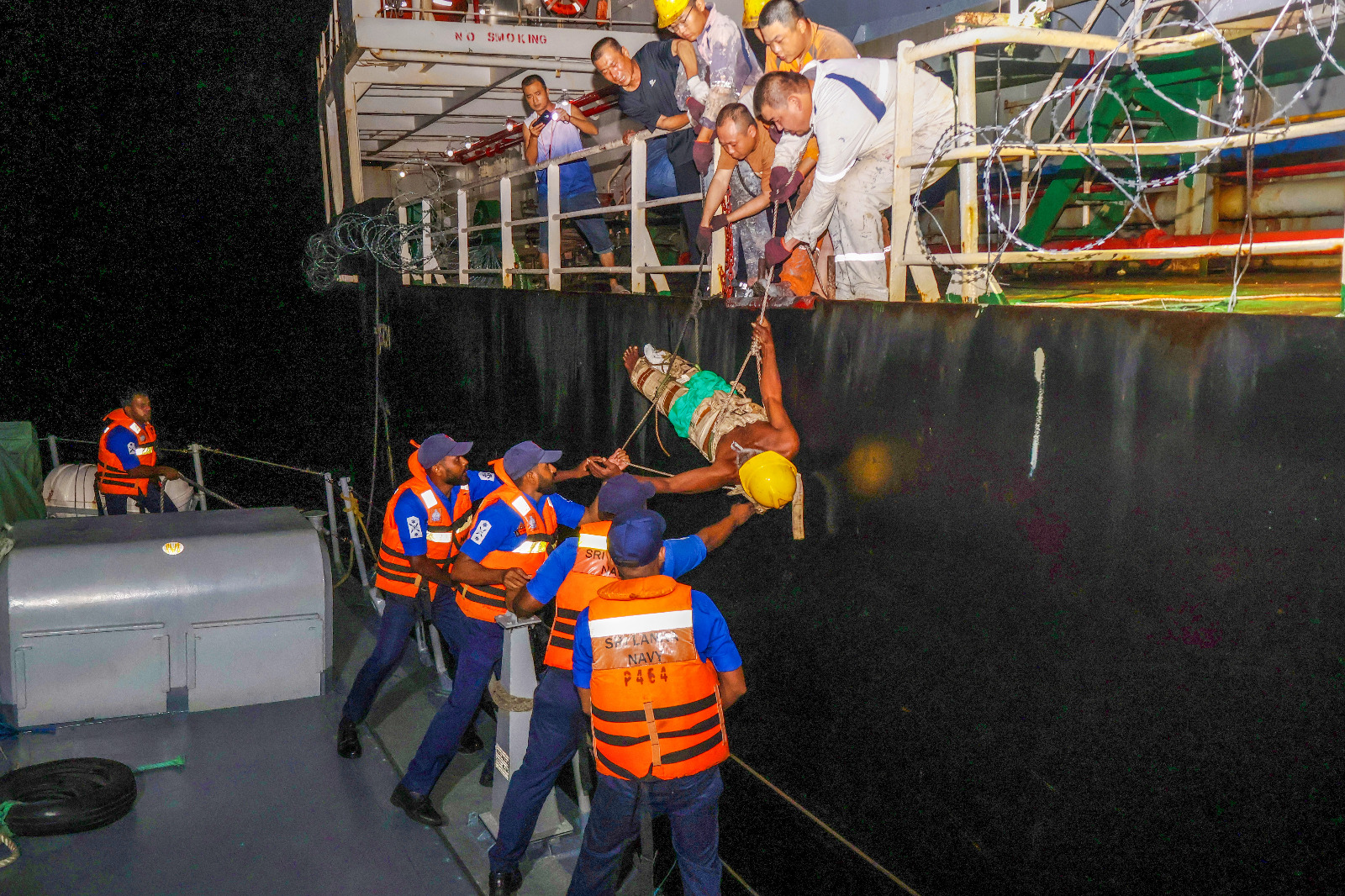
The Sri Lanka Navy demonstrated its commitment to maritime safety by assisting to bring ashore an injured fisherman and rushing him for urgent medical attention on Thursday (28 May 2026)
The fisherman was aboard a local multiday fishing trawler off the south coast and the Maritime Rescue Coordination Centre (MRCC) Colombo coordinated the retrieval of the fisherman.
Reportedly, the multi-day fishing trawler had departed from the Kudawella Fisheries Harbour on 05th May with 06 fishermen. While engaged in fishing activities approximately 730 nautical miles off the south coast, one of the crew members suffered an injury.
Following a formal request for assistance, through MRCC Colombo, the Merchant Vessel ‘Dong Fang Wei Ye’ sailing in the nearby sea area had been informed to retrieve the patient. In a rapid response, the Navy dispatched a craft attached to the Southern Naval Command to the designated sea area where the Merchant Vessel was stationed to transfer the fisherman.
Upon transferring the injured fisherman from the Merchant Vessel, naval personnel provided essential first aid to the injured person before swiftly bringing him to the Galle Harbour And safely transferred him to the National Hospital, Galle.
News
Applications called to recruit 400 public officers as Digital Champions for the Public Impact Champions Network

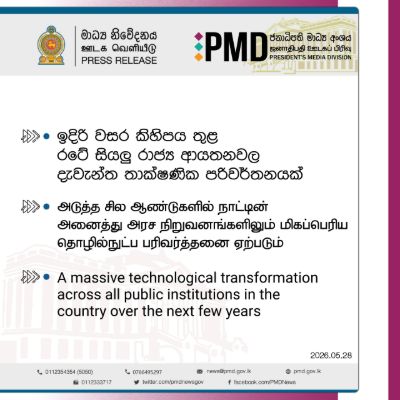
As a key component of the Government’s Digital Economy Plan aimed at enhancing the quality and efficiency of the public sector system, an awareness programme for coordinating executive officers of public institutions was held on Wednesday (27) at the Information and Communication Technology Agency of Sri Lanka (ICTA). The programme marked the first step towards establishing the “Public Impact Champions Network” (PIC-NET), an institutional pilot network intended to drive the optimisation of public services through the digitalisation of public institutions.
During the programme, heads of institutions were informed to submit applications from officers currently serving in public institutions who possess the capability and capacity to represent the “Champions Corps” in spearheading digital transformation, in accordance with Circular PS/ADA/Circular/3/2026.
Chairman of the Information and Communication Technology Agency of Sri Lanka and Senior Adviser to the President on the Digital Economy, Dr. Hans Wijayasuriya, stated that the Government aims to increase Sri Lanka’s digitally empowered economy from its current level of 3% to 12% by 2030.
He further explained that the development of the digital economy is a process aimed at improving efficiency, quality and revenue generation through the use of communication technology in economic activities.
Pointing out how the digital economy has expanded in every developed state, Dr Hans Wijayasuriya noted that the slow growth of the digital economy remains a serious challenge faced by Third World countries. However, he stated that India is currently achieving remarkable progress in digital economic development and that elevating Sri Lanka’s digital economy to a prominent level alongside such developments is one of the Government’s principal objectives.
Dr Hans Wijayasuriya also pointed out that this digital economic growth must take place simultaneously across nearly all public institutions. Accordingly, within the next three years, the coordination and management of transactions among public institutions are expected to function in a fully networked manner similar to banking operations.
He further emphasised that the support of both public institutions and the country’s citizens as a whole would be crucial for the successful implementation of this extensive technological transformation across all public institutions over the next few years.
Ranil Peiris of the Department of Information Technology at the University of Sri Jayewardenepura briefed those present on the foundation of the PIC-NET programme and its future plans.
He explained that, in the future, citizens would be able to access services such as applying for passports and renewing licences entirely online from their homes. He further pointed out that this system would eliminate the need for citizens to repeatedly provide the same information.
Representatives of KPMG also presented the future action plan relating to the selection and training of officers.
Representing the Presidential Secretariat, Sameera Wickremasinghe further briefed participants on the mechanism for calling applications.
The necessary guidance and coordination support for this public sector digitalisation programme are being provided with the support of the Presidential Secretariat, the Ministry of Digital Economy, GovTech Sri Lanka and the Asian Development Bank.
(PMD)

India’s top anti-crime agency has arrested the mother-in-law of an Indian woman whose death has sparked conflicting claims of murder and suicide.
Twisha Sharma’s parents and siblings have alleged that she was tortured by her lawyer husband, Samarth Singh, and his mother – retired judge Giribala Singh – over dowry demands and that she was murdered, allegations they have denied.
The 33-year-old model and actor had been married for just five months when she was found dead in her matrimonial home in Madhya Pradesh state’s Bhopal city on 12 May.
On Thursday, the Central Bureau of Investigation (CBI) arrested Giribala Singh after questioning her for several hours.
The Madhya Pradesh High Court had earlier cancelled her anticipatory bail, finding that a trial court had ignored key evidence and witness testimony.
Following Twisha’s death, the police had registered a case of dowry death against the Singhs. Earlier this week, the investigation was taken over by the CBI.
Twisha’s death has made national headlines and has once against brought the issue of dowry deaths into the spotlight. Every year, thousands of women are murdered for bringing in insufficient dowries, even though the practice was banned in 1961.
The case has drawn significant attention because of the family’s prominence. Twisha was a former beauty pageant winner and actor, while her husband and mother-in-law were lawyers.
Twisha’s parents allege that dowry-related harassment began soon after her marriage to Singh. They also claim that when she became pregnant, Singh and his mother accused her of infidelity and forced her to terminate the pregnancy.
The Singhs deny the allegations, saying Twisha had mental health issues and took her own life. They also contend that the decision to terminate the pregnancy was hers.
Singh is currently in police custody. He had reportedly absconded after Twisha’s death and was arrested by police in Jabalpur on 22 May.
Twisha was cremated on Sunday after a second autopsy. Her family had alleged that the first post-mortem was flawed and accused the police of a cover-up, a charge the police denied.
[BBC]

Tickner five-for wraps up innings win for New Zealand

Ambidextrous spinner Shashini Gimhani in Sri Lanka’s T20 World Cup squad

Pakistan’s famous cheerleader ‘Chacha Cricket’ to retire this year

South Africa Women’s maiden tour to Zimbabwe to feature five T20Is

Navy renders assistance to bring injured fisherman ashore

Applications called to recruit 400 public officers as Digital Champions for the Public Impact Champions Network

‘Dates have the highest sugar content to fight Coronavirus’

Sunday Island 27 December – Headlines

#SundayIsland 17th December – Headlines

Sunday Island – 28th March

Sunday Island Headlines – 21 March

Sunday Island – 21st February – Headlines
-

 News6 days ago
All-New GRAVITE launches at LKR 6.99 Mn
-
 Features6 days ago
The NPP’s pivot to the past
-
 News5 days ago
Police probe underway to ascertain links between criminals deported from UAE and local politicians
-
 News4 days ago
Easter Sunday carnage: Court told Maulana’s statement cannot be accepted without cross-examination
-
 Features6 days ago
End of Peacekeeping
-
 Opinion4 days ago
Undermining the democratic political framework
-
 News4 days ago
UK passport holder hiding here wants to have deportation order rescinded to leave without blemish
-
 News5 days ago
Dickoya double murder suspect arrested