
Business
Import ban on inorganic fertilizers and its effects on the tea industry


by Devaka Dias
1. Vegetatively Propagated Teas are CLONAL HYBRIDS which requires high and correct nitrogen ratios to reach its potential yield of over 3,000 kg per hectare made tea per annum.
2. The required norm is 10 kg nitrogen for every 100 kg of made tea. If soil carbon ratios are good at 7% organic matter in the soil, improving the cation exchange (ability of soils to hold nutrients) capacity, it is possible to reduce the N ratio from 10 N to seven N per 100 kg made tea. However, timing and the method of application is very important to derive absolute benefit.
3. Most soil where tea is grown in Sri Lanka is eroded and the organic matter in the soil is so poor that the tea is fertilizer dependent.
4. A field yielding 3,000 kg of made tea per hectare will require 300 kg N. Less if the soil carbon is good. The N per one ton of compost is believed to be low at 1.5% nitrogen. Based on this, one hectare of tea yielding 3,000 kg per hectare will require 20,000 kg of compost each year. Cost of procurement and application will be prohibitive and not cost effective and practical.
5. The quality of compost supplied to the industry requires to be closely monitored, particularly if imported, as there is the risk of introducing nematodes and other pest and diseases that we did not have hitherto.
6. Where compost is produced locally, proper C:N ratios must be ensured to give a standard of 20:1 or below. Quality control is a must or there will be repercussions as with high ratios the bacteria in the compost will draw nitrogen from the soil.
7. Compost fertilizer will be unable to match nitrogen, phosphate & potassium ratios recommended by the TRI. For example if the potassium levels are too high, it will bring about a magnesium deficiency making the leaf yellow.
8. If nitrogen is reduced, production will take a huge dip and leaf supplied to the factory will not be healthy for producing good tea. Succulent leaf is required for good tea manufacture but with less nitrogen the leaf will be yellowish and leathery. This will result in a brownish tea and high percentage of off grades. Poor quality tea will not fetch good prices at the auctions and the overall average will dip with both the factory and the green leaf supplier severely affected. The tea factories will run into problems of not being able to achieve the desired out-turn from green leaf to made tea which should be 21.50%. Even a loss of 0.50% will mean a loss to the factory in monetary terms which they can ill afford. A tea factory manufacturing 500,000 kg of green leaf based on a green leaf rate of Rs.100/= per kilo, incurring a loss of 0.05% on the out-turn will incur a loss of Rs.250,000/=.
9. The reduction of nitrogen over a long period of time will weaken the tea bush and the casualty rate will be very high after pruning.
10. Dependence on artificial fertilizer can be reduced but not completely stopped. Reducing the current rate of application cannot be done overnight and must be implemented in stages at the grower level. I suggest the following steps:
a. Encourage the grower to establish Gliricidia and Albizzia shade and maintain it correctly. A good cover of both type of shade ensures improving the soil carbon over a period of time. Fifty kg of gliricidia leaves adds 01 kg nitrogen into soil. In land with a high gradient, de-silting of drains is a must.
b. In land with a poor cover of tea due to erosion, most of the soil carbon will be lost and the grower must be encouraged to infill. Bright sunlight falling directly on the soil burns up soil organic matter very fast and also leads to the loss of ammonia in the soil when the soil temperature increases. Therefore establishing shade and infilling vacant tea patches is essential.
c. By changing the method of fertilizing, efficiency can be improved. Currently, the method of fertilizer application is to apply the manure on the surface of the soil by what is popularly known as broadcasting. This, I consider, to be the most inefficient method of application leading to loss of ammonia. I have over a decade adopted a different method of placement of fertilizer.
While this is expensive, it successfully reduces the volume of fertilizer that need be applied. The fertilizer is placed in a 6-inch deep alavangoe hole, one and a half feet away from the bush on the upper side of the slope and the hole covered. The cost of placement works out to three and a half workers per acre as opposed to one when broadcasting. It is a crime at today’s cost to waste fertilizer by broadcasting using more volume than necessary to compensate for volatization. More so as there is a big government fertilizer subsidy.
R & D is required to invent an applicator for fertilizer placement.
In conclusion I must say that with good agricultural practices, dependence on artificial fertilizer can be reduced but we cannot go 100% organic. It is important to educate tea growers, 70% of whom are smallholders using very much more than recommended doses of fertilizer, to mend their ways. They believe that applying more fertilizer means overnight crop increases and make five or six applications when four would suffice if correctly timed. What the smallholder does not understand is that we have to only replace N that has been removed from the soil. This is why we go on a replacement ratio of 10 kg N to 100 kg of made tea which could be reduced to 7% if the soil organic matter is good.
If a study is done on the fertilizer use by the smallholder and N replacement ratio worked out, I am sure the figure will be astronomical. This is where lot of money is wasted and must be corrected. With proper use of fertilizer, imports can be reduced and valuable foreign exchange saved by the country.
The authorities must also develop a method of issuing fertilizer to smallholders based on their production. This should not be a problem as the factories have the required information. In my opinion four application of fertilizer is more than enough with application during and after the two monsoons when the assimilation is best.
Reducing rate of N application with artificial fertilizer, in my view, does not require addition of compost if proper agricultural practices are followed. In an estate I work on, the soil is very rich in organic matter on account of a good cover of Albizzia and Gliricidia. No soil is exposed to direct sunlight as a lot of Albizzzia leaf litter and twigs and gliricidia loppings lie on the soil. They slowly disintegrate into colloids that will attract a negative iron to bind the ammonia and other elements such as Pottasium, Calcium etc.
I appeal to the authorities to rethink the ban on inorganic fertilizer imports. Immediate change will cause a lot of hardships to the grower, particularly the smallholder who contributes 70% to the national production and depend on this income for a living. The grower requires to be educated on the importance of soil organic matter to get them to adopt correct agricultural practices and reduce dependence on artificial fertilizer.
Halting inorganic fertilizer and moving totally to organic will cause irreversible damage to the industry in many ways. What is required is to improve the soil organic matter and reduce the dependence on fertilizer. One has to keep in mind that the tea industry is an interconnected web and the ban will not only affect the grower and the factories but also many others indirectly employed in the tea industry.
(The writer is a senior planter from a planting family with 48 years experience in the industry.)






By Ifham Nizam
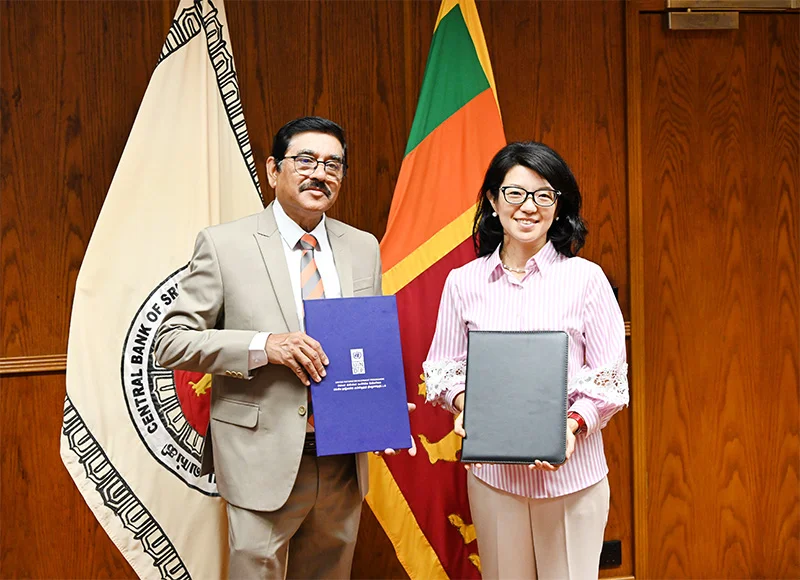
The United Nations Development Programme (UNDP) and the Central Bank of Sri Lanka (CBSL) have strengthened their partnership to advance financial literacy across the country, with a renewed focus on empowering vulnerable communities, strengthening economic resilience and promoting sustainable development.
The two institutions formally launched the second phase of their collaboration recently, reaffirming their commitment to implementing Sri Lanka’s National Financial Literacy Roadmap (2024–2028), a cornerstone of the National Financial Inclusion Strategy (NFIS).
The partnership was marked by a meeting between Central Bank Governor Dr. P. Nandalal Weerasinghe and UNDP Resident Representative in Sri Lanka Ms. Azusa Kubota, together with officials from both organisations.
Building on technical support provided by UNDP during 2024 and 2025, the latest phase seeks to equip individuals, households and businesses with the knowledge required to make sound financial decisions, improve livelihoods and enhance resilience in an increasingly uncertain economic and climatic environment.
The initiative comes at a crucial juncture as Sri Lanka continues its economic recovery while grappling with climate-related challenges that disproportionately affect rural communities and small enterprises.
A key component of the programme will be strengthening the capacity of government outreach officers across all districts to deliver financial literacy training to rural populations and micro, small and medium enterprises (MSMEs).
The training will be based on the Financial Literacy Curriculum developed by the Central Bank, with UNDP supporting the enhancement of modules through the integration of climate-resilient financial management concepts.
The programme aligns closely with Sri Lanka’s Financial Literacy Roadmap and is expected to contribute significantly to improving financial knowledge and access across the country. It is supported by several development and private-sector partners, including the government of Japan, Chrysalis, VISA and Hirdaramani-Lacoste.
Speaking on the importance of the initiative, Central Bank Governor Dr. Weerasinghe said the partnership would help broaden the reach of financial literacy efforts while addressing emerging challenges such as climate-related financial risks.
“We particularly welcome the focus on strengthening financial resilience, climate-related financial preparedness, public awareness campaigns and capacity-building through Training-of-Trainers programmes, he said.
He noted that the initiatives would ensure that different segments of society gain access to practical financial knowledge and develop the skills necessary to foster responsible financial behaviour and improve their overall financial well-being.
UNDP Resident Representative Ms. Kubota underscored the critical role financial literacy plays in creating inclusive and resilient economies.
“Financial literacy is a critical foundation for inclusive and resilient economies. Through our partnership with the Central Bank of Sri Lanka, we have been working to empower individuals, particularly those most vulnerable, with the knowledge and tools needed to make informed financial decisions and build secure livelihoods, she said.


Marking an important milestone in Sri Lanka’s economic development, the National Export Development Plan (NEDP) for the period 2026–2030 was presented to President Anura Kumara Dissanayake on Tuesday morning (16) at the Presidential Secretariat.
The 2026–2030 National Export Development Plan (NEDP) is a key national programme formulated in line with the Government’s policy direction under the 2025 Budget. It aims to strengthen the country’s export sector and achieve export-led sustainable economic growth.
The strategic plan has been developed under the guidance of the Ministry of Industry and Entrepreneurship Development and the leadership of the Sri Lanka Export Development Board (EDB), with technical assistance provided through the Asian Development Bank’s (ADB) Policy-Based Lending (PBL) programme. It is the result of an extensive consultative process carried out in close collaboration with key government institutions, private sector stakeholders, and development partners.
The proposal submitted by the Minister of Industry and Entrepreneurship Development to recognise the “Sri Lanka National Export Development Plan 2026–2030” as the official strategic framework for export development and promotion in Sri Lanka was approved by the Cabinet of Ministers on 4 May 2026. The Plan reflects a broad consensus among government institutions, private sector experts, and international development partners.
In line with the national vision of “A Thriving Nation – A Beautiful Life”, the Plan has been formulated to enhance Sri Lanka’s export competitiveness and achieve an export revenue target of USD 36 billion by 2030.
The core vision of the Plan is to transform Sri Lanka into a competitive logistics and knowledge-based export hub serving regional and global markets. The strategy is based on two key interconnected pillars: “horizontals” and “verticals”, which together provide the foundation for strengthening export competitiveness, diversification, and sustainable growth.
The horizontal enablers, which support the growth and expansion of all priority sectors, include logistics and integrated hub operations, trade facilitation, trade finance and reforms in the business and investment environment, trade promotion and market linkages, quality management, standards, environmental, social and governance (ESG) capacity development, as well as entrepreneurship and innovation.
The Plan also identifies eight priority export sectors to enhance export diversification and value addition, and to position Sri Lanka more competitively in global markets. These include automotive components, mineral-based industries, rubber-based industries, maritime industries (including boat and shipbuilding), spices and concentrates, digital products and services, electrical and electronic equipment, and processed food and beverages.
The preparation of the Plan involved contributions from over 300 stakeholders, including government institutions, the private sector, civil society organisations and international development partners. Broad consensus was achieved through consultations held from October to December 2025 and workshops conducted in January 2026.
The Government expects that, with implementation supported by strong governance and monitoring framework, the Plan will elevate local products to international standards and ensure long-term economic stability and growth. It is further anticipated that the National Export Development Plan will serve as a key driver of Sri Lanka’s economic progress in the years ahead.
Minister of Labour and Deputy Minister of Finance and Planning Dr. Anil Jayantha Fernando, Minister of Industry and Entrepreneurship Development Sunil Handunnetti, Senior Additional Secretary to the President and Secretary to the Ministry of Energy Russell Aponso, Secretary to the Ministry of Industry and Entrepreneurship Development Thilaka Jayasundara, and Chairman of the Sri Lanka Export Development Board Mangala Wijesinghe were also present at the event.
[PMD]
The government’s decision to ban the export of mineral resources in raw form and place all future mineral exploration under state control has triggered fresh debate over how Sri Lanka should develop its untapped mineral wealth and attract foreign investment.
Announcing the new National Mineral Policy, Industry and Entrepreneurship Development Minister Sunil Handunnetti said the country had long failed to capture the full value of its mineral resources by exporting them with minimal processing.
“We will no longer allow mineral resources to leave the country in raw form,” the minister said, arguing that Sri Lanka must move towards value-added industries that generate greater economic returns.
A key feature of the new policy is the transfer of all mineral exploration activities to the state-run Geological Survey and Mines Bureau (GSMB). Under the new system, the GSMB will carry out exploration, publish geological data and subsequently invite investors to participate in commercially viable projects.
Handunnetti defended the move by citing what he described as the failure of the previous licensing regime. According to government figures, 471 exploration licences had been issued since 1993, but only 28 advanced to mining operations, with just 12 remaining active today. The minister alleged that some companies had used exploration licences to boost corporate valuations rather than develop actual mining projects.
He also stressed that mineral deposits located beneath privately owned land belong to the state and should be developed in the national interest.
However, the reforms are likely to attract close scrutiny from foreign investors seeking opportunities in Sri Lanka’s mineral sector.
An independent industry analyst said the policy’s emphasis on value addition is consistent with global trends, as countries increasingly seek to process critical minerals domestically rather than export raw materials.
“The more difficult question is whether a state-controlled exploration model can generate the confidence required by international investors,” the analyst said. “Investors will want access to reliable geological data, transparent licensing procedures and predictable regulations before committing significant capital.”
The analyst noted that the government’s plan to publish exploration data before inviting investment proposals could help improve transparency, but its success would depend on how scientifically the process is implemented.
Sri Lanka possesses commercially valuable deposits of graphite, mineral sands, ilmenite, rutile, garnet, silica and phosphate. As global demand for industrial and strategic minerals continues to grow, the new policy represents a significant test of whether stronger state involvement can translate geological potential into investment, industrial development and export earnings.
“The success of the strategy may ultimately depend on whether the government can balance tighter control over mineral resources with the policy certainty and commercial incentives that international investors typically seek,” the analyst said.
By Sanath Nanayakkare

Hundreds of cats stolen for food in Vietnam rescued by police, welfare group says

Canada-Netherlands ODI abandoned due to dangerous pitch in Toronto

Da Silva and Jangoo earn recalls for West Indies’ Tests against Sri Lanka

Spinners make it two in two for England

Messi hat-trick fires holders Argentina to win over Algeria at World Cup

UNDP, Central Bank deepen financial literacy drive to build economic resilience

‘Dates have the highest sugar content to fight Coronavirus’

Sunday Island 27 December – Headlines

#SundayIsland 17th December – Headlines

Sunday Island – 28th March

Sunday Island Headlines – 21 March

Sunday Island – 21st February – Headlines
-

 News5 days ago
CIABOC summons Yoshitha over his participation in British Navy training programme
-

 Sports2 days ago
Tharanga set for high-profile javelin clash in Ostrava
-

 News5 days ago
Justice Minister responds to social media claims he represented Easter Sunday ringleader
-

 Features3 days ago
Politics of protected species
-

 News2 days ago
Release of 2025 O/L results likely to be delayed
-

 News4 days ago
Commonwealth lawyers urge Lanka to uphold rule of law
-

 News2 days ago
Theft of USD 2.5 mn from Treasury: CoPF accused of complicity in NPP cover-up
-

 News1 day ago
Beijing Capital Airlines to resume flights to Colombo signalling boost to tourism