
News
Urgent action needed to combat deadly COVID-19 surge across South Asia- AU

Governments across South Asia must immediately address healthcare shortages and urgently strengthen their healthcare systems to respond to the rapid surge of COVID-19 cases in the region, sats Amnesty International.
With India and Nepal’s healthcare systems reaching breaking point, the human rights organisation has expressed its concern over the lack of preparedness of other countries in the region for the virus’s latest and most deadly wave. Extremely low vaccination rates across South Asia have also left the region highly vulnerable, with pressing action needed at the global level to ensure more equitable access to vaccines.
“The human catastrophe that is unfolding in India and Nepal should be a warning to other countries in the region to invest heavily in surge capacity for an emergency response. The virus is spreading and transcending borders at a frightening speed and will continue to hit the region’s most marginalized populations hardest of all,” said Yamini Mishra, Amnesty International’s Asia-Pacific Director.
“We are at a critical point. Fewer than one in ten of the region’s population has been vaccinated. The decisions taken by governments in South Asia and across the world in the coming days and weeks will be crucial in mitigating the human cost of this latest surge.”
South Asia, home to a quarter of the world’s population, is fast becoming the new global epicentre of the COVID-19 pandemic. On 6 May, India reported more than 400,000 new cases in one day, taking its total tally of confirmed cases to 21.5 million, though this is likely to be a significant underestimate. As the disease ravages India, several south Asian nations are also facing a resurgence of cases.
Nepal, which shares a porous border with India, has already started to experience a massive spike in infections. According to WHO figures, daily cases increased 30-fold from 303 to 9,317, or an increase of 2,975%, between 12 April and 12 May. On Tuesday, Nepal recorded another 9,317 cases, bringing its total to 413,111.
With India stopping exports of oxygen, Nepal is struggling to find alternative supplies. To make matters worse, Nepal is also in the midst of political upheaval, with its Prime Minister having lost a vote of confidence and parties failing to form a government.
“We have seen how shortages of oxygen, hospital beds, human resources and essential medicines pushed the already under-resourced healthcare response of India over the edge. Now a similar worrying trend is emerging in Nepal,” said Yamini Mishra.
“This is not the time for Nepal’s politicians to indulge in political wrangling and infighting. What the country needs right now is unity and leadership to address the growing crisis.”
After experiencing a second wave last year, Pakistan, Bangladesh, Afghanistan and Sri Lanka are also witnessing a surge with infections picking up sharply. The new Indian variant of coronavirus has been detected in Sri Lanka and Bangladesh, prompting authorities to close borders and ban travellers from India.
Bangladesh’s nationwide lockdown has struggled to limit public movement or contain the surge in daily infections, which rose to 7,200 in early April, its highest point in the pandemic, before beginning to reduce. The country’s health directorate has expressed concern that mass travel ahead of the upcoming Eid celebrations could lead to a resurgence of infections. Pakistan’s authorities have steadily tightened restrictions on travel in a bid to prevent a surge in COVID-19 cases during Eid. Meanwhile, the Afghan government has so far ignored the advice of its Ministry of Public Health to implement a lockdown.
According to media reports, hospital intensive care units in Pakistan, Bangladesh, Sri Lanka and Nepal are now full or close to capacity. With high rates of poverty, fragile health infrastructures, poor socio-economic conditions, inadequate social protection systems, limited access to water and sanitation facilities and inadequate living space, the new wave puts millions of lives in the region at risk. According to the World Bank, South Asia has 0.6 hospital beds per 100,000 people, against an average of five in high-income countries.
“The disease has exacerbated an already dire healthcare situation in the region. Now, more than ever, South Asia’s governments should develop mechanisms for building surge capacity to manage patient loads, sustain essential services, and reduce the social and economic impact of pandemic,” said Yamini Mishra.
“At the same time, States need to focus on protecting the human rights of the marginalised and vulnerable groups at high risk, including daily wage earners, prisoners, refugees and the internally displaced, by ensuring equitable healthcare. They must take effective steps to ensure that health facilities are available, affordable and accessible to everyone without discrimination,” she added.
From late January onwards, countries including Bangladesh, Nepal, and Sri Lanka started receiving vaccine doses through donations from India and other countries, as well as via commercial deals. Amid its current crisis, India temporarily halted exports of vaccines on 24 March to prioritise domestic requirements, leaving the region with a severe shortfall of vaccines. Vaccination rates across South Asia remain extremely low – in Pakistan, only 0.9 percent of the population have received one dose of the vaccine.
Amnesty International is calling on the international community to show solidarity and fulfil its human rights obligations to provide cooperation and assistance, by providing lifesaving medical tools and removing legal uncertainties and barriers that may impede the production and supply of vaccines as the disease continues to ravage the region.
“The new surge in cases poses a huge challenge to a region already struggling to vaccinate its population. In this time of crisis, the international community must come together and extend support to South Asian countries by ensuring equitable access to vaccines and prioritizing resource and technology transfer to produce vaccines locally,” said Yamini Mishra.


A discussion on the Anuradhapura Sacred City Development Plan was held on Wednesday (30) afternoon at the Presidential Secretariat, under the leadership of Chief of Presidential Staff Prabath Chandrakeerthi and Acting Deputy High Commissioner/First Secretary of the High Commission of India Roshini Thomson.
During Indian Prime Minister Narendra Modi’s official visit to Sri Lanka, he had expressed his agreement to provide assistance for a Sacred City development project when he visited the Jaya Sri Maha Bodhi in Anuradhapura.
Accordingly, the Urban Development Authority and the Department of National Physical Planning have proposed jointly implementing development activities in the Anuradhapura Sacred City.
The draft proposal prepared jointly by the Urban Development Authority and the Department of National Physical Planning has already been submitted to the High Commission of India, and the discussion focused on the proposal.
President Anura Kumara Dissanayake also recently held discussions with the Maha Sangha and all relevant stakeholders regarding the Anuradhapura Sacred City Development Plan, and instructed officials to expedite the project.
The initial cost of implementing the Anuradhapura Sacred City Development Plan is currently estimated at Rs. 7.7 billion. The Government of India is expected to provide the financial contribution required for the project, which is expected to commence before the end of this year.
Under the project, a range of development programmes are to be launched while preserving the antiquity and religious character of the Anuradhapura Sacred City. These will include renovating access roads, ensuring the proper disposal of waste, improving sanitation facilities and restoring all dilapidated sites.
Second Secretary (DC) at the High Commission of India Ramya C. S., Director General of the Department of National Physical Planning W.T.H. Ruchira Withana, Director General of the Urban Development Authority D.M.D.S. Dissanayake and Director of the Department of External Resources Chandrika Senanayake, along with senior officials of the High Commission of India and officials from relevant institutions, were among those present at the occasion.
[President’s Media Division (PMD)]
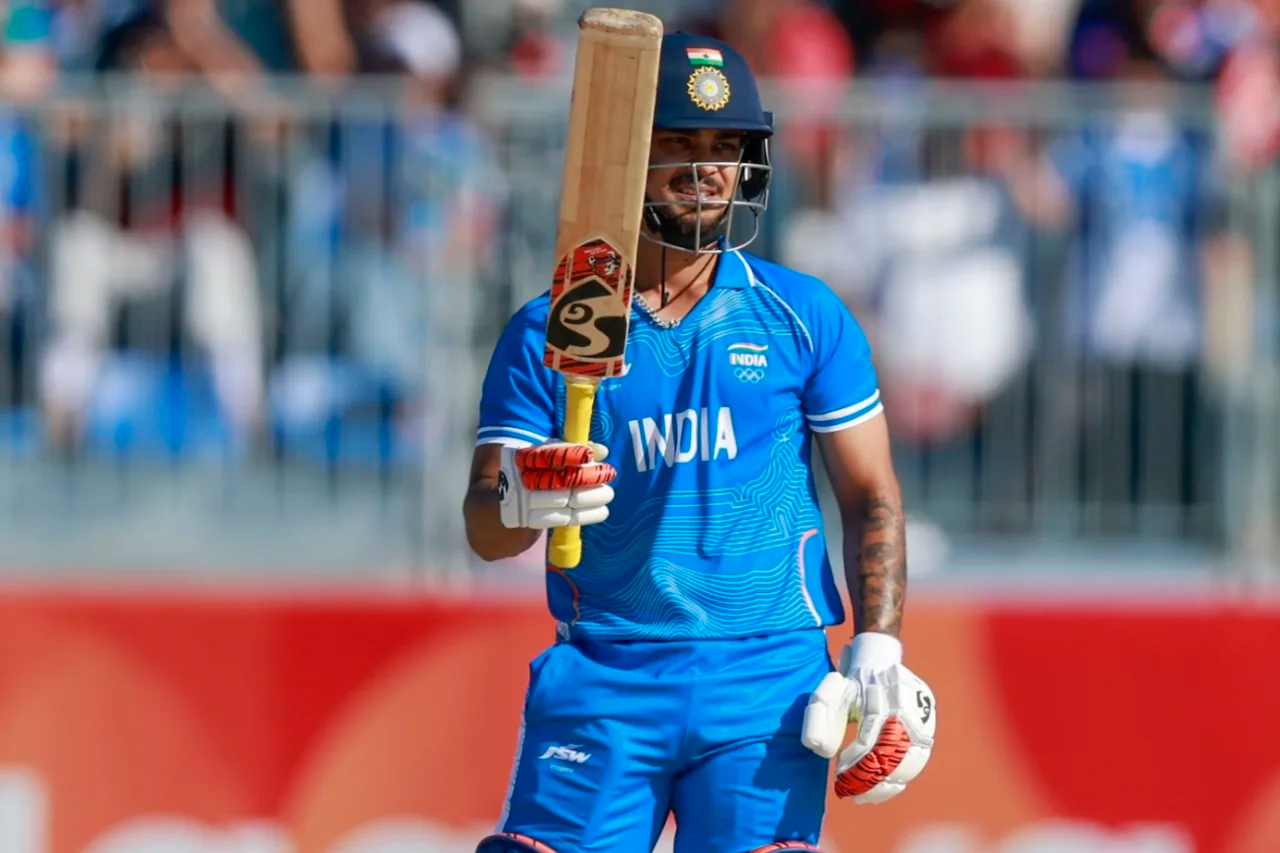
Defending champions India registered their biggest T20I win against Sri Lanka to make the final of the 2026 Asian Games men’s competition in Nisshin on Thursday.
A day after the ODI side chased down 406 against West Indies like it was child’s play on a flat Guwahati pitch, the T20I side scraped their way to 169, well above-par on a treacherous track filled with cracks. Sri Lanka were no match after that.
The result sets up the first India vs Pakistan final of 2026, and there will be a gold medal at stake.
Sri Lanka were a touch unlucky as Ishan Kishan miscued many aerial shots but they all fell in no-man’s land. But Nuwanidu Fernando did drop Kishan on 56, and that didn’t help as he went on to make 80* in just 46 balls. There were a couple of balls that misbehaved wildly, and it was a sign of things to come.
The chase felt like an act of cruelty against batters. Jasprit Bumrah bowled Test lengths and added new degrees of unplayability to the existing ones. Axar Patel bowled 14 dots and got a two-for and India finished the game with a team hat-trick. On top of all that, Sri Lanka suffered three run outs, two of which were of top-four batters.
In the end, they were rolled over for 45, the second lowest total in men’s games at the Asian Games and the joint-lowest total for a Full-Member team in men’s T20Is, alongside West Indies’ 45 against England in 2019.
India picked four spinners in their XI and Sri Lanka three in what was their first bit of action at the competition after their quarter-final fixtures were rained out. It proved to be the right strategy as spinners bowled 83% of all the balls bowled (149 out 179) across the 29.5 overs of play. They took 12 wickets, bowled 73 dots and went at an economy of 6.56. The quick bowlers conceded 44 runs in 30 balls. Bumrah’s share in that: 2 for 7 in two overs.
The bowlers’ domination started early in the game as the weather held for the second game running on the day.
Both Abhishek Sharma and Sanju Samson fell to fingerspin while trying to open up the off side. Samson made room and looked to go inside out over cover and was beaten by extravagant spin, but went for it again and Tharindu Ratnayake fired the ball in to smash his stumps. Sahan Arachchige, who had Abhishek lob one to short third, then checked every form of deviation to knock over Shreyas Iyer – the ball angled in, dipped, drew the batter forward and turned away to hit the stumps.
In the chase, Sineth Jayawardena looked to take Bumrah on early and looked hapless as the ball seamed in to beat the across-the-line swing and hit him on the back leg in front of all three. Sohan de Livera fell victim to Bumrah’s exaggerated angle from over the wicket and nicked to the keeper. For the first time in a men’s T20I, India has taken two wickets before conceding a run.
The fifth ball of Bumrah’s second over trampolined off a length, seemed to pick up pace off the pitch, and needed Samson to leap right up to catch it. Nuwanidu, the batter, was lucky that the line of the ball was not straighter.
Despite the Bumrah threat, India did not turn to pace for the remainder of the innings. That was likely because Lasith Croospulle was run out by sharp work from Ravi Bishnoi at short third in the over before, and Arachchige and Ashen Bandara committing the cardinal sin of sweeping Axar and giving away their wickets.
Washington Sundar’s introduction with Sri Lanka on 18 for 5 did not faze Nuwanidu. The first ball spun big but went down leg. Next three balls had two sixes, the second an effortless twirl of the bat to send the ball over long-on. Then Nuwanidu went for a non-existent single to short third and Sri Lanka ran their way out to a point of no return.
In conditions where batting was far from easy, Kishan and Vaibhav Sooryavanshi found ways to maximise the strengths of their respective games.
Sooryavanshi opened up the off side repeatedly by either making room or standing still and slapping balls, even when they were angling in. He brought up India’s 50 with 4, 6, 4 off Tharindu Ratnayake but fell to Arachchige, in similar fashion to Abhishek, soon after. He made 38 off 21. Only behind Kishan’s 80 not out. The next highest individual score was Nuwanidu’s 15.
Kishan then walked out and hit two sixes in his first 12 balls. He waited for the bad ball and wasn’t going to miss out if he got one… or two. However, he had to take chances as Shreyas Iyer fell and Axar – promoted above Tilak Varma – got stuck. Kishan’s reverse sweep off Arachchige from a leg-stump line during this slowdown showed he could pull off risks on demand.
Both Axar and Tilak fell cheaply but took India past 100 with handy stands with Kishan, who forced errors out of bowlers and brought up a 33-ball fifty in the 17th. He could have been out twice in the next two balls but survived a ball that turned in a right angle and Nuwanidu’s drop at mid-off.
India hit four sixes and four fours in the last eight overs. Kishan hit all of them bar the last six, hit by Washington. That took them to 169 for 7, a par score in general, maybe twice the par on the day.
Scores:
India 169 for 7 in 20 overs (Vaibhav Sooryavanshi 38, Shreyas Iyer 13, Ishan Kishan 80*; Tharindu Ratnayake 2-32, Sahan Arachchige 2-28, Wanuja Sahan 1-17, Lasith Croospullle 1-25, Nuwanidu Fernando 1-20) beat Sri Lanka 45 in 905 overs (Nuwanidu Fernando 15; Jasprit Bumrah 2-07, Axar Patel 2-08, Washington Sundar 1-18, Abhishek Sharma 2-2, ) by 124 runs
[Cricinfo]
Latest News
I extend my heartfelt wishes to all the sons and daughters of our country for a Happy World Children’s Day – President

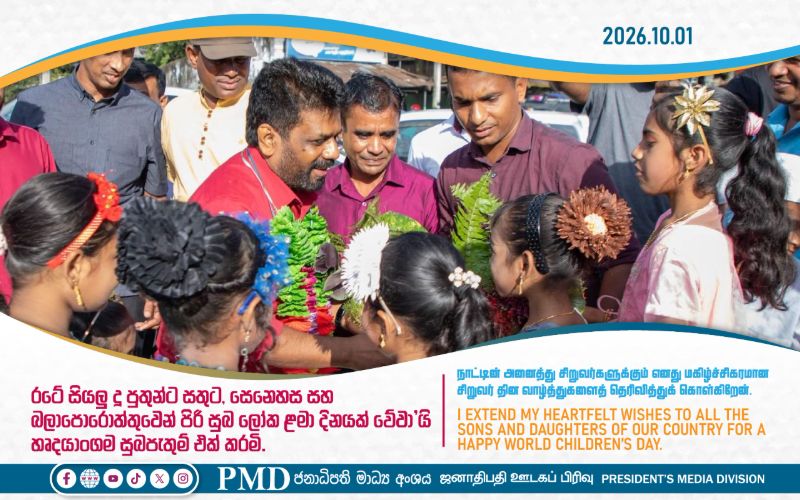
Children’s Day Message from President Anura Kumara Dissanayake:
“Children are the most valuable asset of a nation. Ensuring their physical and mental well-being and creating an environment conducive to their proper development is a primary responsibility of any government. Children’s imagination, aspirations and creativity will determine the shape and colour of the country tomorrow. The country we build for children must not merely be a country prepared to be handed over to them in the future; it must be a country that gives space to their dreams today, listens to their voices and provides opportunities for them to realise their potential.
For the best interests of children, we are taking the necessary steps to ensure equal access to education, guidance, social protection, opportunities for sport, leisure and recreation, proper nutrition and access to healthcare, while protecting children from all forms of violence and discrimination and safeguarding their rights.
Race, religion, economic status, geographical background or any other circumstance should not be a barrier to any child’s education or proper development. Every child should have equal and fair opportunities to realise their potential, pursue their dreams and create the future they wish for themselves. To this end, we have already begun the process of reforming the education system in Sri Lanka, transforming it towards a skills-based system suited to the new world, one that does not place a burden on parents or cause distress to children.
Our aim is to ensure that no child is left behind in the new Sri Lanka we are building, and to provide every child with opportunities for development in a safe environment. It should be emphasised that the fundamental objective of all the programmes being implemented, from expanding educational scholarships to securing the future of children growing up in child development centres and those in need of care, is to create a dignified and secure tomorrow for every child in the country.
It is the aspiration of every parent to give their children a better life than the one they themselves experienced. We are currently steering the country’s economy towards a correct and stable direction in order to provide children with a safe and happy childhood, free from the shadows of an unstable economy. At the same time, we have launched the national operation “A Nation United” (Ratama Ekata), bringing everyone together to free the younger generation from the menace of illicit drugs.
At a time when we are working towards the goal of building a safe and better country for children, I greatly appreciate the initiative of the Ministry of Women and Child Affairs in organising this year’s World Children’s Day celebrations under the theme “Strong Minds – Enriched Children”, declaring a National Children’s Day Week and conducting a range of meaningful programmes aimed at strengthening children’s rights, well-being, protection, education and freedom.
I extend my heartfelt wishes to all the sons and daughters of our country for a Happy World Children’s Day”.

Discussion on Anuradhapura Sacred City Development Plan

India enter Asian Games final after Kishan and Bumrah ride roughshod over Sri Lanka

I extend my heartfelt wishes to all the sons and daughters of our country for a Happy World Children’s Day – President

Sri Lanka bowl first in semi final clash against India

Trump hints US could strike Iran, warns time coming

Showers or thundershowers will occur at most part of the island after 1.00 p.m.

‘Dates have the highest sugar content to fight Coronavirus’

Sunday Island 27 December – Headlines

#SundayIsland 17th December – Headlines

Sunday Island – 28th March

Sunday Island Headlines – 21 March

Sunday Island – 21st February – Headlines
-

 Editorial5 days ago
Birth of a bad law
-

 Features6 days ago
Beyond traditional jobs: Why Sri Lanka needs to facilitate the gig economy
-

 News3 days ago
Police remove Thileepan statue in Jaffna
-
 Latest News7 days ago
Kusal, Wellalage star as Sri Lanka defend 322 in Headingley thriller
-
 News5 days ago
TIN mandatory for key transactions from Nov. 1
-

 Features3 days ago
The 22nd Amendment, constitutional recovery and illiberal slippage
-

 Features3 days ago
Of foreigners as CEOs of Lankan ventures
-

 News3 days ago
Sajith rejects Jt. Opp. protest sabotage claim; SJB TU chief demands remedial action