
News
No referendum needed for passage of 22 A: SC

Fight now moves to the streets with Opposition expected to gather at Polduwa Junction tomorrow
By Saman Indrajith
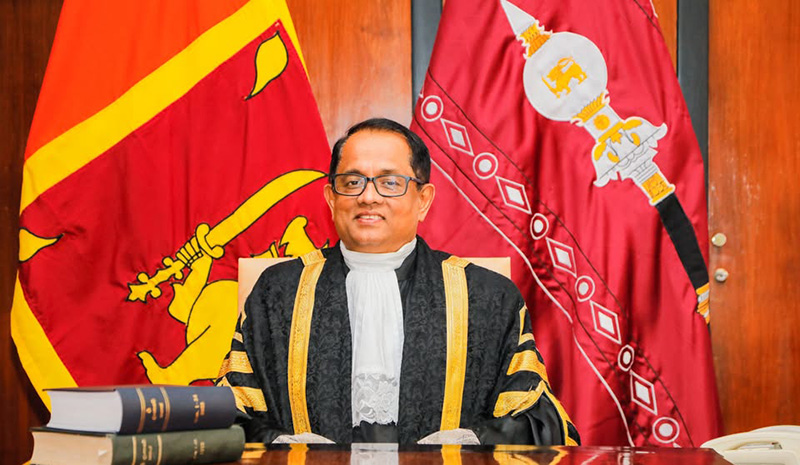
The Supreme Court (SC) has determined that the proposed 22nd Amendment to the Constitution does not require approval at a referendum and may be enacted with a special two-thirds majority in Parliament. Speaker Dr. Jagath Wickramaratne announced the SC determination in the House yesterday.
The determination, delivered to the Speaker following the hearing of 67 petitions challenging the constitutionality of the Bill, clears the way for Parliament to take up the proposed constitutional changes during a two-day debate beginning Thursday (24).
Announcing the determination, Speaker Wickramaratne said the Supreme Court had held that the provisions of the 22nd Amendment Bill, or any part of it, did not require approval by the people at a referendum under Article 83 of the Constitution.
The Court, however, has directed specific changes to the wording of Clause 2 of the Bill concerning the retirement of the Chief Justice.
According to the Speaker, the phrase referring to the date on which the Chief Justice “reaches 67” is to be replaced with wording referring to the date on which the Chief Justice “completes 67 years”.
The Court has further directed that a second proviso be added to Clause 2 stipulating that the six-year term limit proposed for the office of Chief Justice will not apply to a person holding that office on the date the amendment comes into operation.
The Supreme Court has also determined that certain provisions of the 22nd Amendment can be passed by a simple majority of Parliament, while the Bill as a whole, insofar as it requires a constitutional amendment, can proceed without a referendum on the basis of the required special majority.
The Supreme Court separately determined that the provisions of the Judicature (Amendment) Bill are not inconsistent with the Constitution and may be passed by a simple majority in Parliament.
The Judicature Bill is linked to the Government’s wider judicial reform programme and proposes changes to the retirement ages and composition of the lower judiciary.
The two Bills were presented to Parliament on August 18 by Minister of Justice and National Integration Harshana Nanayakkara.
The 22nd Amendment Bill proposes to increase the retirement age of Supreme Court judges from 65 to 67 and that of Court of Appeal judges from 63 to 65. It also seeks to increase the maximum number of Court of Appeal judges from 19 to 24.
The Judicature (Amendment) Bill proposes to increase the retirement age of High Court judges from 61 to 63 and establish 62 as the compulsory retirement age for other judges and magistrates. It also seeks to increase the maximum number of High Court judges from 110 to 120.
The constitutional challenge to the 22nd Amendment generated one of the more extensive challenges to a Bill in recent years, with 67 petitions filed before the Supreme Court.
The petitions were heard on September 1 and 2 by a five-member bench comprising Chief Justice Preethi Padman Surasena and Justices Achala Wengappuli, Arjuna Obeyesekere, Sampath Abeykoon and Gihan Kulatunga. A request for the matter to be considered by a full bench was rejected.
The hearing concluded on September 2, after which the bench informed the parties that its confidential determination would be forwarded to the Speaker.
Among the principal constitutional questions raised before the Court was whether extending the tenure of judges would affect constitutional provisions relating to sovereignty and judicial independence, thereby requiring approval by the people at a referendum in addition to a two-thirds parliamentary majority.
The Centre for Policy Alternatives and its Executive Director Dr. Paikiasothy Saravanamuttu were among those who challenged the Bill, arguing that its provisions concerning judicial retirement ages were inconsistent with Article 3 of the Constitution and therefore required approval at a referendum.
The Court’s determination, communicated through the Speaker, has now settled the constitutional procedure required for the Bill to proceed.
The Committee on Parliamentary Business had already scheduled the second-reading debate on the 22nd Amendment and the Judicature (Amendment) Bill for September 24 and 25.
Parliament is scheduled to debate the two Bills from 11.30 am to 7 pm on both days. The vote is expected to follow the conclusion of the second-reading debate on Friday.
The Supreme Court’s determination therefore comes just two days before the commencement of the parliamentary debate, with the Government now able to proceed without having to prepare for a referendum.
The Opposition, however, has indicated that it will continue its campaign against the proposed amendment despite the Court’s determination on the referendum requirement.
The SJB has organised a protest at Polduwa Junction near Parliament on Thursday, coinciding with the opening day of the debate. The protest is scheduled for 9 am and has been organised under the patronage of Opposition Leader Sajith Premadasa, with other Opposition parties invited to participate.
Opposition parties and civil society groups had earlier signed a joint declaration opposing the Bill and announced plans for a broader mobilisation against it. Their objections have centred particularly on the potential implications of the proposed changes for judicial independence.
The Government, meanwhile, has maintained that the proposed changes form part of a broader effort to reform the judicial system and address delays in the administration of justice. The proposed increase in the retirement ages of judges has been presented as one component of that reform programme.
With the Supreme Court having ruled that no referendum is necessary, the immediate constitutional hurdle has therefore shifted from determining the Bill’s eligibility for a public vote to whether the Government can secure the required parliamentary majority.
The decisive stage will come on September 24 and 25, when MPs take up the proposed constitutional and judicial changes for debate and eventual voting.


The Cabinet of Ministers approved the resolution furnished by the Minister of Agriculture, Livestock, Lands and Irrigation to appoint Ms. P. M. Jayadeera (Engineer) in the Special Grade of Sri Lanka Engineering Service serving at present as the Additional Secretary (Water Resources Development) of the Ministry of Agriculture, Livestock, Lands and Irrigation to the post of Director General which will be vacant from 06.10.2026.
Approval has been granted at the meeting of the Cabinet of Ministers held on 08.06.2026 to prepare a draft bill for restructuring Sri Lanka Cricket.
Accordingly, the Legal Draftsman has formulated Sri Lanka draft bill providing legal provisions for the administration of Sri
Lanka Cricket, control, regulation, promotion, establishment of Sri Lanka Cricket for the development and administration, through the concepts of better governance, integrity, transparency, accountability, inclusiveness and providing equal opportunities for the betterment of the cricket sport, establishment of Sri Lanka Cricket for securing the wellbeing of all participants and securing cricket from corruption and other mal practices.
Clearance of the Attorney General has been received for the said draft bill. Approval of the Cabinet of Ministers has been received for the resolution furnished by the Minister of
Youth Affairs and Sports to publish the said draft bill in the government gazette notification and thereby forward the same to the Parliament for its concurrence.
The Sri Lanka Land Development Corporation performs vitally important functions such as minimizing the risk of inundation in urban and lowland areas, maintaining drainage systems efficiently, carrying out urgent operations during inundation events, and maintaining canals.
The need to strengthen the capacity of the corporation’s internal
operations has been identified by the corporation to perform the aforementioned functions efficiently and expeditiously.
The corporation has planned to purchase small -scale machinery that can be used to clean small canals, which significantly contribute to urban inundation.
The General Treasury has agreed to grant 625 million rupees as an equity contribution for purchasing the relevant machinery.
Accordingly, the Cabinet of Ministers has approved the resolution submitted by the Minister of Transport, Highways, and Urban Development to purchase the relevant machinery by the Sri Lanka Land Development Corporation, following formal procurement procedures at an estimated cost of Rs. 1,233
million, utilizing the aforementioned amount granted by the General Treasury and the funds of the Sri Lanka Land Development Corporation.

Ms. P. M. Jayadeera (Engineer) appointed Director General of Irrigation
Sri Lanka Cricket Draft Bill to be gazetted
Cabinet approves purchase of machinery for the Sri Lanka Land Development Corporation
Cabinet approval for Project to Build Secure, Skilled, and Empowered Community for families resettled at the at Kalinga Mawatha, housing scheme
Appointment of Cabinet Sub-Committee for the Organization of 79th Independence Day Commemoration
Establishment of New Management Framework for the Dr. Nevil Fernando Hospital

‘Dates have the highest sugar content to fight Coronavirus’

Sunday Island 27 December – Headlines

#SundayIsland 17th December – Headlines

Sunday Island – 28th March

Sunday Island Headlines – 21 March

Sunday Island – 21st February – Headlines
-

 News6 days ago
US embassy won’t comment on IGP’s probe into joint drug raid
-

 News4 days ago
Shanakiyan urges urgent action over reported death sentence for Lankan in Saudi Arabia
-

 News5 days ago
Bid for Basil’s extradition nears final stage: Police
-

 News3 days ago
Namal Rajapaksa Buddhist gambit fails, bail denied
-

 Business6 days ago
All-new Bolero MaXX unveiled in Sri Lanka
-

 Features3 days ago
Why the spelling Sri Lankan names in English vary
-
 Opinion6 days ago
A journalist who wrote across the divide
-

 Features3 days ago
Three bands, a new identity: Sri Lankan wolf snake recognised as distinct species