
News
Easter Sunday probe: SJB demands answers to specific questions, disclosure of Fathima Hadiya’s testimony


By Shamindra Ferdinando
Samagi Jana Balavegaya MP Manusha Nanayakkara says the government has not responded yet to specific issues raised by him and his parliamentary colleague, Harin Fernando in parliament in respect of the 2019 Easter Sunday carnage.
Reiterating that the SLPP government bore the responsibility for punishing those who perpetrated the crime regardless of political consequences, Galle district MP Nanayakkara said that the government owed an explanation.
Responding to a query, the former UNPer told The Island that the SJB raised several pertinent questions, both in and outside parliament and of them the foremost was the alleged link between the Easter Sunday suicide bombers and the intelligence services.
A senior official who had served the intelligence services at the time of the 2019 attacks told The Island that interested parties were propagating lies for political benefit. “We never interfered with police investigations or tried to influence the Easter attackers,” the official said. He said so when The Island requested him to comment on SJB’s accusations.
MP Nanayakkara emphasized that the SJB sought an explanation as regards the involvement of some members of the intelligence services on the basis of statements made before the Presidential Commission of Inquiry (PCoI). Therefore, there was no need for the SJB to lodge fresh complaints with the police as accusations, assertions and claims pertaining to the alleged intelligence services link were entirely based on what transpired before the PCoI. Of course some of those statements were made in camera as well as before the media by intelligence and police personnel, both in service and retired.
Lawmaker Nanayakkara said that the SJB demanded in parliament government response to the following questions (1) Did two officers from the Intelligence services and the Terrorist Investigation Department (TID) visit the home of Jamil, the person assigned to mount suicide attack at Taj Samudra, hours before he detonated himself at Tropical Inn, Dehiwela? (ii) Did Directorate of Military Intelligence (DMI) remove a person arrested by the Criminal Investigation Department (CID) following investigations facilitated by technical means (iii) Did relevant authorities conduct an investigation into the alleged links between the DMI officer who removed the suspect claiming the operation was conducted by them? and finally (iv) would the government reveal the identity of the DMI officer identified as ‘Sonic’ on whose intervention with a person known as Matale Zahran soon after the Easter Sunday attacks the ISIS claimed responsibility for the April 2019 incidents.
MP Nanayakkara also raised issue over the failure on the part of the government to conduct a proper inquiry into the disappearance of Sarah, the wife of the Katuwapitiya bomber Hastun in spite of the law enforcement officer who allegedly helped her to secure refuge in India being in police custody.
Emphasizing that the Easter Sunday massacre couldn’t be swept under the carpet under any circumstances, MP Nanayakkara said that the public realized those responsible for negligence should be dealt with. Similarly, those who perpetrated the heinous crime should be exposed without further delay, the MP said adding that they wouldn’t allow the government rhetoric to deceive the public.
Nanayakkara said that in addition to those questions there were other unexplained issues as well. The Galle district lawmaker said that the security establishment owed an explanation why specific intelligence on the impending attack made available by India on April 4, 2019 was ignored whatever the shortcomings on the part of the political apparatus. The MP said that an explanation was also required from the Attorney General’s Department sitting on Zahran’s file since 2017 and the turmoil created by Namal Kumara whose unsubstantiated accusations in respect of an alleged bid to assassinate the then President Maithripala Sirisena and at that time former Defence Secretary Gotabaya Rajapaksa.
The SJB lawmaker questioned the rationale in questioning Zahran’s wife, Abdul Cader Fathima Hadiya, in camera. The government’s sincerity could be proved by making evidence before the PCoI public, the MP said, underscoring the importance of inquiring into the possibility of rogue group operating outside the government control backing Zahran’s gang. The MP also made reference to the members of Zahran’s group taking refuge in safe houses at Panadura and Ja-ela three days before the Easter Sunday attacks.
Claiming that they had discussed the delay in mounting the attack, MP Nanayakkara said that reference had been made to a person identified as ‘Boss’ who expressed concern over that.
The SJB spokesperson asked whether a person who headed a particular intelligence service regularly attended meetings chaired by the Attorney General to discuss matters pertaining to the Easter Sunday attacks. The MP declined to name the person when The Island sought an explanation.
Referring to Chief Government Whip Johnston Fernando’s challenge to the SJB to repeat its accusations outside the parliament, lawmaker Nanayakkara pointed out his party was concerned about leaving out a section of evidence received by the PCoI out of the Easter Sunday report.
When The Island pointed out that Attorney General Dappula de Livera, PC, had been provided with altogether 87 volumes, MP Nanayakkara said that they didn’t receive the entire report.
In spite of the government resorting to various pressure tactics meant to silence the SJB, the party was determined to pursue the case, MP Nanayakkara said.
How could Public Security Minister (ret.) Rear Admiral Sarath Weerasekera claim that they didn’t have information on Katuwapitiya Church suicide bomber Hastun’s wife Sarah, while the policeman who allegedly helped her to flee the country remained in the custody of the TID, MP Nanayakkara asked. The lawmaker also stressed the need to clarify matters pertaining to an alleged conflict between the DMI and the police intelligence (State Intelligence Service) at the time Zahran mounted the attacks.
The CID recently recorded statements from SJB lawmakers Eran Wickremaratne, Nalin Bandara and Ashoka Abeysinghe as regards accusations they made in respect of Easter Sunday attacks. SIS Chief Maj. Gen. Suresh Salley has complained to the CID regarding misleading statements made by lawmakers.

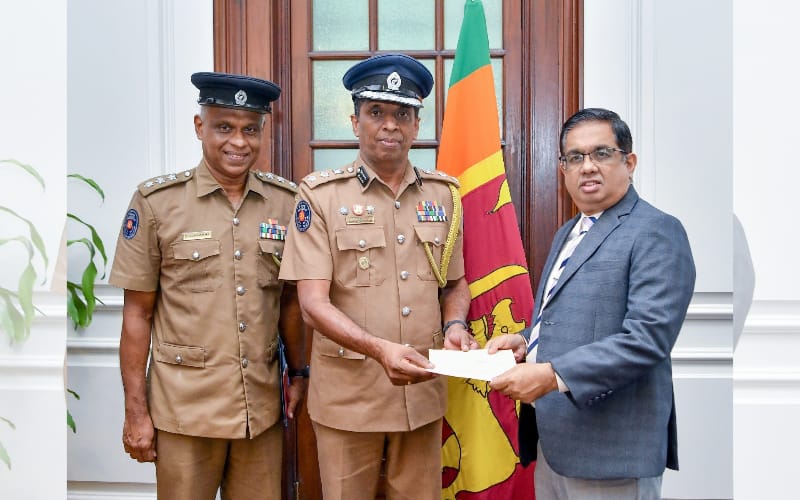
A sum of LKR. 9,687,462, raised from day’s salary officers of the Police Department, has been donated to the ‘Rebuilding Sri Lanka’ Fund, established to support the recovery of communities affected by Cyclone Ditwah and to assist in rebuilding the country following the disaster.
To date, officers of the Police Department have contributed over LKR. 74 million to the ‘Rebuilding Sri Lanka’ Fund through three such contributions of one day’s salary.
The donation was presented on Wednesday (22) afternoon at the Presidential Secretariat by the Personal Assistant to the Inspector General of Police, Senior Superintendent of Police C. C. Bamunuarachchi, to the Secretary to the President, Dr Nandika Sanath Kumanayake.
Chief Inspector Udaya Kumara, Officer-in-Charge of the Police Secretariat, was also present on the occasion.
[Presidents Media Division]
Latest News
Heat Index at Caution Level in the Northern, North-central, North-western, Western, Sabaragamuwa, Southern, and Eastern provinces and in Monaragala district during the day time

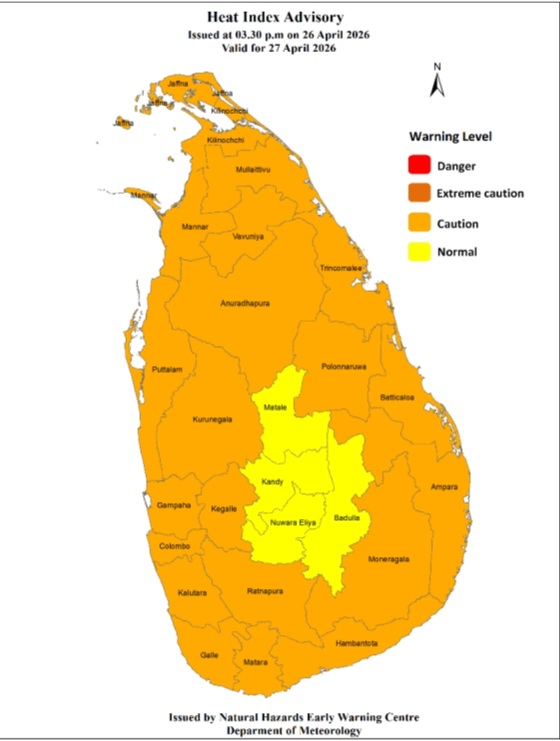
Warm Weather Advisory
Issued by the Natural Hazards Early Warning Centre
Issued at 3.30 p.m. on 26 April 2026, valid for 27 April 2026.
The Heat index, the temperature felt on human body is likely to increase up to ‘Caution level’ at some places in the Northern, North-central, North-western, Western, Sabaragamuwa, Southern, and Eastern provinces and in Monaragala district during the day time.
The Heat Index Forecast is calculated by using relative humidity and maximum temperature and this is the condition that is felt on your body. This is not the forecast of maximum temperature. It is generated by the Department of Meteorology for the next day period and prepared by using global numerical weather prediction model data.

Effect of the heat index on human body is mentioned in the above table and it is prepared on the advice of the Ministry of Health and Indigenous Medical Services.
ACTION REQUIRED
Job sites: Stay hydrated and takes breaks in the shade as often as possible.
Indoors: Check up on the elderly and the sick.
Vehicles: Never leave children unattended.
Outdoors: Limit strenuous outdoor activities, find shade and stay hydrated.
Dress: Wear lightweight and white or light-colored clothing.
Note:
In addition, please refer to advisories issued by the Disaster Preparedness & Response Division, Ministry
of Health in this regard as well. For further clarifications please contact 011-7446491.

Opposition and SJB Leader Sajith Premadasa has called for the appointment of a Parliamentary Select Committee (PSC) to investigate the illegal diversion of Treasury funds, amounting to US$2.5 million to a third-party account.
Premadasa has said both the chairmanship and a majority of the Committee’s membership should be held by the Opposition to ensure impartiality.
The government has not only failed to account for the loss of US$2.5 million but also deliberately withheld information from Parliament, the Committee on Public Finance (COPF) and the public, Premadasa has told the media, accusing the ruling party of seeking to deflect responsibility by initiating an internal departmental inquiry, which he describes as a biased process designed to justify predetermined conclusions.
The Opposition Leader has said only a transparent and independent probe could establish the facts, adding that such an investigation could be effectively carried out through a Parliamentary Select Committee led by the Opposition.
He has also warned that the alleged failure to inform Parliament about the missing funds amounted to a serious breach of accountability.

Police officers donate LKR 9,687,462 from day’s salary to ‘Rebuilding Sri Lanka’ Fund

Iran’s top diplomat in Russia as Tehran intensifies efforts to end the war

Rinku, Narine win Kolkata Knight Riders error-strewn Super Over game

Rabada and Sudharsan crush Chennai Super Kings

Showers or thundershowers will occur at several places in most parts of the island after 1.00 pm

Heat Index at Caution Level in the Northern, North-central, North-western, Western, Sabaragamuwa, Southern, and Eastern provinces and in Monaragala district during the day time

‘Dates have the highest sugar content to fight Coronavirus’

Sunday Island 27 December – Headlines

#SundayIsland 17th December – Headlines

Sunday Island – 28th March

Sunday Island Headlines – 21 March

Sunday Island – 21st February – Headlines
-
 News7 days ago
Rs 13 bn NDB fraud: Int’l forensic audit ordered
-

 News5 days ago
Lanka faces crisis of conscience over fate of animals: Call for compassion, law reform, and ethical responsibility
-
 News4 days ago
Whistleblowers ask Treasury Chief to resign over theft of USD 2.5 mn
-

 News4 days ago
No cyber hack: Fintech expert exposes shocking legacy flaws that led to $2.5 million theft
-

 News23 hours ago
BIA drug bust: 25 monks including three masterminds arrested
-

 Business2 days ago
Nestlé Lanka Announces Change in Leadership
-

 News23 hours ago
Banks alert customers to phishing attacks
-

 News5 days ago
USD 2 mn bribe: CID ordered to arrest Shasheendra R, warrant issued against ex-SriLankan CEO’s wife