
News
Unions oppose govt. move to ‘tamper’ with workers’ superannuation funds

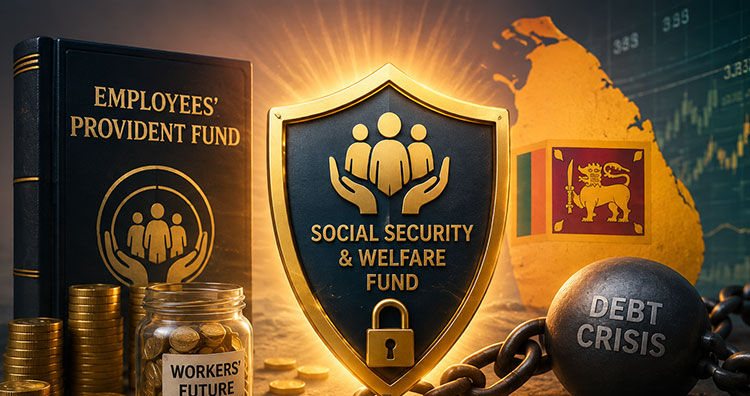
Social security and welfare fund, valued at US$14.63 billion, is in precarious position, says labour activist
Lankan trade unions and labour activists have urged workers to unite and prevent the government’s attempt to undermine the nation’s largest social security and welfare fund amid concerns over economic hardships due to the island nation’s debt crisis, UCAN has reported.
Anton Marcus, joint secretary of Sri Lanka’s Free Trade Zones and General Services Employees Union, said the fund, representing nearly 2.5 million people and valued at 4.9 trillion rupees (US$14.63 billion), is in a precarious position, according the UCAN report.
“There have been several attempts to misuse or take control of this fund under various pretexts, and the latest Cabinet decision has caused concern and unrest among private and semi-public sector employees,” Marcus, a Catholic, said in a press conference on Aug. 4.
The left-wing National People’s Power (NPP) government of President Anura Kumara Dissanayake defended the Cabinet’s decision.
Deputy Labour Minister Mahinda Jayasinghe told parliament on July 24 that the government aims to improve efficiency and member benefits of the Employees’ Provident Fund (EPF) and Employees’ Trust Fund (ETF), and has undertaken a study, the first in decades.
But Media reports said the Cabinet has already approved amendments to the EPF Act of 1958, amid growing concerns among its members about changing social, economic and technological conditions in employment.
Marcus alleged that the labour ministry had submitted the tripartite proposal to the Cabinet without informing the National Labour Advisory Council, the primary tripartite consultative body for cooperation between the government, worker organizations, and employer federations on national labor policies and international labor standards.
The workers remain wary, recalling past attempts by successive governments to misuse the fund, he said.
Marcus recalled the Rajapaksa government’s 2011 attempt to interfere with the fund under the guise of introducing pensions for private-sector workers had prompted trade unions and workers to launch a nationwide protest campaign.
“Workers from the Katunayake Free Trade Zone joined unions in a massive protest, forcing the Cabinet to withdraw the proposal, but police opened fire on the protesters, resulting in the tragic death of young worker Roshen Chanaka and leaving nearly 100 workers injured,” he said.
The island nation’s economic crisis, since the first-ever sovereign debt default in April 2022, has caused heavy reliance on international borrowing. This led to critical shortages of food, fuel, and medicine, alongside massive public protests.
As of early 2026, Sri Lanka’s central government gross public debt stands at $98.97 billion, including $37.47 billion in external debt, as the country restructures debt under its $2.9 billion IMF program.
The EPF and ETF provide workers financial security through retirement savings, housing and medical withdrawals, welfare benefits, migration, disability and marriage-related assistance, plus support for major surgeries, hospitalisation, death and workplace injuries.
Nissanka Sadun, a Christian working as a manager at Katunayake Free Trade Zone, said the latest Cabinet decision has left employees worried about protecting their savings and retirement security.
“The comrades who protested with us against the previous government’s attempts to misuse workers’ security funds are now ministers, but their government is trying to misuse the same fund differently,” Sadun told UCA News on Aug. 5.
Sarojani Pathirana, 52, who has worked at a private company in Wattala for 28 years, said her EPF and ETF savings are her family’s only financial security, like several thousand other families.
“Workers depend on EPF savings for housing loans, medical emergencies and partial withdrawals before retirement,” Pathirana, a Buddhist, told UCA News.
The EPF and ETF are mandatory social security schemes, with EPF contributions coming from employees and employers, while ETF is funded entirely by employers.

News
Cabinet nod to increase the number of new automated passenger clearance gates at the Bandaranayake International Airport to 12


Approval of the Cabinet of Ministers was granted at their meeting held on 19.05.2025 to purchase four (04) automated passenger clearance gates for Bandaranayake International Airport.
In addition, it is expected to extend the automated passenger clearance gates facility so far given only to the Sri Lankans
parallel to the e – passport issuance system to be introduced in the year 2027 also to the foreigners who travel to and from this country.
Furthermore, considering also the number of air passengers rapidly increasing with the fast – forwarding business and tourism field, the appropriateness to increase the total automated passenger clearance gates up to twelve (12) in number has been recognized.
Accordingly, the Cabinet of Ministers, approved the resolution furnished by the Minister of Public Security and Parliamentary Affairs to initiate the procurement and installation of 12
automated passenger clearance gates altogether with the already approved four (04) and another eight (08) automated passenger clearance gates adhering to the formal procurement procedure
Based on the observations submitted by the Task Force on Prevention of Money Laundering and Financing for Terrorism, approval of the Cabinet of Ministers was granted at their meeting held on 18.12.2024 to amend the Trust Ordinance No. 9 of 1917 including amendments proposed by the Financial
Intelligence Unit of the Central Bank of Sri Lanka.
Accordingly, clearance of the Attorney General has been granted for the Trust (Amendment) Draft Bill formulated by the Legal Draftsman.
Therefore, the Cabinet of Ministers approved the resolution furnished by the Minister of Justice and National Integration
to publish the said draft bill in the government gazette notification and thereby, submit the same to the Parliament for its concurrence.
Action was taken to provide a fuel relief for the fuel consumers during the months of April, May and June of 2026 to redress by minimizing the impact caused to the day today life of the citizens of this country as well as the entire economy due to the price hike of petroleum fuel in the global market resulting from the war situation in the Middle East.
Government mediation is essential for minimizing the impact on the day to today life of citizens in this country due to that war situation not being ended further. Therefore, it has been planned to redress on the sale price for Auto Diesel and Industrial Diesel for a period of 03 months by the Government to provide relief to the public as well as to maintain the prices at a bearable level to the consumers without escalating the fuel prices in this country compared to the escalation of fuel prices
in the international market.
Therefore, the Cabinet of Ministers granted approval for the resolution furnished by the President in his capacity as the Minister of Finance, Planning and Economic Development to
allocate provisions subject to the monthly limitations respectively as rupees 15 billion for the month of October, rupees 13.5 billion for the month of November and rupees 12.15 billion for the month of December to provide the said relief

Cabinet nod to increase the number of new automated passenger clearance gates at the Bandaranayake International Airport to 12
Draft Bill for amending the Trust Ordinance
Implementing further relief programme to Public sffected by the Middle East conflict situation
Establishment of a Spectrum Management and Monitoring System and a Quality of Service and Quality of Experience System for the Telecommunications Regulatory Commission of Sri Lanka
Appointment of a Committee for the Restitution of Sri Lankan Cultural Heritage Held Abroad
Ten-Year National Action Plan on the Social Protection Sector (2026–2035)

‘Dates have the highest sugar content to fight Coronavirus’

Sunday Island 27 December – Headlines

#SundayIsland 17th December – Headlines

Sunday Island – 28th March

Sunday Island Headlines – 21 March

Sunday Island – 21st February – Headlines
-

 News7 days ago
Mastermind Naufer Moulavi among 15 found guilty
-

 Midweek Review7 days ago
Thileepan’s fast unto death: An authentic narrative that many missed
-

 Latest News6 days ago
Showers above 100 mm are likely at some places in the Western, Sabaragamuwa, Central and North-western provinces and in Galle and Matara Districts
-

 Editorial7 days ago
Big Bad Bills
-
Editorial6 days ago
Crimes punished and unpunished
-

 Features5 days ago
Beyond traditional jobs: Why Sri Lanka needs to facilitate the gig economy
-

 News7 days ago
One clause in Anti-Corruption (Amendment) Bill requires referendu: SC
-

 News7 days ago
No referendum needed for passage of 22 A: SC