
News
Sajith cites SC ruling requiring referendum for changes to retirement age of sitting SC, CA judges


“2022 SC judgement holds that changing incumbent judges’ retirement ages adversely affects judicial independence”
By Saman Indrajith
SJB and Opposition Leader Sajith Premadasa yesterday told Parliament that a constitutional amendment seeking to extend the retirement age of Supreme Court judges would require people’s approval at a referendum. He cited a 2022 Supreme Court determination which, he said, held that such a change would adversely affect the independence of the judiciary.
Making a special statement under Standing Order 27/2, Premadasa referred to the Supreme Court determination on the constitutionality of the Inland Revenue (Amendment) Bill delivered in 2022 by Justices Buwaneka Aluwihare, PC, Murdu N.B. Fernando, PC, and Janak de Silva.
Quoting from the determination, Premadasa told the House that “unlike public officers and others holding office under the Constitution, the retirement age of the judges of the Supreme Court and Court of Appeal are specified in the Constitution. Any Constitutional amendment to the retirement age or the period of office impacting on incumbent judges, whether directly or indirectly, will impinge on the independence of the judiciary and violate Article 3 which requires a Referendum.”
Premadasa urged the government to take note of the ruling, alleging that despite the Supreme Court’s position, the Justice Minister and the Chief Government Whip had informed the media that a referendum was not necessary..
Premadasa said that although the government had sought to justify the proposed Constitutional amendment on the basis of improving judicial efficiency, it had been opposed by several legal organisations, including the Bar Association of Sri Lanka (BASL). He added that a 2023 report prepared for the Ministry of Justice with technical assistance from the Asian Development Bank (ADB) had identified different priorities for reform.
Premadasa questioned whether extending judges’ retirement age was being pursued as part of a broader judicial reform programme and called on the government to present the remaining reforms, together with a clear implementation timeline.
Pointing to an estimated backlog of 1.1 million pending cases, Premadasa said judicial reform should be based on a comprehensive feasibility study and questioned why the government had not relied on the 506-page assessment report, prepared in 2024, or commissioned a similar study.
The Opposition Leader also sought clarification on whether the government had adequately consulted the BASL, the Law Commission, the Attorney General’s Department and the Judicial Service Commission before proceeding with the proposed constitutional amendment.
Pointing out that judges themselves had rejected the proposal by a margin of 65-0, MP Premadasa said several international legal organisations had also raised concerns that the proposed amendment could undermine judicial independence.
Premadasa called on the government to disclose studies demonstrating that extending the retirement age of judges, without first filling existing vacancies in the Supreme Court and the Court of Appeal, would help reduce delays in the administration of justice. He also requested details of the performance indicators the government intended to use to measure the success of judicial reforms and how the proposed extension would improve those indicators.
He asked the government to reveal when the proposed constitutional amendment had been submitted to the Legal Draftsman’s Department, when it had been approved by the Attorney General, and when it would be gazetted and presented to Parliament for its First Reading.
Premadasa also urged the government to invite the BASL to brief Members of Parliament on the proposed amendments, noting that the SJB had requested such an opportunity. Referring to remarks by the BASL President, he said the Mahanayake Theras of the three Nikayas had also conveyed their opposition to the President in writing and called for that letter to be tabled in Parliament.
He urged the government to subject the proposal to broader public and professional scrutiny, arguing that it should refrain from amending the Constitution solely in relation to the judiciary while simultaneously pledging to introduce a new Constitution to abolish the Executive Presidency.
Responding, Justice Minister Harshana Nanayakkara said the proposal to extend the retirement age of judges was only one component of a wider programme of judicial reforms aimed at improving the efficiency of the court system.
He said the reform programme had been underway since the present government assumed office and would continue throughout its five-year term and beyond.
Nanayakkara said the government had increased the number of courts, identified 11 High Courts with severe case congestion for expansion outside Colombo, and was recruiting judges to the lower courts, while the Judicial Service Commission was appointing additional magistrates.
He added that the government had already implemented several of the more than 160 recommendations contained in the judicial efficiency assessment prepared by President’s Counsel Harsha Fernando under an ADB-supported programme. The government had also taken into account recommendations made by a Constitutional Council subcommittee, headed by Rauff Hakeem, and proposals submitted by former BASL President Jeffrey Alagaratnam to the Parliamentary Committee on Judicial Reforms, chaired by Lal Wijenayake.
The Justice Minister said the draft Bill to extend the retirement age of judges had been received from the Legal Draftsman’s Department on July 28, 2026, and was certified by the Attorney General on July 31, 2026, as being consistent with the Constitution.
He said the Bill would be gazetted after receiving Cabinet approval and presented to Parliament following the expiry of the mandatory seven-day period after publication in the Gazette.

Parliament





By Shamindra Ferdinando
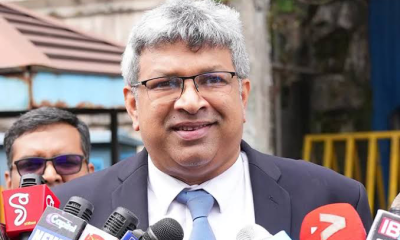
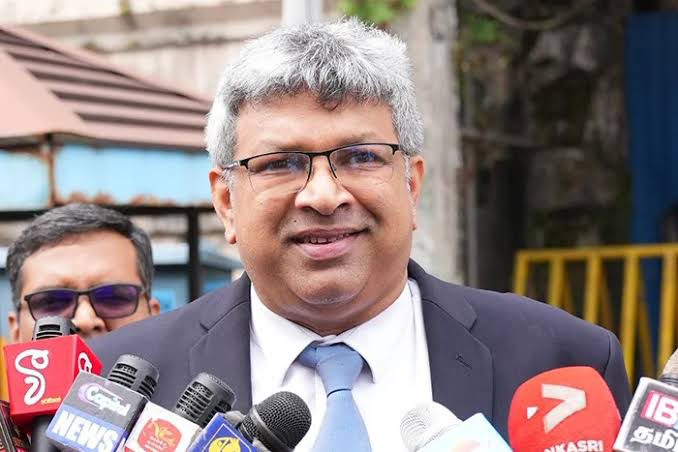
Justice and National Integration Minister Harshana Nanayakkara said yesterday that the government would proceed with both the 22nd Amendment to the Constitution, and the Judicature (Amendment) Bill, because the government could not achieve its goal by increasing the retirement ages of a section of the judges.
The Attorney-at-Law declared that the government would go ahead with both Bills, whatever the obstacles. The Minister was responding to The Island query whether the government would go ahead with the Judicature (Amendment) Bill that hadn’t been so far challenged in the Supreme Court, pending the decision on the controversial 22nd Amendment facing tough legal challenge.
Nanayakkara emphasised the importance of the enactment of both Bills. The 22nd Amendment seeks to increase the retirement ages of Supreme Court judges to 67 from 65 and Court of Appeal judges from 63 to 65. The Judicature (Amendment) Bill seeks to increase the retirement ages of the High Court judges to 63 from 61, and that of the District court judges and and Magistrates to 62.
Minister Nanayakkara said that the enactment of both Bills simultaneously would make a significant contribution to improve the overall situation, particularly dealing with a backlog of 1.1 million cases.
Joint Opposition and the Bar Association of Sri Lanka (BASL), too, acknowledged that petitions against the Judicature (Amendment) Bill were yet to be filed.

U.S. Ambassador-designate Eric Meyer arrived in Colombo on the evening of August 22, 2026, to assume duties as his country’s next Ambassador to Sri Lanka., the embassy said.
Ambassador-designate Meyer expressed his enthusiasm for the opportunity to serve as the 29th U.S. Ambassador to Sri Lanka, stating: “It is an honour to represent the United States in Sri Lanka. I look forward to building on the strong foundation between our two democracies to advance a U.S.-Sri Lanka partnership that creates new opportunities for American businesses, furthers our shared security interests, and delivers greater prosperity for both Americans and Sri Lankans.”
Prior to his assignment in Sri Lanka, he served as Chargé d’Affaires, a.i., at the U.S. Mission to Norway and, before that, as Senior Bureau Official for the Bureau of South and Central Asian Affairs at the Department of State.
By Shamindra Ferdinando
The Joint Opposition yesterday questioned Justice and National Integration Minister Harshana Nanayakkara’s recent declaration that a referendum wouldn’t be held to decide the fate of the 22 Amendment.
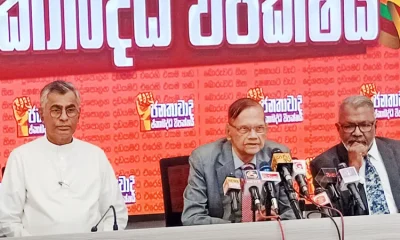
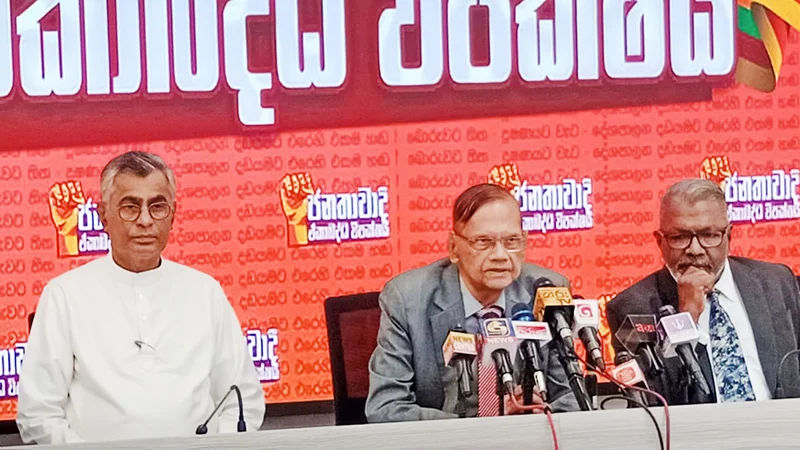
Former External Affairs Minister Prof. G. L. Peiris took exception to Nanayakkara’s statement. Addressing the media at former President Ranil Wickremesinghe’s Flower Road Office, Prof. Peiris said that the Supreme Court was still in the process of receiving petitions against the 22n Amendment to the Constitution.
In fact, petitions could be filed over a period of two weeks from the day the amendment bill was presented to parliament, Prof. Peiris said. Minister Nanayakkara tabled the bill on 18 August.
The convenor of the Joint Opposition asked how Minister Nanayakkara predicted that there wouldn’t be a referendum even before the end of the two week period allocated for the public to submit petitions. The Supreme Court decision would be made known to the Speaker within three weeks, Prof. Peiris said, declaring that the Justice Minister shouldn’t consider the Supreme Court as a rubber stamp of the government.
The former parliamentarian emphasized that the NPP government couldn’t under any circumstances intervene in the process undertaken by the Supreme Court. Referring to the growing number of petitions filed against the 22 Amendment, Prof. Peiris said that all petitioners agreed that the matter should be decided at a referendum.
Prof. Peiris alleged that the Justice Minister ruling out a referendum was contempt of court. He reiterated the call for all sitting Supreme Court judges to hear the petitions. Commenting on three Amendments before the Supreme Court namely the 22 Amendment to extend the retirement ages of superior court judges, Judicature (Amendment) Bill to extend the retirement ages of High Court, District Court and Magistrate court judges and amendments to the Anti-Corruption Act, Prof. Peiris alleged that the government was creating an environment to divide the available Supreme Court judges to deal with all three, simultaneously.
Prof. Peiris said that this was done deliberately to manipulate the process to facilitate the government initiative. Although the Supreme Court consists of 17 judges, including the Chief Justice, four vacancies remained for several months.
The ex-minister appreciated the clergy representing all faiths declaring opposition to the 22 Amendment.

BCCI AGM set for September 18 in Mumbai

Three franchises sold in Afghanistan Premier League T20

Showers above 75 mm are likely at some places in the Western, Sabaragamuwa and North-western provinces and in Kandy, Nuwara-Eliya, Galle and Matara districts

Govt. determined to press ahead with 22A: Justice Minister

U.S. Ambassador designate to Sri Lanka Eric Meyer here

GL alleges Justice Minister committed contempt of court by ruling out referendum

‘Dates have the highest sugar content to fight Coronavirus’

Sunday Island 27 December – Headlines

#SundayIsland 17th December – Headlines

Sunday Island – 28th March

Sunday Island Headlines – 21 March

Sunday Island – 21st February – Headlines
-
 News5 days ago
Country’s first woman Surveyor General appointed
-

 Business4 days ago
SriLankan Airlines makes ShakthiSAT Mission possible for talented Sri Lankan student
-

 Sports6 days ago
Tharanga, Weber headline stellar Lausanne javelin field
-

 Features5 days ago
Medical education in Sri Lanka: Then and now
-
 Business6 days ago
Mannar’s offshore opportunity: the dollar question behind Sri Lanka’s oil and gas search
-
 Latest News5 days ago
Imran Khan moved to private hospital amid deteriorating health
-

 Latest News5 days ago
Government has declared 21, 22 and 23 August 2026 as national days of mourning
-
Latest News4 days ago
Tharanga edges out Chopra in 88m javelin battle