
Latest News
Garry Sobers dies, aged 89

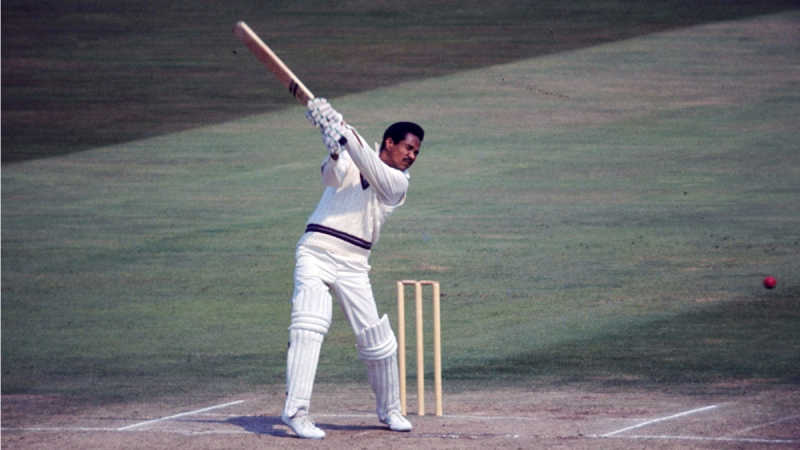
Sir Garry Sobers the legendary West Indies allrounder and one of the sport’s most towering icons, has died at his home in Barbados. He was 89 years old.
Widely regarded by many as the greatest allrounder and most gifted cricketer to have played the game, Sobers excelled as Test batter, could bowl left-arm pace as well as orthodox and wrist-spin, and he was an exceptional fielder and close-in catcher – attributes that once led his fellow all-timer, Sir Donald Bradman, to describe him as a “five-in-one cricketer”.
Sobers played 93 Test matches for West Indies between 1954 and 1974, scoring 8032 runs at an average of 57.78 and took 235 wickets at an average of 34.03. He also captained West Indies in 39 Tests between 1965 and 1972, winning nine and losing 10. The ICC’s premier annual award in men’s cricket – the Sir Garfield Sobers Award – is named in his honour and recognises the most outstanding overall performer in men’s international cricket across all formats.
Sobers made his first-class cricket debut at the age of 16, against the touring India team in January 1953, and excelled with four first-innings wickets to help his side enforce the follow-on. His Test debut followed a year later, against England in Jamaica, where he scored 14 and 26 from No.9 and took 4 for 75 in England’s first innings.
He played his initial Tests as a bowler, but at the age of 23 he scored his maiden Test hundred and also broke Len Hutton’s world record for the highest individual Test score by making 365 against Pakistan at Sabina Park in 1958. It was a record that stood until 1994, when it was broken by Brian Lara, an achievement Sobers was on hand to witness and celebrate.
A decade after that record-breaking innings, Sobers became the first cricketer to hit six sixes in an over in first-class cricket – off Glamorgan’s Malcolm Nash – while playing for Nottinghamshire in Swansea. His first-class career comprised 383 matches for West Indies, Barbados, Nottinghamshire and South Australia and he amassed 28,314 runs at an average of 54.87 and took 1043 wickets at an average of 27.74.
While Sobers played 95 List A games, his international career had wound down by the advent of ODIs and he played only one international in that format – against England at Headingley in 1973. He was knighted for his services to cricket in 1975, and in 2000, he was named as one of Five Cricketers of the Century by Wisden Cricketers’ Almanack, alongside Bradman, Sir Jack Hobbs, Sir Viv Richards and Shane Warne.
Born in Barbados in 1936, Sobers was the fifth of six children, and was raised primarily by his mother after his merchant-seaman father died during the Second World War in 1942. He was born with six fingers on each hand – the extra digits were removed in his childhood – and he excelled in all sports, including basketball, football and golf.
In a statement on behalf of Cricket West Indies, the board president, Dr. The Hon. Kishore Shallow, described Sobers as the “greatest cricketer the world has ever seen”, and offered his “heartfelt condolences to his family, the Government and people of Barbados and all those across the world who mourn his passing.
“There are moments in the story of a people when the life of one individual becomes woven into the hopes, dreams, and identity of generations,” Swallow added. “Today, the Caribbean mourns the passing of such an individual … His mastery of batting, bowling and fielding was unparalleled, but his true significance reached far beyond the boundary ropes.
“He emerged from the Caribbean at a time when our region was finding its voice and asserting its place on the world stage. Through his excellence, he gave millions across our islands and in the diaspora, a renewed belief in what was possible. He showed that greatness was not confined by the size of our nations, the geography of our islands or the circumstances of our beginnings.
“Sir Garfield Sobers became more than a sporting icon. He became a symbol of Caribbean excellence, resilience, and possibility. His achievements brought pride to Barbados, inspiration to the West Indies and admiration from every corner of the cricketing world.”
(Cricinfo)





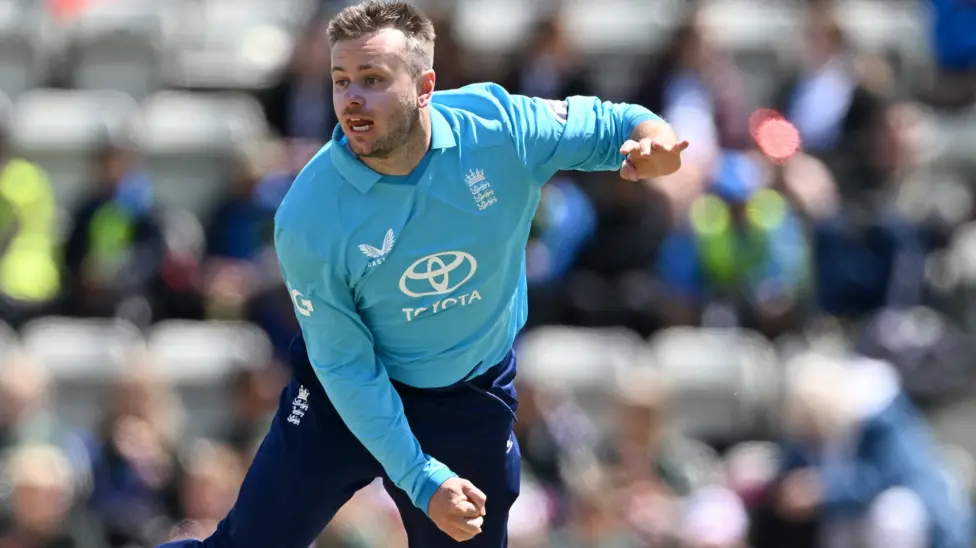
Leg-spinner Mason Crane could play for England for the first time in eight years after being recalled for the one-day international tri-series in Pakistan.
The 29-year-old won his only Test cap against Australia in Sydney in 2018 and is now given an opportunity in the series which also involves Sri Lanka next month.
Crane, who also played two T20 internationals in 2017, could also push his case in the fight to be England’s number one spinner in Test cricket.
Sam Curran and Adil Rashid both return after injuries, and uncapped pair James Coles and Henry Crocombe are included.
Jos Buttler is out with the hamstring injury he sustained last week, while Jacob Bethell is continuing his recovery from knee surgery.
Brydon Carse, who is under an investigation from the Cricket Regulator following an incident outside a nightclub in Derby in August, remains absent.
England are on a diet of white-ball cricket until three Tests in South Africa in December as they build up to the 50-over World Cup in southern Africa next year.
The tri-series in Pakistan involves the three teams taking part playing each other twice, with the top two advancing to the final. Following the trip to Pakistan, England play three one-day internationals and five T20s in Australia in November.
As England continue to shape their backroom staff following the arrival of Stephen Fleming as Test coach, Jeetan Patel, Mike Yardy, David Saker and Carl Hopkinson will assist white-ball head coach Brendon McCullum in Pakistan.
That means Marcus Trescothick, who took temporary charge of the Test team for the series against Pakistan in the home summer, misses the trip.
It is understood the make-up of the coaching staff is part of a plan to rotate the coaches – fielding coach Sarah Taylor and fast-bowling coach Tim Southee are also not going to Pakistan.
All of Trescothick, Taylor and Southee are likely to be part of England’s coaching team for other tours this winter.
England squad for tri-series in Pakistan:
Harry Brook (Yorkshire – captain), Gus Atkinson (Surrey), Sonny Baker (Hampshire), Tom Banton (Somerset), James Coles (Sussex), Jordan Cox (Essex), Mason Crane (Glamorgan), Henry Crocombe (Sussex), Sam Curran (Surrey), Liam Dawson (Hampshire), Ben Duckett (Nottinghamshire), Will Jacks (Surrey), Jamie Overton (Surrey), Adil Rashid (Yorkshire), Joe Root (Yorkshire), Josh Tongue (Nottinghamshire).
(BBC)
Latest News
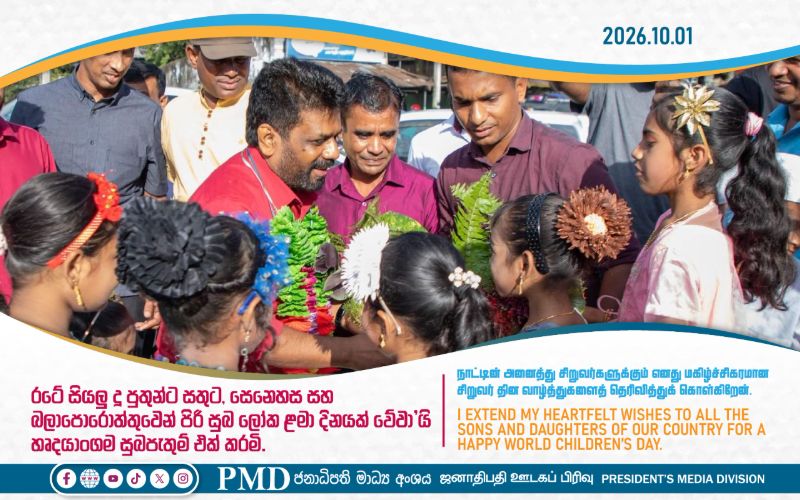
I extend my heartfelt wishes to all the sons and daughters of our country for a Happy World Children’s Day – President
Children’s Day Message from President Anura Kumara Dissanayake:
“Children are the most valuable asset of a nation. Ensuring their physical and mental well-being and creating an environment conducive to their proper development is a primary responsibility of any government. Children’s imagination, aspirations and creativity will determine the shape and colour of the country tomorrow. The country we build for children must not merely be a country prepared to be handed over to them in the future; it must be a country that gives space to their dreams today, listens to their voices and provides opportunities for them to realise their potential.
For the best interests of children, we are taking the necessary steps to ensure equal access to education, guidance, social protection, opportunities for sport, leisure and recreation, proper nutrition and access to healthcare, while protecting children from all forms of violence and discrimination and safeguarding their rights.
Race, religion, economic status, geographical background or any other circumstance should not be a barrier to any child’s education or proper development. Every child should have equal and fair opportunities to realise their potential, pursue their dreams and create the future they wish for themselves. To this end, we have already begun the process of reforming the education system in Sri Lanka, transforming it towards a skills-based system suited to the new world, one that does not place a burden on parents or cause distress to children.
Our aim is to ensure that no child is left behind in the new Sri Lanka we are building, and to provide every child with opportunities for development in a safe environment. It should be emphasised that the fundamental objective of all the programmes being implemented, from expanding educational scholarships to securing the future of children growing up in child development centres and those in need of care, is to create a dignified and secure tomorrow for every child in the country.
It is the aspiration of every parent to give their children a better life than the one they themselves experienced. We are currently steering the country’s economy towards a correct and stable direction in order to provide children with a safe and happy childhood, free from the shadows of an unstable economy. At the same time, we have launched the national operation “A Nation United” (Ratama Ekata), bringing everyone together to free the younger generation from the menace of illicit drugs.
At a time when we are working towards the goal of building a safe and better country for children, I greatly appreciate the initiative of the Ministry of Women and Child Affairs in organising this year’s World Children’s Day celebrations under the theme “Strong Minds – Enriched Children”, declaring a National Children’s Day Week and conducting a range of meaningful programmes aimed at strengthening children’s rights, well-being, protection, education and freedom.
I extend my heartfelt wishes to all the sons and daughters of our country for a Happy World Children’s Day”.

Showers or thundershowers will occur in most parts of the island after 1.00 p.m.

Unions resist tripartite EPF management plan

Two arrest warrants issued for Gnanasara thera

CA dismisses GR’s writ petition against arrest

ADB-backed virtual net metering project faces policy contradiction

Media action group flays NPP over new anti-terrorism law

‘Dates have the highest sugar content to fight Coronavirus’

Sunday Island 27 December – Headlines

#SundayIsland 17th December – Headlines

Sunday Island – 28th March

Sunday Island Headlines – 21 March

Sunday Island – 21st February – Headlines
-

 Editorial6 days ago
Birth of a bad law
-

 News4 days ago
Police remove Thileepan statue in Jaffna
-

 News6 days ago
TIN mandatory for key transactions from Nov. 1
-

 Features4 days ago
The 22nd Amendment, constitutional recovery and illiberal slippage
-

 Features4 days ago
Of foreigners as CEOs of Lankan ventures
-

 News4 days ago
Sajith rejects Jt. Opp. protest sabotage claim; SJB TU chief demands remedial action
-

 Features3 days ago
Thailand’s biggest new global star …
-

 Latest News2 days ago
Gold winner Tharanga gets brand-new Honda Vezel from SLAAJ