
Foreign News
Pakistan issues nationwide alert over fears of heavy rains, floods


Pakistan has entered what its disaster authority is calling a “critical” weather window.
The National Disaster Management Authority (NDMA) on Sunday issued a nationwide alert, warning of thunderstorms, heavy rainfall, urban flooding, and an elevated risk of Glacial Lake Outburst Floods (GLOFs) across the country’s northern regions over the next 12 to 24 hours
The alert identified Hunza and Skardu areas in the mountainous Gilgit-Baltistan region in the north and the Khyber Pakhtunkhwa province in the northwest among the most vulnerable areas to a possible climate disaster.
Authorities also warned of flooding in capital Islamabad, and other urban areas, including Rawalpindi and its adjoining areas. Provincial and district administrations have been placed on high alert and directed to keep their drainage systems clear.
The NDMA advised tourists and travellers to avoid unnecessary travel during heavy rains. People have also been asked to check weather forecasts and road conditions before visiting the northern regions, where landslides could cause closure of some roads.
The warning came as Pakistan braces for a likely fourth consecutive year of punishing monsoon, which is expected to arrive later this month.
Last year, monsoon rains in Pakistan killed more than 1,000 people, including 275 children, and displaced three million from their homes.
But it was the historic floods in 2022 – mainly caused by melting glaciers and submerging nearly a third of the country – that put Pakistan on a global climate crisis watch.
Pakistan contributes less than 1 percent of global emissions, yet remains among the five countries most affected by climate change.
In Gilgit-Baltistan, temperatures this year reached a record 48.5 degrees Celsius (119.3 degrees Fahrenheit), breaking a previous high set in 1971. The heat has accelerated glacial melt, swelling and bursting lakes across the ecologically sensitive region.
Pakistan is home to some 13,000 glaciers – the most in the world after the polar icecaps. And global warming is fast melting them.

According to the United Nations Development Programme (UNDP), melting glaciers across Pakistan’s Hindu Kush, Himalayas and Karakoram mountain ranges have formed more than 3,000 glacial lakes in Gilgit-Baltistan and Khyber Pakhtunkhwa. Of those, 33 have been assessed as vulnerable to hazardous outbursts, with more than 7.1 million people living around them at risk.
GLOFs release millions of cubic metres of water and debris within hours, destroying bridges, farms and entire communities downstream.
In partnership with the UNDP, Pakistan in 2017 launched the scaling-up of the Glacial Lake Outburst Flood Risk Reduction project, known as GLOF-II, covering 24 valleys across 15 districts in Gilgit-Baltistan and Khyber Pakhtunkhwa.
The initiative focused on early warning systems, flood protection infrastructure, and community-based disaster preparedness.
But Zakir Hussain, director general of the Gilgit-Baltistan Disaster Management Authority, told Al Jazeera that the scale of coverage under Pakistan’s early warning infrastructure is widely misunderstood.
The GLOF-II project, he said, covered only 16 selected valleys, not Gilgit-Baltistan as a whole, and within those valleys, only a limited number of sites. In many of the areas hit hardest in 2025, including Ghizer, Diamer and parts of Hunza, no early warning system existed at all.
“The problem there was the absence of coverage altogether,” Hussain told Al Jazeera.
“The one exception is Shishper in Hunza valley. That is the single case where an early warning system was in place but did not generate a warning despite the glacier changing its behaviour. In the other instances, these are very different problems, and we should be clear about the distinction.”
(Aljazeera)

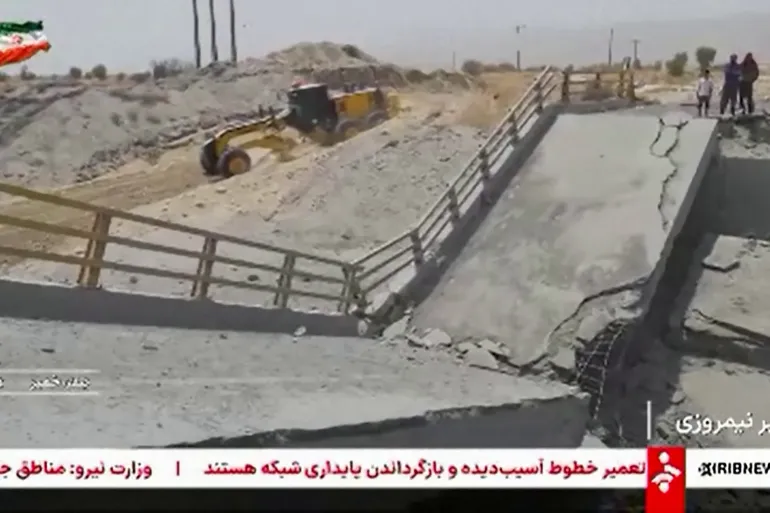
A seventh consecutive night of attacks by United States forces on targets across Iran has left 10,000 people without water after a desalination plant was hit, with Iran retaliating by launching another wave of drones and missiles at US-allied Gulf states.
Hamzeh Pour, chief executive of the Hormozgan Water and Wastewater Company, was quoted by the Tasnim news agency on Saturday as saying that a seawater pumping station and a power transformer at the Bunji desalination plant in Jask in southern Iran were “completely destroyed”, depriving 20 villages of water.
Iran’s retaliation also targeted civilian infrastructure, a war crime under international humanitarian law.
In the early hours of Saturday, Kuwait announced the closure of its airspace and said two power and water desalination plants were hit by Iranian attacks. Several Kuwaiti firefighters were wounded while responding to a fire sparked by the strikes, the country’s firefighting force said.
Air raid sirens also sounded repeatedly in Bahrain, where authorities urged residents to seek shelter.
In Jordan, authorities said they intercepted 10 Iranian ballistic missiles.
Iran’s Islamic Revolutionary Guard Corps (IRGC) said its naval forces had targeted a US military fuel pier at Kuwait’s al-Ahmadi port and a US warplane assembly site at Bahrain’s Sheikh Isa Air Base. The IRGC also said it attacked a US base in Azraq in Jordan, claiming to have destroyed two American fighter jets.
The Iranian attacks came after the US military’s Central Command, or CENTCOM, announced it had carried another wave of overnight strikes targeting “surveillance sites, military logistics infrastructure, underground weapons storage, and maritime capabilities” in Iran.
[Aljazeera]
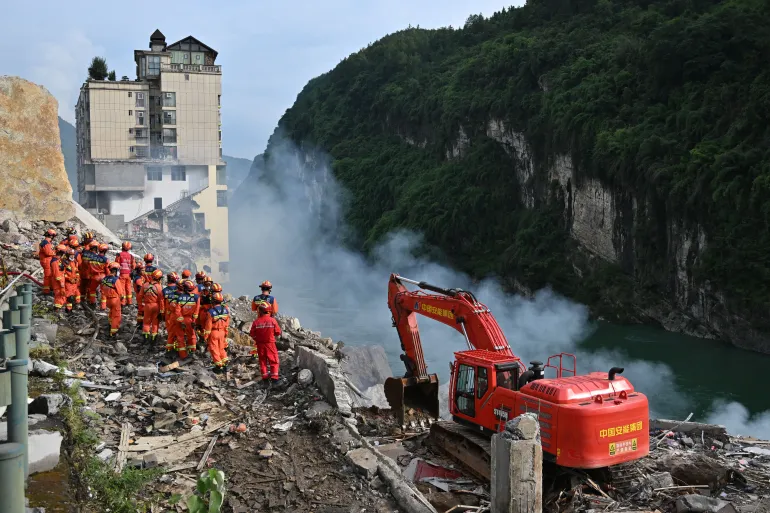
Rescuers are rushing to locate dozens of people missing in the southwestern Chinese city of Chongqing, after a deadly landslide buried homes in the area, according to Chinese authorities.
The landslide took place around 9:10am (01:10 GMT) on Friday in Chongqing’s Pengshui county, killing eight people, leaving 34 unaccounted for and displacing more than 1,100, reported state media.
Footage shared by China’s CCTV broadcaster showed a huge buildup of rocks and dirt covering part of a residential and commercial street at the bottom of a mountain in the region.
Ten people have been rescued from the debris, including two who are seriously injured, reported China’s state-run Xinhua news agency.
Water, electricity and gas supplies were cut off within a one-kilometre (0.6-mile) radius of the landslide to prevent further disruptions. More than 800 rescuers have gone to the site, reported CCTV.

Authorities said they sent more than 8,000 disaster relief items to Chongqing, including tents, folding beds and family emergency kits.
Pengshui county is located in the southeast part of Chongqing, bordering the provinces of Hubei and Guizhou.
The area where the landslide happened is known for “unpredictable” steep terrain, a local official told a news conference, adding that dangerous rocks remain along the sides of the cliff.
The government has allocated 50 million yuan ($7.36m) in natural disaster relief funds to support the rescue and relief operations and to provide assistance to affected residents, the Ministry of Finance and the Ministry of Emergency Management said.
[Aljazeera]

Almost 5,000 people are known to have died in two earthquakes that devastated Venezuela in June, but the United Nations estimates that as many as 50,000 people may still be missing – with many feared buried under rubble.
The number of confirmed deaths is now higher at 4,930, lawmaker Jorge Rodriguez announced on Thursday
The disaster almost a month ago impacted tens of thousands of others. Nearly 17,000 people are wounded, and 21,120 are living in shelters.
Venezuelan teams have been operating since the earthquake struck, but locals say their response has been slow.
“From the very first moment, from when the earthquake happened, there was an immediate response, but from civilians. Civilians and independent people. The state’s response is only being seen now,” Cinthia Pulido, a Venezuelan displaced by the earthquakes, told Al Jazeera. “We’re watching and waiting for some kind of answer.”
International rescue teams sent in the immediate aftermath of the disaster have left as the focus moves to providing humanitarian relief.
“The little I can get is just for me to survive, support my children, and help my mum,” Louismarez Paez, who has also been displaced, told Al Jazeera.
Her mother, she said, does not receive any assistance other than that which she herself provides.
Venezuela has ‘crucial resources’ it cannot access
Venezuela has faced tight US sanctions since 2015, which experts say is making the government’s job even harder.
“Venezuela has crucial resources that it is not being allowed to access,” Mark Weisbrot, senior economist and co-director at the Center for Economic and Policy Research, said.
That includes $11bn blocked by the US and European countries that Venezuela “should legally have”, Weisbrot said.
Earlier this week, a group of 14 Democratic lawmakers in the US sent a letter urging the White House to ease economic sanctions on Venezuela to aid recovery efforts, according to a report from Spanish newspaper El Pais.
The sanctions, they wrote, are “severely hampering urgent relief efforts” and have “severely undermined the country’s response and reconstruction efforts”.
The UN estimates that the recovery efforts in Venezuela could cost the country $37bn.
[Aljazeera]

Iran accuses US of striking critical infrastructure as war intensifies

President meets with Department of Prisons Officials

Prioritize Vocational Education in future Education Planning – President

Davis cup Asia/Oceania Group IV 2026 to be held in Colombo from 20th to 25th July

Navy brings fisherman in distress off Pothuvil, ashore

Malinga, Asalanka seal Galle Gallants win in LPL opener

‘Dates have the highest sugar content to fight Coronavirus’

Sunday Island 27 December – Headlines

#SundayIsland 17th December – Headlines

Sunday Island – 28th March

Sunday Island Headlines – 21 March

Sunday Island – 21st February – Headlines
-

 Features7 days ago
Prison riots and politics: NPP’s biggest challenge and Sri Lanka’s biggest opportunity
-

 Features4 days ago
Dirty Money
-

 Editorial7 days ago
Much ado about crime: Fish or cut bait
-

 Sports7 days ago
The banker who rescued Sri Lankan cricket
-

 Features7 days ago
More on Saudi Arabia: ARAMCO and beyond
-

 News2 days ago
Money laundering case against Yoshitha, fixed for pre-trial conference
-

 Midweek Review4 days ago
The sordid tale of theft and tragedy at Finance Ministry
-
 Latest News4 days ago
Oil prices hit 1-month high as US-Iran attacks dim Strait of Hormuz outlook