
News
George Floyd died from lack of oxygen, not fentanyl, says expert

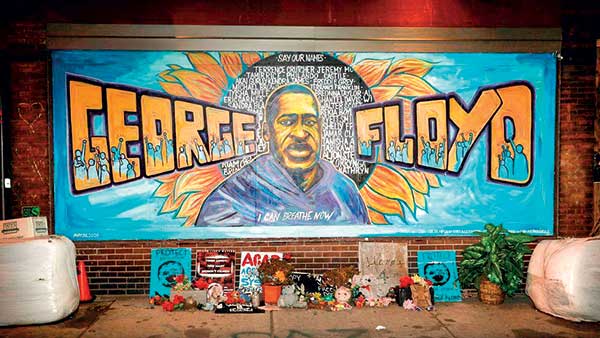
George Floyd died from a lack of oxygen during his arrest, a doctor at the trial of ex-police officer Derek Chauvin in Minneapolis has said.
Contradicting the defence, Dr Martin Tobin said fentanyl did not cause Mr Floyd’s death. He said even a “healthy person…would have died”.
Mr Chauvin, 45, was filmed kneeling on Mr Floyd’s neck for more than nine minutes during his arrest last May.
The ex-officer is on trial for murder and has denied the charges against him.
The footage of Mr Chauvin, who is white, with his knee on African-American Mr Floyd’s neck sparked global protests against racism.
Prosecutors are trying to prove Mr Chauvin’s use of force resulted in Mr Floyd’s death, while Mr Chauvin’s defence are seeking to show he was following his training and that drugs may have caused Mr Floyd’s death.
The trial is in its second week and is expected to last for at least one month. The defence is due to begin arguing its case in court next week.
What did the experts say about fentanyl?
A toxicology report released last June said that Mr Floyd had the painkiller fentanyl and the drug methamphetamine in his system.
Since then, the defence has argued that the fentanyl caused Mr Floyd’s loss of oxygen.
However Dr Tobin, an intensive care doctor, said that Mr Floyd’s breathing did not slow down enough for the painkiller to have been a factor in his total loss of oxygen.
Forensic toxicologist Daniel Isenschmid, whose laboratory tested Mr Floyd’s blood and urine samples following his death, said there was evidence that some of the fentanyl had metabolised, meaning that an overdose was less likely.
The defence also questioned Kentucky police surgeon Dr Bill Smock, an expert in forensic emergency medicine.
Dr Smock said Mr Floyd displayed “air hunger”, a term for when the body becomes desperate for oxygen. While a fentanyl overdose can slow down breathing, he said people who are overdosing are not aware that they are lacking oxygen and often appear sleepy. In contrast, he said Mr Floyd appeared to be alert.
On cross-examination, he agreed with the defence that there was “no safe” amount of methamphetamine to be in someone’s system, and that an overdose of methamphetamine and fentanyl combined may look different from fentanyl alone.
Dr Smock also told the court that while viewing the footage, he heard Mr Floyd complain about being unable to breathe before he was restrained on the ground.
What else was the court told?
Asked about the positioning of the handcuffs behind Mr Floyd’s back, coupled with the downward pressure of Mr Chauvin’s weight against him, Dr Tobin – an expert in pulmonary medicine – said that Mr Floyd’s ability to expand his chest to breathe was severely impaired.
It was, Dr Tobin said, like the left side of his chest was “in a vice”.
Dr Tobin said the positioning of the handcuffs was also significant.
“It’s how they’re being pushed, where they are being pushed, that totally interfere with central features of how we breathe.”
“[Mr Floyd] has used up his resources and is literally trying to breathe with his fingers and knuckles against the street to try to crank up his chest, to try to get air into his right lung,” he added.
“You can see he’s conscious, you can see slight flickering and then it disappears. One second he’s alive, one second he’s no longer.”
‘Healthy person would have died too’
Dr Tobin said that Mr Floyd had already shown signs of brain injury about four minutes before Mr Chauvin took his knee off his neck, and that a healthy person who was put through this “would have died” too.
About three minutes before Mr Chauvin removed his knee, Dr Tobin said, there was “not an ounce of oxygen left in his body”.
“The knee remains on the neck for another three minutes and 27 seconds after he takes his last breath,” Dr Tobin said. “After the officers have found themselves that there’s no pulse, the knee remains on the neck for another two minutes and 44 seconds.”
Dr Tobin used footage captured during Mr Floyd’s arrest to provide his medical opinion on the ninth day of Mr Chauvin’s trial.
During his cross-examination, defence attorney Eric Nelson suggested that Dr Tobin’s assessment was “conditioned upon [Mr Floyd] being a healthy individual”.
“We understand that Mr Floyd had some heart disease,” Mr Nelson said. “That’s going to affect blood flow in a person?”
Dr Tobin said that if Mr Floyd had been suffering from a coronary condition at the time he would have been “complaining of chest pain and demonstrating a very rapid respiratory rate,” adding: “We don’t see either.”
What has happened in the trial so far?
The court has heard from witnesses, medical experts and police officers. The moments leading to Mr Floyd’s encounter with police, as well as the footage that sparked nationwide protests, have been closely scrutinised.
The early stages of the trial saw often tearful testimony from onlookers. The teenager whose video of the arrest went viral said “it’s been nights I stay up apologising and apologising to George Floyd for not doing more”.
This week the Minneapolis police chief Medaria Arradondo said Mr Chauvin had violated the agency’s policy on using force. An expert witness also said that the use of force was “excessive”.
The defence has sought to show Mr Chauvin acted lawfully in a volatile situation. His lawyer said the evidence “is clearly more than about nine minutes and 29 seconds,” referring to the videos of Mr Floyd’s death.
The jury’s verdict must be unanimous and US police officers are rarely convicted or charged at all for deaths that occur in custody. (BBC)


As per the provisions of section 51 of the Public Finance Managaement Act No. 44 of 2024, the public should be issued with a report on the final budgetary situation for each year and, the report is then published in the official website of the Ministry of Finance, Planning and Economic Development.
Thereby the report has to be submitted to the Parliament. The final budgetary situation report (Annual Report) – 2025 has been prepared by the Ministry of Finance, Planning and Economic Development and published. The report contains the Public Finance Policy, strategies and challenges, economic trends in 2025, macro – economic and socio – economic indicators covering all sectors of the economy as well as description on the global economic growth.
Furthermore, it accompanies a detailed description government revenue and expenditure, cash flow management, financing the budget deficit and the loan structure.
Accordingly, the Cabinet of Ministers approved the resolution furnished by the President in his capacity as the Minister of Finance, Planning and Economic Development to submit the Report on the Final Budgetary Condition (Annual Report) – 2025 to Parliament.
Business
Cabinet nod to accept increased Loan Grant provided by the Asian Development Bank under Policy Based Loan Facilities – 2026

Approval of the Cabinet of Ministers was granted at their meeting held on 16.03.2026 to obtain United States Dollars 380 million from the policy – based loan facilities of the Asian Development Bank in the year 2026.
United States Dollars 100 million out of it is allocated for Trade, Investment and Industries Development Programme – Sub Programme 1. However, amidst the economic uncertainty resulting from the current Middle East crisis and the climatic tragedies, the Asian Development Bank has agreed to assist
by increasing a supplementary financing package of United States Dollars 100 million so that it will beMincreased up to United States Dollars 200 million.
Accordingly, the Cabinet of Ministers approved the resolution furnished by the President in his capacity as the Minister of Finance, Planning and Economic Development to take further measures to obtain the said loan grant.
News
Submission of Revenue Protection Order Prepared under the Provisions of the Revenue Protection Act No. 19 of 1962 to the Parliament for its approval.
Approval of the Cabinet of Ministers was given at the meeting held on 23.02.2026 to impose the custom import duty amounts under four (04) categories as 0%, 10%, 20%, and 30% which had been executed only under three (03) categories in order to increase the target export income of the country, to execute the
recommendations of the national customs duty policies committee, and to implement new national sub division customs codes for promoting the local agricultural and industrial sector.
Imposing provisions in relation to the above, the Revenue Protection Order – No. 01/2026 under the Revenue Protection Act No. 19 of 1962 has been published in the extraordinary gazette notification No. 2478/03 of 03.03.2026.
Accordingly, the Cabinet of Ministers approved the resolution furnished by the President in his capacity as the Minister of Finance, Planning and Economic Development to submit the said revenue protection order to Parliament for its concurrence.

Report on the Final Budgetary Condition (Annual Report) – 2025 submited to parliament
Cabinet nod to accept increased Loan Grant provided by the Asian Development Bank under Policy Based Loan Facilities – 2026
Submission of Revenue Protection Order Prepared under the Provisions of the Revenue Protection Act No. 19 of 1962 to the Parliament for its approval.
Resettlement of unauthorized settlers affected by the Land Acquisition process for the implementation of Phase III of the Baseline Road Extension Project
Cabinet approves project to modernize school hostel facilities during the 2026–2028 period at an estimated cost of Rs. 1,008 million
New National Action Plan for Human-Elephant Conflict Management to be drafted

‘Dates have the highest sugar content to fight Coronavirus’

Sunday Island 27 December – Headlines

#SundayIsland 17th December – Headlines

Sunday Island – 28th March

Sunday Island Headlines – 21 March

Sunday Island – 21st February – Headlines
-
 News5 days ago
CIABOC summons Yoshitha over his participation in British Navy training programme
-
 News7 days ago
Local firms move millions of dollars overseas for phantom imports: Govt.
-
 Midweek Review7 days ago
July 09: An inexcusable overall security failure and exceptional contingency plan
-

 Sports2 days ago
Tharanga set for high-profile javelin clash in Ostrava
-

 News5 days ago
Justice Minister responds to social media claims he represented Easter Sunday ringleader
-

 News4 days ago
Commonwealth lawyers urge Lanka to uphold rule of law
-

 Features3 days ago
Politics of protected species
-

 News7 days ago
AI raises concerns over arrest of Sallay and rapper under PTA