
Business
Climate damage costing Sri Lanka over Rs. 50 billion annually; private capital key to recovery and growth

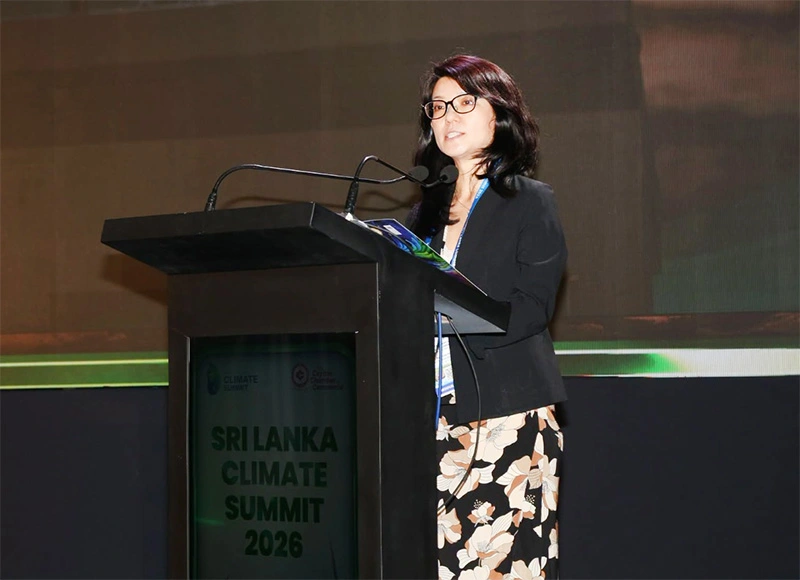
– UNDP Resident Representative Azusa Kubota
Sri Lanka’s climate crisis is no longer merely an environmental challenge but a growing economic threat that is inflicting losses exceeding Rs. 50 billion annually, while placing immense pressure on public finances, investment flows and long-term economic stability, according to United Nations Development Programme (UNDP) Resident Representative Azusa Kubota.
Delivering the keynote address at the Climate Summit organised by the Climate Action Committee of the Ceylon Chamber of Commerce, Kubota said the country urgently needs to transform climate ambition into investable projects capable of attracting private capital, strengthening resilience and driving economic growth.
“Climate change is no longer a distant environmental issue. It is already a risk shaping markets, supply chains, trade, investment and human development. It is fundamentally an economic and development issue,” she stressed.
Kubota warned that climate volatility is intensifying in real time, citing forecasts from the World Meteorological Organisation indicating an 80 percent probability of El Niño conditions during the June-August period, rising to over 90 percent later this year.
For Sri Lanka, this could mean weaker rainfall, higher temperatures, greater pressure on agriculture and hydropower generation, and increased risks to water security, food production and business continuity.
The UNDP official noted that the devastating impacts of recent climate-related disasters had exposed the vulnerability of the economy. Following last year’s severe weather events, the Government’s Post Disaster Needs Assessment estimated damages of approximately Rs. 618 billion, while recovery requirements over the next three years are expected to exceed Rs. 1 trillion, with nearly half the losses concentrated in infrastructure.
“Public finance alone will not be sufficient. Private capital must be strategically directed towards bridging these enormous financing gaps,” she said.
Kubota highlighted that global climate finance reached a record USD 1.9 trillion in 2023, while private climate finance surpassed USD 1 trillion for the first time. However, she pointed out that the world still requires approximately USD 6.3 trillion annually through 2030 to remain on track with climate goals.
“The capital exists. But it will only flow at scale where policies, institutions and project pipelines are credible,” she observed.
She said Sri Lanka has made significant progress in strengthening its climate policy framework through the updated National Climate Change Policy, Nationally Determined Contributions (NDC 3.0), sectoral transition plans and the recently Cabinet-approved Climate Finance Strategy.
However, she cautioned that policy ambitions alone are insufficient unless backed by strong implementation mechanisms.
“The private sector does not invest on the basis of ambition alone. Businesses invest where policy is credible, institutions are clear and projects can move from concept to execution,” Kubota said.
She stressed that investors require certainty regarding procurement systems, regulatory frameworks, financing mechanisms, revenue models and governance structures before committing capital.
The UNDP representative identified renewable energy, energy efficiency, industrial decarbonisation, waste management, circular economy solutions, climate-smart agriculture, ecosystem restoration, resilient infrastructure and carbon markets as sectors with substantial investment potential.
She also pointed to Sri Lanka’s emerging carbon market framework under Article 6 of the Paris Agreement as a potentially significant source of climate finance and international partnerships.
“These are not technical details. They are the conditions that determine whether market interest becomes a credible investment,” she said.
Kubota further noted that Sri Lanka’s first Biennial Transparency Report (BTR), submitted to the UN Framework Convention on Climate Change, provides valuable insights into policy, financing and implementation gaps that need to be addressed.
According to her, transparency and accurate climate reporting are increasingly important not only for international compliance but also for investor confidence, risk assessment and financing decisions.
She urged stronger collaboration between government agencies, financial institutions, industry leaders and development partners to accelerate implementation of climate commitments.
“Climate policy succeeds when it becomes economic policy, and when the private sector becomes a co-owner of implementation, resilience and recovery,” she emphasized.
Kubota said resilience should be viewed not as a social cost but as a strategic economic investment.
“Building back better is not simply a humanitarian imperative. It is central to protecting supply chains, lowering long-term costs and strengthening economic confidence,” she noted.
She added that investments in resilient infrastructure, insurance, climate-smart agriculture, water efficiency, early warning systems and sustainable construction could create entirely new markets and competitive advantages for Sri Lanka.
Looking ahead, Kubota called for stronger alignment between NDC 3.0, the country’s long-term economic vision, emerging carbon market frameworks and financing mechanisms.
“The task now is to connect policy to projects, projects to finance, and finance to measurable results for people, businesses and communities,” she said.
She reaffirmed UNDP’s commitment to supporting Sri Lanka through initiatives including climate investment pipeline facilities and the proposed Canopy Fund, a blended finance mechanism designed to mobilise investment for nature-based solutions.
“The decisions we make today will shape not only Sri Lanka’s climate future, but its economic future as well,” Kubota concluded.
By Ifham Nizam

Business
CMTA warns of further Rs. 40 billion revenue leakage in 2026, calls for urgent removal of 15% depreciation


The Ceylon Motor Traders’ Association (CMTA), the senior-most automotive association in Sri Lanka affiliated with the Ceylon Chamber of Commerce, has issued an urgent appeal to the government to abolish the 15% depreciation currently granted on used vehicle imports, warning that the concession is causing massive revenue leakages at a time when the country can least afford them.
The Association estimates that the existing depreciation mechanism resulted in approximately Rs. 40 billion in lost government revenue in 2025 alone. If corrective action is not taken immediately, a similar level of revenue leakage could occur in 2026, further impacting the government’s fiscal position and depriving the country of much-needed funds for national development and public services.
The Association notes that loopholes within the existing system have created opportunities for misuse, resulting not only in unfair advantages for certain importers but also in substantial losses to government revenue. Addressing these abuses, alongside the removal of the 15% depreciation concession, is essential to ensuring greater transparency, strengthening regulatory oversight, and protecting the integrity of Sri Lanka’s vehicle import sector.
While no official announcement has yet been made regarding the removal of the 15% depreciation, the CMTA has consistently highlighted the issue through multiple budget proposals submitted via the Ceylon Chamber of Commerce. The Association has repeatedly maintained that there is no viable justification for the continued application of this concession on used vehicle imports.
Currently, used vehicles receive a 15% depreciation on their Cost, Insurance and Freight (CIF) value for duty calculation purposes. However, the vast majority of vehicles entering the country through the used vehicle market are virtually zero-mileage units, with CIF values that are often comparable to those of brand-new vehicles. In such circumstances, the CMTA argues that granting a blanket 15% depreciation creates an unfair and unjustifiable tax advantage while significantly reducing government revenue collections.
The Association acknowledges that if the objective through this concession is making vehicles more affordable for consumers, then the CMTA stresses that affordability cannot be achieved through arbitrary concessions that create market distortions and substantial losses to the Treasury. If the intention is to reduce vehicle prices, similar policy considerations could be extended to brand-new vehicles rather than selectively benefiting one segment of the market.
Consumers who purchase brand-new vehicles benefit from manufacturer warranties, which help mitigate maintenance and repair costs during the warranty period. As a result, vehicle owners are less likely to incur additional expenses associated with importing replacement parts, providing greater long-term value, reliability, and peace of mind.
The CMTA further notes that as far back as 2013, a structured depreciation framework was implemented based on the age of a vehicle, rather than a flat-rate concession. Under this proposal, depreciation would be calculated according to a defined scale and capped at a maximum of 10%, ensuring greater fairness, transparency and alignment with the actual value of the vehicle.
The Association stated that the continued application of a blanket 15% depreciation is resulting in significant and unnecessary revenue leakages for the government. At a time when every rupee of revenue is critical to the country’s economic progress, this issue requires immediate attention and decisive action.
The CMTA therefore strongly urges the relevant authorities to take swift action to abolish the current 15% depreciation concession and close this avenue of revenue leakage without delay. The Association emphasises that every month of inaction increases the risk of further losses to the state and undermines efforts to strengthen public finances.
Should the government determine that some form of concession should continue to be extended to the used vehicle market, the CMTA maintains that it must be implemented through a structured and transparent framework based on vehicle age and capped at a reasonable level. Such an approach would ensure fairness while safeguarding government revenue and maintaining a level playing field across the automotive industry.

Businesses in Sri Lanka risk severe financial and operational disruption unless they urgently invest in climate adaptation and resilience measures, leading climate experts warned at a high-level dialogue on “Climate-Proofing Business Sri Lanka” held on Wednesday at Genesis – The Dilmah Centre for a Sustainable Future.
The event, jointly organized by Genesis and the Ceylon Chamber of Commerce, brought together corporate leaders, sustainability professionals, policymakers and climate specialists to discuss how climate change is rapidly emerging as one of the biggest risks facing Sri Lanka’s economy.
Climate Change and Disaster Risk Management Specialist Rohan Cooray said climate-related disasters were already exacting a heavy economic toll globally and locally.
He noted that climate-induced losses divert resources that could otherwise be invested in economic development and business growth and stressed the need for stronger adaptation measures to protect investments and livelihoods.
Delivering the keynote address, internationally renowned climate lawyer and governance specialist Dr. Lalanath de Silva said climate change was no longer a future threat but a present-day economic reality that businesses could not afford to ignore.
“The impacts are coming whether we like it or not,” he said. “The question is whether we prepare now or pay a much higher price later.”
Dr. de Silva explained that while global efforts have largely focused on mitigation—reducing greenhouse gas emissions—adaptation has become equally important, particularly for vulnerable countries such as Sri Lanka.
“Sri Lanka contributes less than one percent of global greenhouse gas emissions, yet we are among the countries most vulnerable to climate impacts,” he said.
He warned that climate change would alter rainfall patterns, intensify floods and droughts, increase the frequency of extreme weather events and place growing pressure on infrastructure, agriculture, water resources and businesses.
“We are very good at producing plans in Sri Lanka. What we have not been good at is implementing them.”
Calling for stronger institutional coordination, Dr. de Silva proposed the establishment of a high-level climate coordination mechanism operating at the highest level of government to ensure coherent action across ministries and agencies.
Providing scientific context to the discussion, Cooray presented projections based on global and regional climate models adopted by Sri Lanka’s Department of Meteorology.
According to Cooray, rainfall patterns across Sri Lanka are expected to become increasingly erratic.
The wet zone is projected to receive more intense rainfall events while many dry-zone regions could experience prolonged drought conditions interspersed with extreme rainfall episodes.
“The danger is not simply that some places become wetter and others become drier. The danger is the increasing variability and unpredictability of rainfall,” he said.
While mitigation projects often generate measurable returns, adaptation investments require innovative financing mechanisms and stronger public-private partnerships, speakers noted.
The event also featured contributions from Dilhan C. Fernando, chairman of Dilmah Ceylon Tea Company PLC; Shiran Fernando, Secretary General and CEO of the Ceylon Chamber of Commerce; and Yasangi Randeni, Chief Sustainability Officer of Aitken Spence PLC.
Speakers agreed that climate-proofing businesses is no longer simply about environmental responsibility but about safeguarding assets, maintaining competitiveness, protecting supply chains and ensuring long-term economic sustainability.
The consensus emerging from the forum was clear: while mitigation remains important, Sri Lanka’s immediate priority must be preparing businesses, communities and institutions for climate impacts that are already unavoidable.
By Ifham Nizam

Lassana.com, Sri Lanka’s leading floral and gifting brand, officially unveiled its newest flower shop at Cinnamon Grand Colombo recently. The move strengthens the brand’s presence in Colombo’s hospitality and lifestyle sector, offering customers convenient access to premium floral gifting and floral wedding experiences.
The new shop was ceremonially declared open by the Chief Guest Sanath Manatunge – CEO of Commercial Bank of Ceylon, together with the Guest of Honour, Lassana.com Brand Ambassador and former Miss Sri Lanka World Anudi Gunasekera. Dr. Lasantha Malavige – Chairman & Managing Director, Piet De Jong – Head of Flower Division, both of Lassana Group of Companies, Nazoomi Azhar – General Manager of Cinnamon Grand Colombo, Yoosuf Sirajudeen – Manager-Luxury Weddings at Lassana Flora Weddings, together with a large gathering of distinguished guests and well-wishers were also present at the occasion.
The new Lassana.com outlet has been designed to offer a carefully-curated selection of fresh flowers, floral arrangements and gifting solutions, providing hotel guests, corporate clients, residents, and visitors with convenient access to high-quality floral gifting in the heart of the city. Located in the lobby of one of Colombo’s most iconic hospitality destinations, the new flower shop combines elegance, convenience, and the trusted quality that customers have come to associate with the Lassana.com brand. The outlet will also serve as a showcase for the company’s floral artistry and wedding expertise.

Wife, counsel seek regular access to ex-Spy Chief Sallay held under President’s detention order

CIABOC summons Yoshitha over his participation in British Navy training programme

Communist Party condemns ill-treatment of Sallay, calls for review of PTA

Justice Minister responds to social media claims he represented Easter Sunday ringleader

Several SLTB Depots suffer losses due to their remote locations

Three Lankans among seven suspects arrested in Kuwait for alleged drug links

‘Dates have the highest sugar content to fight Coronavirus’

Sunday Island 27 December – Headlines

#SundayIsland 17th December – Headlines

Sunday Island – 28th March

Sunday Island Headlines – 21 March

Sunday Island – 21st February – Headlines
-

 News5 days ago
Women’s T20 World Cup 2026 warm-up: Chamari Athapaththu’s 94 helps Sri Lanka beat Pakistan
-

 News6 days ago
Asst. Manager, security officer arrested over Rs 30 mn snatch at Horana PB branch
-

 Editorial4 days ago
Probe Sallay’s complaint
-

 News5 days ago
Lankan-Canadian inducted to Toronto Sports Hall of Fame
-

 News2 days ago
Local firms move millions of dollars overseas for phantom imports: Govt.
-

 Editorial5 days ago
Prez in the dock
-

 Features5 days ago
Entering MIT for my Ph.D program, coping with harsh Boston winter and breasting the tape
-

 News6 days ago
No blanket ban on musical performances; only those promoting LTTE