
Sports
Sithuka rattles Ananda as Isipatana continue unbeaten run


by Reemus Fernando
Left-arm spinner Sithuka Gunawardana picked up five wickets as Isipatana rattled Ananda for 66 runs before cruising to a ten wicket victory in their final group match of the Under-19 Division I Tier ‘B’ tournament at BRC on Wednesday.
The massive win reconfirmed Isipatana as the unbeaten champions of their group in the Division I Tier ‘B’ competition.
St. Peter’s pulled off a decisive win against Mahinda to conclude the league stage as unbeaten champions in their group, also in Tier ‘B’. Despite a defeat, Mahinda as the runner up of that group have qualified for the knockout stage.
St. Anthony’s, Wattala emerged as the champions in Group ‘Z’ of Tier ‘B’ as they recorded a win against St. Sylvester’s.
In Tier ‘A’, Royal finished their group matches unbeaten as Ahan Wickramasinghe with a half century and Resandu Thilakarathne with a run a ball 42 helped them top 300 runs against D.S. Senanayake. Abishek Liyanarachchi’s century was in vain for DSS as they finished the group stage with just a solitary win in five outings.
While Royal are the champions in Group ‘X’, Trinity who beat Gurukula yesterday are the runners up.
De Mazenod earned their only win of the tournament when they handed Wesley a shocking 29 runs defeat.
Meanwhile in a traditional match Ryan Fernando scored a century for S. Thomas’ Mount Lavinia to post 262 for eight wickets against St. Anthony’s, Katugastota. The match is played at Sooriyawewa. The Thomians are playing the match there to prepare for the Big Match. The Battle of the Blues will be played at the venue in May.
Results
Tier ‘A’
Royal beat DSS at Reid Avenue
Royal
319 for 7 in 50 overs (Sineth Jayawardena 49, Ahan Wickramasinghe 70, Uvindu Weerasekara 22, Sadisha Rajapaksha 33, Resandu Thilakarathne 42n.o., Kavindu Pathirathna 30, Extras 42; Amitha Dabare 2/60, Imesh Adeesha 3/62)
DSS
255 all out in 48.4 overs (Abishek Liyanarachchi 107, Maneendra Jayathilaka 68, Kenula Gunaratne 26; Dan Poddiwela 4/37, Uvindu Weerasekara 2/24)
Trinity beat Gurukula at Asgiriya
Trinity
243 all out in 49.2 overs (Umair Raizan 71, Pawan Pathiraja 22, Ranuda Somaratne 52, Abhishek Anandakumara 24, Vibhawith Ehelepola 27; Kemira Nayanatharu 2/32, Thushara Wanigasinghe 3/35, Vihanga Iranjana 2/53)
Gurukula
184 all out in 40 overs (Kemira Nayanatharu 38, Sithija Chamod 82; Shenuka Ilukkumbura 3/33, Umair Raizan 2/31)
De Mazenod beat Wesley at Kandana
De Mazenod
261 for 9 in 50 overs (Lester Jayaweera 100, Salindu Pathirana 44, Senash Fernando 28, Thareen Sanketh 24n.o.; Denuwana Mendis 3/47, Thenuka Perera 2/29, Anudith Wickramasinghe 2/59)
Wesley
232 all out in 45.5 overs (Sahil Dias 32, Semila Liyanage 38, Denuwana Mendis 33, Rakitha Fernando 39; Senash Fernando 2/45, Thareen Sanketh 2/29)
Thurstan win according to Parabola Method at Galle
(Parabola target 224 in 43 overs)
Thurstan
237 for 6 in 49.5 overs (Dananja Silva 100, Ruvinda Dilshan 34, Bawantha Jayasinghe 64; Mihiranga Nimsara 2/36, Sandun Madushanka 2/35)
St. Aloysius’
146 for 5 in 43 overs (Bashana de Silva 52, Omal Sadith 33, Dineth Nimsara 36; Ranga Rasanka 3/43)
St. Peter’s beat Mahinda at Galle
Mahinda
230 all out in 48 overs (Navod Paranavithana 91, Sandew Induwara 25, Rashmika Madushanka 26, Dhanuja Induwara 24n.o.; Vinuda Liyanage 2/42, Jesuran Benjamin 4/41)
St. Peter’s
236 for 4 in 45.1 overs (Shanuka Galagoda 63, Shenal Botheju 41, Rusanda Gamage 27, Lahiru Chethaka 36, Wanuja Kumara 57; Kavindu Lakshan 2/30)
Isipatana rout Ananda at BRC
Ananda
66 all out in 31.4 overs (Maoshada Fernando 19; Sithuka Gunawardana 5/15, Amaan Thaha 2/14)
Isipatana
68 for no loss in 9.1 overs (Tharush Nethsara 38n.o., Naveen Kanishka 20n.o.)
St. Anthony’s beat St. Sylvester’s at Wattala
St. Sylvester’s
261 for 9 in 50 overs (Malith Lakshan 24, Sadeepa Halangoda 39, Charith Samuditha 41, Maleesha Silva 56, Nimsha Deshan 67; Romesh Suranga 4/39)
St. Anthony’s
262 for 8 in 50 overs (Gihan Sathmika 64, Dilip Fernando 47, Kaveesha Dulanjana 41, Kanishka Gimhan 24; Malith Lakshan 2/37, Shashika Gihan 2/44)
Thomians post 262/8 at Sooriyawewa against St. Anthony’s, Katugastota
S. Thomas’
262 for 8 in 78.4 overs (Shalin de Mel 19, Anuk Palihawadena 22, Ryan Fernando 100rtd. Mahith Perera 63; Nimnaka Jayathilaka 4/64, Kaneesha Rajapakshe 2/13)


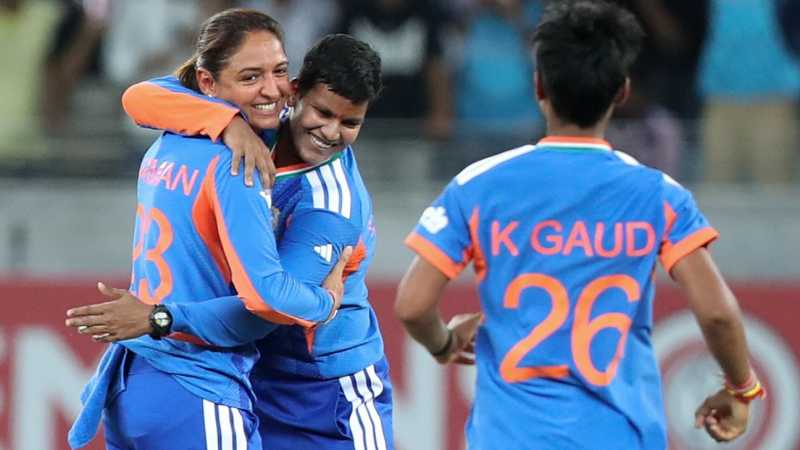
Pakistan were bowled out for 55, their lowest total in T20I cricke. A collapse where they lost six wickets for eight runs in 29 balls set them so far back that they couldn’t even bat out 20 overs. Harmanpreet Kaur, who broke new ground by becoming the first player – male or female – to lead her team 150 times in T20Is, had the time of her life celebrating each wicket and eventually scoring the winning runs as well.
Shree Charani shines
Old-fashioned left-arm spin is having a resurgence. India men have found Manav Suthar. India women already had N Shree Charanin. The No. 1-ranked T20I bowler in the world picked up two wickets in her first over on Saturday.
The flight on the ball drew Gull Feroza out of her crease. The drift in had her looking leg side. The dip and the turn resulted in a leading edge and a simple catch to point. The bowler did everything right. The batter did everything wrong. Shawaal Zulfiqar was the only Pakistan batter to put any kind of pressure on India. Charani had her lbw for 14 off 14 and from there it was a procession.
Pakistan’s batting troubles
Playing their 200th T20I, Pakistan went from 27 for 0 to 35 for 6 before the innings was halfway done. They could not find a risk-free way to score runs, absorbing long periods of dot balls and trying to get out of it by playing low-percentage shots, often against the turn, on a Dubai pitch that was offering plenty of it. Only the openers got to double digits and only Zulfiqar was able to score a run a ball.
Rawat’s support act
Prema Rawat finished with figures of 4-0-9-3. Nineteen of her 24 balls were dots. All of that is remarkable considering she is a legspinner, whose release points tend to be just shy of the perpendicular. Like Shane Warne. From there, they turn their wrist over and it can either be awesome or awful. Rawat’s release point is perpendicular, maybe even beyond it, like Rashid Khan’s. And she doesn’t turn her wrist. For the most part, she just flicks the ball out the front of her hand. This gives her better control at the cost of big turn and in T20Is, that trade-off is well worth it. Nobody could hit Rawat off her line and length and when Sadaf Shamas tried, she got bowled off her pads.
A simple enough chase
Scores:
India Women 57 for 3 in 8.4 overs (Shafali Verma 12, Harmanpreet Kaur 18*, Deepti Sharma 12*; Fatima Sana 3-17) beat Pakistan Women in 18.1 overs 55 (Muneesha Ali 13, Shawal Zulfiqar 14, Shafali Verma 1-10, Shree Charani 3-07, Deepti Sharma 2-05, Prema Rawat 3-09) by seven wickets
(Cricinfo)

Rumesh Tharanga created history in emphatic fashion, winning the men’s javelin at the Diamond League Final in Brussels to become the country’s first Diamond League champion.
The recently crowned Commonwealth champion sealed the prestigious Diamond Trophy with a superb third-round throw of 89.04 metres, producing yet another major performance on the biggest stage.
Tharanga became the first Sri Lakan to win a top position at a global competition conducted under the auspice of World Athletics.
The victory also extended Tharanga’s extraordinary run of form, giving him his 12th victory in his last 13 competitions. His only defeat during that sequence came earlier in the season, underlining the consistency that has made him one of the outstanding performers in world javelin this year.
Tharanga’s winning effort was enough to keep a determined international field at bay, with Poland’s Dawid Wegner producing a lifetime best of 87.47m to take the silver medal. Trinidad and Tobago’s Keshorn Walcott completed the podium in third place.


by Rex Clementine
There is a growing sense of disappointment that, after all that early promise, Kamindu Mendis has faded away somewhat. A player who brings such a multidimensional skill set should by now have cemented his place in Sri Lanka’s white ball sides. But part of the problem with our cricket has been a chronic lack of patience, compounded by some awful choices.
A case in point is Dunith Wellalage. Not many people realise that he made his Test debut two years before his T20I debut. Pramodya Wickramasinghe was the man who made that call and interestingly, he has been heavily involved in selection panels over the last decade, most of them as chairman. No wonder Sri Lankan cricket has spent so much time in the doldrums.
That is not to suggest Kapila Wijegunawardene has arrived as some sort of godsend either. In his fantasy world, Niroshan Dickwella is Alan Knott and Lahiru Kumara is Malcolm Marshall.
Coming back to Kamindu, there was a time early in his Test career when he could do no wrong. At one stage, he reached 1,000 Test runs in 13 innings, equalling Don Bradman’s remarkable feat. During that purple patch, he also scored hundreds in each innings of a Test, something Aravinda de Silva, Sri Lanka’s finest, achieved in the prime of his career.
After that spectacular start, however, Kamindu has been brought back down to earth.
The Indians worked him over with a barrage of short balls. Kamindu succeeded in depositing a few over mid-wicket, but India’s quicks refused to abandon the plan. Their persistence eventually paid off when he was caught in the deep attempting another pull.
When Kamindu fell with Sri Lanka following on, there was criticism that the stroke was unwarranted given the precarious situation the team found itself in. That criticism intensified when a bunch of younger players subsequently dug in, kept India on the field for 240 overs and denied them victory to secure a hard fought draw.
Head Coach Gary Kirsten later elaborated on the freedom given to players to play the strokes that bring them runs without fear of failure. Kirsten’s view was that a player could perhaps minimise the risk involved, but certainly should not completely put away a productive stroke.
Given the prolific start he had made in Test cricket and the package he offered as an all-rounder in the white ball formats, it was only natural that an IPL deal came his way. Kamindu signed up with Sunrisers Hyderabad and made a handful of appearances for them.
It was around this period, however, that some began to notice a change. His attitude was considered indifferent in certain quarters and by last year, there were concerns that he had become something of a disruptive influence within the side. Authorities identified him as one of the key instigators pushing for the team to leave Pakistan despite repeated security assurances from the Pakistani government.
That episode cost his schoolmate the captaincy of the national team, while Kamindu himself was dropped from the T20 side before earning a recall shortly before the World Cup.
At training, though, Kamindu is said to be meticulous. He pays attention to the smallest details and is extremely organised in his preparation. In the middle of a white ball series, for instance, if the entire team is working on the sweep, Kamindu will still find extra time to go through his own routine in addition to whatever the batting coach has prescribed.
He is also not afraid to experiment.
This domestic season, Kamindu opted to move up the order rather than remain in the middle order and the results have been spectacular. Opening the batting on Thursday, he smashed 139 for CCC against Tamil Union.
It remains to be seen whether that domestic experiment will be carried all the way to Southampton in a week’s time, particularly with Kusal Mendis ruled out of the T20 leg of the tour.
Sri Lanka’s planning when it comes to leadership has been equally baffling. In recent years, there has been no proper succession plan for the captaincy. For some strange reason, the practice of naming a vice-captain was abandoned for a period, hardly clever planning when the idea should have been to groom future leaders.
Dhananjaya de Silva, for example, is Test captain almost by default rather than because he possesses any exceptional leadership qualities. Now, when he comes under pressure, you look around and there is hardly an obvious successor waiting in the wings.
Even next year, once the current World Test Championship cycle concludes, the cupboard looks bare. There is no clear candidate ready to take over the Test captaincy.
That was why it appeared a sensible move when the selectors named Kamindu deputy across all three formats for the tour of the West Indies in June. Yet, barely three months later, ahead of the tour of the UK, he has been replaced.
Back comes Charith Asalanka, less than a year after being sacked as captain.
It appears the selectors were concerned that the additional responsibility might affect Kamindu’s batting. He has therefore been relieved of leadership duties, with the expectation that freeing his mind will bring greater consistency with the bat.

Shree Charani, Prema Rawat spin Pakistan out for 55 in one-sided contest

Sun directly overhead Bentota, Thiniyawala, Iththakanda, Udawalawe, and Kataragama about 12.08 noon t9day (06)

Showers above 75 mm are likely at some places in the Uva and Eastern provinces.

Tharanga creates history with Diamond League crown in Brussels

UN welcomes Lanka’s anti-graft drive, seeks end to impunity

Dispute which triggered listed company director being detained at BIA resolved

‘Dates have the highest sugar content to fight Coronavirus’

Sunday Island 27 December – Headlines

#SundayIsland 17th December – Headlines

Sunday Island – 28th March

Sunday Island Headlines – 21 March

Sunday Island – 21st February – Headlines
-

 Features6 days ago
When Sri Lankan stories find their own voice
-

 News6 days ago
BASL takes exception to Justice Ganepola being denied a place in SC
-

 News3 days ago
Denied of promotion to SC despite vacancies, justice Gurusinghe retires
-

 Latest News4 days ago
Grade 5 scholarship exam results released
-

 News3 days ago
22A: SC urged to suspend hearing, appoint full bench
-

 Midweek Review4 days ago
The local and global dynamics of Sri Lanka’s 22nd Amendment
-

 News4 days ago
Ai-CHA expands Lankan footprint with new Negombo outlet
-

 Business6 days ago
ADB-funded Thalaiyadi plant serves as blueprint for vulnerable dry zones in Sri Lanka