
Sports
Quarter-finalists found in U14 boys singles


Clay Court National Tennis
The quarter-finalists of the Under-14 boys’ singles of the Clay Court National Tennis Championship were found as top seeds won their fourth round matches at the Sri Lanka Tennis Association courts on Monday.
Number one ranked Lisal Goonetilleke and second seed Methvan Wijemanne were joined by other top ranked players in the quarter-final. They are Tharuk Marasinghe, Dhanushka Dias, Sandas Usgodaarachchi, Janava de Saram, Senuk Herath and Ganuka Fernando.
Match results
Lisal Goonetilleke bt. Louis Knese 6-1, 6-4
Ganuka Fernando bt. Jayin de Saram 6-3, 6-1
Tharuk Marasinghe bt. Amrik Wettimuny 6-2, 6-7(3), 10-3
Dhanushka Dias bt. Rehan Gunawardhana 7-6 (2), 6-1
Senuk Herath bt. Raveen Akuretiyagama 6-1, 6-1
Sandas Usgodaarachchi bt. Yuthila Hettiarachchi 3-6, 6-2, 10-2
Janava de Saram bt. Methika Wickramasinghe 6-3, 6-2
Methvan Wijemanne bt. Abdul Cader 6-2, 7-6


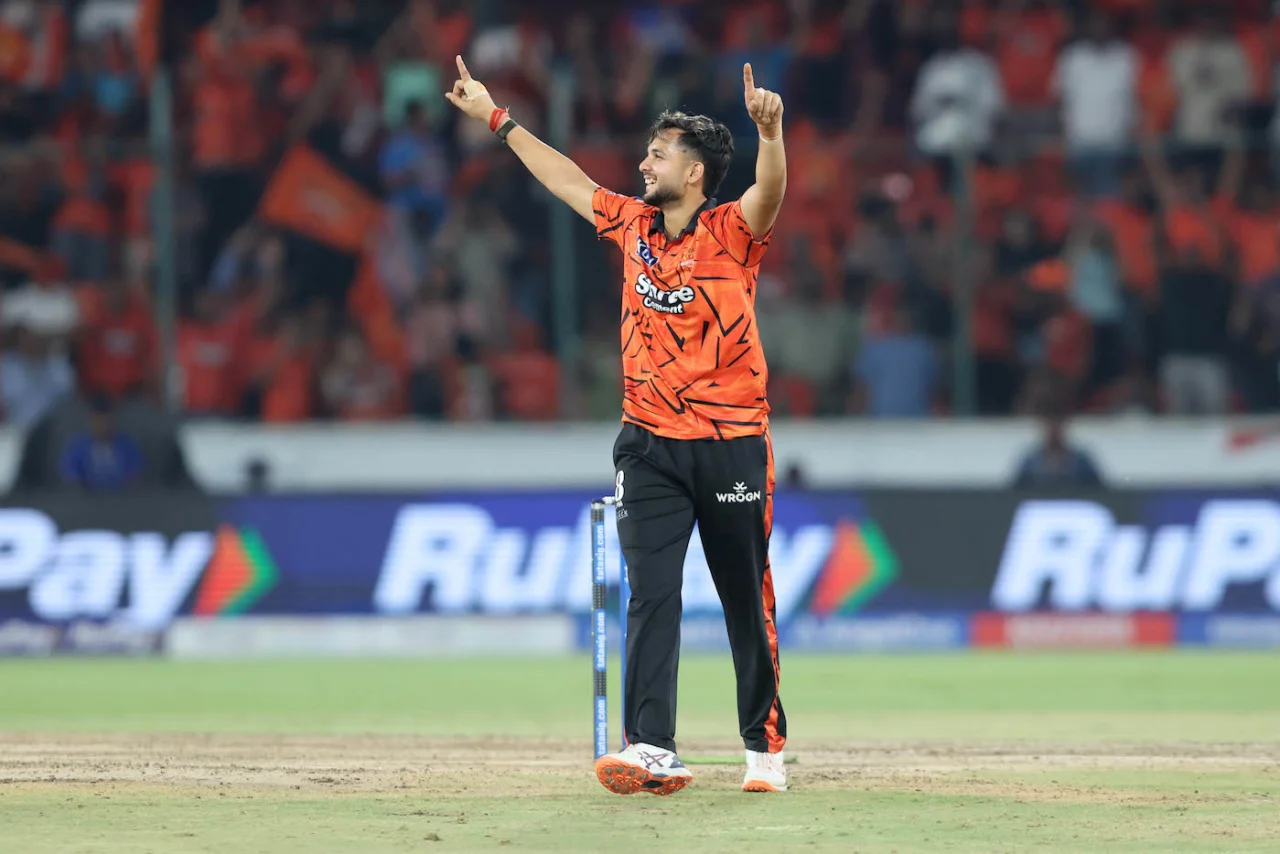
Read this closely. Abhishek Sharma played within himself to bat through a full 20-over IPL innings for the first time and still ended up with 135 not out off 68. Sunrisers Hyderabad’s (SRH) consequent 242 for 2, with supporting vigour provided by Ishan Kishan and Heinrich Klaasen, was more than enough against one of the hitting lightweights of this year’s IPL, Delhi Capitals (DC). The win took SRH level on No. 2 with Royal Challengers Bengaluru and Rajasthan Royals, but the others have a game in hand.
This was Abhishek’s ninth T20 hundred, taking him level with Virat Kohli for most centuries by an Indian. Only three men have more T20 hundreds than him. He equalled his own record for most sixes in an innings for an SRH batter, ten, and made this his second entry in the top-five IPL scores.
It was always going to be a tough ask for DC against a strong bowling line-up at home. Nitish Rana, playing more as an offspinner for the three left-hand batters at the top, kept SRH at bay with a fifty, but the asking rate kept soaring. Three wickets in the tenth and 11th overs to Eshan Malinga and Sakib Hussain ended the contest, leaving DC 137 to get off 58 balls. And as offspinner, Rana went for 55 in his four.
For the second match in a row, Abhishek and Travis Head made a measured start. They followed up their 23 for 0 in three overs against Chennai Super Kings with 26 for 0 in three overs here. There seems to be recognition there that their lower middle order is not the most accomplished, and that they don’t always need 250 with their bowling line-up.
On 12 off seven at the start of the fourth over, Abhishek began to manufacture shots, starting with Lungi Ngidi and his slower balls. Having snuck a quiet Rana over in with the new ball, DC looked like they were happy with the small winnings, but then they raised the stakes by handing over the fifth over to Rana. Abhishek was 21 off 11 at this point, and in a mood to hit the next gear. He hit Rana for two successive sixes before Head got one in. All of a sudden, the powerplay read 67 for 0, still among their slower powerplays, especially when they don’t lose wickets.
The DC captain looked like he wasn’t going to get caught in match-ups arising from the direction of turn as he bowled the seventh over without a boundary but Abhishek then took his second over for 16. Even though he got lucky with Head’s wicket off a short ball, Axar didn’t bowl again.
With the wicket just gone, DC snuck in another quiet over from Rana, but Ishan Kishan and Abhishek resumed carnage against the left-arm wristspin of Kuldeep Yadav, taking 22 off the 11th over. T Natarajan and Mukesh Kumar bowled as well as they could for the next three overs, but still conceded 34. At this juncture, Rana was asked to bowl again, and Abhishek took 23 off him, bringing up his hundred with the second of the sixes in that over. Abhishek’s first T20 hundred took 59 balls; the remaining eight have all come in fewer than 50 balls. This one took 47.
At 115 at the end of the 15th over, Abhishek was a decent shout to challenge Chris Gayle’s 175, but he just couldn’t impart power into his shots even though he kept charging the bowlers. He got only 20 off the last 17 balls he faced, but the remaining 13 balls were maximised by Klaasen, who scored 37 off 13 to go with Kishan’s 25 off 13.
SRH have been keen to give Dilshan Madushanka his IPL debut but a batting collapse in the last match resulted in an extra batter as Impact Player. It didn’t take long to see why. Madushanka swung the ball in the first over, he bowled wobble-seam in the second, and was excellent with old-ball bowling outside the powerplay as well. At the start of his second over, he got rid of compatriot Pathum Nissanka with a catch at mid-off.
Rana and KL Rahul kept fighting but the game was always slipping away. The bowling from Madushanka, Hussain and Malinga kept the pressure up, and the floodgates opened around the halfway mark. Rahul was the first one to go, hitting a low full toss from Hussain straight to deep square leg. Four balls later, Malinga was on a hat-trick, having dismissed Rana and David Miller at the start of the 11th over.
Once again, Malinga found reverse swing, but cleverly he kept mixing it up with slower balls. His four-for took him to 21 wickets after the 10th over in his 14 matches since his IPL debut last year. Among fast bowlers, only Prasidh Krishna has taken more.
Left-arm spinner Harsh Dubey joined the party with three wickets in the last over, all catches in the deep.
Brief scores:
Sunriser Hyderabad 242 for 2 in 20 overs (Abhishek Sharma 135*, Travis Head 37, Ishan Kishan 25, Heinrich Klaasen 37*; Axar Patel 1-23) beat Delhi Capitals 195 for 9 in 20 overs (KL Rahul 37, Nitish Rana 57, Sameer Rizvi 41, Tristan Stubbs 27, Ashutosh Sharma 14; Dilshan Madushanka 1-36, Eshan Malinga 4-32, Sakib Hussain 1-29, Harsh Dubey 3-12) by 47 runs
[Cricinfo]
Marylebone Cricket Club’s generous support not in vain
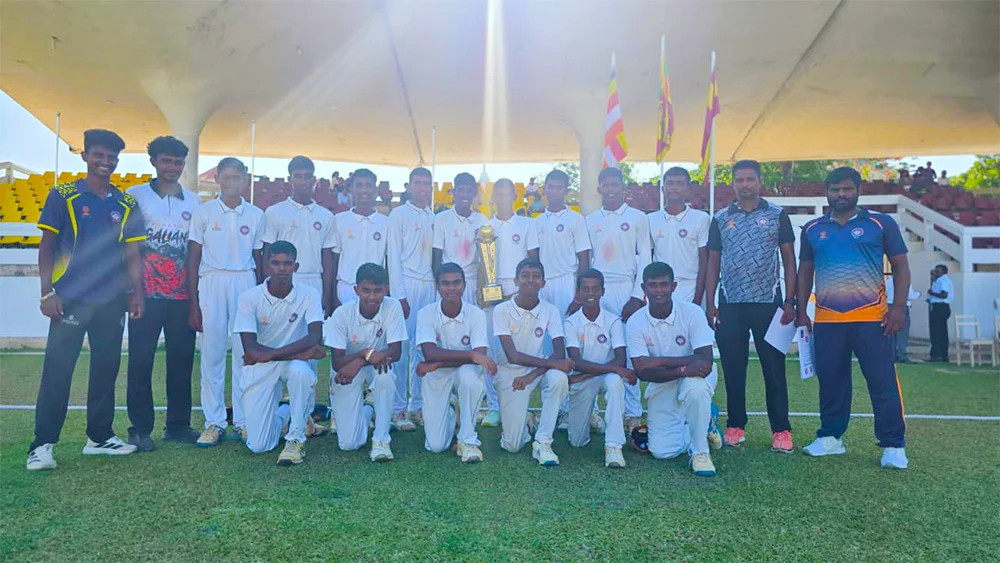
Spinner Tharun Damsith delivered a match-winning all-round performance, claiming 13 wickets after scoring a crucial half-century, as Sri Sumangala Vidyalaya, Hikkaduwa crushed Christ King College, Ja-Ela by ten wickets with a day to spare in the Under 19 Division II Tier ‘B’ tournament final at Ananda Mawatha on Tuesday.
The comprehensive victory capped a remarkable campaign for the Hikkaduwa outfit, who sealed no fewer than nine outright wins since November. Their only setback of the season came earlier in the tournament, when they suffered a narrow two-wicket defeat to the same opponents during the group stage.
Opting to bat first, Sri Sumangala posted a solid 226 in 60.4 overs, built around three valuable contributions. Damsith led from the front with 52, while Shanuka Denuwan stroked a fluent 61 and P. Nirukshan added a steady 43. Despite a fine bowling effort from Lahiru Lakmal, who claimed six for 83, Sri Sumangala had laid a strong platform.
The match turned decisively in the very next innings as Christ King were skittled out for just 61 in 22.4 overs. Damsith ripped through the batting lineup with outstanding figures of five for eight, well supported by Latheendra Akash and Sanjana Nethupul, who shared the remaining wickets.
Asked to follow on, Christ King showed greater resistance, thanks to a spirited counterattack led by Lahiru Lakmal and Avishka Nirmal. Lakmal played a dazzling innings of 93 off 86 balls, smashing five fours and seven sixes, while Nirmal contributed a quickfire 51 off 37 deliveries with five fours and three sixes. Their efforts helped the side avoid an innings defeat.
However, Damsith once again proved unstoppable, returning to claim a sensational eight for 52 in 12.4 overs to complete a match haul of 13 wickets and effectively seal the contest.
Set a token target of 12 runs, Sri Sumangala reached 15 without loss in just 1.5 overs to secure a dominant ten-wicket victory and clinch the Division II Tier ‘B’ title in style.
Both finalists are set to compete in the Tier A category of the Division II tournament from next season.
Sri Sumangala Vidyalaya, Hikkaduwa has been supported by the charity run by cricket icon Muttiah Muralitharan. The Foundation of Goodness, run by former cricketer and philanthropist Kushil Gunasekara at Seenigama, has now for close to three decades generously supported sports activities in the Seenigama area. Their support has gone beyond cricket and young athletes of the area have now started completing at the global stage having succeeded at national level.
Sri Sumangala’s cricket ground was developed by Marylebone Cricket Club, who continue to support the school. Kushil Gunasekara is an Honorary Life Member of MCC.
The school’s success in cricket is a Cinderella story as they have risen from the lowest ranks. Given the way they are progressing, there’s little doubt that in their ranks they could be having the next Jayasuriya or Muralitharan.
Scores:
Sri Sumangala Vidyalaya Hikkaduwa – 226 all out in 60.4 overs (P. Nirukshan 43, Tharun Damsith 52, Shanuka Denuwan 61; Lahiru Lakmal 6/83, Pramodh Chamika 3/23) & 15/0 in 1.5 overs
Christ King College Ja Ela – 61 all out in 22.4 overs
(Vihanga Dilum 16; Tharun Damsith 5/08, Latheendra Akash 3/17, Sanjana Nethupul 2/19) & 176 all out in 42.4 overs (Lahiru Lakmal 93, Avishka Nirmal 51; Tharun Damsith 8/52)
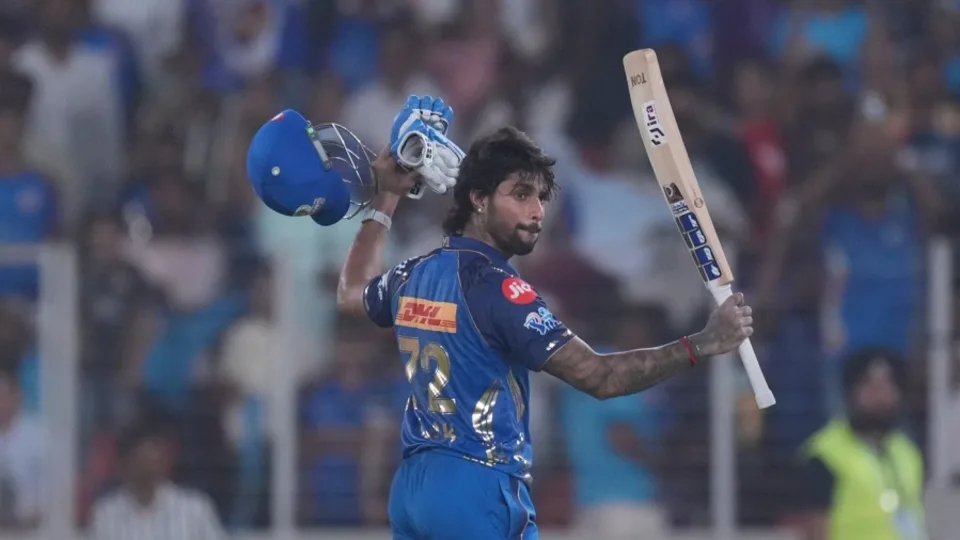
Mumbai Indians (MI) needed something dramatic to scrape themselves off the bottom of the table, and Tilak Varma provided that with a record-breaking hundred to lift them from 103 for 4 in 14 overs. The momentum MI built at the end of their innings was so irresistible it carried into a first-ball wicket for Jasprit Bumrah after he had gone six IPL games wicketless, and the Gujarat Titans (GT) wickets just kept tumbling, ending MI’s four-match losing streak. It was so dramatic in the end that GT ended one short of Tilak’s 101, losing by 99 runs.
The 82 runs that Tilak scored in the last six overs is the most anyone has scored in that period of an IPL innings, resulting in the joint-quickest century for MI, level with Sanath Jayasuriya’s effort in 45 balls in the inaugural IPL season. Sensationally, Tilak did so after not having hit a boundary in his first 20 balls, making this the highest IPL score after such a start.
Without taking anything away from Tilak, Naman Dhir arguably scored the tougher runs when the GT bowlers were red-hot: 45 off 32 from No. 3, when MI had slipped to 44 for 3. Tilak was offered some gifts by bowlers failing to stick to their plans, but his response to the errors was intimidating and likely resulted in further errors.
GT take the fewest risks among IPL teams when they bat. They can afford to do so because their bowlers regularly give them low scores to chase. For the second match in a row, they had their Test bowlers Mohammed Siraj and Kagiso Rabada bowl like they would in a Test match, running through the powerplay with three overs each.
Siraj was excellent with three overs for 15 runs, but the wickets went to Rabada, who was direct with his attack, bowling full, straight and fast. He ripped out Danish Malewar, Quinton de Kock and Suryakumar Yadav in this spell, the latter two with balls timed at 150 and 152kmph.
Led by Rashid Khan, GT kept the batters honest in the middle overs. Encouraged by the turn on offer for Rashid, Shubman Gill went to Washington Sundar in the 11th over. Tilak, still struggling for fluency, turned the strike over to Dhir, who took down Washington like a medium-pacer. And Washington did bowl like a medium-pacer, firing the ball at upwards of 100kmph and getting step-hit for six and four.
However, Prasidh Krishna soon got the wicket of Dhir with yet another short ball, making it 23 IPL wickets for him with short or short-of-a-length balls since the start of the 2025 season. That’s nine more than anyone. He also has the third-best economy rate off those lengths (minimum 30 balls bowled).
Which is what makes what followed all the more inexplicable. When he started the 15th over, Prasidh had the field set for the short ball, but proceeded to bowl one full ball after another. One can be a bluff, two can be errors, but four in a row is hard to explain. Tilak was ruthless, taking 16 off these balls.
Rabada came back to bring some order to proceedings, ending with figures of 4 for 33. Rashid, though, didn’t enjoy a similar end. He overpitched and underpitched the first two balls of the 17th over, and Tilak was now in an irresistible flow, hitting him for four and six.
The biggest over was the 18th, when Tilak outdid Ashok Sharma, who actually followed his plans. The first ball was a wide slower bouncer with the bigger boundary on the off side, but he still upper-cut it for a six. The second ball was hard length outside off, but he still managed to ramp it just over short fine. Now the young fast bowler begun to falter, and Varma demolished the rest of the over for 4, 4 and 6.
Siraj bowled a good 19th, getting the wicket of Hardik Pandya and ending up with figures of 4-0-25-1, but Prasidh again started the 20th over with a full ball. When he eventually went short, Tilak pulled him for a six, but only just cleared the sweeper. A high full-toss flew over long leg for a huge six, and the last ball was pulled away for four to bring up the hundred.
The last time Bumrah took a wicket in the IPL was in the Eliminator last year, incidentally against GT. He had gone six IPL matches without a wicket since then without bowling badly at all. He took the brand-new ball for the first time this season, and had a wicket first up with an unremarkable full ball, which B Sai Sudharsan sliced to cover point.
That MI’s luck was turning was evident in how Pandya got Jos Buttler lbw on umpire’s call with the ball projected to just clip the top of leg stump. Gill then played a nothing pull, neither rolling his wrists over nor trying to hit a six, to make it the first time in 21 matches that GT had lost all of their big three in the powerplay.
The powerplays cancelled each other out with GT scoring 45 for 3 to MI’s 46 for 3. Any hopes of a similar fightback to MI were dashed when Mitchell Santner took out Washington and Glenn Phillips in the same over, Washington to an excellent boundary catch by Dhir.
Ashwani Kumar was then at the receiving end of pressure-induced gifts on three occasions as GT continued to slide. Mystery spinner AM Ghazanfar wrapped up the tail with the wickets of Siraj and Rabada in the same over, making it the first time that an MI batter had outscored the entire opposition.
Brief scores:
Mumbai Indians 199 for 5 in 20 overs (Quinton de Kock 13, Tilak Varma 101*, Naman Dhir 45, Suryakumar Yadav 15, Hardik Pandya 15; Mohammed Siraj 1-25, Kagiso Rabada 3-33, Prasidh Krishna 1-54) beat Gujarat Titans 100 in 15.5 overs (Shubman Gill 14, Washington Sundar 26, M Sharukh Khan 17, Kagiso Rabada 12; Jasprit Bumrah 1-15, Hardik Pandya 1-18, Ashwani Kumar 4-24, Mitchell Santner 2-16, AM Ghazanfar 2-17) by 99 runs
[Cricinfo]

Abhishek’s 135 not out blows Delhi Capitals away

Trump announces Iran ceasefire extension but says blockade remains

Showers above 75 mm are likely at some places in the Western, Sabaragamuwa, Central, Uva and Southern provinces and in Ampara and Kurunegala districts

Cardinal: Presidents, IGPs and AG sabotaged Easter carnage probes before 2024 regime change

CIABOC asks Parliament not to transfer witness in case against Deputy Secy General

UN wants Sri Lanka to deliver concrete results in Easter Sunday bombing probe

‘Dates have the highest sugar content to fight Coronavirus’

Sunday Island 27 December – Headlines

#SundayIsland 17th December – Headlines

Sunday Island – 28th March

Sunday Island Headlines – 21 March

Sunday Island – 21st February – Headlines
-

 News1 day ago
Rs 13 bn NDB fraud: Int’l forensic audit ordered
-

 Business4 days ago
Harnessing nature’s wisdom: Experts highlight “Resist–Align” path to resilience
-

 News7 days ago
PNS TAIMUR & ASLAT set sail from Colombo
-

 News4 days ago
Gratiaen Trust announces longlist for the 33rd Annual Gratiaen Prize
-

 News3 days ago
From Nuwara Eliya to Dubai: Isha Holdings markets Agri products abroad
-

 Opinion2 days ago
Shutting roof top solar panels – a crime
-

 News4 days ago
Heroin haul transported on 50-million-rupee contract
-

 Latest News6 days ago
Singapore Zoo’s first Sri Lankan leopard cubs make their public debut