
Latest News
Finn Allen’s 47-ball ton powers Kolkata Knight Riders to huge win over Delhi Capitals


Kolkata Knight Riders picked up their fourth win on the trot, their spin bowlers (12-0-76-3) capturing Delhi Capitals in a vice-like grip and never letting go Finn Allen made sure that wouldn’t repeat in the second innings. He pulverised DC’s spinners (9-0-102-1) to score his first IPL century even though he only had 143 to chase.
Pathum Nissanka scored a good half-century. He made 50 of DC’s first 85 runs at a strike rate of 172. The other end could only contribute 33 at a strike rate of 103. It was symbolic of how hard it was for a new batter to settle in and how much pressure comes on the set batter on a pitch like this. Even though he was going at a good clip, and had hit the previous ball for four, he still left his crease looking for more and was stumped off Anukul Roy. The left-arm spinner took another wicket, four balls later.
DC were 74 for 2 after eight overs. But only four of those overs were from spin bowlers and three of them were inside the powerplay. Given the comfort of five fielders on the boundary, and a pitch that was slow and turning, Roy, Sunil Narine and Varun Chakravarthy started to dictate proceedings. At one point, DC scored just 11 runs in 30 balls. This was between overs 12 to 16. No IPL team in nearly two decades has ever been this sluggish in this period of play.
Roy set this choke up, stumping Nissanka out with a slower and wider delivery and bowling Tristan Stubbs out with the exact opposite of that. That was solid range for a bowler with no mystery about him.
With DC at 89 for 5, Axar Patel in wretched form (his 44 runs, with only three boundaries, are the fewest by any batter this season having faced at least 50 balls) and the conditions not helping run-scoring, all Narine and Varun had to do was what they do so well. Amp up the mystery. Aim at the stumps. Narine finished with 4-0-17-1. Varun, badly limping when he bowled his final over which cost 16 runs, finished with 4-0-28-0.
Ashutosh Sharma broke a boundary drought that last 38 balls in the 17th over. He reverse swept Vaibhav Arora, coming around the wicket, for six in the 19th over. His cameo – 39 off 28 balls – carried KKR to 142 for 8.
For the first time in his IPL career, Allen played through the powerplay. This was his eighth innings. He might have felt bad for running out his captain Ajinkya Rahane when his straight drive flicked Mitchell Starc’s outstretched finger and deflected onto the stumps but he quickly got over it. DC played a part in that a well with Kuldeep Yadav and Vipraj Nigam bowling balls right in the slot. Allen is superb down the ground and needed no second invitation. From 20 off 17, he launched 10 sixes, the last of them when KKR needed two to win and he needed six to bring up 100.
Allen had a strike rate of 235 against spin (73 off 31). The next best, from both teams, was Rahane with 167, benefiting from playing just three balls and scoring five runs.
In a match where his former team’s spinners held so much sway (economy rate 6.33), Kuldeep suffered, going at 13.66 an over even though he was spared the trouble of bowling in the powerplay. Axar bowled three with the field up and still finished with figures of 4-0-27-1.
Brief scores:
Kolkata Knight Riders 147 for 2 in 14.2 overs (Ajinkya Rahane 13, Finn Allen 100*, Cameron Green 33*; Axar Patel 1-27 ) beat Delhi Capitals 142 for 8 in 20 overs (Pathum Nissanka 50, KL Rahul 23, Axar Patel 11, Ashutosh Sharma 39; Kartik Tyagi 2-25, Anukul Roy 2-31, Vaibhav Arora 1–29, Sunil Narine 1-17, Cameron Green 1-12) by eight wickets
[Cricinfo]

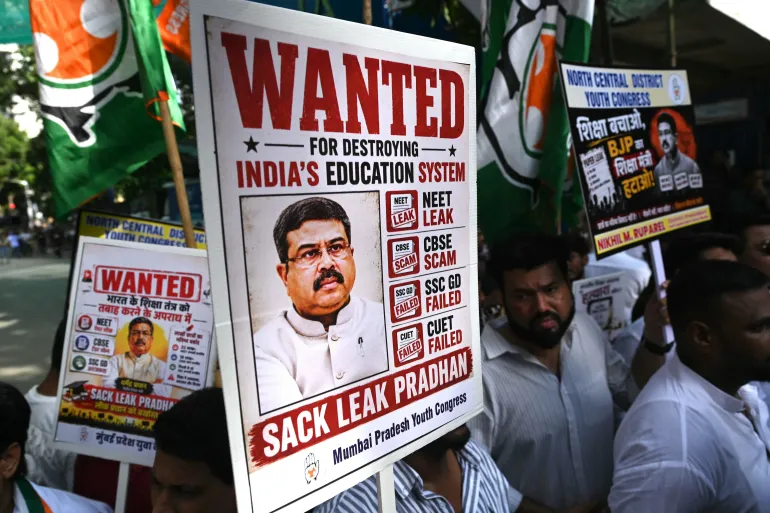
India’s Education Minister Dharmendra Pradhan has resigned, handing a big victory to youth protesters nationwide who had demanded that he quit to take responsibility for a series of examination paper leaks.
Pradhan announced his resignation on X on Saturday, just as police fired tear gas to scatter the protesters in New Delhi, hours before their leaders were set to hold another round of talks with federal ministers.
“Considering the situation that has arisen at Jantar Mantar and across the country, so that antinational forces do not take advantage of this situation … I have sent my resignation letter to Prime Minister [Narendra Modi],” Pradhan wrote in his post.
“I deeply respect the aspirations, feelings, and legitimate expectations of the country’s youth.”
Pradhan said he did not want to allow tens of thousands of students calling for his resignation to be taken advantage of by “anti-national forces”. He said he did not want to see pupils become “entangled in legal complexities” instead of studying and building their careers.
Cheers erupted among the thousands of protesters who have been rallying at New Delhi’s Jantar Mantar area and elsewhere as the news of Pradhan quitting spread.
The demonstrators are part of a political satire movement, known as the Cockroach Janta Party (CJP), established to channel the discontent of India’s youth, many of whom believe they have been failed by Modi and his government.
Federal authorities have restricted access to the internet and to 18 metro stations to try to limit the protest in the capital.
Anger has boiled over since police on Monday injured many students, launching baton charges and firing tear gas and even alleged pellet guns to deter crowds of protesters marching on parliament.
In a post on X, the CJP said: “Cockroaches won… Democracy won!”
A second round of talks between senior members of the group and the government was due to take place on Saturday. It is not clear if that meeting will still go ahead.
Talks were also held on Friday, with the government asking to be given until Saturday afternoon to respond to the demand that Pradhan quit.
The movement is also demanding that no protesters face criminal charges and that families of students who died by suicide following the paper leaks are compensated.
The protests, one of the most visible signs of public dissent against Modi’s government in recent years, reflected growing anger over job scarcity, corruption and government accountability.
[Aljazeera]
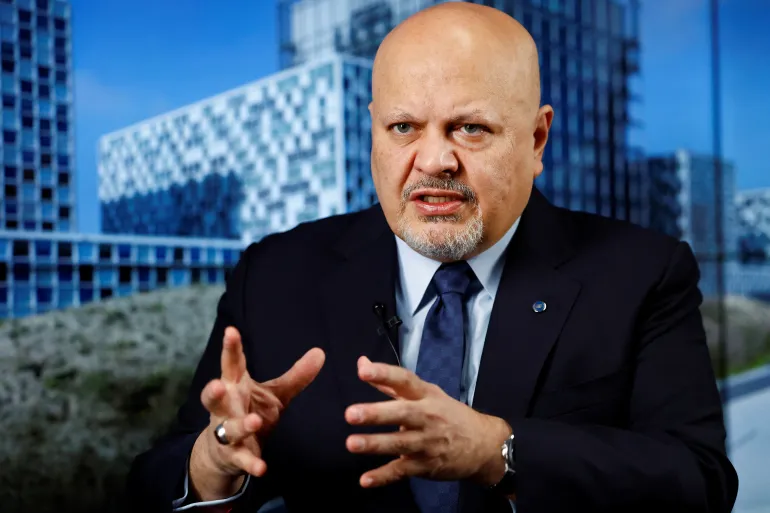
The Assembly of States Parties of the International Criminal Court (ICC) has voted to remove prosecutor Karim Khan over sexual misconduct allegations, his legal team has confirmed, suggesting that the move was “political”.
The vote on Friday came as the ICC faces backlash from the United States and Israel after Khan issued arrest warrants for Israeli Prime Minister Benjamin Netanyahu and his then-Defence Minister Yoav Gallant in 2024.
Tayab Ali, head of Khan’s legal team, noted that a judicial panel had “unanimously” determined that findings by the United Nations Office of Internal Oversight Services “did not establish misconduct or breach of duty by Mr Khan under the relevant legal framework”.
The administration of President Donald Trump had imposed sanctions on Khan and several other ICC officials and judges over the Netanyahu warrant.
“The decision has grave implications beyond Mr Khan’s individual case,” said Ali.
“The independence of the International Criminal Court depends upon its elected officials being protected from removal through processes that are political, procedurally unfair or inconsistent with the findings of independent judicial bodies.”
The lawyer added that Khan was removed “by an executive vote while under sanctions and while the Court is under immense political pressure”.
Ali added that the decision by the Assembly of States Parties “does not follow the evidence or the findings of the only judicial determination in this matter”.
Member states approved Khan’s dismissal almost two years after the allegations first surfaced. The 56-year-old British barrister had already stepped aside in June after an oversight panel concluded he had committed “serious misconduct”.
The ICC said on Friday that Khan’s office will now be headed by deputy prosecutors Nazhat Shameen Khan and Mame Mandiaye Niang.
“Mr Khan’s removal was determined by a process in which he was never given a fair opportunity to be heard, and in defiance of the conclusions of the independent judges who examined the full evidential record,” Ali said.
Khan’s accuser, named only as Sarah, recently told CNN that Khan had shown escalating behaviour of touching and groping her, recounting a time she said he touched her intimately while she was pretending to be asleep.
Khan has denied any wrongdoing and his lawyers have called the process that led to the vote procedurally unfair and unsupported by evidence.
Khan was leading probes into multiple conflicts, but his decision in 2024 to seek arrest warrants for Netanyahu and Gallant over war crime charges in Gaza prompted an intense backlash from governments and advocacy groups.
Former European Union chief diplomat Josep Borrell wrote in an editorial that the case against Khan is “obviously part of a larger offensive against the ICC”.
Khan’s dismissal immediately triggers the election process for a new ICC prosecutor, although a vote is not expected before next year.
(Aljazeera)
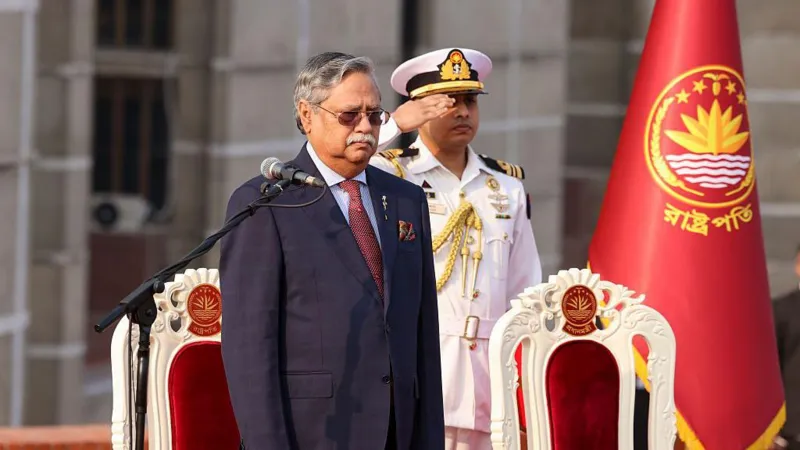
Bangladesh president Mohammed Shahabuddin has resigned, as concerns grow that his former ally, ousted prime minister Sheikh Hasina, will return to the country.
Shahabuddin’s resignation comes days after Hasina told Reuters that she would return to Bangladesh, where she faces the death penalty for crushing student-led protests in 2024 which led to the toppling of her government.
Since then, Shahabuddin has been under pressure to resign from leaders of the ruling Bangladesh Nationalist Party, sources had told BBC Bangla.
Several officials from the president’s office said Shahabuddin signed his resignation letter on Friday afternoon. In the letter he cited ill health as the reason for quitting.
The resignation letter has been submitted to the speaker of parliament, Hafiz Uddin Ahmad.
The speaker is cutting short his visit to Thailand, where he had gone for medical treatment, sources told BBC Bangla.
He will be discharging the duties of the president until a new leader is elected. According to Bangladesh’s constitution, a new president must be elected by parliament within 90 days.
Following the ouster of Sheikh Hasina’s government in the July mass uprising, sweeping changes were made across the board.
Many of her allies were removed, ranging from top-ranking bureaucrats and police officials who had served under her administration to others in key positions.
Shahabuddin was one of the few allies to remain in office.
He continued to serve when an interim government led by Nobel laureate Muhammad Yunus took power, and even after the Bangladesh Nationalist Party secured a landslide victory in the general election in February.
But Shahabuddin, whose term was supposed to end in 2028, told Reuters last December that he was eager to leave his presidency.
He said he had felt “humiliated” by the interim government, citing the sudden removal of his portraits from Bangladeshi consulates and embassies.
At that time he said he would continue his presidency until elections were held and let the next government decide on his position.
Hasina vows to return
Earlier this month, Hasina said in a Reuters interview that she and her allies would return from exile in India and face the court in Bangladesh.
Last year, the International Crimes Tribunal in Bangladesh found Hasina guilty of allowing lethal force to be used against protesters.
The UN Human Rights Commission has estimated that at least 1,400 people died during the unrest which eventually saw Hasina flee the country.
The court sentenced her to death in absentia.
In the months following her departure, her party, the Awami League, has been banned from politics, and many of its leaders jailed.
“My party leaders and workers are being subjected to tremendous repression,” she told Reuters during the interview earlier this month.
“If death comes, I want it to come on my own soil, where my parents are buried and where their blood was shed.”
(BBC)

Spain’s De la Fuente slams Argentina’s World Cup conduct as ‘unacceptable’

Commonwealth Games: Gymnast Langton’s headfirst crash leads to concussion

India’s education minister resigns after weeks of ‘Cockroach’ protests

ICC prosecutor Karim Khan removed over ‘political’ sex abuse claims

A few showers will occur in the Western, Sabaragamuwa and North-western provinces and in Galle and Matara districts

Govt. urged to withdraw Media Professionals Bill

‘Dates have the highest sugar content to fight Coronavirus’

Sunday Island 27 December – Headlines

#SundayIsland 17th December – Headlines

Sunday Island – 28th March

Sunday Island Headlines – 21 March

Sunday Island – 21st February – Headlines
-
 Features7 days ago
Two memorable excerpts from a former SLAF commander’s memoir
-

 Business7 days ago
‘Giving up was never an option’: The fisherman who fought back after losing millions in SL
-

 Life style7 days ago
Taste of the Swiss Alps comes to Colombo
-
 Features7 days ago
Erdoğan’s New Republic
-
 Midweek Review3 days ago
Three high-profile alleged suicides shaping key investigations
-

 News3 days ago
Customs asked to resume probe or face legal action
-

 Editorial4 days ago
Welcome bid to tackle rolling death traps
-
 Foreign News7 days ago
Iran accuses US of striking critical infrastructure as war intensifies