
Latest News
Heat Index at Caution Level in the Northern, North-central, Eastern, Sabaragamuwa, North-western provinces and in Monaragala district during the day time

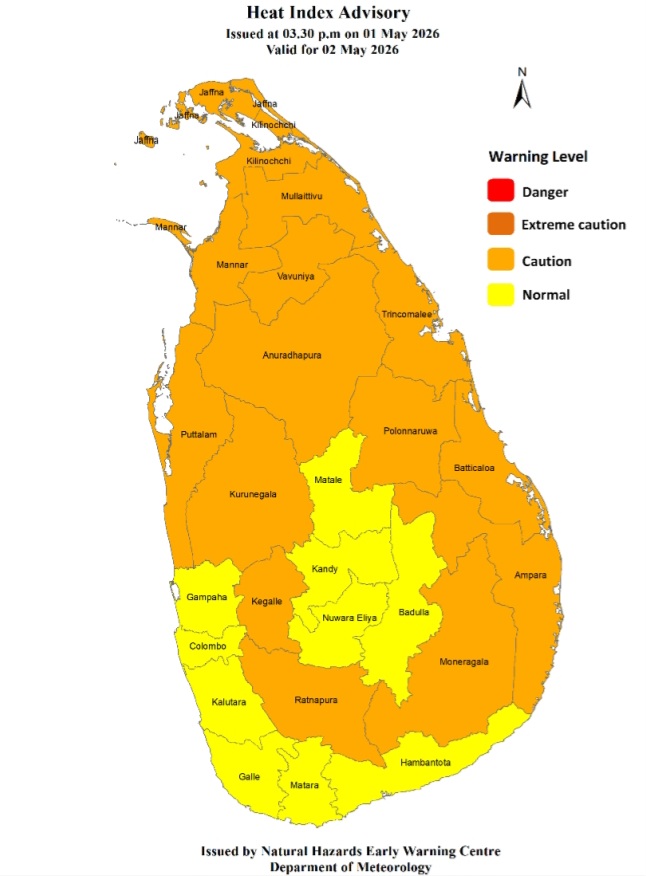
Warm Weather Advisory
Issued by the Natural Hazards Early Warning Centre
Issued at 3.30 p.m. on 01 May 2026, valid for 02 May 2026.
The Heat index, the temperature felt on human body is likely to increase up to ‘Caution level’ at some places in the Northern, North-central, Eastern, Sabaragamuwa, North-western provinces and in Monaragala district during the day time.
The Heat Index Forecast is calculated by using relative humidity and maximum temperature and this is the condition that is felt on your body. This is not the forecast of maximum temperature. It is generated by the Department of Meteorology for the next day period and prepared by using global numerical weather prediction model data.

Effect of the heat index on the human body is mentioned in the above table and it is prepared on the advice of the Ministry of Health and Indigenous Medical Services.
ACTION REQUIRED
Job sites: Stay hydrated and takes breaks in the shade as often as possible.
Indoors: Check up on the elderly and the sick.
Vehicles: Never leave children unattended.
Outdoors: Limit strenuous outdoor activities, find shade and stay hydrated.
Dress: Wear lightweight and white or light-colored clothing.
Note:
In addition, please refer to advisories issued by the Disaster Preparedness & Response Division, Ministry of Health in this regard as well. For further clarifications please contact 011-7446491.

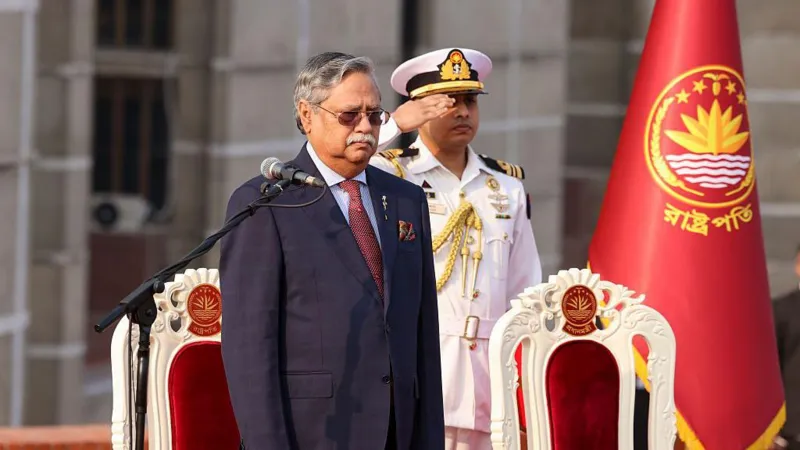
Bangladesh president Mohammed Shahabuddin has resigned, as concerns grow that his former ally, ousted prime minister Sheikh Hasina, will return to the country.
Shahabuddin’s resignation comes days after Hasina told Reuters that she would return to Bangladesh, where she faces the death penalty for crushing student-led protests in 2024 which led to the toppling of her government.
Since then, Shahabuddin has been under pressure to resign from leaders of the ruling Bangladesh Nationalist Party, sources had told BBC Bangla.
Several officials from the president’s office said Shahabuddin signed his resignation letter on Friday afternoon. In the letter he cited ill health as the reason for quitting.
The resignation letter has been submitted to the speaker of parliament, Hafiz Uddin Ahmad.
The speaker is cutting short his visit to Thailand, where he had gone for medical treatment, sources told BBC Bangla.
He will be discharging the duties of the president until a new leader is elected. According to Bangladesh’s constitution, a new president must be elected by parliament within 90 days.
Following the ouster of Sheikh Hasina’s government in the July mass uprising, sweeping changes were made across the board.
Many of her allies were removed, ranging from top-ranking bureaucrats and police officials who had served under her administration to others in key positions.
Shahabuddin was one of the few allies to remain in office.
He continued to serve when an interim government led by Nobel laureate Muhammad Yunus took power, and even after the Bangladesh Nationalist Party secured a landslide victory in the general election in February.
But Shahabuddin, whose term was supposed to end in 2028, told Reuters last December that he was eager to leave his presidency.
He said he had felt “humiliated” by the interim government, citing the sudden removal of his portraits from Bangladeshi consulates and embassies.
At that time he said he would continue his presidency until elections were held and let the next government decide on his position.
Hasina vows to return
Earlier this month, Hasina said in a Reuters interview that she and her allies would return from exile in India and face the court in Bangladesh.
Last year, the International Crimes Tribunal in Bangladesh found Hasina guilty of allowing lethal force to be used against protesters.
The UN Human Rights Commission has estimated that at least 1,400 people died during the unrest which eventually saw Hasina flee the country.
The court sentenced her to death in absentia.
In the months following her departure, her party, the Awami League, has been banned from politics, and many of its leaders jailed.
“My party leaders and workers are being subjected to tremendous repression,” she told Reuters during the interview earlier this month.
“If death comes, I want it to come on my own soil, where my parents are buried and where their blood was shed.”
(BBC)
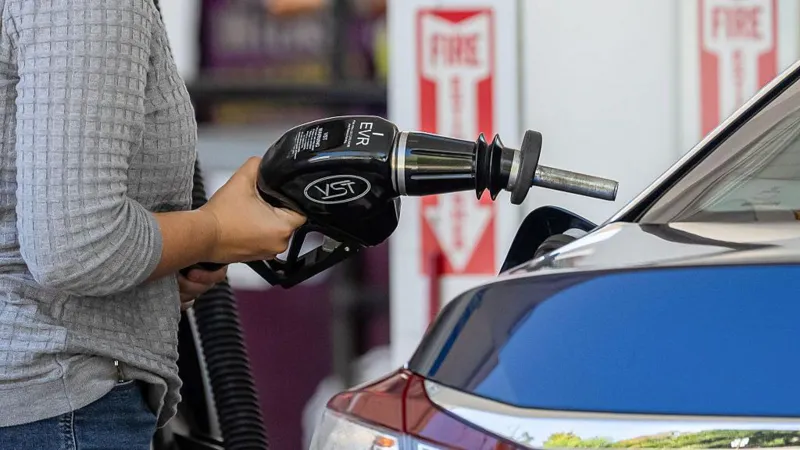
Oil prices hit $100 a barrel for the first time since May as the escalating conflict in the Middle East reignited fears over global energy supplies.
Brent crude – the global benchmark for oil prices – rose more than 6% on Thursday following several days of increases as the US stepped up military strikes against Iran.
Prices spiked after Houthi militia in Yemen attacked oil tankers in the Red Sea, threatening a key export route that Saudi Arabia has used to bypass the Strait of Hormuz.
Gas prices have also risen steadily over the past month, with the benchmark UK gas price currently at around 150 per therm, up from around 98p at the end of June.
Oil prices had been falling following a temporary ceasefire between the US and Iran.
They dropped back to levels last seen before the US and Israel began military action against Iran on 28 February.
However, the ceasefire has failed and this week US Secretary of State Marco Rubio said the people in charge in Iran were “not ready to make a deal”.
The ongoing conflict risks pushing up inflation for many countries, including UK and the US leading to higher prices for consumers.
Higher oil prices typically lead to petrol and diesel becoming more expensive.
While drivers are affected directly, households could also see prices of other goods, such as food, increase due to businesses passing on higher transportation costs to customers.
Inflation has fallen both in the UK – down to 2.6% in the year to June helped by slowing diesel and petrol prices – and in the US to 3.5%.
But questions remain whether the slow down will prove short lived due to the renewed conflict in the Middle East.
New data released on Thursday showed that UK petrol prices have risen by 5p a litre since the beginning of July, hitting reaching almost £1.56.
Diesel is at £1.72 a litre, on average, according to the RAC.
Average gasoline prices in the US have surpassed $4 a gallon once more, up from $3.92 a month ago, according to motorist advocacy group AAA.
“More expensive fuel and energy can ripple through the wider economy, increasing costs for businesses and ultimately feeding through into the price of food and other goods,” said Jonathan Raymond, investment manager at Quilter Cheviot.
“This creates another headache for central banks as they continue their battle against inflation.
“If energy prices remain elevated, policymakers may come under pressure to keep interest rates higher for longer or even raise them. This would come as a blow to mortgage holders and borrowers already feeling the strain.”
The Bank of England, which sets UK interest rates, has held them at 3.75% in its last four meetings.
Paul Dales, chief UK economist at Capital Economics, said he believed the Bank will “almost certainly” hold them again. But he said analysts still expected that interest rates could be cut next year if energy price rises ease.
Kevin Warsh, the newly-appointed chair of the US Federal Reserve, last week told Congress that the central bank had “no tolerance to persistently elevated inflation”.
US President Donald Trump had pushed Warsh’s predecessor, Jerome Powell, to cut interest rates.
Trump has made it clear he expects Warsh to fulfil his demand for reductions in borrowing costs for Americans.
But the Fed held US interest rates between 3.5% and 3.75% at Warsh’s first meeting last month. He also told Congress that he was committed to “restoring price stability” in the wake of the Middle East conflict impacting prices.
[BBC]
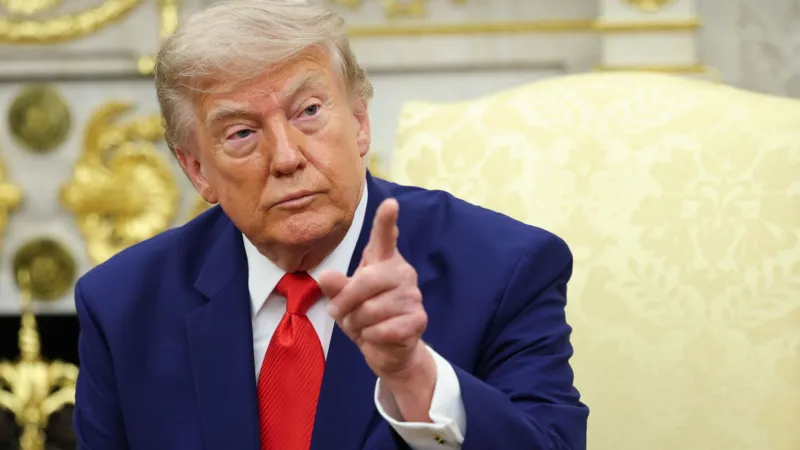
The US has imposed new tariffs on 60 trading partners as a temporary global levy brought in after February’s Supreme Court ruling struck down a host of duties expires.
The duties, ranging from 10% to 12.5% and accounting for the vast majority of American imports, target key economic partners over claims they have failed to properly tackle forced labour – including the UK, China, the European Union, Canada, Japan and India.
They mark the latest escalation in the global trade war reignited by US President Donald Trump when he returned to office last year.
The US Supreme Court ruled earlier this year that many of the tariffs imposed globally under emergency powers were illegally enacted.
Last month, the White House proposed 10% – 12.5% duties on imports from dozens of countries over concerns they were not doing enough to tackle forced labour.
On Thursday, US Trade Representative Jamieson Greer, acting under Trump’s direction, said those duties would now take effect.
“Today’s action will begin to correct what is both a human rights abuse and distortive trade practice to improve the welfare of workers everywhere,” his statement said.
Greer invoked Section 301 of the Trade Act of 1974, which governs US trade enforcement of practices that burden or restrict American commerce.
Earlier this week, the Trump administration invoked a different statute, Section 338 of the Tariff Act of 1930, to impose 50% tariffs on products from Canada.
On Thursday, the Office of the US Trade Representative said the latest tariffs were being imposed on partners “for their failure to impose and effectively enforce a prohibition on the importation of goods produced with forced labour”.
The new duties apply to the top 60 US trade partners covering 99.4% of US imports, it added.
The office said Trump had made adoption of a ban on imports produced with forced labour a “critical” part of reciprocal trade agreements with other nations.
It said so far 10 trading partners had agreed to enact such a ban in these agreements, and other countries had implemented bans in response to its investigations in recent weeks.
Trading partners that have “made commitments to adopt, and effectively enforce” bans on forced labour imports will be subject to a 10% tariff, while those that have not will have the higher 12.5% rate, the office added.
Greer said he was “encouraged by the trading partners who have moved quickly to adopt forced labour import prohibitions, and look[ed] forward to ensuring their effective enforcement”.
The new levies show the Trump administration is “determined” to push on with its tariff strategy, said trade policy expert Deborah Elms from the Hinrich Foundation.
It is unlikely countries hit with tariffs will be able to prove that they have sufficient measures to prevent forced labour imports, she told the BBC.
The levies are likely to raise costs for businesses and consumers, although its impact could be softened due to the number of exempted goods, said the Asia Society Policy Institute’s economic security expert Wendy Cutler.
Most trading partners will be disappointed with the new levies and are likely to focus on ways to “reduce their dependence on the US market” by making deals with other countries, Cutler added.
The head of the British Chambers of Commerce (BCC) told the BBC’s Today programme the UK had lost its comparative advantage against the European Union as a result of the new tariffs.
William Bain said the EU has a 10% all-inclusive deal for tariffs on its goods, while the UK is facing 10% universal tariffs on top of any duties imposed on individual goods.
“So there will be some concerns in the business community this morning about what the UK needs to do to get the same treatment the European Union has got here,” Bain added.
What have other countries said?
Some countries have responded to the announcement, including Brazil. Its government called the move “unjustified” and “arbitrary”.
Washington has chosen to “manipulate an issue of great importance” to workers’ rights to support its protectionist trade policy, Brazil’s government said in a statement.
Brazil, which has been hit with a new 12.5% US tariff, added that it will respond with measures under its “reciprocity law” and consider other trading partners.
Earlier this month, the US imposed a separate 25% tariff on furniture, machinery, sugar and other imports from Brazil, while keeping exemptions of some goods, including beef and coffee.
The Japanese government said on Friday that it “regrets” the new US tariffs, saying that its trade is conducted in line with international rules.
Australian Trade Minister Don Farrell said the levies were “completely unjustified” and that he will continue to press Washington to lift all duties on his country’s goods.
China has previously said it opposed any form of unilateral tariff, and denied allegations of forced labour.
“There is no so-called forced labour in China, and we oppose using this as an excuse for political manipulation,” Chinese foreign ministry spokesperson Mao Ning said.
But several international human rights groups have said forced labour does exist in China, particularly among Muslim ethnic minorities in Xinjiang.
Trump has long argued that tariffs protect American workers and boost the US economy.
In April 2025, Trump imposed tariffs of up to 50% on global trading partners on what he called “Liberation Day”, aiming to address what he saw as unfair treatment of the US.
In February, the US Supreme Court struck down those tariffs and said the president had exceeded his authority, prompting tens of billions of dollars in refunds.
But the White House has since looked at alternative ways to impose import duties, including a sweeping 10% levy as part of a temporary solution that expired on Friday.
Washington has also imposed other tariffs on countries like Brazil and Canada.
The US and China have also been embroiled in a tit-for-tat tariffs war, which is currently on hold.
Trump has used tariffs to press countries, such as Mexico, on non-trade issues.
The administration could be set to impose further tariffs as it is currently investigating 16 countries – accounting for the vast majority of US imports – over claims of manufacturing overcapacity.
[BBC]

Sheikh Hasina ally resigns as Bangladesh’s president

Oil prices hit $100 for the first time since May

US hits dozens of trading partners with new wave of tariffs

Arachchige, Rathnayake and Malinga pump Jaffna

Hermann, Liyanage and Mujeeb steer Colombo Kaps to a 23 run win

Showers expected in the Western and North-western provinces and in Galle and Matara districts

‘Dates have the highest sugar content to fight Coronavirus’

Sunday Island 27 December – Headlines

#SundayIsland 17th December – Headlines

Sunday Island – 28th March

Sunday Island Headlines – 21 March

Sunday Island – 21st February – Headlines
-
 Features6 days ago
Two memorable excerpts from a former SLAF commander’s memoir
-
 Business6 days ago
‘Giving up was never an option’: The fisherman who fought back after losing millions in SL
-

 Latest News6 days ago
Davis cup Asia/Oceania Group IV 2026 to be held in Colombo from 20th to 25th July
-
 Life style6 days ago
Taste of the Swiss Alps comes to Colombo
-
 Features6 days ago
Erdoğan’s New Republic
-

 Midweek Review3 days ago
Three high-profile alleged suicides shaping key investigations
-
 News7 days ago
Evidence recorded in money laundering case against Yoshitha Rajapaksa
-
 News7 days ago
Dengue outbreak gallops ahead: Infections surpasses 73,455, leaving 50 dead