
Foreign News
Will another film star be able to sway the election in India’s Tamil Nadu?

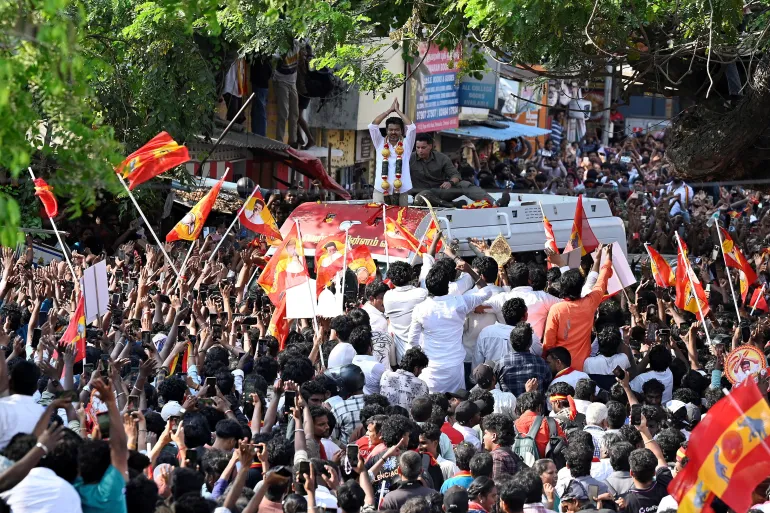
Standing on top of a customised van on a hot and humid afternoon in Tirunelveli, about 600km (373 miles) south of Tamil Nadu’s capital Chennai in southern India, C Joseph Vijay tells his supporters his opponents have joined hands to stop him from becoming the state chief minister.
“My rivals might appear different from outside, but they have only one aim: that Vijay should not become the chief minister,” says the 51-year-old actor-turned-politician to a mammoth crowd that begins to chant his name, which means “victory” in Tamil, in unison.
Tamil Nadu, one of India’s most developed states with impressive human development indices, also has a long history of electing film stars as leaders, some of whom are still revered by people as demigods years after their deaths.
As Tamil Nadu votes on Thursday to elect its 234-member state legislative assembly, Vijay’s bid for power is the latest addition to the state’s trend of film star-politicians, turning a traditionally bipolar battle into a triangular contest.

Vijay entered politics with much fanfare when he launched the Tamilaga Vettri Kazhagam (TVK) party in 2024, promising to end the decades-old dominance of the governing Dravida Munnetra Kazhagam (DMK) and the main opposition All India Anna Dravida Munnetra Kazhagam (AIADMK).
Incumbent Chief Minister MK Stalin leads the DMK and its 14-party Secular Progressive Alliance, in which the Indian National Congress is a junior partner. On the other hand, opposition leader Edappadi K Palaniswami of the AIADMK heads the 10-party National Democratic Alliance, which also includes Prime Minister Narendra Modi’s Bharatiya Janata Party (BJP).
The DMK and the AIADMK identify themselves as Dravidian parties, which derive their names from a powerful political and social justice movement in Tamil Nadu that opposed caste inequalities, championed social reforms, and rejected perceived attempts by India’s more dominant north Indian parties to impose Hindi – and upper-caste Hindu values – on the non-Hindi speaking southern states.
Dravidian parties have held power in Tamil Nadu continuously since 1967, with national parties like the Congress and the BJP playing secondary roles. While the BJP is contesting 27 seats in alliance with the AIADMK, the Congress is fighting for 28 seats as part of the DMK-led coalition.
More than 87 percent of Tamil Nadu’s 72 million people are Hindu, followed by Christians at 6.1 percent and Muslims at 5.8 percent, according to the last census conducted in 2011.
Among Hindus, the so-called “backward” or less-privileged castes constitute 45.5 percent, “extremely backward” castes 23.6 percent, while Dalits are at 20.6 percent. Dalits, formerly referred to as “untouchables”, fall at the bottom of India’s complex caste hierarchy and have faced marginalisation and violence for centuries.
Vijay, son of a Christian filmmaker father and a Hindu mother who is a background singer in films, belongs to the Vellalar community, an affluent agrarian group in Tamil Nadu with both Hindu and Christian members.
Vijay started his film career as a child actor in movies directed by his father. His 1992 debut as a hero, however, in Naalaiya Theerpu (Tomorrow’s Verdict), flopped. Following the setback, his father cast him alongside popular star Vijayakanth — who later founded his own political outfit, Desiya Murpokku Dravida Kazhagam (DMDK) — in Senthoorapandi (1993), which gave his career a new lease of life.
It was the 2004 film Ghilli (Gutsy), which carried a subtle political undertone, that catapulted Vijay to superstar status. He dropped hints about his political ambitions in the 2013 hit Thalaivaa (Leader), which was launched with the tagline: “Time to Lead”.
Soon, political messaging became central to many of Vijay’s subsequent films. Even the title of his yet-to-be-released Jana Nayagan (People’s Leader) — which he claims will be his final film — alludes to his political aspirations.
Riding on personal charisma, Vijay has attracted millions of supporters to his rallies, despite allegations of poor crowd management, which caused a stampede at one such gathering in September last year, killing 42 people.
He is expected to draw a share of Dalit and minority Christian votes that would have otherwise flowed to the DMK-led coalition. He is also banking on anti-incumbency votes that could have benefited the AIADMK alliance.
Yet analysts say Vijay’s ambition of becoming the next chief minister will not be as easy as the scripted blockbusters he has built his career on, since he faces two opponents with decades of experience in real politics.
That leads political commentator R Kannan to describe Vijay as “both a blessing and a curse” for the two Dravidian coalitions.
“When the AIADMK joined the BJP-led NDA, many predicted the Dravidian party would lose heavily, with minorities and Dalits flocking to the DMK. Vijay’s entry, however, has offered the AIADMK a ray of hope — he is expected to draw a decent share of votes that would otherwise have gone to the DMK,” he said.
“At the same time, he works in the DMK’s favour by siphoning off anti-incumbency votes that might have gone entirely to the AIADMK. For both Dravidian parties, he is at once a blessing and a curse.”
Vijay is aiming to follow the path of illustrious predecessors: Maruthur Gopalan Ramachandran, popularly known as MGR, and his protege, Jayaram Jayalalithaa – Tamil Nadu’s most beloved on-screen pair.
Born into poverty, MGR’s rise to stardom was nothing short of phenomenal. He captured the imagination of Tamil Nadu’s working class, who idolised him in return. From his first superhit, Rajakumari (Princess) in 1947, his films cast him as a champion of the masses, battling oppression and corrupt authority.
MGR launched the AIADMK in 1972 after breaking away from the DMK and served as Tamil Nadu’s chief minister from 1977 to 1987. He introduced several welfare programmes, the most significant being a free meal scheme for schoolchildren in order to eliminate malnutrition and boost school enrolment.
His political heir, Jayalalithaa, was a six-time chief minister between 1991 and 2016, when she became India’s first female state leader to die in office. She is remembered for launching several women-centric programmes, including all-women police stations and subsidised two-wheelers for working women, apart from her work in curbing female infanticide.

The DMK also has a history of film personalities, including the party’s founder, CN Annadurai, who rose to fame as a pathbreaking scriptwriter with films like Velaikkari (1949), and MGR as the party’s star campaigner and leader before he founded the AIADMK.
Soon, Muthuvel Karunanidhi emerged as another prominent writer, poet and screenwriter with films like Parasakthi (1952), meaning Supreme Power, often cited as a turning point in Tamil cinema. Directed by Krishnan-Panju and written by Karunanidhi, then 28 years old, the film fiercely attacked casteism and social inequality, while propelling the spread of the Dravidian ideology.
Karunanidhi, popularly known as Kalaignar (artist), wrote scripts for more than 75 films that resonated with the struggles of the working class, championing rationalism and social equality.
He won the Tamil Nadu Legislative Assembly election for a record 13 terms and served as the state’s chief minister for five terms between 1969 and 2011. He died at the age of 94 in 2018, with his son, Stalin, taking over as the DMK chief.
Film star-politicians who embraced Tamil identity politics flourished, while those who did not fell by the wayside.
“Successful leaders such as MGR, popularly known as Puratchi Thaalaivar [Revolutionary Leader], Jayalalithaa, who earned the monikers Puratchi Thalaivi [Revolutionary Female Leader] and Amma [Mother], embraced identity politics. Another popular film actor, Sivaji Ganesan, by contrast, could not make the same mark in politics even after he tried,” said Kannan, who has written biographies of MGR and Annadurai.

In 2005, popular actor Vijayakanth added to the starry mix by launching his DMDK party, another Dravidian political outfit. He made every attempt to position his party as an alternative to the DMK and the AIADMK, but failed. The party won just one seat in 2006 — Vijayakanth’s own — and drew a blank in 2009. Though he went on to become the leader of the opposition in the assembly in 2011, the election reverses forced him to seek alliances. The DMDK, now led by his wife Premalatha, is contesting 10 seats in alliance with the DMK.
Which is where, say analysts, Vijay’s pitch for power is unlikely to make an impact in this election. They say his TVK party does not fall in the long line of Dravidian parties that have a distinct political ideology and programme that appeals to their voters.
“Tamil Nadu is an ideologically and politically evolved state. Issues such as social justice, centre-state relations, and linguistic and cultural identity are paramount here. People will not back a politician without a clear ideology,” Ramu Manivannan, former professor of political science at the University of Madras, told Al Jazeera.
Manivannan said large crowds at Vijay’s rallies should not be mistaken for potential votes. “Film stars always attract crowds. To assume all of them will translate into votes is unfair.”
Vijay’s TVK is rooted in his fan clubs, which thrive on masculine aggression, said S Anandhi, retired professor at the Madras Institute of Development Studies.
“Vijay’s populist rhetoric — defying all authority — appeals strongly to the youth. But he never clarifies what he will actually do in power. He frames it as all established forces being arrayed against young men, and youngsters see this as an opportunity for a new kind of collectivisation. I would call it a dangerous class,” she told Al Jazeera.
Vijay appears to be banking heavily on two voter blocs: younger voters between 18 and 39 years, who number 23 million of the state’s 57 million voters, and women, who account for more than half of them.
At his rallies packed with young people and women, Vijay has alleged that Stalin’s true allies are “bribery and corruption”, framing the contest as a personal battle between himself and the chief minister.
Stalin, for his part, has largely brushed off Vijay’s attacks. “Newly-formed parties have a wrong notion that they can survive by criticising DMK,” he said in a recent interview.
Instead, Stalin has focused his attacks on the Modi government, accusing it of depriving Tamil Nadu of its share of federal funds, and framing the election as a contest between Tamil Nadu and New Delhi – a ploy that simultaneously targets the AIADMK for allying with an “adversary”, the BJP.
The AIADMK’s Palaniswami has countered by saying Stalin raises the centre-state issue only because he has “no achievements of his own to show”.
Despite their ideological differences, all parties are competing heavily on welfare promises in a state known for freebies during elections.
The DMK has pledged to double the monthly women’s allowance to 2,000 rupees ($21), offer 8,000 rupees ($85) in home appliance coupons, and build one million homes for the poor over five years. The AIADMK, also promising a monthly allowance of 2,000 rupees for women, has additionally offered free refrigerators to the poor and a one-time family grant of 10,000 rupees ($106).
Vijay’s TVK, hoping to cash in on the ongoing global fuel crisis, has promised six free LPG cylinders annually, 2,500 rupees ($26.5) monthly support for the female heads of a household, 8gm gold and a silk saree for poor women getting married, 4,000 rupees ($42.5) stipend for unemployed college graduates, and interest-free education loans of up to 2 million rupees ($21,257).
Still, Kannan feels Vijay can at best be a disruptor in the three-cornered contest.
“Vijay’s campaign gained momentum in the final lap. He turned what was a bipolar contest into a three-cornered one. But apart from his personal charisma, he lacks proper organisational machinery. Many of his party’s candidates are unknown faces,” he said.
[Aljazeera]


A court in Malta has acquitted businessman Yorgen Fenech of masterminding the murder of prominent anti-corruption journalist Daphne Caruana Galizia.
Fenech, 44, was acquitted on Wednesday at the end of a jury trial. He had been tried on charges of complicity to murder and for the lesser charge of criminal association to commit murder.
If found guilty, Fenech could have faced life in prison.
Caruana Galizia’s family were seen weeping in the packed courtroom in Valletta after the businessman was cleared of both counts by an 8-1 margin following eight hours of deliberation by the jury.
“Nine years after Daphne’s brutal assassination, the institutional failures that enabled her murder remain unaddressed and unreformed,” the slain reporter’s family said in a statement.
“Lasting justice means no person should ever face the same risks again. Our country failed to protect Daphne’s life. It owes it to her to prevent other lives being lost.”
Fenech’s family members were seen celebrating the jury’s decision.
The killing of Caruana Galizia in October 2017 shocked Europe’s journalist community and set off a political firestorm in Malta, focusing international attention on its police and judiciary.
Dubbed a “one-woman WikiLeaks”, Caruana Galizia had exposed corruption at the highest level in the Mediterranean island country, shining a spotlight on links between Malta’s business and political elites. She was 53 when she was killed.
Prosecutors argued that Fenech had wanted Caruana Galizia killed because she was about to reveal information about him.
Fenech has denied the accusations. His defence instead pointed fingers at his one-time friend Keith Schembri, the former chief of staff of then-Prime Minister Joseph Muscat and a target of Caruana Galizia’s blogs.
Muscat, who was never linked to the murder, stepped down in January 2020 due to the political fallout from the assassination.
Police told the court that Schembri had never been a suspect. He has denied any role in the murder.
An independent inquiry in 2021 found that officials in Malta had failed to protect Caruana Galizia from threats to her life before her death.
[Aljazeera]
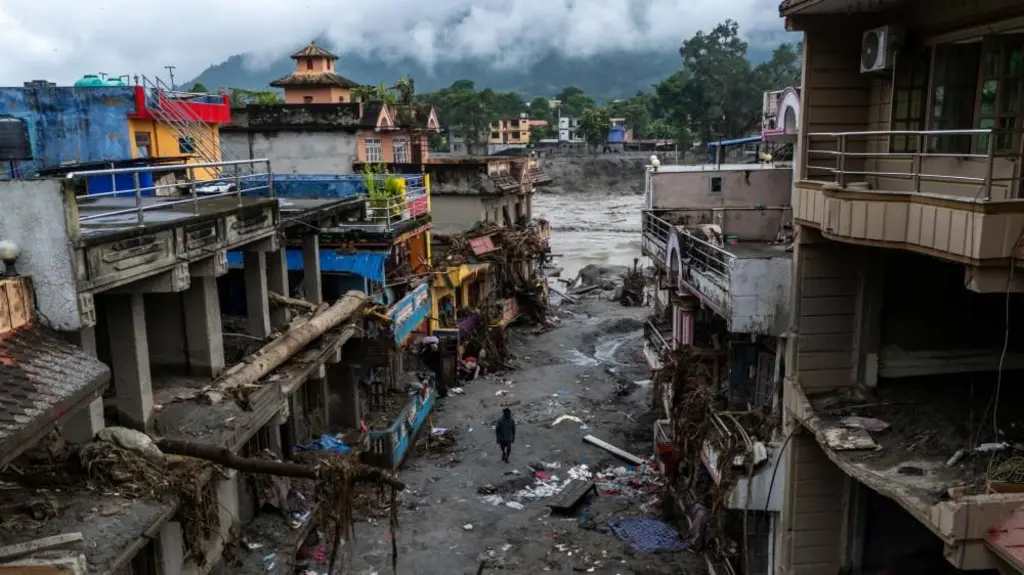
A head teacher’s quick decision to evacuate his school saved 900 pupils from deadly flash floods along the Nepal-Tibet border
Rajendra Dawadi tells the BBC he was tipped off about incoming flood waters and moved students to higher ground with just minutes to spare. One pupil says she and her friends survived by just 10 seconds and watched as a nearby bazaar was swept away
Wednesday’s disaster has killed at least 794 people and more than 2,500 people are missing in Nepal, local officials say
In Tibet, the official death toll is 16, with 546 reported to be missing, according to Chinese state media –
[BBC]

A ferry carrying around 260 people has capsized off the coast of northern Cyprus with a search underway for survivors, according to local media.
The catamaran-style boat was travelling from the port of Kyrenia, also known as Girne, and started sinking a few kilometres off the coast of the island state on Sunday.
There were no immediate reports of casualties.
[Aljazeera]

Sun directly overhead Galle, Angulugaha, Imaduwa, Telijjawila, Yatiyana and Tangalle about 12.08 noon today (07)

Showers above 50 mm are likely at some places in the Uva and Eastern provinces.

Harshitha’s composed knock seals Sri Lanka’s semi-final berth

‘Choka Malli’ slips out of country before travel ban

Dengue death toll rises to 73

Ranil accuses govt. of undermining democracy

‘Dates have the highest sugar content to fight Coronavirus’

Sunday Island 27 December – Headlines

#SundayIsland 17th December – Headlines

Sunday Island – 28th March

Sunday Island Headlines – 21 March

Sunday Island – 21st February – Headlines
-

 News5 days ago
Denied of promotion to SC despite vacancies, justice Gurusinghe retires
-

 Latest News5 days ago
Grade 5 scholarship exam results released
-

 News5 days ago
22A: SC urged to suspend hearing, appoint full bench
-

 Midweek Review6 days ago
The local and global dynamics of Sri Lanka’s 22nd Amendment
-

 News3 days ago
Namal remanded until Sept. 18 over Airbus deal investigation
-

 News5 days ago
Govt. seeks NATO assistance
-

 Latest News2 days ago
Tharanga creates history with Diamond League crown in Brussels
-

 News6 days ago
40 professional organisations and TU oppose proposed 22A