
Midweek Review
Saying ‘I Do’ in a Green Haven

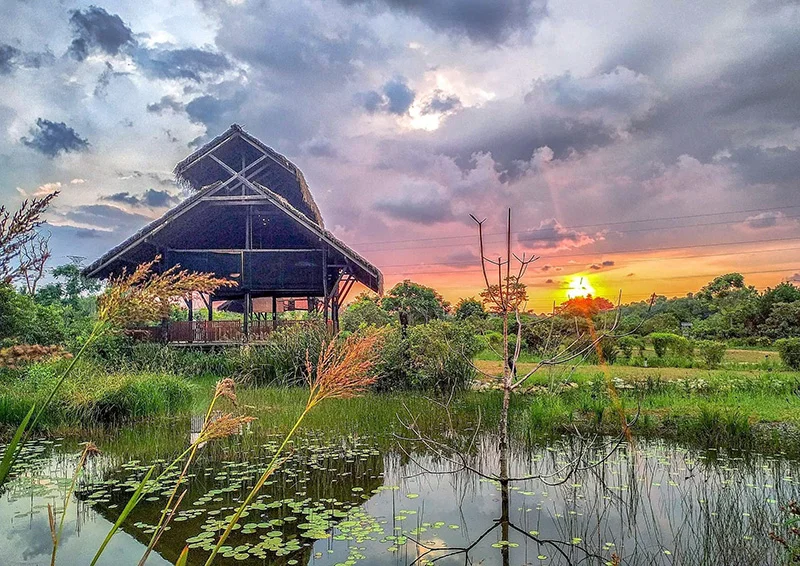
There was this elevating sight,
Of a young woman and man,
Tying the reverential ‘knot’,
With the registrar and retinue in tow,
Amid the silently pulsating beauty,
Of the suburban ‘Diyasaru Park’,
Famous as the Concrete Jungle’s lung,
Where microbes take the long journey,
To jousting, snarling animal life,
And they kept it small, simple and smart,
With a practical sense on saving rupees,
Combining with the drive to unite as one.
By Lynn Ockersz

During the recent debate on the No-Confidence Motion (NCM) against Energy Minister Kumara Jayakody, Illankai Thamil Arasu Kadchi (ITAK) Batticaloa District lawmaker, Shanakiyan Rajaputhiran Rasamanickam, warned that the next NCM would be moved against Fisheries Minister Ramalingham Chandrasekaran. Rasamanickam accused the National List member of corruption, a charge vehemently denied by the NPPer. The NPP/JVP needs to initiate an internal inquiry before corruption allegations overwhelm the party that received the full advantage of Aragalaya to transform the outfit from just a three-member parliamentary group, in 2024, to a staggering 159, a year later. The UNP and SLFP led alliances were dealt harshly by the electorates for want of action to curb corruption. Today, the UNP and SLFP are not represented in Parliament, while the SLPP, that secured 145 seats at the 2020 general election, was reduced to just three with its parliamentary group leader Namal Rajapaksa entering Parliament through the National List. Rajapaksa junior obviously feared to face the Hambantota electorate at the last general election. That is the undeniable truth.
By Shamindra Ferdinando
The ongoing controversy over Agriculture, Lands, Irrigation and Livestock Minister K.D. Lal Kantha’s three-storeyed luxury house has intensified pressure on the Janatha Vimukthi Peramuna (JVP)-led National People’s Power (NPP) government struggling to cope-up with the devastating coal scam, blamed on Energy Minister Kumara Jayakody forcing him to resign.
Jayakody, one of those who financed the NPP/JVP campaign in the run-up to the 2024 national polls ,resigned on 17 April, along with Prof. Udayanga Hemapala, Secretary to the Energy Ministry. Their resignations happened eight months after the Frontline Socialist Party (FSP), a breakaway faction of the JVP, revealed the alleged coal scam. The Lal Kantha affair received significant public attention though the primary issue at hand is the massive coal scam that ripped through the government.
Jayakody will continue as a National List member of the ruling party. The NPP/JVP won an unprecedented 159 seats, including 18 National List slots at the November 2024 parliamentary elections.
The Opposition dismissed government claims that the resignations were meant to facilitate the Presidential Commission of Inquiry into the procurement of coal, since the commissioning of the country’s only coal-fired power plant during the onset of Mahinda Rajapaksa’s second term. In the wake of the much delayed resignations, NPP/JVP heavyweight Foreign Minister Vijitha Herath, addressing the media at the Information Department, pathetically vouched for Jayakody’s integrity.
Let us discuss the accusations directed at Lal Kantha who had served the SLFP-led Cabinet for a short period, years ago, in terms of an agreement between the SLFP and the JVP. Lal Kantha had never been accused of corruption and was, in fact, one of those lawmakers who raised the issue both in and outside Parliament. Political parties may have forgotten that the UNP got rid of Lacille de Silva, Director General of Administration, Parliament, during Ranil Wickremesinghe’s premiership, in the 2001-2003 period, alleging he passed on information to Lal Kantha to attack the government.
The NPP Executive Committee member, as well as JVP politburo and Central Committee heavyweight, has publicly defended his right to own a luxury house amidst a section of the social media pushing for police investigation into the lawmaker’s wealth.
Unlike the owner/owners of the mysterious Malwana mansion, built on a 16-acre land overlooking the Kelani river, Lal Kantha didn’t try to disclaim the house ownership at Jusse Road, Welivita, in the Kaduwela area. The Malwana house was built towards the end of Mahinda Rajapaksa’s second term as the President. The hullabaloo over the ownership of the Malwana mansion, and construction costs, dominated the 2015 presidential election campaign. On the basis of the Malwana mansion, the UNP and the JVP built a strong case against the Rajapaksas, accusing the family of corruption.
It would be of pivotal importance that the JVP backed Maithripala Sirisena’s 2015 presidential polls candidature. The campaign was built on an anti-corruption platform that earned the appreciation of the public who disregarded the unprecedented development work successfully carried out by the Rajapaksas, while also fighting a war to defeat the most ruthless terrorist organisation that was out to break up the country.
During a US-India backed violent protest campaign, in March-July 2022, an organised gang set the stately Malwana mansion ablaze. The general consensus was that the Malwana mansion belonged to Basil Rajapakasa, though he vehemently denied having anything to do with it.
Yahapalana Justice Minister Dr. Wijeyadasa Rajapakshe, PC, is on record as having declared that the Malwana mansion would be renovated and used to accommodate a state institution. Lal Kantha’s newly acquired wealth has to be examined and discussed, taking into consideration his long standing claim that as a fulltime member of the JVP he entirely depended on his wife’s monthly salary and help provided by friends and associates. If that was the case, Lal Kantha couldn’t have ended up among the richest group of politicians, within less than two years after the last presidential election, held in September 2024.
Lal Kantha couldn’t have been unaware of the possibility of the Opposition, particularly the Sri Lanka Podujana Peramuna (SLPP), attacking him and the NPP/JVP over his Kaduwela house. Responding to critics, the Anuradhapura District lawmaker has claimed, on YouTube, that he sold a property he owned in Anuradhapura and used that money to acquire the Jusse Road land.
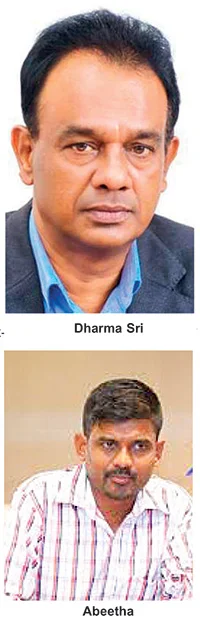
The outspoken Minister is also on record as having said that the existence of his new house, to which he moved in late 2024, was disclosed by him. However, incisive Youtuber Dharma Sri Kariyawasam has claimed that he made the revelation on 01 October, 2025, while another You-Tuber, Abeetha Edirisinghe, rammed up pressure on the NPP by lodging a complaint with the police, via the special number 1818. Edirisinghe’s SL Leaders YouTube posted a video of him lodging the complaint.
What made the complaint really interesting was Edirisinghe’s declaration based on ‘Dark Room’ YouTube allegations that wealthy businessman Nissanka Senadhipathi, who had been one of the closest associates of the Rajapaksas, provided the wherewithal required to acquire land, build and then furnish the Jusse Road mansion. Defending his position, Lal Kantha claimed that he acquired a piano for his daughter, about 15 years ago, while declaring he enjoyed the capacity to raise large sums of funds if necessary. A smiling Lal Kantha explained how he could effortlessly collect Rs 500,000 each from 100 associates/friends. Programmes posted by Dharma Sri Kariyawasam and Abeetha Edirisinghe are must-watch for those genuinely interested in knowing the explosive story, from different angles.
Close on the heels of debates on Lal Kantha’s mansion, the media reported the Minister’s last available asset declaration, sent to the Commission to Investigate Allegations of Bribery or Corruption (CIABOC), dealt with over Rs 80 mn worth of property, vehicles and gold, etc. The JVP heavyweight’s annual income has stunned even the staunchest supporters of the ruling party. Lal Kantha, through his lawyer, demanded Rs 10 bn in damages from ‘Hiru’ for wrongly estimating his properties, etc., at Rs 460 mn.
Both Dharma Sri Kariyawasam and Abeetha Edirisinghe propagated that police wanted the public to complain to special the number 1818, created to accept such complaints in case they felt suspicious about newly acquired property, regardless of who owned them.
Unexpected disclosure of Lal Kantha’s unprecedented wealth obviously stunned the public who genuinely believed in the unshakable NPP/JVP stand on corruption. Lal Kantha, who had joined the JVP in 1982, before becoming a full time member, in 1987, had no qualms in defending his new lifestyle, having repeatedly and bitterly complained about the difficulties experienced by him and his family.
In his defence, Lal Kantha emphasised that he hadn’t been accused of robbing the taxpayer or public sector corruption. However, the NPP/JVP all-out attack on all previous governments, over waste, corruption, irregularities and mismanagement, and branding all their MPs corrupt, cannot adopt such a stance. The Kaduwela mansion has sent shockwaves through the electorate. Dharma Sri Kariyawasam, in his response to Lal Kantha, repeatedly stressed that his wealth was being questioned by those who exercised their franchise in support of the NPP/JVP at the national elections and Local Government polls, in 2025.
Growing public resentment over what various interested parties, including the NPP/JVP called ill-gotten wealth of members and henchmen of previous governments fuelled Aragalaya (31 March-14 July 2022). Those who set houses and other property, belonging to various then government politicians and their associates ablaze, operated on the presumption that they were beneficiaries of ill-gotten wealth. The NPP/JVP powered the campaign, alongside the breakaway JVP faction, styled as Peratugami Pakshaya (Frontline Socialist Party) as well as the UNP.
Ranwala and others
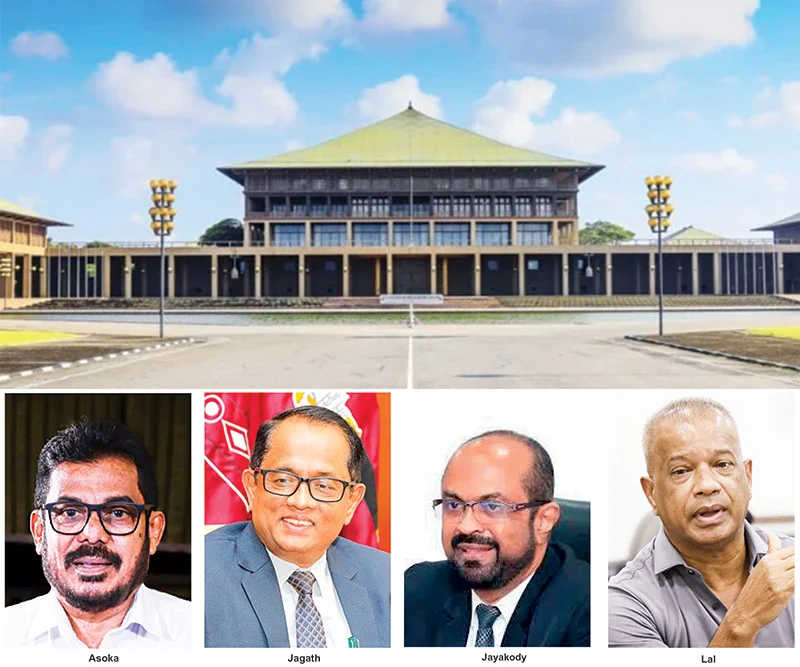
 Against the backdrop of Auditor General Samudrika Jayarathne’s devastating report on coal procurement for the 2025/2026 period and Lal Kantha’s declaration that he owned a three-storeyed house, the resignation of Asoka Ranwala, as the Speaker of Parliament, over his failure to prove his declared academic qualifications seemed uncalled for. Jayarathne signed that report on behalf of the National Audit Office (NAO).
The Gampaha District MP resigned on 13 December, 2024, just 22 days after being appointed the Speaker. The main Opposition Samagi Jana Balawegaya (SJB) relentlessly attacked Ranwala over his fabricated or unverified educational qualifications, specifically a Ph.D. from a Japanese university and a degree from the University of Moratuwa.
The NPP/JVP tried to defend Ranwala but quickly succumbed to SJB pressure. We never managed to establish whether Ranwala resigned on his own accord or the NPP/JVP asked him to resign to save the party. Similarly, the resignations of Energy Minister Jayakody and Prof. Hemapala, who cut a sorry figure before the Committee on Public Enterprises (COPE) recently, must have been demanded by the ruling party. Had the NPP bosses acted prudently, much earlier, after he was indicted before the Colombo High Court on a previous corruption case, they could have easily asked Jayakody to resign his ministerial portfolio before the Parliament debated the no-confidence motion against him.
Another case that really embarrassed the ruling party was accusations directed at Dr. Jagath Wickremeratne, who succeeded Ranwala as House Speaker. The Polonnaruwa District MP was the next to face fire, following a dispute with the Deputy Secretary General of Parliament Chaminda Kularatne who is also the Chief of Staff of the House. Kularatne hit back hard after Parliament sacked him over alleged irregularities. In a petition, dated 2 February, 2026, sent to CIABOC, Kularatne disclosed the circumstances the Speaker reacted angrily after he brought to the NPPer’s notice illegal actions and corruption, as well as his (Kularatne) recommendation in his capacity as the Right to Information (RTI) officer, to release certain information sought by civil society activists. Kularatne further claimed that the situation deteriorated further over an incident that happened on 18 June, 2025, or a date closer to that date, in the room where Speaker Wickremeratne had his lunch. Kularatne refrained from revealing the incident.
There hadn’t been a previous instance of a senior parliamentary official moving the CIABOC against the Speaker. The allegations directed at the Speaker, in respect of abuse of vehicles, taking two fuel allowances, misuse of equipment belonging to the Media Unit of Parliament, inadequate payment for lunch obtained for Chameera Gallage, Speaker’s private secretary, who had lunch with him, illegal payments made to retired Ministry Additional Secretary S.K. Liyanage, who was appointed to inquire into Kularatne’s conduct, suppression of release of information in terms of RTI, and uncalled for interventions in administration.
Kularatne’s complaint to the CIABOC failed to result in an expeditious inquiry, though a complaint lodged against a sacked parliamentary official appeared to have received much more attention. The NPP has responded cautiously to Kularatne vs Wickremeratne battle as pressure mounted on the ruling party over the coal scam that threatened to cause further increase in already unbearable electricity tariffs. The Auditor General’s report, in no uncertain terms, has implicated the Energy Ministry and Lanka Coal Company in the sordid operation that resulted in low-grade coal ending up at the Lakvijaya coal-fired power plant that earlier met about 30 to 40% percent of the country’s power requirements at essentially low cost, barring hydroelectricity.
The report declared that the term tender for the supply of coal was awarded to Trident Champhar, an Indian company that hadn’t been registered at the time it bid for Sri Lanka’s largest tender and procedures in respect of loading and unloading the cargo. To make matters worse, Minister Jayakody, who had been implicated in the coal scam, was recently indicted on corruption charges in the High Court of Colombo. There hadn’t been a previous instance of a sitting member of the Cabinet being indicted for corruption. Therefore, the NPP government cannot be happy over its steamroller majority in Parliament having defeated the no-confidence motion moved against Jayakody who remained confident in the parliamentary group’s support at the behest of the top party leadership.
The NPP/JVP finds itself in an extremely embarrassing and pitiful situation over the coal scam. The damning report issued by the Auditor General pertaining to the coal scam has to be examined taking into consideration the failure on the part of the government and the Constitutional Council to reach a consensus on filling the vacant Auditor General’s post in 2025. The post of Auditor General remained vacant from early April 2025 to early February 2026.
Role of NAO
The NAO functions as an independent body answerable to Parliament. The recent NAO report that dealt with coal procurement exposed the utterly corrupt system in place, regardless of assurances given by the government. The report proved that irregularities can be perpetrated and corrupt practices continued, regardless of assurances given by the current dispensation.
Over the past several years, tangible measures were taken to strengthen the NAO. Parliament certified the National Audit (Amendment) Act, No. 19 of 2025 on 22 September, 2025. That act introduced reforms meant to enhance public sector accountability, enforce audit findings, and streamline the surcharge process. The no nonsense report proved that in spite of interference and undue influence exerted on the NAO, those responsible did their job without fear or favour.
SJB lawmaker Mujibur Rahman, during the debate on the no-confidence motion against Minister Jayakody, alleged in Parliament that COPE (Committee on Public Enterprises) Chairman Dr. Nishantha Samaraweera directly intervened when the NAO was in the process of finalising the report. The former UNPer called for an investigation to establish whether the Galle District NPP MP visited the NAO on several days to meet those handling the investigation.
We are not aware whether the COPE Chief, who called for the NAO to inquire into allegations in respect of coal procurement, visited the NAO.
However, the NAO report on the coal scam, now available online for all to study, underscores the pivotal importance of the anti-corruption fight.
In September 2025, the SJB asked the CIABOC to probe how some NPP/JVP Ministers amassed so much property. The SJB raised the issue with the focus on Trade, Commerce, Food Security and Cooperative Development Minister Wasantha Samarasinghe (like Lal Kantha, he, too, represents the Anuradhapura District) amassed Rs 275 mn. The SJB’s complaint to CIABOC sought investigations on Ministers Sunil Handunetti, Bimal Rathnayake, Dr. Nalinda Jayathissa and Kumara Jayakody, and Deputy Minister Sunil Watagala.
Lal Kantha, who has now acknowledged having as much as Rs 80 mn worth property, was not among the lawmakers targeted by the SJB. Having falsely propagated an anti-corruption campaign to deceive the public, the NPP/JVP stand literally exposed before the public. The coal scam and Lal Kantha fiasco have caused irreparable damage to such an extent, their anti-corruption campaigns may not carry any weight with the public at future elections.
‘… where the world has not been broken up into fragments by narrow domestic walls; ….
Where the clear stream of reason has not lost its way into the dreary desert sand of dead habit;
Where the mind is led forward….into ever-widening thought and action…’
With wide apologies, I am going to put snatches of that poem into more dreary uses, though not quite desert sand.
What are those narrow domestic walls which break up the world into fragments? Languages.
Amiya reads the Gitanjali but does not read the Tirukkural. Hong Li reads Kong Fut Ze’s Analects but not Plato’s Republic. Paul reads Miton’s Paradise Lost but not Njal Saga. Sarath Kumara reads Wickremasinghe’s satva santatitya but not Darwin’s Origin of the Species. Ngidi does not read Thomas Picketty’s Capital in the 20th Century or Anthony Atkinson’s Inequality at all. Hirono uses Large Language Models to do homework but Rasolomanana has not seen a computer. And so on and so forth. The world is broken into fragments by languages, but not by languages alone. The daughter of a rich black man living in Howard County in Maryland goes to Stanford but a brown dweller in Dharavi cannot enter Jawaharlal Nehru University. The lesson is that it is not only languages or orthodoxies that break up the world into ‘fragments’ but also many other barriers, about one of which Tagore sang.
Language is a marvellous ‘invention’ of nature well cultivated by humans. No other species has the faculty to use language to know. Ludwig Wittgenstein expressed it epigrammatically, ‘whereof one cannot speak, thereof one must be silent.’ It is language that carries forth knowledge. It is not only language that carries forth knowledge: mathematics, in its own right, is a powerful carrier of knowledge. One can write something simple like if x-y=0, then x=y, as well as whole pages of complex and complicated arguments using mathematical notations. Mathematics may and often does write nature and about nature; it also writes about things that exist only in the mind. That is not different from languages: heaven and Vishnu exist in some minds but not in others or elsewhere. Galileo Galilei learnt ‘Nature is an open book but it is written in mathematics’. Much of nature is a closed book to those to whom mathematics is alien territory. But today, I am interested in how some languages ‘break the world into fragments by domestic walls’, while a few others fly about regardless. When a team from India played cricket with a team from Pakistan a few weeks back, the commentary was broadcast in India in 14 languages and in Nigeria national news is read in several languages. That same game of cricket also was broadcast to the rest of the world in one language: English.
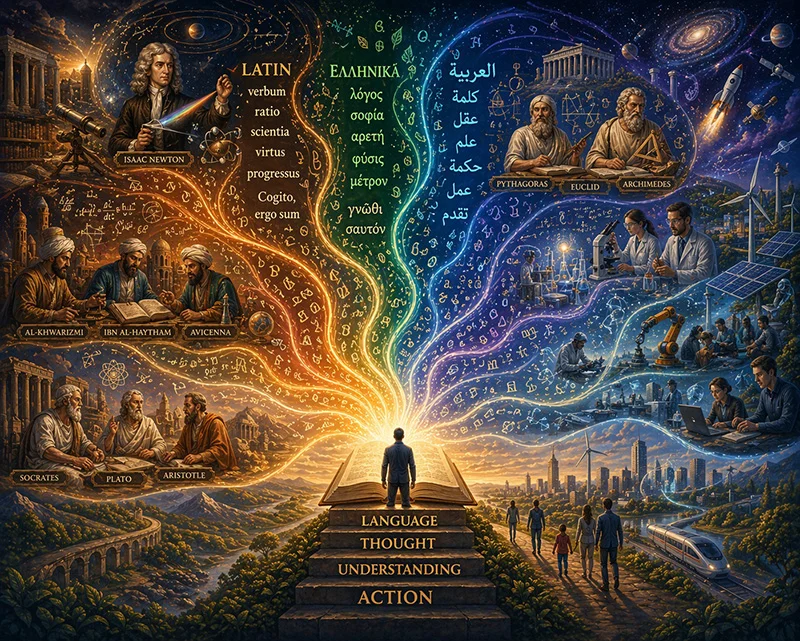
When and how do some languages come to ‘lead the mind forward into ever widening thought and action’? The transformation occurs when users of one language become conquerors and rulers of peoples using other languages and when the users of a language become generators of new knowledge which are eagerly sought after by users of other languages. Greek, Latin and Arabic contributed mightily to the vocabulary of modern Western European languages. When new ideas in law, government, philosophy, medicine and science had to be expressed, they went to Greek, Latin or Arabic. Consequently, you will bump into Greek terms the moment you begin thinking about those disciplines. The serious study of Greek was introduced to England by Erasmus (of Rotterdam) about 1500 AC. The use of Latin began with the Roman Empire but took on new functions when Latin became the vehicle carrying Christianity east and north (of Europe) and elsewhere later. Until about the 18th century AC Latin was the language of learning in most of Europe. At its inception, Manchester Grammar School was a Latin school and the Boston Latin School which started in 1635 still thrives in that name. The two medieval universities in England were mostly seminaries teaching in Latin well into the 19th century. A wide swathe of languages is written with the Latin alphabet: European languages from the Black Sea to the Atlantic and from the North Sea to the Mediterranean, America from Canada to Chile, sub-Saharan Africa including Togo, and Indonesian, Malaysian and several others. The exodus of Jewish, Arabic and other scholars, after the fall of Constantinople (1453) to the Ottomans, brought Greek and Arabic to Western Europe including England. From about the 14 to the 18th century, European indigenous vernaculars grew to be carriers of new knowledge, especially in sciences. Luther’s reformation and the development of German had much in common. Gutenberg’s new printing press (1450 AC) helped the growth of European vernaculars and the spread of reformed Christianity.
Four western European languages stood out as both conquerors and carriers of new knowledge: Portuguese, Spanish, French and English. Arabic performed the same function from about 800 AC to the 13 AC when that language carried a new religion and new knowledge in mathematics, astronomy and medicine. Arabic replaced the indigenous languages in the entire Maghreb. The language of governance and learning from Mexico south to Chile is Spanish with Brazil using Portuguese and are collectively called Latin America, because Portuguese, Spanish, French, Italian and Romanian are Romance or Latin Languages. French is the language of governance and learning in several parts of West Africa. English was a phenomenon in itself. It destroyed the use of hundreds of languages in North America. It conquered almost half the world and English is the language of governance and higher education in a good part of the land it once ruled. As a language carrying new knowledge, English excels all others. As the collapse of four European empires, including the Ottoman, went on from about 1915 to about 1960, English, which produced new knowledge faster than any other, began to break ‘domestic walls’, the world over. China, which had little love for the English-speaking world, had millions of its citizens schooled in the US, the UK, Canada and Australia during the last 30 years and continues to do so, to date. In contrast, during that time how many rushed to Niger to learn Fulfulde or to Lanka to study Sinhala? The prominence of English was promoted by two other processes: one was translation into English of major works in other languages and the other the growth of a class of indigenous writers and readers in the conqueror’s language. One reads Oblomov, Gilgamesh and, indeed, Gitanjali translated into English. India now probably has more readers in English than any other single country. Persons in Western African countries have crafted in French and English, masterpieces in fiction, poetry and drama. Modern European languages have been both conquerors’ languages and carriers of new knowledge.
Several people recently have written in The Island and in Lankadeepa about the importance of using the ‘mother tongue’. They have stressed the importance of the ‘mother tongue’ in creative writing. As with observations regarding empirical phenomena, it is necessary to test those generalisations against reality. Samskrt is a language not entirely unfamiliar to many in this land. Samskrt was nobody’s mother tongue. (After all, it is deva bhaashitam.) There is not a shred of evidence that Kalidasa’s mother talked to him in Samskrt. But Kalidasa wrote rtusmahara and shakuntalam.. The vedas and upanishads were first spoken and later written in samskrt. Pali is nobody’s mother tongue but Theravada writings are almost entirely in that language. Isaac Newton wrote Principia Mathematica in Latin; we have no evidence that baby Isaac babbled in Latin. Paul Dirac wrote about particle physics in mathematics rather than in his father’s beloved French. Leopold Senghor’s mother tongue was not French nor Chinua Achebe’s English. More casually, check your own libraries. I had a collection of about 2,300 books until last year. There weren’t even 200 written in Sinhala and that 200 included editions of works from the 13th century. Check how many books written in Sinhala and English you bought in the last two years. There were far too many writers and scientists who brought forth highly acclaimed work in languages other than their mother tongue, contradicting the argument that the mother tongue was essential or even desirable for original work, in science or in literature.
Most languages ‘break the world into narrow fragments’. A few coagulate them into large masses: 900 million people speak Mandarin and 325 million, Bengali. A half dozen bind themselves together speaking a conqueror’s language. Four languages stand out as having ‘led the ‘mind forward into ever-widening thought and action’: Greek, Latin, Arabic and English. English, so far, is unrivalled.
by Usvatte-aratchi

Coordinated suicide attacks targeted three churches—St. Anthony’s in Colombo, St. Sebastian’s at Katuwapitiya and Zion Church in Batticaloa—along with popular tourist hotels Shangri-La, Kingsbury, and Cinnamon Grand. No less a person than His Eminence Archbishop of Colombo Rt. Rev. Malcolm Cardinal Ranjith is on record as having said that the carnage could have been averted if the Yahapalana government shared the available Indian intelligence warning with him. Yahapalana Minister Harin Fernando publicly admitted that his family was aware of the impending attack and the warning issued to senior police officers in charge of VVIP/VIP security is evidence that all those who represented Parliament at the time knew of the mass murder plot. Against the backdrop of Indian intelligence warning and our collective failure to act on it, it would be pertinent to ask the Indians whether they knew the Easter Sunday operation was to facilitate Gotabaya Rajapaksa’s victory at the 2019 presidential poll. Perhaps, a key to the Easter Sunday conspiracy is enigma Sara Jasmin (Tamil girl from Batticaloa converted to Islam) whose husband Atchchi Muhammadu Hasthun carried out the attack on St. Sebastian’s Church, Katuwapitiya
By Shamindra Ferdinando
Pivithuru Hela Urumaya (PHU) leader Udaya Gammanpila’s Pasku Praharaye Mahamolakaru Soya Yema (Searching for the mastermind behind the Easter Sunday attacks) inquired into the 2019 April 21 Easter Sunday carnage. The former Minister and Attorney-at-Law quite confidently argued that the mastermind of the only major post-war attack was Zahran Hashim, one of the two suicide bombers who targeted Shangri-la, Colombo.
Gammanpila launched his painstaking work recently at the Sambuddhathva Jayanthi Mandiraya at Thummulla, with the participation of former Presidents Gotabaya Rajapaksa, who had been accused of being the beneficiary of the Easter Sunday carnage at the November 2019 presidential election, and Maithripala Sirisena faulted by the Presidential Commission of Inquiry (PCoI) that probed the heinous crime. Rajapaksa and Sirisena sat next to each other, in the first row, and were among those who received copies of the controversial book.
PCoI, appointed by Sirisena in September, 2019, in the run-up to the presidential election, in its report submitted to President Gotabaya Rajapaksa, in February, 2020, declared that Sirisena’s failure as the President to act on ‘actionable intelligence’ exceeded mere civil negligence. Having declared criminal liability on the part of Sirisena, the PCoI recommended that the Attorney General consider criminal proceedings against former President Sirisena under any suitable provision in the Penal Code.
PCoI’s Chairman Supreme Court Judge Janak de Silva handed over the final report to President Rajapaksa on February 1, 2021 at the Presidential Secretariat. Gotabaya Rajapaksa received the first and second interim reports on 20 December and on 2 March, 2020, respectively.
The Commission consists of the following commissioners: Justice Janak De Silva (Judge of the Supreme Court and Chairman of the Commission), Justice Nissanka Bandula Karunarathna (Judge of the Court of Appeal), Justice Nihal Sunil Rajapakse (Retired Judge of the Court of Appeal), Bandula Kumara Atapattu (Retired Judge of the High Court) and Ms W.M.M.R. Adikari (Retired Ministry Secretary).
H.M.P. Buwaneka Herath functioned as the Secretary to the PCoI.
It would be pertinent to mention that the Archbishop of Colombo Malcolm Cardinal Ranjith, declined an opportunity offered by President Rajapaksa to nominate a person for the PCoI. The Church leader asserted such a move would be misconstrued by various interested parties. Both the former President and Archbishop of Colombo confirmed that development soon after the presidential election.
Having declared its faith in the PCoI and received assurance of the new government’s intention to implement its recommendations, the Church was taken aback when the government announced the appointment of a six-member committee, chaired by Minister Chamal Rajapaksa, to examine the PCoI and recommend how to proceed. That Committee included Ministers Johnston Fernando, Udaya Gammanpila, Ramesh Pathirana, Prasanna Ranatunga and Rohitha Abeygunawardena.
The Church cannot deny that their position in respect of the Yahapalana government’s pathetic failure to thwart the Easter Sunday carnage greatly influenced the electorate, and the SLPP presidential candidate Gotabaya Rajapaksa directly benefited. Alleging that the Archbishop of Colombo played politics with the Easter Sunday carnage, SJB parliamentarian Harin Fernando, in June 2020, didn’t mince his words when he accused the Church of influencing a decisive 5% of voters to back Gotabaya Rajapaksa. At the time that accusation was made about nine months before the PCoI handed over its report, President Rajapaksa and the Archbishop of Colombo enjoyed a close relationship.
The Church raised the failure on the part of the government to implement the PCoI’s recommendations six months after President Rajapaksa received the final report.
The National Catholic Committee for Justice to Eastern Sunday Attack Victims, in a lengthy letter dated 12 July 2021, demanded the government deal with the following persons for their failure to thwart the attacks. The Committee warned that unless the President addressed their concerns alternative measures would be taken. The government ignored the warning. Instead, the SLPP adopted delaying tactics much to their disappointment and the irate Church finally declared unconditional support for the US-India backed regime change project.
Sirisena and others
On the basis of the 19th Chapter, titled ‘Accountability’ of the final report, the Committee drew President Rajapaksa’s attention to the following persons as listed by the PCoI: (1) President Maithripala Sirisena (2) PM Ranil Wickremesinghe (3) Defence Secretary Hemasiri Fernando (4) Chief of National Intelligence Sisira Mendis (5) Director State Intelligence Service Nilantha Jayawardena.
The 20th Chapter, titled ‘Failures on the part of law enforcement authorities’ in the Final report (First Volume), identified the following culprits ,namely IGP Pujith Jayasundera, SDIG Nandana Munasinghe (WP), Deshabandu Tennakoon (DIG, Colombo, North), SP Sanjeewa Bandara (Colombo North), SSP Chandana Atukorale, B.E.I. Prasanna (SP, Director, Western province, Intelligence), ASP Sisira Kumara, Chief Inspector R.M. Sarath Kumarasinghe (Acting OIC, Fort), Chief Inspector Sagara Wilegoda Liyanage (OIC, Fort)., Chaminda Nawaratne (OIC, Katana), State Counsel Malik Azeez and Deputy Solicitor General Azad Navaavi.
The PCoI named former Minister and leader of All Ceylon Makkal Congress Rishad Bathiudeen, his brother Riyaj, Dr Muhamad Zulyan Muhamad Zafras and Ahamad Lukman Thalib as persons who facilitated the Easter Sunday conspiracy, while former Minister M.L.A.M. Hisbullah was faulted for spreading extremism in Kattankudy.
Major General (retd) Suresh Sallay, who is now in remand custody, under the CID, for a period of 90 days, in terms of the prevention of Terrorism Act (PTA) ,was not among those named by the PCoI. Sallay, who served as the head of the Directorate of Military Intelligence (DMI/from 2012 to 2016) was taken into custody on 25 February and named as the third suspect in the high profile investigation. (Interested parties propagated that Sallay was apprehended on the basis of UK’s Channel 4 claim that the officer got in touch with would-be Easter Sunday bombers, including Zahran Hashim, with the help of Sivanesathurai Chandrakanthan, alias Pilleyan. However, Pilleyan who had been arrested in early April 2025 under PTA was recently remanded by the Mount Lavinia Magistrate’s Court, pending the Attorney General’s recommendations in connection with investigations into the disappearance of a Vice Chancellor in the Eastern Province in 2006. There was absolutely no reference to the Easter Sunday case)
The Church also emphasised the need to investigate the then Attorney General Dappula de Livera’s declaration of a ‘grand conspiracy’ behind the Easter Sunday carnage. The Church sought answers from President Rajapaksa as to the nature of the grand conspiracy claimed by the then AG on the eve of his retirement.
Sallay was taken into custody six years after the PCoI handed over its recommendations to President Rajapaksa and the appointment of a six-member parliamentary committee that examined the recommendations. The author of Pasku Praharaye Mahamolakaru Soya Yema, Gammanpila, the only lawyer in the six-member PCoI, should be able to reveal the circumstances that committee came into being.
Against the backdrop of the PCoI making specific recommendations in respect of the disgraced politicians, civilian officials and law enforcement authorities over accountability and security failures, the SLPP owed an explanation regarding the appointment of a six-member committee of SLPPers. Actually, the SLPP owed an explanation to Sallay whose arrest under the PTA eight years after Easter Sunday carnage has to be discussed taking into consideration the failure to implement the recommendations.
Let me briefly mention PCoI’s recommendations pertaining to two senior police officers. PCoI recommended that the AG consider criminal proceedings against SDIG Nandana Munasinghe under any suitable provision in the Penal Code or Section 82 of the Police Ordinance (Final report, Vol 1, page 312). The PCoI recommended a disciplinary inquiry in respect of DIG Deshabandu Tennakoon. The SLPP simply sat on the PCoI recommendations.
Following the overthrow of President Rajapaksa by a well-organised Aragalaya mob in July 2022, the SLPP and President Ranil Wickremesinghe paved the way for Deshabandu Tennakoon to become the Acting IGP in November 2023. Wickremesinghe went out of his way to secure the Constitutional Council’s approval to confirm the controversial police officer Tennakoon’s status as the IGP.
Some have misconstrued the Supreme Court ruling, given in January 2023, as action taken by the State against those named in the PCoI report. It was not the case. The SC bench, comprising seven judges, ordered Sirisena to pay Rs 100 mn into a compensation fund in response to 12 fundamental rights cases filed by families of the Easter Sunday victims, Catholic clergy and the Bar Association of Sri Lanka. The SC also ordered ex-IGP Pujith Jayasundara and former SIS head Nilantha Jayawardene to pay Rs. 75m rupees each, former Defence Secretary Hemasiri Fernando Rs. 50 million and former CNI Sisira Mendis Rs. 10 million from their personal money. All of them have been named in the PCoI report. As previously mentioned, Maj. Gen. Sallay, who headed the SIS at the time of the SC ruling that created the largest ever single compensation fund, was not among those faulted by the sitting and former justices.
Initial assertion
The Archbishop of Colombo, in mid-May 2019, declared the Easter Sunday carnage was caused by local youth at the behest of a foreign group. The leader of the Catholic Church said so in response to a query raised by the writer regarding a controversial statement made by TNA MP M. A. Sumanthiran. The Archbishop was joined by Most Ven Ittapane Dhammalankara Nayaka Thera of Kotte Sri Kalyani Samagri Dharma Maha Sangha Sabha of Siyam Maha Nikaya. They responded to media queries at the Bishop’s House, Borella.
The Archbishop contradicted Sumanthiran’s claim that the failure on the part of successive governments to address the grievances of minorities over the past several decades led to the 2019 Easter Sunday massacre.
Sumanthiran made the unsubstantiated claim at an event organised to celebrate the first anniversary of the Sinhala political weekly ‘Annidda,’ edited by Attorney-at-Law K.W. Janaranjana at the BMICH.
The Archbishop alleged that a foreign group used misguided loyal youth to mount the Easter Sunday attacks (‘Cardinal rejects TNA’s interpretation’, with strap line ‘foreign group used misguided local youth’, The Island, May 15, 2019 edition).
Interested parties interpreted the Easter Sunday carnage in line with their thinking. The writer was present at a special media briefing called by President Sirisena on 30 April, 2019 at the President’s House where the then Northern Province Governor Dr. Suren Raghavan called for direct talks with those responsible for the Easter Sunday massacre. One-time Director of the President’s Media Division (PMD) Dr. Raghavan emphasised that direct dialogue was necessary in the absence of an acceptable mechanism to deal with such a situation. Don’t forget Sisisena had no qualms in leaving the country a few days before the attacks and was away in Singapore when extremists struck. Sirisena arrived in Singapore from India.
The NP Governor made the declaration though none of the journalists present sought his views on the post-Easter Sunday developments.
During that briefing, in response to another query raised by the writer, Army Commander Lt. Gen. Mahesh Senanayake disclosed that the CNI refrained from sharing intelligence alerts received by the CNI with the DMI. Brigadier Chula Kodituwakku, who served as Director, DMI, had been present at Sirisena’s briefing and was the first to brief the media with regard to the extremist build-up leading to the Easter Sunday attacks.
The collapse of the Yahapalana arrangement caused a security nightmare. Frequent feuds between Yahapalana partners, the UNP and the SLFP, facilitated the extremists’ project. The top UNP leadership feared to step in, even after Justice Minister Dr. Wijeyadasa Rajapaksha issued a warning in Parliament, in late 2016, regarding extremist activities and some Muslim families securing refuge in countries dominated by ISIS. Instead of taking tangible measures to address the growing threat, a section of the UNP parliamentary group pounced on the Minister.
The UNP felt that police/military action against extremists may undermine their voter base. The UNP remained passive even after extremists made an abortive bid to kill Thasleem, Coordinating Secretary to Minister Kabir Hashim, on 8 March 2019. Thasleem earned the wrath of the extremists as he accompanied the CID team that raided the extremists’ facility at Wanathawilluwa. The 16 January 2019 raid indicated the deadly intentions of the extremists but PM Wickremesinghe was unmoved, while President Sirisena appeared clueless as to what was going on.
Let me reproduce the PCoI assessment of PM Wickremesinghe in the run-up to the Easter Sunday massacre. “Upon consideration of evidence, it is the view of the PCoI that the lax approach of Mr. Wickremesinghe towards Islamic extremists as the Prime Minister was one of the primary reasons for the failure on the part of the then government to take proactive steps towards tackling growing extremism. This facilitated the build-up of Islam extremists to the point of the Easter Sunday attack.” (Final report, Vol 1, pages 276 and 277).
The National Catholic Committee for Justice to Easter Sunday Attack Victims, in its letter dated 12 July, 2021, addressed to President Rajapaksa, questioned the failure on the part of the PCoI to make any specific recommendations as regards Wickremesinghe. Accusing Wickremesinghe of a serious act of irresponsibility and neglect of duty, the Church emphasised that there should have been further investigations regarding the UNP leader’s conduct.
SLPP’s shocking failure
The SLPP never made a serious bid to examine all available information as part of an overall effort to counter accusations. If widely propagated lie that the Easter Sunday massacre had been engineered by Sallay to help Gotabaya Rajapaksa win the 2019 presidential poll is accepted, then not only Sirisena and Wickremesinghe but all law enforcement officers and others mentioned in the PCoI must have contributed to that despicable strategy. It would be interesting to see how the conspirators convinced a group of Muslims to sacrifice their lives to help Sinhala Buddhist hardliner Gotabaya Rajapaksa to become the President.
Amidst claims, counter claims and unsubstantiated propaganda all forgotten that a senior member of the JVP/NPP government, in February 2021, when he was in the Opposition directly claimed Indian involvement. The accusation seems unfair as all know that India alerted Sri Lanka on 4 April , 2019, regarding the conspiracy. However, Asanga Abeygoonasekera, in his latest work ‘Winds of Change’ questioned the conduct of the top Indian defence delegation that was in Colombo exactly two weeks before the Easter Sunday carnage. Abeygoonasekera, who had been a member of the Sri Lanka delegation, expressed suspicions over the visiting delegation’s failure to make reference to the warning given on 4 April 2019 regarding the plot.
The SLPP never had or developed a strategy to counter stepped up attacks. The party was overwhelmed by a spate of accusations meant to undermine them, both in and outside Parliament. The JVP/NPP, in spite of accommodating Mohamed Yusuf Ibrahim, father of two Easter Sunday suicide bombers Ilham Ahmed Ibrahim (Shangila-la) and Imsath Ahmed Ibrahim (Cinnamon Grand), in its 2015 National List was never really targeted by the SLPP. The SLPP never effectively raised the possibility of the wealthy spice trader funding the JVP to receive a National List slot.
The Catholic Church, too, was strangely silent on this particular issue. The issue is whether Mohamed Yusuf Ibrahim had been aware of the conspiracy that involved his sons. Another fact that cannot be ignored is Attorney-at-Law Hejaaz Hizbullah who had been arrested in April 2020 in connection with the Easter Sunday carnage but granted bail in February 2022 had been the Ibrahim family lawyer.
Hejaaz Hizbullah’s arrest received international attention and various interested parties raised the issue.
The father of the two brothers, who detonated suicide bombs, was granted bail in May 2022.
Eric Solheim, who had been involved in the Norwegian-led disastrous peace process here, commented on the Easter Sunday attacks. In spite of the international media naming the suicide bombers responsible for the worst such atrocity Solheim tweeted: “When we watch the horrific pictures from Sri Lanka, it is important to remember that Muslims and Christians are small minorities. Muslims historically were moderate and peaceful. They have been victims of violence in Sri Lanka, not orchestrating it.”
That ill-conceived tweet exposed the mindset of a man who unashamedly pursued a despicable agenda that threatened the country’s unitary status with the connivance of the UNP. Had they succeeded, the LTTE would have emerged as the dominant political-military power in the Northern and Eastern Provinces and a direct threat to the rest of the country.

Abhishek’s 135 not out blows Delhi Capitals away

Trump announces Iran ceasefire extension but says blockade remains

Showers above 75 mm are likely at some places in the Western, Sabaragamuwa, Central, Uva and Southern provinces and in Ampara and Kurunegala districts

Cardinal: Presidents, IGPs and AG sabotaged Easter carnage probes before 2024 regime change

CIABOC asks Parliament not to transfer witness in case against Deputy Secy General

UN wants Sri Lanka to deliver concrete results in Easter Sunday bombing probe

‘Dates have the highest sugar content to fight Coronavirus’

Sunday Island 27 December – Headlines

#SundayIsland 17th December – Headlines

Sunday Island – 28th March

Sunday Island Headlines – 21 March

Sunday Island – 21st February – Headlines
-
 News1 day ago
Rs 13 bn NDB fraud: Int’l forensic audit ordered
-

 Business4 days ago
Harnessing nature’s wisdom: Experts highlight “Resist–Align” path to resilience
-

 News7 days ago
PNS TAIMUR & ASLAT set sail from Colombo
-

 News4 days ago
Gratiaen Trust announces longlist for the 33rd Annual Gratiaen Prize
-

 News3 days ago
From Nuwara Eliya to Dubai: Isha Holdings markets Agri products abroad
-

 Opinion2 days ago
Shutting roof top solar panels – a crime
-
 News4 days ago
Heroin haul transported on 50-million-rupee contract
-

 Latest News6 days ago
Singapore Zoo’s first Sri Lankan leopard cubs make their public debut