
Business
IMF reviews progress as Sri Lanka stresses economic resilience amid external pressures


Sri Lanka has made steady progress under the International Monetary Fund Extended Fund Facility (EFF) programme, with the fifth and sixth reviews now under close assessment, informed officials said following high-level discussions held at the Presidential Secretariat yesterday.
A visiting delegation led by IMF Mission Chief for Sri Lanka Evan Papageorgiou met President Anura Kumara Dissanayake and senior government leaders to evaluate the country’s performance against key reform benchmarks, including fiscal consolidation, revenue mobilisation and external sector stability.
“Informed officials indicated that Sri Lanka has demonstrated notable resilience despite a challenging global environment,” sources familiar with the discussions told The Island Financial Review. “There has been measurable progress in stabilising macroeconomic conditions, particularly in terms of rebuilding foreign reserves and strengthening public finance management.”
The talks focused extensively on maintaining the current reform momentum, with both sides acknowledging that policy consistency would be critical to sustaining recent gains.
“Officials emphasised that the economy is now in a more shock-resilient position compared to the height of the crisis,” a senior source said. “However, they also cautioned that this stability remains fragile and requires continued fiscal discipline and structural reforms.”
Particular attention was paid to Sri Lanka’s revenue performance, which has been a cornerstone of the IMF-supported programme.
“The improvement in revenue collection has been a key positive,” an official noted. “It reflects both policy measures and better administration, but sustaining this trajectory will be essential to meeting programme targets.”
The discussions also addressed the buildup of foreign reserves, a critical buffer against external vulnerabilities.
“Rebuilding reserves has strengthened confidence,” another official said. “It provides a degree of insulation against global shocks, although the country is not yet fully out of risk territory.”
Officials acknowledged that emerging geopolitical tensions—particularly the ongoing instability in the Middle East—pose a fresh external challenge.
“The impact from the Middle East situation is unavoidable,” a source said. “Higher energy prices and supply uncertainties are already exerting pressure, and these factors could affect inflation and the balance of payments.”
In response, the government has prioritised targeted relief measures to cushion vulnerable groups from rising costs, particularly in relation to fuel and energy.
“There is a clear focus on ensuring that any shocks are managed without derailing the broader reform programme,” an official explained. “Targeted support, rather than broad subsidies, remains the preferred approach.”
Energy security and pricing were also
key areas of discussion, given their direct impact on both fiscal stability and household welfare.
“Maintaining cost-reflective pricing while protecting the most vulnerable is a delicate balance,” a senior official said. “But it is essential for the sustainability of the sector.”
The IMF team is expected to continue its assessment in the coming days, with outcomes of the fifth and sixth reviews likely to play a crucial role in determining the next phase of disbursements under the programme.
“Informed officials stressed that successful completion of these reviews would send a strong signal to international markets and development partners,” sources said.
They added that Sri Lanka’s reform trajectory has already contributed to improved investor sentiment, although sustained confidence will depend on consistent policy implementation.
“The message from both sides is clear—stay the course,” an official said. “The foundations for recovery are being laid, but the process is far from complete.”
By Ifham Nizam


Investor appetite for Sri Lanka’s government securities strengthened sharply during the week ending May 22, with the Treasury Bill auction attracting bids amounting to about 1.7 times the offered volume, while secondary market transactions in Treasury Bills and Bonds surged 22.8 percent from the previous week, according to the latest weekly report of the Central Bank of Sri Lanka.
The renewed demand for government securities appears to reflect a growing preference among investors for safer and more liquid assets at a time when several segments of the economy are showing signs of uncertainty despite the broader macroeconomic recovery.
A market analyst told The Island Financial Review that the rise in demand for Treasury securities is likely driven by a combination of factors including rising inflation expectations, weakening equity market sentiment, currency depreciation pressures and investors may be attempting to lock in currently attractive yields before any further decline in market interest rates.
“The National Consumer Price Index-based headline inflation accelerated to 4.7 percent in April from 2.4 percent in March, while core inflation also rose to 4.4 percent. Such inflationary pressures may have encouraged institutional investors to lock into relatively attractive government yields before any future market volatility emerges,” he said.
At the same time, the Colombo stock market came under pressure during the week, with the All Share Price Index falling 4.26 percent and the S&P SL20 Index declining 3.55 percent.
The analyst said that part of the funds flowing into government securities may have shifted away from equities as investors sought more predictable returns.
“Another important factor supporting government securities is the persistent surplus liquidity in the banking system. The outstanding market liquidity remained in surplus at Rs. 141.27 billion by May 22, although slightly lower than the previous week’s Rs. 156.8 billion. Excess liquidity typically pushes banks and large institutional investors toward government debt instruments, particularly when private sector credit expansion remains subdued,” he noted.
“According to the data, foreign holdings of Treasury Bills and Bonds declined by 3.32 percent during the week. This suggests the recent demand surge was driven largely by domestic investors rather than foreign inflows, underscoring strong local institutional confidence in government-backed instruments,” he added.
In conclusion, he noted that the strong oversubscription at Treasury auctions reflects growing market confidence that Sri Lanka’s domestic debt market remains one of the few relatively stable investment avenues amid external vulnerabilities and domestic realities.
By Sanath Nanayakkare

INSEE Lanka, Sri Lanka’s fully integrated cement manufacturer and market leader, took center stage as the Corporate Sponsor of the Build Sri Lanka Housing & Construction Exhibition 2026, organised by the Chamber of Construction Industry of Sri Lanka (CCI). The partnership showcases INSEE’s commitment to advancing the country’s construction sector through quality, sustainability, and industry collaboration.
The exhibition was held from 22-24 May 2026 at BMICH. Stakeholders representing different sectors of the Construction Industry and international participants will be present.
As Sri Lanka’s construction sector enters a new era, the need to unite, innovate, and collaborate has never been greater. Build Sri Lanka is recognized as one of the industry’s most influential events and brings together the full construction value chain including manufacturers, suppliers, architects, engineers, developers, and homeowners into one dynamic platform.
Build Sri Lanka also plays a vital role in bridging industry knowledge with public understanding, enabling informed decision‑making for the construction ecosystem.
For INSEE Lanka, the exhibition is an opportunity to showcase capabilities to contribute to shaping the future of construction in Sri Lanka. Participation also highlights a dedication to drive progress to benefit the sector and the country, creating lasting value for communities and the environment.
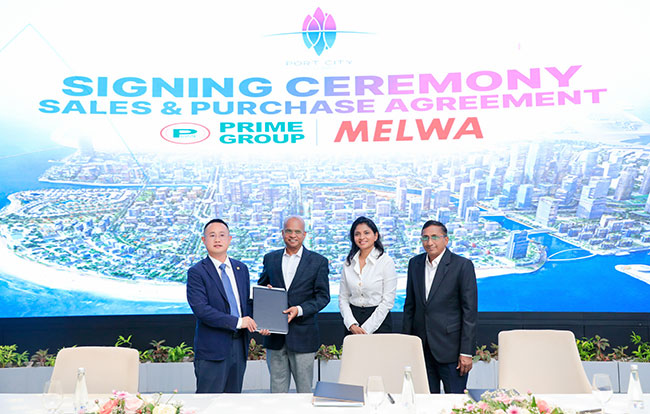
In a major boost for Sri Lanka’s luxury real estate sector, industrial giants Prime Lands and Melwa Conglomerate have partnered to develop a landmark USD 57.6 million marina-front project at Port City Colombo. The four-acre parcel, located within the city’s Marina District, will feature ultra-luxury residences with uninterrupted waterfront views—a rare design combining direct access to both the marina and water channel. Construction is set for completion in four years, with projected revenues exceeding USD 250 million.
This collaboration signals growing investor confidence in Sri Lanka’s long-term economic direction, as Port City Colombo operates as the nation’s first foreign currency-designated Special Economic Zone. Beyond luxury living, the project aims to attract global buyers and long-term capital, positioning Colombo as an international lifestyle and investment hub. Prime Lands, Sri Lanka’s top real estate developer, brings three decades of local expertise, while Melwa contributes decades of experience in steel and infrastructure. Together, they emphasize financial discipline, transparency, and global standards—setting a new benchmark for waterfront living and reinforcing Sri Lanka’s presence on the global investment map.

‘Dates have the highest sugar content to fight Coronavirus’

Sunday Island 27 December – Headlines

#SundayIsland 17th December – Headlines

Sunday Island – 28th March

Sunday Island Headlines – 21 March

Sunday Island – 21st February – Headlines
-

 Features5 days ago
Octopus, Leech, and Snake: How Sri Lanka’s banks feast while the nation starves
-
 Opinion4 days ago
Murder of Ehelepola family, Bogambara Wewa and Sightings of Wangediya
-
 News4 days ago
Steps underway to safeguard Sri Lanka’s maritime heritage
-

 Sports5 days ago
Sri Lanka women’s volleyball team ready for Central Asian challenge
-

 Editorial4 days ago
A play without its protagonist
-

 Midweek Review5 days ago
Overall SLPP failures stressed in new Aragalaya narrative
-

 Opinion3 days ago
The need to reform Buddhist ecclesiastical order
-

 Features1 day ago
The NPP’s pivot to the past