
Latest News
Philippine transport strikers say Marcos Jr failing to control oil prices


Despite driving his jeepney through some of Metro Manila’s busiest neighbourhoods on a daily basis, Arturo Modelo, 52, only takes home about a third of the 600 Philippine pesos ($10) he would normally earn, as thecost of fuel has soared in the Philippines and his profits have diminished as a result.
“I can’t even afford my kid’s lunch money,” he told Al Jazeera.
Leaning on his jeepney, Modelo explained how he joined two days of transport strikes in Manila on Thursday and Friday because he wanted “a deaf government to listen”.
Besides, he added, “you can’t really make a living on the road these days.”
The iconic jeepney, which emerged at the end of World War II when Filipinos repurposed old United States military jeeps to use as minibuses, is the cheapest and most common form of commuter transport in the Philippines.
Last week, jeepney owners staged a strike, which was followed by bigger demonstrations this week, as workers – from bus, taxi and minibus drivers to motorcycle taxi riders – representing nearly a dozen national transport groups joined the stoppage to protest rising fuel costs amid what they see as government inaction.
Thousands marched to the Presidential Palace on Friday, demanding price controls on petrol and diesel, scrapping fuel taxes, and tighter government regulation of the fuel industry.
The workers, who came together on Thursday and Friday under the No to Oil Price Hike Coalition, believe the government was too slow to act and had, for weeks, ignored their demands for price controls.
The No to Oil Price Hike Coalition also called out what it said was “American aggression” against Iran for the economic woes being felt in the Philippines.
“Filipinos didn’t start this war, don’t want any part of it, but are suffering because of it,” said Jerome Adonis, chairperson of the national workers’ group Kilusang Mayo Uno (May First Movement), who joined the strike.
“It’s like the United States also dropped a bomb on us,” Adonis said.
President Ferdinand Marcos Jr declared a state of national energy emergency on Tuesday night, a first as the US-Israel war on Iran entered its fourth week.
The emergency decleration will remain in force for one year, and allows the government to more rapidly procure fuel and petroleum products and to take action against the hoarding, profiteering and manipulation of petroleum product supplies.
Marcos said he ordered the “implementation of the fuel and energy allocation plan and other energy conservation measures” as a means to tackle the price surge and promised the country would have “a flow of oil”.
The Philippines has been hit harder than its neighbours by price shocks since the US and Israel attacked Iran last month. It has among the highest diesel and petrol prices in Southeast Asia, slightly behind Singapore – a country with higher wages and a far higher standard of living – as the global oil shortage bites.

Singapore diesel, according to various reports, was about $2.7 per litre this week, while diesel in the Philippines went up to $2.3 per litre. Petrol was about $2.35 per litre in Singapore, while in the Philippines it was nearly $2 per litre. In contrast, Malaysia, Vietnam and Thailand have recorded prices at about half of that at the fuel pumps.
As transport costs rise, students and workers in some cities in the country have been given free access to bus rides, and the government has started to provide a 5,000 peso ($83) subsidy to motorcycle taxi drivers and other public transport workers.
But for many, strike action is the only platform to express their concerns.
Transport union leaders said thousands had joined picket lines at 85 commuter terminals across the capital and major cities, while very few jeepneys could be seen on typically congested streets during the strike on Friday.
Authorities, however, said the two days of industrial action failed to paralyse Metro Manila, criticising the strike’s organisers and participants for inconveniencing commuters.
Asked on Friday if the government was considering directly subsidising fuel costs, similar to some countries in Southeast Asia, presidential spokesperson Claire Castro said the administration would study such a proposal.
Castro said the government had already doled out 2.5 billion pesos ($414m) in fuel subsidies this week to nearly 300,000 transport workers. However, advocacy groups say some 2 million people are likely working in the sector.
But transport workers also reported extremely long queues or missing out on the 5,000-peso payment due to their work details being absent from official government databases.
Jeepney driver Modelo, who spoke to Al Jazeera, said nobody from the transport terminal where he worked in Manila had received any government assistance.
Mody Floranda, national president of the transport workers group Piston, which initiated some of the strike action, said President Marcos Jr was favouring oil companies over Filipinos.
“Right now, Marcos can release an executive order for a price cap. He says it’s an emergency but acts like it isn’t,” said Floranda.
Presidential spokesperson Castro told reporters that the government’s swiftest action was “talking to manufacturing companies and other stakeholders not to increase the prices of goods”.
In a radio interview, Department of Energy (DOE) chief Sharon Garin said the agency aimed to please all stakeholders and that price caps imposed on fuel firms required the “right formula” to avoid harming businesses.
Experts attribute the high prices in the Philippines to the country’s dependence on oil imports and a deregulated market, plus excise taxes and a high value-added tax (VAT) of 12 percent.
Industrial economics Professor Krista Yu at De La Salle University in Manila said the dire situation was also due to the country’s “very limited domestic production and refining capacity”.
Yu said the government should prioritise securing “physical supply and reducing exposure to external shocks”.
According to the Energy Department, about 98 percent of the domestic crude oil supply is imported in the Philippines.

Emmanuel Leyco, chief economist at Credit Rating and Investors Services Philippines and the Center for People Empowerment in Governance (CenPEG), said that while the president is concerned about supply, “the public is already feeling the pain caused by unreasonable runaway prices.”
Leyco blamed the Oil Industry Deregulation Law of 1998 for the current situation, as it leaves fuel price adjustments in the hands of industry players.
“It is the main culprit. Even slight price adjustments cause serious problems because half the population is poor,” Leyco told Al Jazeera.
Faced with the likelihood of more strikes and growing public dissatisfaction, Marcos Jr separately signed a law on Wednesday allowing him to temporarily suspend excise taxes on fuel when crude oil exceeds a certain price per barrel for a month.
“Why not include the VAT and remove it with the excise taxes permanently?” asked opposition Kabataan Partylist lawmaker Renee Co.
“Both forms of taxation are regressive because they place the weight of commodity expenses on the people,” Co told Al Jazeera.
Co, along with other opposition lawmakers in Congress, had previously filed a bill to cancel both taxes, and on Wednesday filed a separate bill for state regulation of the oil industry.
Co was also among 50 members of Congress who passed a resolution calling for the “immediate cessation of hostilities in Iran, particularly an end to the military aggression instigated by the United States of America and Israel, in order to prevent further loss of life and humanitarian suffering”.
[Aljazeera]


A decision has been taken to declare a Special Dengue Prevention Week from 15 to 21 of June by the Colombo District Dengue Control Committee to curb the spread of the disease in the Colombo District.
This decision was taken at the meeting of the Colombo District Dengue Control Committee held on Friday (12) at the Colombo District Secretariat under the patronage of Prime Minister Dr. Harini Amarasuriya.
Compared to last year, the number of dengue cases reported this year has increased significantly. According to the National Dengue Control Unit, approximately 39,100 dengue cases have been reported island wide to date, of which 25.8% have been recorded in the Colombo District. Following this situation, the Colombo District has been identified as a high-risk district.
Health authorities informed that the increasing spread of the disease has been influenced not only by the nature of circulating virus but also to the lack of sufficient immunity among the population. They further noted that the recent period of heavy rainfall has aggravated the spread of Dengue.
It was also identified that the current outbreak is being reported more frequently from public places such as government institutions, private establishments, schools, and religious venues rather than from residential premises. Observations have identified improperly managed solid waste and drainage systems in offices and other public locations as major breeding grounds for mosquitoes.
Accordingly, during the Dengue Prevention Week from 15 to 21 June, a series of measures will be implemented, including, organising community clean-up campaigns in government and private institutions, schools, residential areas, and other public spaces; Conducting inspections of high-risk premises by Divisional Secretariats and taking legal action, where necessary, followed by awareness programmes; Distributing informational leaflets, displaying banners, and carrying out public awareness campaigns through the media. Health authorities also requested school administrations not to involve students below Grade 10 in school cleaning programmes and to immediately notify the relevant Medical Officer of Health (MOH) office if a student is diagnosed with dengue.
The programme is expected to receive the active support and participation of the district’s political leadership, religious leaders of all faiths, public officials, local government institutions, the tri-forces, the police, and the general public.
The event was attended by the Chairperson of the District Coordination Committee, Members of Parliament, representatives of local government authorities, government secretaries, police officers, and officials representing the education and health sectors, among others.
[Prime Minister’s Media Division]

SpaceX has debuted on US markets with a market valuation of more than $2 trillion, minting CEO Elon Musk as the world’s first trillionaire.
Shares opened on Friday at $150 per share, marking a 11 percent increase from the initial public offering (IPO) price of $135, valuing the company at $1.96 trillion and putting the aerospace company on track to become the sixth-largest company in the United States.
The stock surged 18 percent to $159 per share, up from the $135 it had been priced at, as the trading day came to a close.
Markets more broadly ticked higher amid a possible interim peace deal between the United States and Iran that could open the Strait of Hormuz. The Dow Jones Industrial Average is up 0.6 percent, the Nasdaq is up 0.2 percent, and the S&P 500 is up 0.35 percent as trading wraps up for the week.
The company sold $75bn in shares, immediately valuing it at $1.77 trillion. The IPO was oversubscribed four times higher than was otherwise expected, according to the Reuters news agency.
Of the institutional investors allocated, according to Bloomberg News, as much as 70 percent went to what are called long-only investments — a strategy in which holders buy assets based on the expectation that their value will grow over time — and sovereign wealth funds, including those from Saudi Arabia and Kuwait as well.
SpaceX President Gwynne Shotwell and Chief Financial Officer Bret Johnsen rang the opening bell at Nasdaq MarketSite in New York City at 9:30am local time as US markets opened.
On Thursday, protesters gathered outside the MarketSite to protest the IPO amid continued allegations that Grok, part of xAI, a subsidiary of SpaceX, allowed users to create non-consensual deepfake sexualised images before the IPO debut.
Shares of SpaceX did not trade until the middle of the trading day as the exchange collected buy and sell orders and underwriters delayed trading until supply and demand were balanced.
“We would expect SpaceX to see an immediate pop in trading due to the hype around the deal, north of 20 percent perhaps,” said Samuel Kerr, global head of equity capital markets at Mergermarket. “Anything lower would actually make me nervous.”
Exchanges and trading firms are eager to avoid the technical mishaps that marred Meta’s 2012 debut. With SpaceX widely viewed as a dress rehearsal for a new generation of mega-listings, market participants will also be watching for signals on investor appetite in advance of forthcoming IPOs for AI heavyweights Anthropic and OpenAI.
The landmark listing cemented Musk’s status as the first trillionaire ever and propelled SpaceX into the ranks of the world’s most valuable companies — even though the firm posted a loss of nearly $5bn last year and generated only a fraction of the revenue brought in by similarly valued tech giants.
The surge comes amid growth driven by its Starlink subsidiary, which drives as much as 80 percent of its revenue.
On Friday, SpaceX launched its Falcon 9 rocket with 29 satellites into space from Cape Canaveral in Florida.
[Aljazeera]
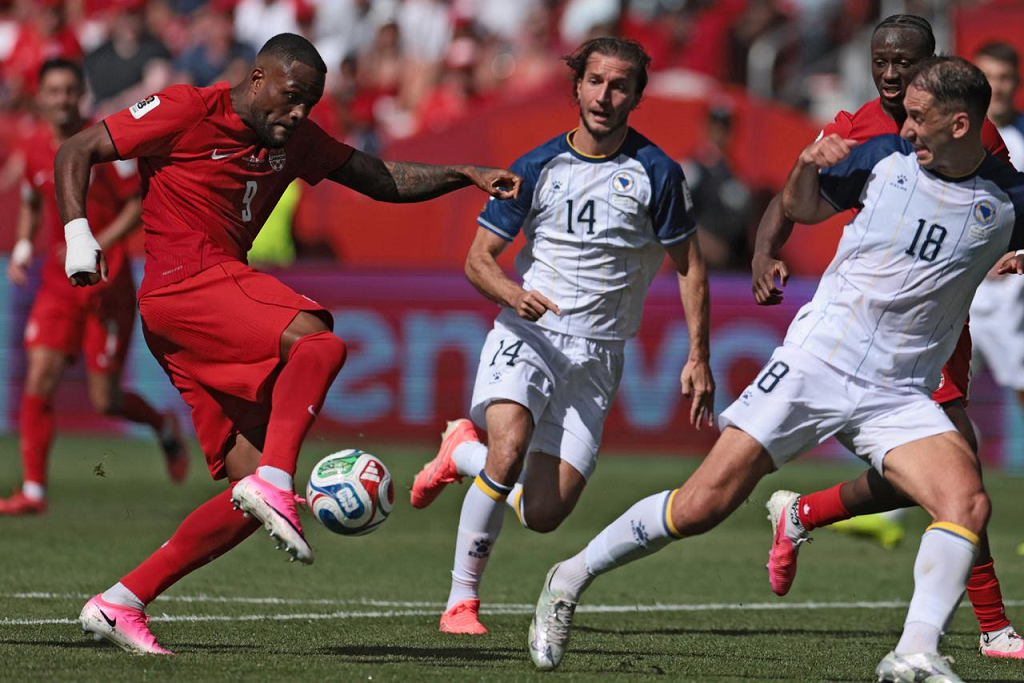
Canada substitute Cyle Larin made an instant impact as his goal rescued a point for the co-hosts as they began their 2026 World Cup campaign with a draw against Bosnia-Herzegovina.
Southampton striker Larin had only been on the pitch for just over two minutes when he superbly spun away from Tarik Muharemovic and fired past Nikola Vasilj, aided by a slight deflection.
It was the first time Canada had avoided defeat in the World Cup finals, after they had been beaten in all three games in 1986 and then again in 2022.
Bosnia, who gained penalty shootout wins in the qualifying play-offs over Wales and then Italy to secure their place in North America, took a 21st-minute lead in Toronto.
Jovo Lukic grabbed his first goal for his country when he headed in after ex-Arsenal defender Sead Kolasinac had flicked on Ivan Basic’s corner.
Canada nearly equalised early in the second half as Richie Laryea’s shot was going in, only for Kolasinac to produce an excellent clearance by diverting the ball on to the crossbar and away.
The hosts pushed for a leveller and had another good opportunity, only for Nikola Katic to clear off the line from Tani Oluwaseyi’s goal-bound header.
But, in a thrilling end-to-end match, Canada got a deserved equaliser in the 78th minute for their first ever World Cup draw.
Canada are one of three host nations for the 2026 World Cup, along with Mexico and the United States, and were looking to record a win, just as Mexico did when they beat South Africa 2-0 in Thursday’s tournament opener.
The Toronto Stadium was packed, with the majority of the home fans wearing red shirts and those away supporters in blue, with both groups contributing to a superb atmosphere.
After Alanis Morissette had sung the Canadian national anthem, the fans were treated to an entertaining, open game.
Canada, managed by former Leeds boss Jesse Marsch, had seen Jonathan David, Oluwaseyi and Stephen Eustaquio all guilty of missing opportunities, with Bosnia looking to hold on to their one-goal advantage.
But Marsch’s attacking substitutions proved successful, with Larin’s goal coming 121 seconds after he was introduced.
Group B always looked like being one of the closest, and Canada will still fancy their chances of advancing with games against Qatar on 18 June and Switzerland on 24 June still to come.
[BBC]

Special Dengue Prevention Week declared in Colombo District from June 15 to 21

The leader of the indigenous Vedda community Uru Warige Wannila Aththo Meets Prime Minister Dr. Harini Amarasuriya

SpaceX IPO debuts in US markets, Musk becomes world’s first trillionaire

Fans on concourses instead of in seats, claims FIFA

Co-hosts Canada begin 2026 World Cup campaign with a draw against Bosnia-Herzegovina.

Showers will occur at times in the Western, Sabaragamuwa and North-western provinces and in Galle, Matara, Kandy and Nuwara-Eliya districts

‘Dates have the highest sugar content to fight Coronavirus’

Sunday Island 27 December – Headlines

#SundayIsland 17th December – Headlines

Sunday Island – 28th March

Sunday Island Headlines – 21 March

Sunday Island – 21st February – Headlines
-

 News7 days ago
Women’s T20 World Cup 2026 warm-up: Chamari Athapaththu’s 94 helps Sri Lanka beat Pakistan
-

 News7 days ago
Lankan-Canadian inducted to Toronto Sports Hall of Fame
-

 Editorial6 days ago
Probe Sallay’s complaint
-
 News4 days ago
Local firms move millions of dollars overseas for phantom imports: Govt.
-

 Editorial7 days ago
Prez in the dock
-
 News2 days ago
CIABOC summons Yoshitha over his participation in British Navy training programme
-

 Features7 days ago
Entering MIT for my Ph.D program, coping with harsh Boston winter and breasting the tape
-
 Midweek Review4 days ago
July 09: An inexcusable overall security failure and exceptional contingency plan