
Foreign News
One ant for $220: the new frontier of wildlife trafficking

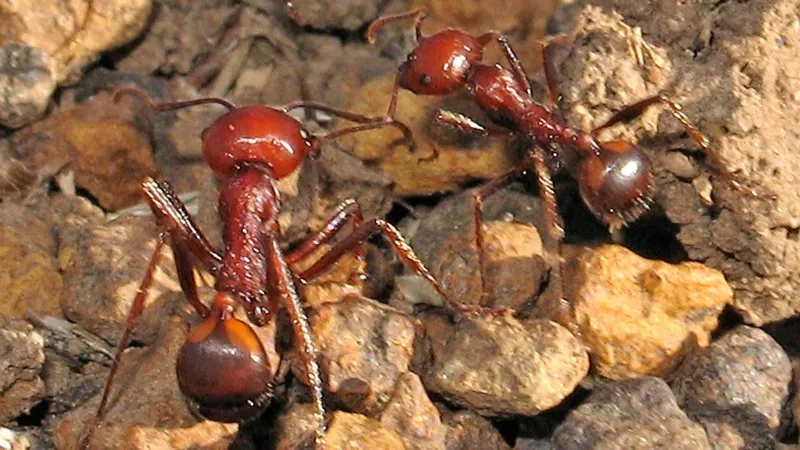
The ants are flying in Kenya at the moment
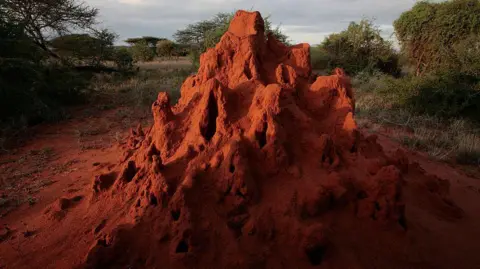
During this rainy season, swarms can be seen leaving the thousands of anthills in and around Gilgil, a quiet agricultural town in Kenya’s Rift Valley that has emerged as the centre of a booming illegal trade.
The mating ritual sees winged males leave the nest to impregnate queens, who also take flight at this time. This makes it the perfect time to chase down queen ants to sell on to smugglers who are at the heart of a growing global black market, that taps into the pet craze for keeping ants in transparent enclosures designed to observe the insects as they busily build a colony.
It is the giant African harvester ant queens, which are large and coloured red, that are most prized by international ant collectors – one can fetch up to £170 ($220) on the black market, which tends to operate online.
A single fertilised queen is able to create a whole colony and can live for decades – and can be easily posted as scanners do not tend to detect organic material.
“At first, I did not even know it was illegal,” a man, who asked not to be named, told the BBC about how he had once acted as a broker, linking foreign buyers with local collection networks.
Also known as Messor cephalotes, these ants are native to East Africa and known for their distinctive seed-gathering behaviour making them popular with ant collectors.
“A friend told me a foreigner was paying good money for queen ants – the big red ones which are easily seen around here,” the former broker said.
“You look for the mounds near open fields, usually early morning before the heat. The foreigners never came to the fields themselves – they would wait in town, in a guest house or a car, and we would bring the ants to them packed in small tubes or syringes they supplied us with.”
The scale of the illicit trade in Kenya became apparent last year when 5,000 giant harvester ant queens – mainly collected around Gilgil – were found alive at a guest house in Naivasha, a nearby lakeside town popular with tourists.
The suspects – from Belgium, Vietnam and Kenya – had packed the test tubes and syringes with moist cotton wool, which would enable each ant to survive for two months, according to the Kenya Wildlife Service (KWS).
The plan was to take them to Europe and Asia and put them up for sale.
This trade in ants has caught scientists and the authorities by surprise.
The East African nation is more accustomed to high-profile wildlife crimes involving elephant tusks and rhino horns.
UK based retailer Ants RbUs described the giant African harvester ant as “many peoples dream species” – though the queens are currently out of stock, with the site explaining that it is very hard for retailers to source them.
“Even I, as an entomologist, have been surprised at the extent of the apparent trade,” Dino Martins, a biologist based in Kenya, where there are around 600 kinds of ants, told the BBC.
However, he can understand the fascination with East Africa’s harvester, with colonies created by a “foundress queen”, who can grow up to 25mm (0.98 inches) and who produces eggs throughout her life.
“They are one of the most enigmatic species of ants – they form large colonies, engage in interesting behaviours and are easy to keep. They are not aggressive.”
During the swarming he says the queens mate with several males.
“Then that is it for the males – their job is done… most are eaten by predators or die,” the entomologist says, going on to explain how the queen then scurries away to dig a small burrow and begin laying eggs to start her empire.
Her workers and soldier ants, those that protect the nest, are all female and will eventually number in the hundreds of thousands.
“Nests can live for over 50 years, perhaps even up to 70 years. I personally know of nests near Nairobi that are at least 40 years old as I’ve been visiting them for that long,” said Martins.
This means the queens live that long too – because as soon as she dies, the colony collapses and any surviving workers will look for another nest.
Kenyans who have had to deal with ants raiding their crops or invading their houses know this well – and to get rid of a colony someone is sent in to locate the queen, often hidden deep in one of the tunnels or chambers of an ant mound.
The former broker said ants could also be harvested by gently disturbing the mound and collecting them as they tried to escape.
“It was only when I saw the arrests on the news that I realised what I had been part of – and I immediately quit,” he said.
Those arrested were convicted on charges of biopiracy and ordered to pay fines or serve 12 months in jail – they opted to pay the $7,700 fee and the foreign nationals left the country.
Two weeks ago, a Chinese national – the alleged mastermind behind last year’s ring and who is said to have escaped using a different passport, was arrested at Nairobi’s Jomo Kenyata International Airport with another 2,000 queen ants packed in test tubes and tissue rolls.
For Zhengyang Wang, who was part of a team of researchers who published a report on the ant trade in 2023 focusing on China, this is a worry and could “wreak havoc” with local ecosystems.
“Initially, we were very excited when we learnt that many people have taken up keeping ants,” Wang, assistant professor at Sichuan University, told the BBC.
“A colony of pet ants are often kept in a formicarium, which is basically a transparent plastic box so that keepers can observe colonies at work, digging tunnels, collecting food, and guarding their queen. I’d say it’s quite charming and… can be a good way of educating people about insects and their behaviour.
“But then we realised, wait, isn’t keeping invasive species incredibly dangerous?”
Monitoring online sales – of more than 58,000 colonies – in China over six months, the researchers found that more than a quarter of the traded species were not native to China – despite it being illegal to import them.
“If the trade volume of invasive ants continues to grow, it’s only a matter of time before a few escape from their formicaria and become established in the wild,” said Wang.
The study he worked on, published in the journal Biological Conservation, explained what could happen in the case of giant African harvester, one of the most traded species in China: “For example, Messor cephalotes, an East African native, is among the largest seed harvesters in the world and could potentially disrupt predominantly grain-based agriculture in south-eastern China.”
The environmental consequences are also a concern in Kenya.
“Harvester ants are both keystone species and ecosystem engineers. They harvest seeds of grasses, and other plants and in so doing also help to disperse the seeds,” said Martins, adding that the insects “create a more healthy and dynamic grassland”.
Mukonyi Watai, a senior scientist at Kenya’s Wildlife Research and Training Institute, shares these fears.
“Unsustainable harvesting – particularly the removal of queen ants – can lead to colony collapse, disrupting ecosystems and threatening biodiversity,” he told the BBC.
It is possible to collect ants legally in Kenya – in line with various international treaties – with a special permit, which would require the buyer to sign a benefit-sharing agreement with the local community involved to split any profits.
But, according to the KWS, so far none have been applied for – with the paperwork also requiring details of how many ants are being collected and their destination.
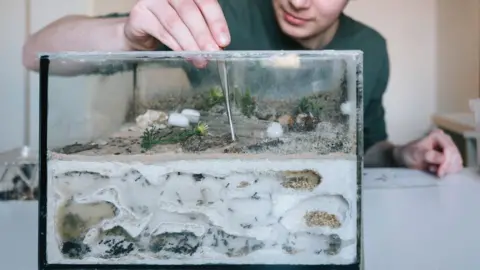 formicarium allows collectors to see the workings of an ant colony (BBC)
Some conservationists are now calling for greater trade protections for all ant species under the Convention on International Trade in Endangered Species (Cites), the global wildlife trade treaty.
“The reality is that no ant species is currently listed under Cites,” Sérgio Henriques, a researcher into the global ant trade, told the BBC.
“Without international treaties monitoring these movements, the scale of the trade remains largely invisible to policy makers and the global community,” he said.
But for the KWS the real problem is more immediate – how to monitor and clamp down on “under-reported” insect trafficking, with the agency suggesting better surveillance equipment at airports and others border points would be a good start.
Martins agrees: “It is likely only a fraction of the actual ants being traded that are being detected, so one can only guess at the scale for now.”
Journalist Charles Onyango-Obbo argues that Kenya is overlooking a significant global revenue opportunity.
“The ants are not finite items like gold or diamonds. They are biological assets that can be bred and farmed, and their production can be scaled up to thousand a day. Yet we treat them like stolen artefacts,” he recently wrote in Kenya’s Daily Nation newspaper.
In fact, Kenya’s cabinet did approve policy guidelines last year aimed at commercialising the wildlife economy, including the ant trade.
“The guidelines seek to promote sustainable use trade of wild species such as ants to generate jobs, wealth and community livelihoods across all the counties,” said Watai.
With careful monitoring in place, it could be that future farmers around Gilgil will have special formicaria on their land expanding the yields from their fields and orchards – full of vegetables and fruits – to include lucrative queen ants.
But the debate over the dangers of exporting ants to hobby collectors in different parts of the world is yet to be settled.

The US has been holding regular negotiations with Denmark to expand its military presence in Greenland, according to multiple officials familiar with the discussions, with talks between both sides progressing in recent months.
US officials are seeking to open three new bases in the south of the territory, a semi-autonomous part of Denmark, as they work to resolve a diplomatic crisis sparked by President Donald Trump when he threatened to seize Greenland by force.
Trump said in January that the US should “own” Greenland to prevent Russia or China from taking it. He said this could happen the “easy way ” or “the hard way”.
The White House confirmed the administration was engaged in high-level talks with Greenland and Denmark, but declined to comment on details of the negotiations. A White House official told the BBC the administration was very optimistic the talks were headed in the right direction.
Denmark has previously expressed a willingness to discuss additional American military bases in Greenland, and its foreign ministry confirmed talks with the US were taking place. “There is an ongoing diplomatic track with the United States. The Ministry of Foreign Affairs will not go into further detail at this time,” a spokesperson said.
US officials have floated an arrangement in which the three new military bases would be formally designated as US sovereign territory, according to one source with knowledge of the negotiations.
The bases would be in southern Greenland and primarily focus on surveillance of potential Russian and Chinese maritime activity in an area of the northern Atlantic between Greenland, Iceland and the United Kingdom known as the GIUK Gap, the officials who spoke to the BBC said.
The two sides have not formally agreed to anything yet and the final number of bases could change, the sources said. One of the new bases would likely be located in Narsarsuaq, on the site of a former US military base that housed a small airport.
Any other new military bases would likely also be located on sites in Greenland that have existing infrastructure such as airfields or ports, which could be upgraded at a lower cost than building new facilities, analysts said.
US officials have not raised the possibility during talks of somehow seizing control of Greenland, something that Denmark and Nato have publicly rejected.
Despite Trump’s threats, the countries have been actively working towards a deal in recent months.
The talks have been confined to a small working group of officials in Washington who have made headway negotiating outside of the spotlight while the administration has been consumed by the war in Iran.
General Gregory Guillot, the head of US Northern Command, gave a broad sense of the negotiations during congressional testimony in March. He said the US was seeking to open new bases, but the sources close to the talks described new details that paint a picture of regular high-level meetings that have progressed in recent months.
The delicate diplomatic effort is being led by Michael Needham, a senior state department official who has been tasked with crafting a deal that satisfies Trump while also respecting Denmark’s redlines around protecting its borders.
“Needham is running point” on Greenland, said a senior diplomat with knowledge of the talks. Behind the scenes, the person said, the administration is “approaching it very professionally”.
The teams have met at least five times since mid-January. Needham is usually accompanied by one or two US officials from the state department or National Security Council, several sources said. His counterparts in the room include Jesper Møller Sørensen, Denmark’s ambassador to the US, and Jacob Isbosethsen, the top Greenlandic diplomat in Washington.
Trump’s special envoy to Greenland, Republican Louisiana Governor Jeff Landry, hasn’t taken part in the negotiations and is largely absent from the diplomatic process, three sources said.
“He was supposed to be more of like a rah-rah cheerleader of the idea that we could just flex our muscles and take over Greenland as a security asset,” said a close Landry ally who asked not to be named. Landry “has never been to any of the actual talks.”
Landry’s office did not respond to a request for comment.
The US currently has one military base in Greenland, down from approximately 17 military facilities during the height of the Cold War. Pituffik Space Base is located in northwestern Greenland – it monitors missiles for NORAD but is not configured to conduct maritime surveillance.
Some current and former officials, as well as Arctic security experts, told the BBC that Washington could have advanced its interests in Greenland without threatening a Nato ally in such strong terms.
“Why threaten an ally with a military operation or invasion when what you want is something that could be negotiated quite easily?” said one former senior US defence official.
Others, however, praised the co-operation between the US and Denmark.
“Wherever the US and our allies leave a vacuum, that vacuum is often filled by China and Russia,” retired General Glen VanHerck, the head of Northern Command and North American Aerospace Defense Command (NORAD) from 2020 to 2024, told the BBC.
Behind closed doors, negotiators have sought to reach a compromise under the framework of an existing decades-old security agreement between the US and Denmark.
The 1951 pact grants the US a wide berth to expand its military operations in Greenland. The Danish government must approve any US military expansions in the territory, but Denmark has historically supported America’s military operations there and has never rejected a US request to expand its presence, Arctic security experts said.
Representatives of the Greenland government in Washington declined to comment. The US state department also declined to comment.
Trump expressed interest in the US gaining greater access to Greenland during his first term as president. But his renewed interest earlier this year set off a diplomatic crisis that highlighted tensions between Nato and the Trump administration.
[BBC]

The Philippine House of Representatives has voted to impeach Vice-President Sara Duterte for a second time, threatening her plan to run for president in 2028.
Monday’s vote moves the impeachment process to the Senate for trial, where if convicted, the daughter of former President Rodrigo Duterte will be disqualified from holding public office.
The 47-year-old is leading early surveys to replace her ally-turned-bitter foe, President Ferdinand Marcos Jr.
The case against the vice-president stemmed from her alleged misuse of public funds and public threats against Marcos, his wife and his cousin, the former House speaker.
Duterte was impeached on the same grounds in 2025, but the Supreme Court blocked it on a technicality before the
senate trial could start.
The case was revived this year. Last week, a House committee that looked into the evidence against the vice-president ruled that there was sufficient grounds to impeach her.
Duterte described the case as “nothing more than a scrap of paper” in a formal written response. She refused to appear in the committee hearings which she said had been politically motivated.
After the impeachment vote on Monday, Duterte’s defence counsel said in a statement that “the burden now rests on the accusers to substantiate their claims” according to the law.
Monday night’s impeachment vote served as a barometer of Marcos’ support in the House. 257 of the 290 lawmakers in attendance voted to impeach Duterte, more than the one-thirds required to advance the case to trial.
But unlike in the House, a conviction in the Senate is uncertain, if a trial does start and runs its course.
In Philippine politics that is dominated by patronage and dynastic alliances, House members, who are elected per legislative district are friendlier to the incumbent president, compared to senators.
The country’s 24 senators are elected on the national level and the Senate is a traditional springboard for those hoping to run for president or vice-president in the future.
In the 2025 mid-term vote, where half of the Senate was elected, candidates allied with Duterte fared better than those who ran under Marcos’ coalition.
But the outcome of an impeachment vote will be difficult to predict under the country’s multi-party system with shifting alliances.

Duterte announced her intention to run for president in February, much earlier than expected. Marcos is limited by the constitution to a single six-year term.
She holds a 17-point lead over her nearest rival based on a survey in March by Manila pollster WR Numero.
In the 2022 elections, Duterte was the survey frontrunner to succeed her father, but she formed an alliance with Marcos and ran for vice-president instead to consolidate their support bases and fend off a reformist wave. The pair won by a landslide.
But the alliance soon unravelled as they pursued divergent political agendas.
Marcos’ allies in the House, led by cousin, then speaker Martin Romualdez, investigated allegations of fund misuse in Duterte’s office.
At the height of public scrutiny, Duterte hosted a late night online press conference, where she said she told one person that “if I get killed, go kill BBM [President Marcos], [First Lady] Liza Araneta, and [House Speaker] Martin Romualdez”.
Then in March last year, Marcos allowed theInternational Criminal Court to arrest Rodrigo Duterte and detain him at The Hague, where he now awaits trial for crimes against humanity over the hundreds who died in his so-called war on drugs.
[BBC]

A car bombing at a police post, followed by an intense firefight, has killed at least 21 officers in northwestern Pakistan, according to police and security sources.
An alliance of armed groups known as the Ittehad-ul-Mujahideen Pakistan has claimed responsibility for the attack in Bannu, a district in Khyber Pakhtunkhwa province bordering Afghanistan, late on Saturday.
[Aljazeera]

Kohli’s ninth IPL hundred powers Royal Challengers Bengaluru to the top

Special Coordination Committee meeting for Badulla District chaired by the President

Showers or thundershowers will occur at times in the Western, Sabaragamuwa, Central, Southern, North-western and Northern provinces

SJB flays PUCSL for shifting coal scandal losses to electricity consumers

Rains bring relief to debt-ridden CEB as reservoirs fill; one dead, 62 families affected by adverse weather

President orders acceleration of Ditwah relief programmes

‘Dates have the highest sugar content to fight Coronavirus’

Sunday Island 27 December – Headlines

#SundayIsland 17th December – Headlines

Sunday Island – 28th March

Sunday Island Headlines – 21 March

Sunday Island – 21st February – Headlines
-

 News4 days ago
Lanka Port City officials to meet investors in Dubai
-

 News1 day ago
Ex-SriLankan CEO’s death: Controversy surrounds execution of bail bond
-

 News5 days ago
SLPP expresses concern over death of former SriLankan CEO
-

 Editorial6 days ago
The Vijay factor
-

 News5 days ago
Police inform Fort Magistrate’s Court of finding ex-CEO of SriLankan dead under suspicious circumstances
-
Features2 days ago
High Stakes in Pursuing corruption cases
-

 Features2 days ago
When University systems fail:Supreme Court’s landmark intervention in sexual harassment case
-

 Features6 days ago
Palm leaf manuscripts of Sri Lanka – 1