
Features
Rapid re-vegetation of Ditwah scars urgently needed for SL’s economic health

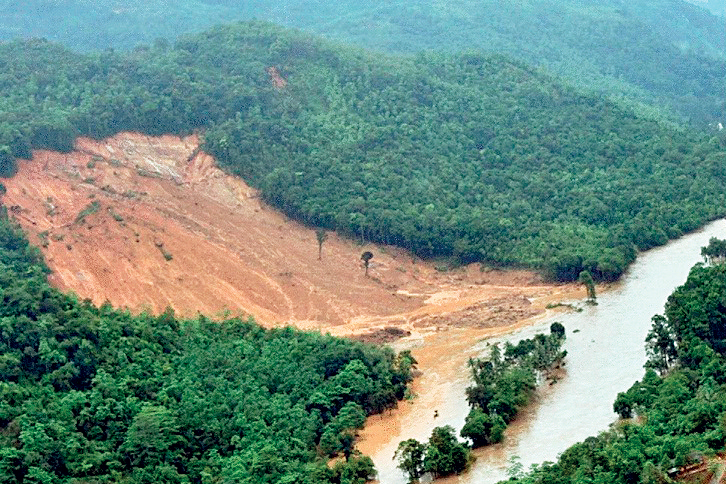
In late November 2025, Cyclonic Storm Ditwah hit Sri Lanka, pouring a deluge that would trigger one of the most devastating landslide events in recent memory. While the immediate toll—lives lost, homes destroyed, families displaced—broke the nation’s heart, a slower-moving disaster is now unfolding on the denuded slopes of the central highlands. Unless urgent action is taken, the environmental aftermath could threaten the very infrastructure that must support the country’s economy for decades to come.
The relentless rainfall saturated the steep, fragile terrain of districts like Badulla, Matale, Nuwara Eliya, and Kegalle, triggering an estimated 1,200 landslides. According to data from the UNOSAT Geodata platform, these events scarred approximately 2,200 hectares of land. Kandy District bore the brunt with 618 hectares impacted, followed by Nuwara Eliya (507 ha), Badulla (434 ha), and Matale (262 ha).
These are not just blemishes on the landscape. The landslides have violently stripped hillsides of vegetation and fertile topsoil, leaving expanses of bare, compacted earth. In this state, the ground acts like concrete. Instead of absorbing rainfall, water rushes off the surface, carrying massive amounts of sediment with it.
This leads to a critical, and largely overlooked, threat: the siltation of Sri Lanka’s lifeblood—its major multipurpose reservoirs. Many of the landslide sites are located within the catchment areas of critical dams, including Kotmale, Victoria, Randenigala, and Moragahakanda. The sediment washing into these reservoirs accelerates siltation, which slowly but surely chokes their capacity. This directly undermines hydropower generation, threatens irrigation reliability for farmlands, and degrades water quality for millions downstream.
The slow recovery of a wounded forest
In a healthy forest, soil stability is maintained by a complex root system that binds the earth, while leaf litter together with the plant cover acts as a shield, absorbing the pounding power of raindrops, significantly reducing the risk of soil particle detachment and subsequent erosion. The exposed slopes are highly susceptible to even moderate rainfall, which carves deep gullies into the hillside and raises the risk of secondary mudflows. These subsequent events can be just as dangerous as the initial landslide, threatening villages, roads, and rivers below.
Nature does attempt to heal these wounds. Grasses and shrubs slowly creep in from the edges. But on poor, unstable soil, this natural regeneration is a process that can take centuries. Sri Lanka cannot afford to wait that long.
A blueprint for rapid intervention
The solution, experts argue, lies in rapid re-vegetation. Re-establishing plant cover is the most effective, and most urgent, way to stabilize these fragile slopes. Plant roots bind the soil, leaves break the fall of rain, and organic matter slows runoff, allowing water to seep back into the ground.
However, replanting a landslide scar is not as simple as scattering seeds. It requires a coordinated strategy, beginning with a thorough geotechnical assessment to identify the most unstable areas. Some locations may require structural reinforcements like check dams or contour terraces to provide a stable foundation. Others need improved drainage to safely divert surface water.
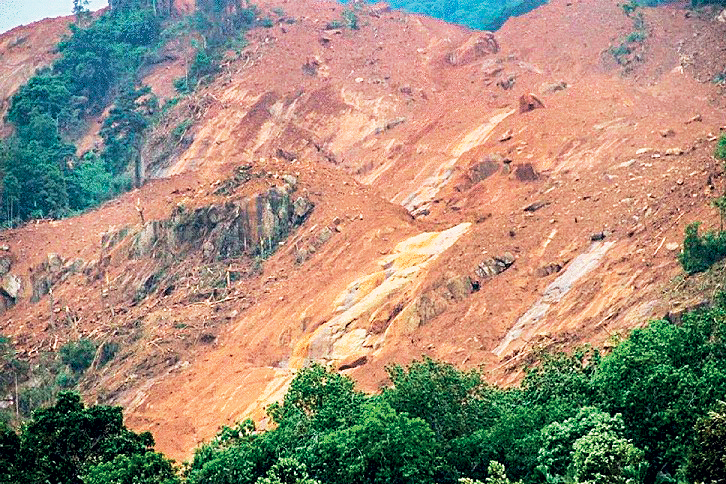
Photo by Red Cross, Sri Lanka https://www.redcross.lk/main-news/180-persons-rescuedfrom- aranayaka-landslide-rescue-missions-well-underway/
The biological strategy is equally important. The focus must be on native species. In the first one to two years, fast-growing “pioneer” species—grasses, sedges, and nitrogen-fixing plants—are essential to quickly cover the soil, control erosion, and create a nurturing micro-climate. Once this initial layer is established, the focus can shift to planting slower-growing shrubs and trees that will, over the following five years, build a permanent, resilient forest.
Revegetation operations: Restoring stability to landslide-scarred slopes
The method used to restore vegetation after a landslide depends largely on the size of the damaged area and how easily it can be reached. Smaller, accessible scars can often be treated through manual seeding with the support of local labour. But where landslides have carved out vast, steep and unstable slopes, mechanical solutions become essential. In such terrain, hydro seeding has proven to be one of the most effective techniques for rapid slope stabilization.
Hydro seeding involves spraying a carefully prepared mixture of water, seeds, mulch, fertilizers, soil amendments and binding agents onto exposed soil. In landslide zones—where both vegetation and nutrient-rich topsoil have been stripped away—this slurry provides immediate surface protection. The mulch layer softens the impact of heavy rainfall, conserves moisture and regulates soil temperature, while binding agents help the mixture cling to steep gradients. To compensate for lost topsoil, compost, biochar and suitable fertilizers can be added to improve soil structure and nutrient content. Fast-germinating grasses and legumes are typically included to establish quick ground cover, alongside selected native species to support long-term ecological recovery.
Traditional hydro seeding systems use truck-mounted tanks that spray large volumes of slurry through hoses or high-pressure cannons. Operations are most effective when timed with the onset of the main monsoon, when consistent rainfall promotes seed germination—usually within five to fourteen days, depending on the species used.
However, in extensive and inaccessible areas such as the central highlands affected by Ditwah, drone-assisted hydroseeding offers a safer and more practical alternative. With appropriate technical modifications, unmanned aerial vehicles (UAVs) can distribute seed mixtures over unstable terrain without exposing ground crews to hazardous conditions. This approach allows rapid treatment of erosion-prone slopes and can cover tens of hectares in a single day—an important advantage in preventing freshly exposed soils from becoming long-term sediment sources during subsequent rains.
In addition, for hydro seeding drones can also be deployed for targeted broadcasting of grass and tree seeds. These seeds may be coated with soil-binding agents, nutrients and beneficial microbes to enhance establishment success. Similar technologies are already being applied in countries such as Australia, demonstrating their potential to accelerate vegetation recovery while minimizing operational risks.
Modern agricultural and reforestation drones further enhance precision and efficiency. GPS-guided flight paths ensure uniform seed distribution, while variable-rate dispersal enables higher seed densities in high-risk erosion zones identified through slope mapping and modelling. Compared with manual broadcasting or ground-based hydro seeding in remote hill terrain, drone-assisted seeding reduces manpower needs, lowers logistical complexity and minimizes long-term costs. Crucially, it eliminates the need for heavy machinery, preventing additional soil compaction or disturbance of the fragile surface layer essential for seed establishment.
A coordinated national strategy is now urgently needed. Key government institutions—including the Forest, Agriculture and Environmental authorities, together with the National Building Research Organization—should develop a comprehensive restoration framework that can be applied not only to current landslide-affected areas but also to future events. Successful implementation will require collaboration with international funding agencies, the private sector and local environmental organizations. Without timely and technically sound intervention, landslide scars risk becoming chronic sources of erosion and sedimentation, with lasting consequences for Sri Lanka’s fragile hill country ecosystems.
(The writer is a former research officer attached to the Department of Agriculture, Sri Lanka. Detail report of this article with references and other resources can be found in his blog: https://outofboxag.wordpress.com/. . He can be reached at anawicks@gmail.com )
By Ananda Wickramasinghe ✍️


 Despite some sections of the Trump administration persisting with the view that the possibility could not be entirely ruled out of there being a diplomatic solution to the current US-Iran hostilities in West Asia, the skeptic could not be blamed for thinking otherwise. The intensity, scale and frequency of the tit-for-tat strikes by the antagonists over the past few days against selected military targets and civilian infrastructure in particular in West Asia make the adoption of this stance excusable.
The continuing hostilities render the mentioning of the MOU signed between the warring parties in mid-June a laughable matter. While it could very well be that the foes are wishing privately for a cessation of hostilities before long, what seems to be uppermost on their minds right now is to negotiate with each other from a position of strength. This strategy compels them to incapacitate each other militarily to the extent possible, lest they have to concede too much to each other during negotiations. Hence the stepped-up hostilities.
However, even on the question of there being a negotiated political settlement in the West Asian theatre in the longer term, the skeptic could come to be seen as scoring over the optimist. Developments on the ground account for this.
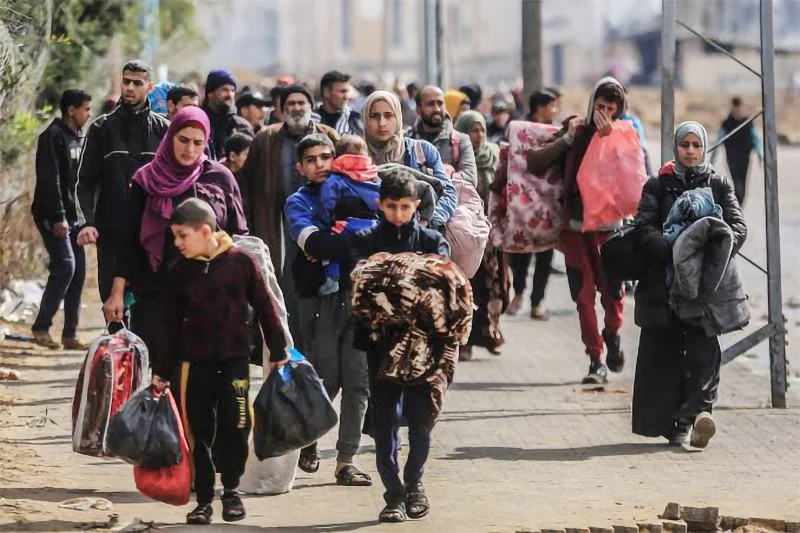
At the time of writing Israel’s Netanyahu government is going ahead in fairly care-free fashion with the establishment of more Jewish settlements in the Gaza and the West Bank, and it’s all happening under the apparently complacent gaze of the US. In fact, some quarters estimate that Israel is in control of some 65% of the Gaza Strip. Ethnic cleansing, that is, is being drastically stepped-up.
Accordingly, in terms of the power relations of West Asia, the world is almost back to the status quo of the late forties of the last century when the state of Israel was established and the Palestinians were reduced to a microscopic minority in the land they came to inhabit. Therefore, even the impartial observer would be compelled to ask: ‘Will a negotiated peace be ever possible in the Middle East?’
The humanist in the observer would prefer to answer this question in the affirmative and it is indeed the ideal stance to adopt considering the staggering human and material costs of the conflict. But the way ahead to peace could be expected to be highly hazardous and arduous. Among other odds, it would also prove an uphill endeavour to win minds and hearts.
The US’ Trump administration would need to be counted out in this pursuit. This is on account of the fact that it has been far too wayward in its management of West Asian affairs in particular over the past couple of years. Given its unpredictable character it is a matter for conjecture whether it could be counted on to live up to its commitments.
Moreover, Israel could be expected to ‘go it alone’ in the Middle East regardless of whether US help is coming or otherwise. It has indicated as much in recent times and Israel could be doubted on this score only at the doubter’s peril. Because time and again Israel has demonstrated that it could steadfastly defend its interests even single-handedly in the Middle East. History bears this out.
However, a durable alliance with the US would stand Israel in good stead. On the matter of military and intelligence assistance, for example, the US’s help proved invaluable for Israel in the past and going forward this is bound to be so as well. Moreover, it is unlikely that the Trump administration would give up on Israel, considering that a strong Israel is crucial for the furtherance of the US’ strategic and economic interests in West Asia.
But whether the above factors would have a considerable bearing on the question of working out a durable solution to the West Asian tangle is an entirely different matter. Israel, as in the case of the Palestinian enclaves, is acutely security conscious and would need to satisfy itself fully that it could live in a security environment that would guarantee its complete safety, going forward.
The Middle East is badly in need of another peace effort on the lines of the Oslo Accords of the mid-nineties that brought the key actors together and helped hammer out a solution that addressed some of their notable concerns. To be sure, that process did not prove to be the ideal answer to the tangle, but it yielded some respite to the region and drove home that one-time sworn foes could indeed negotiate with a degree of success. The West Bank authority, although falling short of fulfilling some key Palestinian aspirations, is testimony that a degree of success is possible if the intent is right.
Given the current realities of West Asia, peace-making is bound to be an uphill challenge. The violence faced in recent times by the Palestinian community, in particular, has been nothing less than mind-numbing. Merciless has been the violence visited on them by the Israeli side. In such circumstances, durable peace in the region could smack of an idealist’s dream.
Nevertheless, there needs to be urgently, a meeting of minds over the divides. The US would need to be counted out as an honest broker in bringing the sides together but the rest of the West would do well to step up to the challenge.
In this exercise the onus would be on the world’s democracies to take the initiative and doggedly stay the course. An acceptable combination would be the EU and the UN. Given their credentials, the main sides in West Asia ought to find them the least controversial.
Even if the relevant institutional and political arrangements could be shored up to take a reconciliation process forward, winning hearts and minds for the peace drive would prove a grueling challenge. Over the past few years in particular tens of thousands of hearts and minds on both sides of the divide have been bruised badly in the runaway murderous violence that has come to define the Middle East.
These badly scarred personalities would need to experience healing without much delay. It is therefore a multi-faceted challenge that is at hand. Since wide-ranging expertise would be needed in the healing process, people’s participation in peace-making, ranging over the divides, would need to be made a durable reality. It will be a time for enthroning humanity and ensuring the rejection of all forms of violence and coercion.

 For many Sri Lankans, Thailand is the go-to holiday — beaches, temples, food, and that famous warm hospitality.
In fact, I’ve been to Amazing Thailand 24 times myself, and was honoured with the Friends of Thailand International Media Award by the Tourism Authority of Thailand for promoting Thai tourism.
The good news I have for you today is that you don’t even need a passport to get a taste of Amazing Thailand.
The Royal Thai Embassy, in Colombo, is bringing a vibrant slice of Thailand, to the city of Colombo, with Thai Festival 2026 — a cultural experience like never before.
Whether you are an avid enthusiast of Thai culture, a total novice, or simply just interested in exploring foreign cultures, Thai Festival 2026 is going to be the perfect opportunity for you to get more than just a glimpse into one of the most celebrated cultural heritages in South East Asia. And ENTRANCE IS FREE.
The festival will be held on the 1st and 2nd of August, 2026, at Siam Nivasa, 43, C.W.W. Kannangara Mawatha, Colombo 7, and the East Parking Area, of the Colombo Municipal Council, from 11:00am to 5:00pm.
Both days will be full of live entertainment, and dispersed throughout with Thai cultural displays, including exhilarating traditional dance performances and breathtaking Muay Thai demonstrations.
Exploring art and craft specific to Thailand, tasting irresistible authentic Thai cuisine, and playing arcade games, are just a few more fun-filled events available for visitors at the festival premises.
An array of Thai products will also be available for purchase.
While at the festival, you will find Sri Lankan Alumni from Thai universities sharing their experiences with you and willing to answer any questions you might have, related to studying abroad in Thailand.
You can also register for the Muay Thai workshop that will be happening on the 7th and 8th of August, 2026, in Colombo.

Irresistible authentic Thai cuisine
Visitors can also stand a chance to win traditional Thai souvenirs, get exclusive photo opportunities, and, the big one — to enter the raffle draw, at the end of each day, for the grand prize of an all-inclusive round trip to Thailand.
Be sure to avail yourself of this exceptional opportunity and add a cultural spin to your weekend.
To keep up with the latest updates on Thai Festival 2026, head over to the Thai Festival official social media pages.
The Royal Thai Embassy in Colombo official webpage:
https://colombo.thaiembassy.org
Official social media:
Facebook: @RTEColombo
Instagram: @thaiembassysrilanka
Thai Festival official social media:
Facebook: Thai Festival in Colombo
Instagram: @thaifestival_colombo
TikTok: @thaifestival.incolombo

 Hair fall, in this heat, can be so frustrating, and noticing a thin patch is even more worrying. The good news is … yes, with a little care and kitchen ingredients, you can nourish your scalp and support healthy regrowth.
Try these four easy home remedies … even our grandmothers trusted:
* Coconut Oil and Curry Leaves Tonic:
Warm 04 tablespoons of coconut oil, with a handful of curry leaves, till the leaves turn black. Cool, strain, and massage into scalp 02-03 times a week. Leave for 01 hour, or overnight.
Why:
Coconut oil deeply nourishes, while curry leaves help strengthen roots and add shine.
* Onion Juice for Spot Treatment:
With cotton, dab the juice of 01 small onion, directly on the thin/bald patches. Leave for 20-30 minutes, and then wash with a mild shampoo. Use twice a week.
Why:
Rich in sulfur, onion juice helps boost blood circulation to the scalp.
* Aloe Vera and Castor Oil Mask:
Mix 02 tablespoons of fresh aloe vera gel and 01 tablespoon castor oil and apply to the scalp, focusing on thinning areas. Leave for 45 minutes, and then rinse with cool water.
Why:
Aloe vera soothes the scalp, while castor oil coats hair to make it look thicker.
* Fenugreek and Curd Strengthening Pack:
You will need 02 tablespoons fenugreek seeds, soaked overnight, and 02 tablespoons plain curd.
Grind to a paste, apply to scalp for 30 minutes, and then wash.
Why:
Fenugreek strengthens strands and reduces breakage.
Extra Tips for Healthy Hair:
Avoid tight hairstyles that pull on the scalp.
Eat iron and protein rich foods: greens, dhal, eggs, fish.
Use lukewarm water, not hot.
Be gentle when brushing and drying.
Manage stress — it plays a big role in hair fall.
Important: If bald patches are growing, or there is itching/redness, please consult a dermatologist.
Home remedies support hair health, but a doctor can find the exact cause.
Remember, healthy hair starts with a healthy, happy you.

More than 4,200 Israelis storm Al-Aqsa Mosque in Jerusalem

Feroza, Amin, Sandhu shine as Pakistan go 1-0 up against Sri Lanka

Colombo District Waste Management subcommittee convenes at Parliament

Government to coordinate Kotte Rajamaha Viharaya Sri Dalada Maha Perahera

Taskin Ahmed withdraws from LPL to prepare for Australia tour

US and Saudi Arabia announce nuclear cooperation deal

‘Dates have the highest sugar content to fight Coronavirus’

Sunday Island 27 December – Headlines

#SundayIsland 17th December – Headlines

Sunday Island – 28th March

Sunday Island Headlines – 21 March

Sunday Island – 21st February – Headlines
-

 Features5 days ago
Two memorable excerpts from a former SLAF commander’s memoir
-

 Business5 days ago
‘Giving up was never an option’: The fisherman who fought back after losing millions in SL
-

 Latest News5 days ago
Davis cup Asia/Oceania Group IV 2026 to be held in Colombo from 20th to 25th July
-

 Features5 days ago
Erdoğan’s New Republic
-

 Life style5 days ago
Taste of the Swiss Alps comes to Colombo
-

 News6 days ago
Evidence recorded in money laundering case against Yoshitha Rajapaksa
-
 Midweek Review2 days ago
Three high-profile alleged suicides shaping key investigations
-
 News6 days ago
Dengue outbreak gallops ahead: Infections surpasses 73,455, leaving 50 dead