Connect with us

Foreign News

Qatar partially reopens airspace as Iranian strikes continue to hit Gulf

Published

on

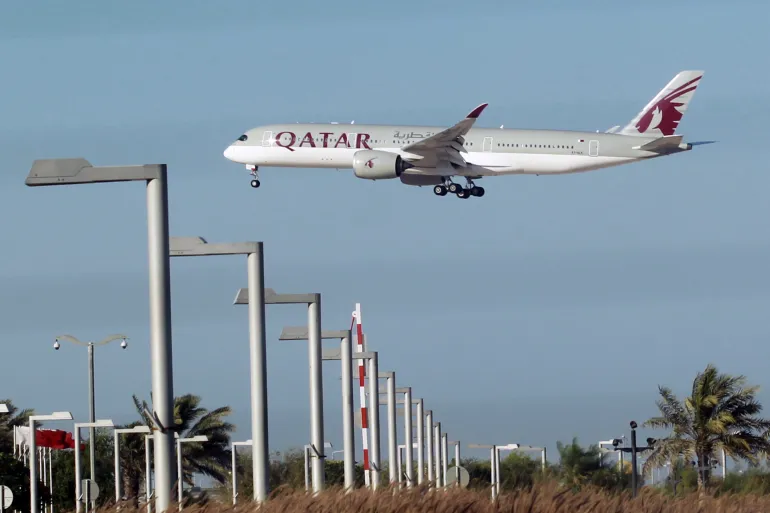
A Qatar Airways Airbus A350-900 plane is seen in Doha, Qatar [File: Aljazeera]

Qatar has partially reopened its airspace days after Iranian missile and drone strikes forced the country to ground all flights as a United States-Israeli military campaign against Iran continues into its seventh day.

The Qatar Civil Aviation Authority announced the limited opening on Friday evening, saying flights would operate through “designated navigational contingency routes with limited operational capacity” in coordination with the Qatari armed forces.

The move marks a cautious first step towards restoring air links to one of the Gulf’s most important aviation hubs but falls well short of a return to normality, with scheduled commercial flights to and from Doha remaining suspended until a further official announcement is made.

The Qatar Civil Aviation Authority said the partial reopening covers only a narrow category of flights “designated for passenger evacuation” and air cargo services.

Passengers with confirmed bookings were urged to follow updates from their airlines directly before travelling to the airport.

Early on Saturday, Qatar Airways said it “intends to operate repatriation flights on 07 March, departing Hamad International Airport to the following airports: London (LHR), Paris (CDG), Madrid (MAD), Rome (FCO), Frankfurt (FRA)”.

It added that priority would be given to “stranded passengers with families, elderly passengers, and those with urgent medical and compassionate travel needs”.

The Gulf country has been repeatedly struck by Iranian missiles and drones throughout the now seven-day conflict, forcing the country to activate its air force and use interceptors to defend its territory. Qatar’s Ministry of Defence confirmed the country had been struck by 14 ballistic missiles and four drones fired from Iran on Thursday.

More than 2,000 flights have been cancelled at Doha’s Hamad international airport since the conflict began.

Aviation across the Gulf

Across the Gulf, airports and airlines have been scrambling to manage the fallout from nearly a week of Iranian missile and drone barrages, launched in retaliation for the ongoing US-Israeli military campaign – codenamed Operation Epic Fury – which has killed at least 1,332 people in Iran since strikes began last Saturday, according to Iranian officials.

Emirates airline announced it is operating a reduced schedule while working to restore full network operations, carrying approximately 30,000 passengers out of Dubai on Friday alone.

By Saturday, the airline said it would have 106 daily return flights operating to 83 destinations, close to 60 percent of its full network, with a return to 100 percent expected “within the coming days, subject to airspace availability”.

Dubai international airport, the world’s busiest airport for international passengers, was evacuated on Sunday following Iranian strikes and has recorded close to 4,000 flight cancellations since Monday.

Abu Dhabi’s Zayed international airport has seen more than 1,000 cancellations and continues to operate at limited capacity.

Kuwait, also impacted by Iranian strikes, saw its airport undergo sustained physical damage in drone strikes, leaving some workers with minor injuries, and its airspace remains fully closed to commercial traffic.

Kuwait Airways has begun rerouting citizens with prior bookings through Jeddah, Saudi Arabia.

An estimated 23,000 flights have been cancelled since late February, according to analytics firm Cirium.

[Aljazeera]



Continue Reading
Advertisement
Click to comment

Leave a Reply

Your email address will not be published. Required fields are marked *

Foreign News

Spirit Airlines shutting down after rescue talks collapse

Published

on

By

Spirit Airlines is shutting down as a business after failing to secure a $500m (£368m) bailout from the Trump administration.

The budget airline was in talks with the US government about a rescue deal which would have saved it from collapse.

But discussions collapsed and the carrier said in an announcement on its website on Saturday that with “great disappointment” the airline had “started an orderly wind-down of our operations, effective immediately”.

Spirit was emerging from its second bankruptcy filing in recent years before the US-Israel war in Iran, but the resulting surge in jet fuel costs pushed it over the brink.

All upcoming flights with Spirit have been cancelled.

In Saturday’s statement, the airline said it would automatically process refunds for any flights purchased through Spirit with a credit or debit card to the original form of payment.

Guests who booked flights via a travel agent should contact the travel agent directly to request a refund.

Compensation for those who booked flights using a voucher, credit, airline points or any other method will be determined at a later date through the bankruptcy court process.

The airline said it was unfortunately not able to reimburse guests for other related costs such as emergency hotel stays or replacement flights associated with cancelled trips.

Spirit’s customer service is no longer available, the airline said early on Saturday, but customers with questions can contact the carrier’s claims agent.

The airline’s demise was so abrupt that it has left some ticket holders in the lurch.

One Spirit customer, Yash Kothari, told the BBC’s US partner CBS News that he didn’t learn about the airline’s shutdown until he arrived at Philadelphia International Airport for a flight at 05:45 local time (09:45 GMT) on Saturday.

“The email came in at 1 am, so I was unaware,” Kothari told the outlet.

Fuel costs can make up as much as 40% of an airline’s outgoings, and airlines have seen the cost of jet fuel double since the US and Israeli strikes began at the end of February.

Savanthi Syth, airlines analyst at the investment bank Raymond James, said spiralling jet fuel costs in the wake of the Iran war had proved “the final nail in the coffin” for Spirit.

Speaking to the BBC, Syth said the operator had shied away from the radical overhaul it needed during a 2024 bankruptcy procedure.

Spirit had been in the process of making the changes it needed in its current bankruptcy process, scaling back the number of flights it was offering and aircraft it owned, she said.

But its ability to survive the year was in question even before the Iran war, Syth added.

“If it wasn’t for the fuel scenario, they would have been okay through the summer, beyond the summer I would have said it was still precarious.”

Some have been cutting flights and others have hiked fares to cope. with the cost increases. At the same time, the head of the International Energy Agency (IEA) has warned Europe could run out of jet  fuel in as little as six weeks.

At the end of April, Spirit had been confident its rescue deal with the Trump administration was to be finalised imminently.

But after that deal fell through, Trump on Friday told BBC partner CBS the airline had been offered “a final proposal” to keep it in business.

The earlier plan, which would have seen the US government take effective ownership of as much as 90% of the airline, faced stiff opposition from Wall Street, Capitol Hill and even a member of Trump’s own cabinet. Transportation Secretary Sean Duffy told Reuters a rescue would amount to tossing “good money after bad”.

[BBC]

Continue Reading

Foreign News

The cost of 76 years of US wars, from Korea to Iran

Published

on

By

“We called it ‘moon dust’,” Jeffery Camp, a 61-year-old retired military veteran who lives in Sarasota, Florida, says when describing the terrain in Maidan Shar, Afghanistan, where he served with the United States Army from 2008 to 2009.

The fine particles of dust there would find their way into “your vehicles, your equipment, your lungs”, he says ruefully while describing the searingly dry summers and freezing windy winters in the eastern provincial capital.

Camp is one of the 832,000 US service members deployed to Afghanistan from 2001 to 2021 during what became the longest war in US history.

He joined the Army in 1983, well before the September 11, 2001, attacks on the US, which led to the war in Afghanistan. “Service was a calling, not a reaction to a national crisis,” he tells Al Jazeera.

During 20 years of war, 2,461 US soldiers were killed and at least 20,000 wounded.

“I left both Iraq and Afghanistan with a profound respect for the human cost of war, not just for American service members but for the populations of those countries. War is not clean, and the people who bear the longest burden are rarely the ones who made the decisions,” Camp says.

Tuesday marks 60 days of the US-Israel war on Iran.

Since February 28, US-Israeli attacks on Iran have killed at least 3,375 people, according to Iran’s Ministry of Health.

The US military has confirmed 13 combat-related deaths among its service members across the region, with more than 200 injuries.

INTERACTIVE_LIVETRACKER_IRAN_US_ISRAEL_MIDDLEEAST_ATTACKS_April 27_2026_GMT1645-1777299147
[Al Jazeera]

Since the 1950s, US-led wars have killed millions of civilians and tens of thousands of military personnel.

According to an analysis by the Cost of War Project at Brown University’s Watson Institute of International and Public Affairs, US-led wars since 2001 have directly caused the deaths of about 940,000 people across Afghanistan, Pakistan, Iraq, Syria, Yemen and other post-9/11 conflict zones.

The graphic below breaks down the estimated number of civilians killed for every US soldier in the Korean, Vietnam, Afghanistan and Iraq wars.

INTERACTIVE - CIVILIAN CASUALTIES IN US WARS - APRIL 24, 2026 copy 3-1777366845
[Al Jazeera]

Iran war: $11.3bn spent on munitions in first six days

According to the Pentagon, the Trump administration spent $11.3bn during the first six days of the war, with an estimated $1bn subsequently spent on the war every day until the April 8 ceasefire.

According to Mark Cancian, a senior adviser with the Defense and Security Department at the Center for Strategic and International Studies, the $1bn per day figure is “a little high”.

Speaking to Al Jazeera, he says the war “was very expensive in the first few days” because the US used costly long-range munitions, including Tomahawk missiles. They cost $2.5m each, and the US military used hundreds of them.

Cancian calculates that in addition to the $11.3bn spent on munitions, an additional $1.4bn should be added for combat losses and infrastructure damage and a further $26.5m for support costs, bringing the total for the first six days to $12.7bn.

Cancian estimates that after the first week of its air strikes, the US spent “about half a billion dollars a day”, and now, during the ceasefire, that figure is likely “under $100m per day” because the US is not using any munitions.

On a per-day cost basis, the Iran war may be one of the most expensive in recent history.

According to figures from the Costs of War Project, the 20-year Afghanistan war cost an estimated $2.3 trillion, averaging more than $300m per day, while the eight-year Iraq War, which began in 2003, cost an estimated $2 trillion, averaging about $684m per day.

INTERACTIVE - economic COST OF US WARS - APRIL 24, 2026 copy 3-1777382933

‘Another prolonged war’

Naveed Shah is the political director of Common Defense, a grassroots veteran-led organisation based in Washington, DC, that aims to engage, organise and mobilise veterans.

Shah, who served in Iraq from 2006 to 2010, believes the US must defend its national interests and has a vital role to play in deterring threats, but too often overreaches with open-ended wars of choice that create more problems than they solve.

“The current conflict with Iran is repeating the mistakes that led us to spending 20 years in Iraq and Afghanistan: shaky evidence at best, moving goalposts and dangerous rhetoric that risks drawing us into another prolonged war,” Shah tells Al Jazeera.

“At the same time, while we’re deploying troops overseas, the government is trying to claw back the care we promised for our veterans,” Shah says.

“The true cost of war extends far beyond the battlefield. It echoes for decades in veterans’ bodies and minds and for their families. For the families of the troops who won’t come home, it will be an empty seat at the dinner table and a hole in their heart for eternity,” he says.

According to the Cost of War Project, the US is expected to spend at least $2.2 trillion on obligations for veterans’ healthcare over the next 30 years.

Iran war most unpopular in US history

According to a Reuters/Ipsos poll from April 12, 60 percent of Americans disapprove of US military strikes on Iran. This is up from a 43 percent disapproval rating at the start of the war.

Historically, US wars have mostly enjoyed a “rally around the flag” effect, which causes low disapproval at the outset.

The chart below compares the disapproval rating at the start and end of the five main wars the US has led since the 1950s.

INTERACTIVE - ratings - US WARS - APRIL 24, 2026 copy 2-1777382952

US consumers are paying the price

Marwa Jadoon, 40, from Oklahoma, whose name has been changed to keep her identity concealed, says her out-of-pocket expenses have increased by more than 35 percent over the past couple of months.

“As someone with multiple considerably expensive health conditions, I’m paying more than I’ve ever paid before just to cover only my essential medications and recurring testing. It’s limited my ability to afford additional treatments since healthcare costs are astronomical in the US. I’ve cut costs in groceries and anything outside of essentials,” Jadoon says.

Jadoon feels she’s been shortchanged with the policy shifts that came at the same time she was made redundant, further complicating her life.

“I find it appalling that my tax dollars are funding a war when we have repeatedly been told that we cannot afford universal healthcare. At the end of last year, I lost my job and had to apply for unemployment and Soonercare,” she says, referring to state-covered healthcare.

She explains that unemployment benefits would not even cover her rent.

“How can my tax dollars afford to pay for wars and foreign governments while I can’t even receive Medicaid because they deemed $400 is too much a month? My phone bill alone is $116 a month. My student loan payments are almost $200 a month. I would love to see anyone in the current administration survive on $400 a week with no medical coverage,” Jadoon says.

Another woman in Oklahoma, who also wished to remain anonymous due to her job with the state government, says, “The war in Iran and its funding has made me feel cornered. I feel it at the gas pump, I feel it at the doctor, dentist. I feel it at the bank. I feel it when I’m at the grocery store, thinking how exactly everyone is acting so calm. And it moves me, literally. Emotions carry little power. I’m ready to do something about it. I’ve been stolen from and lied to, and I’ve had enough.

According to the Climate Solutions Lab at the Watson Institute for Public and International Affairs at Brown University, the total consumer burden from the increase in petrol and diesel prices across the US as a result of the war on Iran is estimated at $27.8bn, roughly $200 per household.

The national average price of petrol has increased nearly 40 percent from $2.90 per gallon ($0.76 per litre) before the war to $4.10 per gallon ($1.08 per litre) now.

INTERACTIVE - fuel cost IN US WARS - APRIL 24, 2026 copy 4-1777384719

[Aljazeera]

Continue Reading

Foreign News

Smiles and wonder: How the US reacted to King Charles

Published

on

By

Statistics show that King Charles was never a favourite Royal among Americans - but that may be changing. [BBC]

The United States declared independence from the British crown 250 years ago – but this week, it could not get enough of it.

From the minute King Charles and Queen Camilla stepped onto the White House South Lawn, US networks dumped their standard diet of political warfare and breaking news for something rare: pure pageantry.

In a country that seems to agree on almost nothing, the British royals managed something close to a clean sweep – drawing warm receptions from both sides of a political spectrum where neutral ground is rare.

The visit came at a fraught time in US-British relations, with the White House and Downing Street at odds over the war in Iran, straining a relationship both governments insist remains unshakeable.

The reviews following the King’s appearances at the White House, in Congress and in New York were warm across the political divide.

A commentator in the conservative Washington Examiner wrote that the UK needed more than conventional diplomacy – and that King Charles delivered.

“His Majesty’s Government under scandal-plagued Labour Prime Minister Keir Starmer needed the monarchy to do what only the king could do,” the editorial said.

The King’s comments in Congress and at the White House’s lavish banquet on Tuesday – mixing humour with history and a call for unity – also were widely praised.

Some saw them as a subtle rebuke of President Trump.

“Sometimes it takes an outside perspective to see what’s really going on,” an opinion writer wrote in the Arizona Republic. “It’s striking to have a king remind us of what democracy is all about.”

For months, Donald Trump – a committed Anglophile and avid fan of the Royals – repeatedly told reporters that he was excited for the King’s visit. That excitement was on full display throughout the King’s visit to Washington, in which the world saw a warmer version of a president not shy to make his feelings known.

Uncharacteristically, Trump largely stuck to a script, making no mention of policy disagreements with Downing Street and lauding the long ties between the US and Britain.

“Before we ever proclaimed our independence, Americans carried within us the rare gifts of moral courage,” he said. “And it came from a small but mighty kingdom from across the sea.”

On Capitol Hill, where the King became only the second British monarch to address a joint session of Congress, Charles received a standing ovation – though some in the room heard something more pointed in his words.

“As opposed to Keir Starmer, who is looked at…as a leftist weenie, we saw in King Charles – someone who is proud of Britain,” Washington Republican Representative Michael Baumgartner told the BBC. “I think that was good.”

The warm welcome on Capitol Hill was not lost on President Trump.

“He got the Democrats to stand, I’ve never been able to do that. I couldn’t believe it,” Trump said at the banquet a few hours later. “They liked him more than they’ve ever liked any Republican or Democrat, actually.”

Elizabeth Holmes, an expert on the Royal Family and author, told the BBC that many members of the American public are broadly interested in the family, even as that interest has ebbed and flowed over the years.

“I think the fascination is rooted in a combination of novelty and distance,” she said. “It’s not something we have here.”

The King and Queen traveled to New York City on Wednesday where they made a few stops, including one at the 9/11 Memorial. Jacob Knutton, who manages a British-themed restaurant and store in New York, says business has been “a lot busier” around the King’s visit.

“There’s definitely been a lot of people talking about it,” said Knutton, who grew up in London and Australia. “Americans are talking about it and trying to get our opinions on it.”

But not every American is as enthused.

While recent statistics are hard to come by, a YouGov poll conducted in 2024 found that only 42% of Americans held a favourable view of King Charles.

In comparison, his mother, Queen Elizabeth, garnered a 67% approval rating. Over three quarters of those polled – 76% – held a favourable view of the King’s ex-wife, Princess Diana, who died in 1997.

According to Holmes, in the eyes of some Americans, Charles had a “far less compelling” narrative than his mother, who became Queen at a young age.

US feelings about King Charles are further complicated by his complex relationship with son Prince Harry, Holmes added.

Data from Google Trends suggests that US-based searches for the King during the visit spiked by 20 to 25 times over normal, and by 50 times during his speech to Congress.

Others who haven’t followed the royal visit closely, still are excited. “I think it’s cool that he’s here,” said Harry James, 21, who works in a fish and chips shop in New York. “It’s cool we can keep these traditions going.”

Holmes believes the visit already has improved US perceptions of the King. “Trump is such a polarising figure, and I think people were very eager to see their interactions,” she said.

His dinner comments, in particular, have “really taken off”.

“I think people are delighted to see British wit on display,” she added.

Near the White House on Tuesday, some of those who turned out to watch the King’s motorcade pass said they felt hopeful.

“It’s natural for human beings to disagree,” said Maribeth Massie, of Maine, who watched the King’s motorcade near the White House on Monday. “Hopefully they’ll lay some common ground together and move forward.”

Knutton also hopes the visit helps – in part for his business’ sake. His store imports nearly all of its goods from the UK, and feels the pinch of Trump’s tariffs, he said.

“I’m sure it will have an effect,” he said. “But I’m not expecting magical wand-waving.”

[BBC]

Continue Reading

Trending