
Latest News
A ‘delicate’ balance for Canada and a ‘win-win’ for Modi as Carney visits India

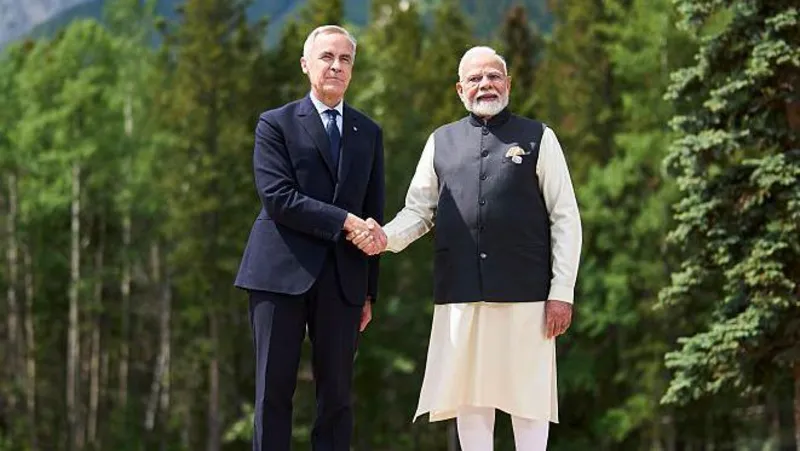
Canadian Prime Minister Mark Carney is in India for a pivotal trip aimed at repairing ties with the world’s largest democracy, as both countries seek to reduce their trade reliance on the US.
Carney began his visit in Mumbai, where he is meeting with business leaders. He will then travel to New Delhi for talks with Prime Minister Narendra Modi.
The trip marks a remarkable turnaround in relations, which had collapsed when Canada accused India of carrying out an extrajudicial killing of a Canadian Sikh separatist on Canadian soil — an allegation India strongly denied.
Both sides now appear ready to move forward.
Here’s what has changed, and what each country hopes to gain as Carney’s trip gets underway.
For Carney, this trip is strictly business, aligned with his broader goal of diversifying Canada’s trade partners to reduce economic dependence on the US.
A big focus will be making progress on a comprehensive free trade agreement with India, which has been discussed on-and-off for the last 15 years.
The latest derailment in trade talks occurred after former Prime Minister Justin Trudeau made a bombshell public accusation against India in 2023, alleging it was involved in the killing of Hardeep Singh Nijjar, a Sikh separatist, who was gunned down in British Columbia. Four men were later charged in his death, and their case is still before the courts.
India has repeatedly denied any involvement.
Now faced with US tariffs, and under Carney’s more “pragmatic” approach to foreign policy, Ottawa is repairing ties with Delhi.
Still, the allegations remain a point of contention for some members of Canada’s Sikh community, who say they continue to be targeted by India through transnational repression, and have criticised Carney for prioritising economic interests over their safety.
It is a situation that will require “delicate handling”, Vina Nadjibulla, vice-president of the Asia Pacific Foundation of Canada, told the BBC.
Asked repeatedly about these concerns, Canadian officials told reporters ahead of Carney’s trip that the two countries are engaged in “robust” discussions on national security and foreign interference.
They added that Canada does not believe the Indian government is currently linked to any violent crimes or threats on Canadian soil, and that they “probably would not be taking this trip” if that were the case.
Not everyone is convinced. Sukh Dhaliwal, an MP from Carney’s Liberal party, told Canadian media that the claim of India no longer being a threat is “disconnected from the reality”.
Canada has made several diplomatic overtures to India since Carney took office last year, beginning with inviting Modi to the G7 summit in Kananaskis, Alberta last summer.
That was followed by a series of meetings between Foreign Minister Anita Anand and her Indian counterpart, S Jaishankar, as well as a visit to Ottawa last month by India’s national security advisor, Ajit Doval.
Carney’s itinerary in India offers some insight into his priorities.
He will stop only in Mumbai, India’s financial hub, to meet with business leaders, and New Delhi, where he will sit down with Prime Minister Modi on Monday.
Unlike Trudeau, Carney will not be visiting cultural sites like the Taj Mahal. Nor will he travel to Punjab, the home state of many of India’s Sikhs, which was a stop for both Trudeau and another former prime minister, Stephen Harper.
Those stops were often seen as nods to Canada’s large Indo-Canadian and Sikh communities. Their omission signals that, this time, Canada’s focus is squarely on trade.
On the agenda will be discussions around energy, technology, artificial intelligence and defence, Carney’s office has said, as well as attracting top talent to Canada.
Carney and Modi are also likely to discuss tariff policies enacted by President Donald Trump, which have had an impact on both their economies.
Heading into the trip, Canada remains the only G7 country that has not reached a preferential trade agreement with India. Nadjibulla of the Asia Pacific Foundation of Canada said that fact “adds urgency” for Carney.
“There is a window of opportunity, and it needs to be seized,” Nadjibulla said.
It was in 2024, not too long ago, that both countries were openly trading barbs, suspending visa services and expelling diplomats.
But a lot has changed since then.
India is now more open for business, which is evident from a flurry of free trade deals that it has signed recently.
Then there is Trump, who has targeted both India and Canada with steep tariffs.
In Carney’s own words, the world is “in the midst of a rupture, not a transition” and “if you are not at the table, you are on the menu”.
For India’s Prime Minister Modi, a reset with Canada is a win-win situation.
Domestically, the visit will boost Modi’s image as a leader who refused to come under pressure from Canada.
Ottawa has already said it believes India is not currently linked to violent crimes or threats on Canadian soil.
But more broadly, it is the trade potential between the two countries that will drive the outcome of this visit.
[BBC]

Bangladesh commanded proceedings on the first day, but Pakistan changed that around dramatically on the second, led by the youngest member of the team. Azan Awais, making his debut, steered Pakistan into a position of relative comfort in a century partnership alongside Imam-ul-Haq and then another solid stand with fellow debutant Abdullah Fazal.
By the end of the day, Awais had taken his side to 179 for the loss of just Imam’s wicket. Awais had contributed an unbeaten 85, nearing a debut hundred on the third morning. As a result, Pakistan were only another 234 runs behind with nine wickets standing after Bangladesh posted 413.
The confidence and poise he demonstrated across the last session was not immediately obvious when thrown in for an awkward ten overs before tea. The first ball Nahid Rana bowled to him was a wicked short delivery that reared up and hit him square on the badge of the helmet. With Awais visibly dazed, the physio was called and a concussion test began, one he looked in real danger of failing. Batting on, Awais briefly called for the physio again shortly after, but was allowed to stay on.
And once he did, there was no looking back. While Imam remained fidgety, Awais began to demonstrate why he has been the most prolific domestic run-scorer in Pakistan across the last two seasons. A delicious cover drive off Nahid showed his refusal to back down under the stern test. Awais’ ability to force Bangladesh to spread the field kept the hosts unsettled as he found boundaries through the covers, either side of the wicket, and straight down the ground.
Imam’s dismissal, an arm ball from Mehidy Hasan Miraz, appeared to have little impact on Awais’ own confidence. In the final hour during Nitish’s last burst, he pitched the first two balls short, with Awais dispatching them for boundaries either side. When Nahid went full at 147.1kph off the following delivery, Awais merely flicked him to fine leg to make it three in a row. It was the last time Nahid would bowl on the day.
It helped, perhaps, that Fazal showed he was comfortable at the crease during a crucial phase in the game. It was an attritional innings, but crucially, one that has not come to an end. It may easily have ended in the final ten minutes, though, when Bangladesh put down a chance off Taskin at third slip – the second such reprieve for a Pakistan batter after a nick from Imam was grassed earlier.
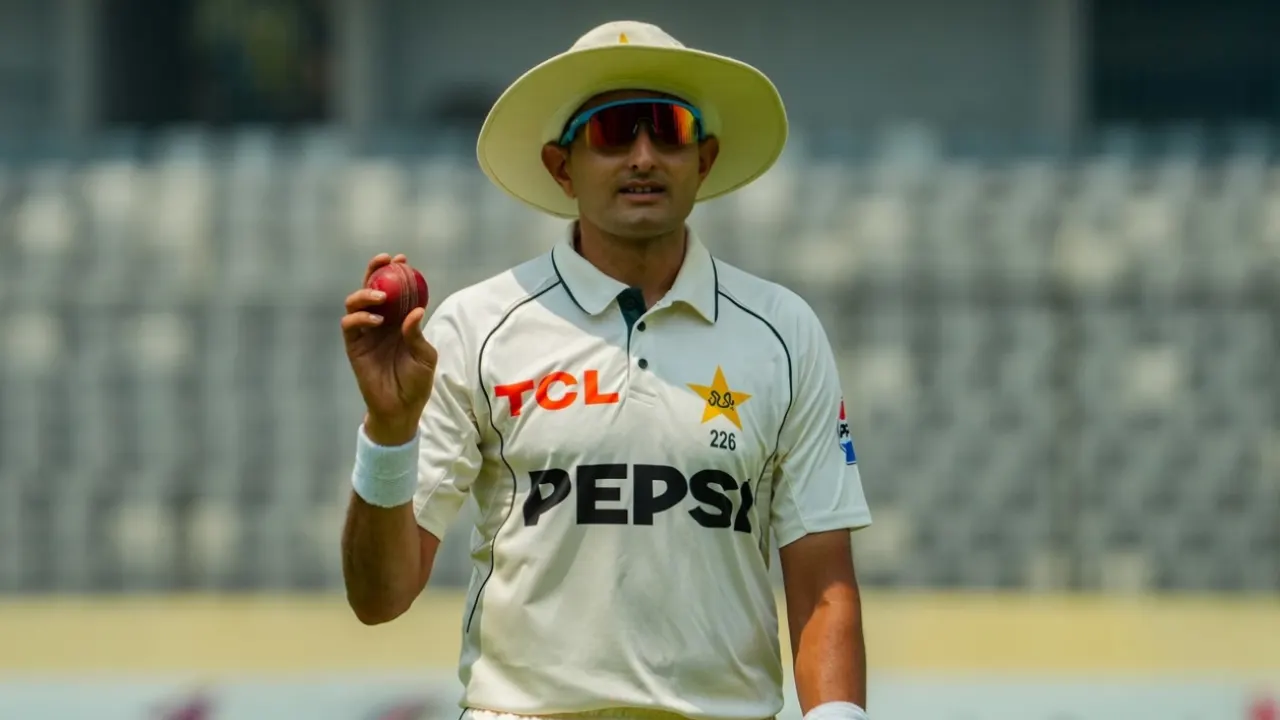
But the position these young batters found themselves in would not have been possible without an old hand. Mohammad Abbas had said Pakistan had been slightly unlucky on the first day, and then played an instrumental part turning that luck around on the second morning. Four wickets to add to Friday’s one gave the fast bowler a five-wicket haul that undid some of the damage Bangladesh inflicted on Pakistan on day one, thus bowling them out for 413.
It was still the highest first-innings score Bangladesh have ever managed against Pakistan, though it fell short of what they may have hoped when they looked solid at 338 for 4, before losing 5 for 46.
Earlier, Bangladesh had threatened to run away after Litton Das struck three boundaries off Shaheen Shah Afridi’s first three balls. But Pakistan managed to rein the scoring rate back in. It set the stage for Abbas to try and get something out of a pitch his compatriots appeared to have written off for dead.
Always searching for unconventional ways to gain an edge, he surprised Litton Das with a bouncer that, despite his modest pace, grew big on the batter as he tried to mow it over mid-on. Litton found Amad Butt, the substitute fielder, stationed there, and he took a splendid catch for Pakistan’s first success in the morning.
Shortly after, Abbas added a second wicket in the morning as Mehidy Hasan Miraz tried to transfer pressure back onto him. A six off the previous delivery emboldened the batter to scythe him through point, but Mehidy only found Imam’s safe hands.
It appeared Bangladesh had decided to take Pakistan on from one end while Mushfiqur Rahim shepherded them from the other. Taijul Islam went after Hasan Ali in a little cameo that sped up the scoring rate, but, again, found himself succumbing to the unlikely Abbas bumper that he failed to get on top of.
The other quicks finally jumped in to help. Shaheen Shah Afridi broke the innings open by ending Mushfiqur’s stubborn resistance on 71 with a lovely nipping ball post-lunch. But Abbas was not denied his fifth – it was yet another bouncer that Ebadot Hossain could not handle and nicked off to. Bangladesh found a way to get over the 400 mark with a breezy cameo from Taskin Ahmed, who scored 28 off 19 balls, and added 29 with last batter Nahid.
Awais, along with Imam, then came out to bat an hour before tea. He then led the way in ensuring Pakistan’s goals in this Test are far loftier than mere survival.
Brief scores:
Pakistan 179 for 1 in 46 overs (Azan Awais 85*, Imam-ul-Haq 45, Abdullah Fazal 37*; Mehidy Hasan Miraz 1-37) trail Bangladesh 413 in 117.1 overs (Najmul Hosein Shanto 101, Mominul Haq 91, Mushfiqur Rahim 71; Mohammed Abbas 5-92, Shaheen ShahnAfridi 3-113) by 234 runs
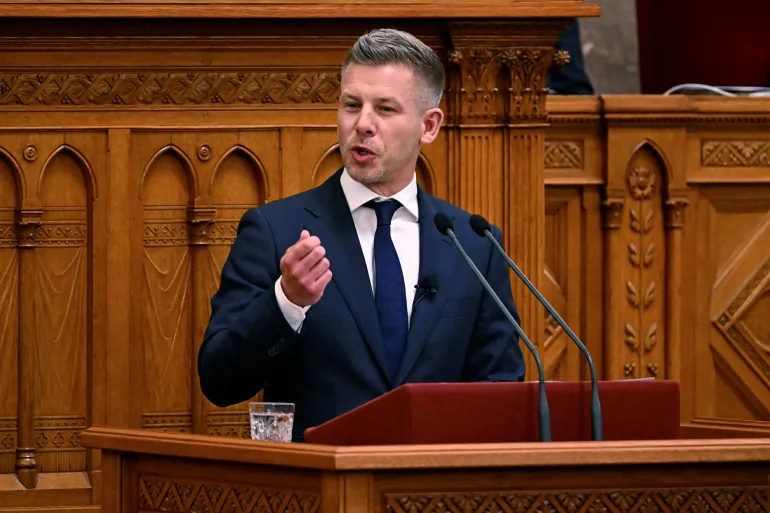
Peter Magyar has been sworn in as Hungary’s new prime minister, almost a month after parliamentary elections that ended Viktor Orban’s 16 years in power.
Magyar, 45, who leads the centre-right Tisza party, was propelled into office on promises of change after years of economic stagnation under Orban, and strained ties with key allies, including the European Union.
On Saturday, Magyar invited Hungarians to “step through the gate of regime change”.
His party has a huge parliamentary majority, winning 141 of the 199 seats.
However, Magyar faces several challenges in his new role, including restoring Budapest’s relations with the EU, reviving the economy and tackling a budget deficit that reached almost three-quarters of its full-year target by April.
A ceremony was held inside Hungary’s neo-Gothic parliament building as Magyar was sworn in. The EU flag, removed under Orban, was displayed inside the chamber for the first time in 12 years.
The newly appointed parliamentary speaker, Agnes Forsthoffer, used her first decision in office to order the flag’s reinstatement, describing the move as “the first symbolic step on this path [back to Europe]”.
The new prime minister aims to strike a deal with the EU that would unlock around $20bn in frozen funding. The money was withheld over concerns about worsening human rights under Orban and a decline in the rule of law.
During Orban’s tenure, Hungary drifted further away from the EU as ties with Moscow deepened. The former prime minister used his veto in the European Council to oppose sanctions on Russia and block support for Ukraine.
Theofanis Exadaktylos, a professor of European politics at the University of Surrey, told Al Jazeera that Magyar will need to prove he is different from Orban while dealing with the bureaucracy left behind by his predecessor.
“The challenges for the new PM are primarily related to the extensive presence of the previous regime. Orban was in power for such a long time and he has managed to change Hungary substantially from an administrative point of view. To that end, uprooting the previous establishment will be a challenge,” he said.
“The second [challenge] will be to establish himself as different to the previous regime. Considering his background there will be sceptic voices, however let’s not forget that ideologically he belongs to the right,” he continued.
“Nonetheless, his election marks a turning point in Hungary showcasing that the previous regime had started to lose ground in its popular basis. The third challenge is the way he will reconnect Hungary to the European Union: to that end, he has a bit of work to do from a diplomatic point of view to create new allies within the Union.”
Magyar’s rise to prime minister is widely regarded as a remarkable feat. He was largely unknown in Hungarian politics until early 2024, when he became embroiled in a public dispute with Orban’s ruling Fidesz party, of which he had previously been a prominent member.
[Aljazeera]
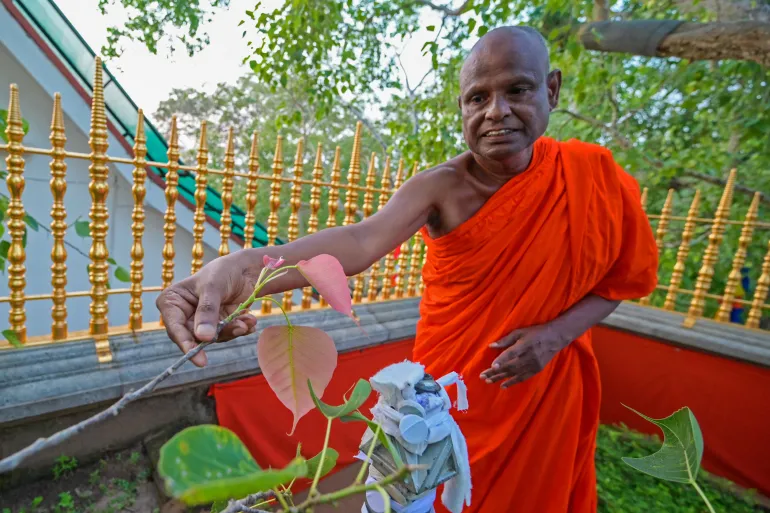
A prominent Buddhist monk has been arrested in Sri Lanka for allegedly sexually abusing an 11-year-old girl, in the highest-profile case involving a local religious leader.
Authorities took 71-year-old Pallegama Hemarathana into custody on Saturday from a private hospital in the capital, Colombo, where he had checked in for treatment as a criminal probe against him progressed.
Hemarathana is accused of committing the abuse in 2022 in a highly venerated temple in Anuradhapura, where he is the chief priest.
Authorities said the victim’s mother has also been arrested for aiding and abetting the monk.
“We will be guided by the magistrate on further action,” a police statement said Saturday.
Hemarathana, who had been subject to a foreign travel ban, was detained on the orders of the chief magistrate in Anuradhapura, after child protection authorities cited complaints of delays in his arrest, reported Sri Lanka’s Daily News. It said the court instructed police to arrest Hemarathana and bring him before the court “without delay”.
There have been several cases of clergy abusing children in Sri Lanka, but the latest arrest involves the most senior monk to be accused of such a crime.
Last month, 22 monks were arrested at Colombo’s international airport after 110kg (242lbs) of cannabis were found hidden in their bags, in what was the biggest drug smuggling discovery ever in the facility.
[Aljazeera]

Debutant Awais leads Pakistan’s strong reply after Abbas five-for

Peter Magyar sworn in as Hungary’s PM, ending Orban’s 16 years in power

Senior Sri Lankan monk arrested for alleged child sex crimes

Trade, Investment and Tourism Cooperation Forum strengthens economic ties between Sri Lanka and Vietnam

Accelerate projects related to resolving the public’s drinking water issues – President Instructs Officials

President of Vietnam and delegation departs Sri Lanka

‘Dates have the highest sugar content to fight Coronavirus’

Sunday Island 27 December – Headlines

#SundayIsland 17th December – Headlines

Sunday Island – 28th March

Sunday Island Headlines – 21 March

Sunday Island – 21st February – Headlines
-

 News3 days ago
MIT expert warns of catastrophic consequences of USD 2.5 mn Treasury heist
-
 News5 days ago
CJ urged to inquire into AKD’s remarks on May 25 court verdict
-

 News6 days ago
USD 3.7 bn H’tota refinery: China won’t launch project without bigger local market share
-
 News7 days ago
Easter Sunday Case: Ex-SIS Chief concealed intel, former Defence Secy tells court
-

 Business7 days ago
Dialog Surpasses 1,000 5G Sites, Strengthening Nationwide 5G Coverage
-

 Editorial3 days ago
Clean Sri Lanka and dirty politics
-

 Editorial6 days ago
Deliver or perish
-
 Opinion5 days ago
Security, perception, and trust: Sri Lanka’s delicate balancing act