
Latest News
US build-up of warships and fighter jets tracked near Iran

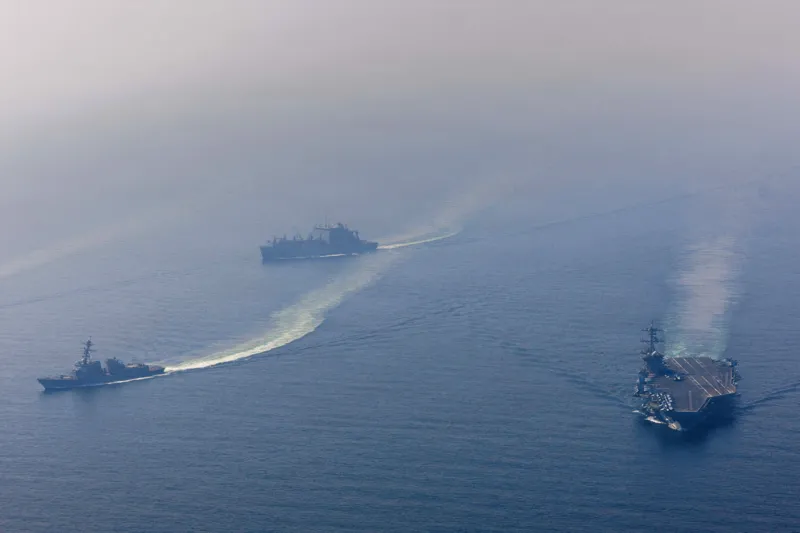
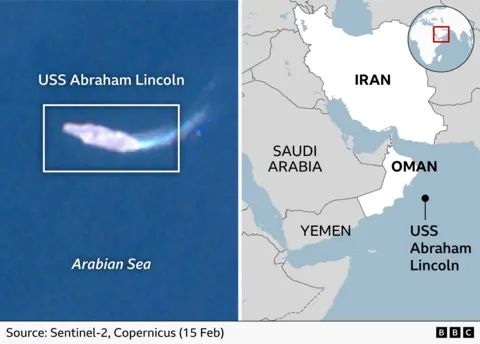
BBC Verify has confirmed the location of US aircraft carrier the USS Abraham Lincoln near Iran using satellite imagery, as Washington continues to put pressure on the country over its military program and recent deadly crackdown on protesters.
US and Iranian officials are set to meet in Swizerland on Tuesday for a second round of talks. Iran says the meeting will focus on its nuclear programme and the potential lifting of economic sanctions imposed by the US. Washington has previously indicated it wants to discuss other issues as well.
The Abraham Lincoln, which leads a strike group with three guided missile destroyers, carries 90 aircraft including F35 fighters, and 5,680 crew, was reportedly deployed to the Gulf region in late January but has not been seen in satellite imagery until now. It has been located off the coast of Oman, around 700km from Iran.
The US has also reportedly sent the USS Gerald R Ford, the world’s largest warship, to the Middle East, which could arrive in the region within the next three weeks.
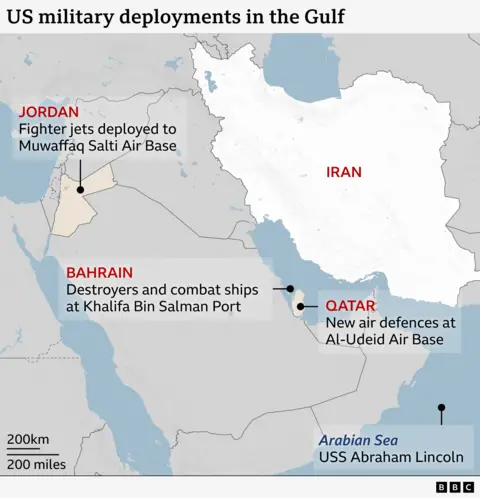
The Abraham Lincoln’s arrival adds to what we know about the current US military build-up in the Middle East over the past few weeks, where BBC Verify has tracked an increase of US destroyers, combat ships and fighter jets in the region.
Publicly available images from the European Sentinel-2 satellites show Abraham Lincoln in the Arabian Sea around 150 miles (240km) off the coast of Oman.
It had not been seen since it reportedly entered the region in January but it had been crossing the open sea where satellite coverage is limited. Military assets on land are more visible and frequently captured on satellite.
It means we have now tracked 12 US ships in the Middle East through satellite imagery: the Abraham Lincoln, a nuclear-powered Nimitz-class carrier, which together with three Arleigh Burke class destroyers forms a carrier strike group; plus two destroyers capable of carrying out long-range missile strikes and three specialist ships for combat near to the shore that are currently positioned at Bahrain naval station in the Gulf. Two other destroyers have been seen in the eastern Mediterranean near the Souda Bay US base, and one more in the Red Sea.
We have also been following the movements of US aircraft in the region, where we have seen an increase of F-15 and EA-18 fighter jets stationed in Muwaffaq Salti military base in Jordan, and an increase in US cargo planes and refuelling and communications aircraft moving towards the Middle East from the US and Europe.
The US Central Command released images of the Abraham Lincoln flanked by destroyers, fighter jets, surveillance aircraft and coastguard vessels in the Arabian Sea in an apparent show of military prowess on 6 February, which Iran has met with its own show of force.
On Monday the Islamic Revolutionary Guard Corps (IRGC) launched a maritime drill in the Strait of Hormuz, located in the Gulf between Oman and Iran. The drill saw IRGC Commander‑in‑Chief Maj Gen Mohammad Pakpour inspecting naval vessels at a harbour before missiles are seen launching from a ship, the IRCG-linked Tasnim News Agency reported.
The Strait is considered one of the world’s most important shipping routes and a vital oil transit choke point. Around a fifth of the world’s oil and gas flows through the Strait, including from Kharg Island, Iran’s main oil export terminal. Pakpour was seen flying over the island in a helicopter in the report showing Iran’s latest military manoeuvres.
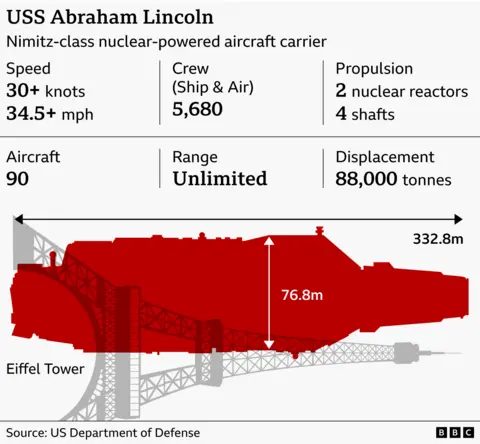
Military intelligence expert Justin Crump told BBC Verify that the current US military preparations in the Middle East show “more depth and sustainability” than its manoeuvres ahead of the seizure of former Venezuelan president Nicholas Maduro in January, or the operation carrying out air strikes on Iran’s nuclear facilities last June.
They all feature a carrier strike group and several destroyers operating independently. However, the US deployed its assets in Venezuela and Iran last year under quite different circumstances.
The US deployed the Gerald R Ford to the Caribbean ahead of its strikes on Venezuela, one of eight warships we tracked in the region at the time, though it used fewer aircraft as it could easily send jets from surrounding US bases on America’s mainland or from its base in Puerto Rico instead. The US also deployed amphibious assault ships within the Caribbean, which can be used as launch platforms for helicopter operations as was seen with the capture of Maduro. But Venezuela’s military is generally seen as less capable of defending itself or retaliating against the US.
When the US struck Iran last year in Operation Midnight Hammer, which targeted Iran’s nuclear facilities, it was attacking a country with a much more powerful military than Venezuela. Iran’s military is capable of hitting US bases across the Middle East.
During Midnight Hammer the US had two aircraft carrier strike groups in the region, five destroyers placed in the Mediterranean and Red Seas, and three combat ships in the Gulf. It had also moved squadrons of fighter jets and refuelling aircraft from the US to Europe, but the B2 stealth bomber flights that were used to hit the Fordo, Isfahan and Natanz nuclear sites actually took off from US bases in Missouri.
Crump, chief executive of risk and intelligence company Sibylline, said the build-up of US warships and aircraft, as well as eight existing airbases in the region would allow it to conduct a “fairly intensive and sustained strike rate” of about 800 sorties a day, with the aim of rendering any Iranian responses “ineffective”.
“What we are seeing isn’t just strike preparation, but rather a broader deterrent deployment capable of being scaled up or down,” he said. “This means it has more depth and sustainability than the force packages arranged for either Venezuela or Midnight Hammer last year. It’s designed to sustain an engagement and counter all potential responses against US assets in the region and, of course, Israel.”
[BBC]

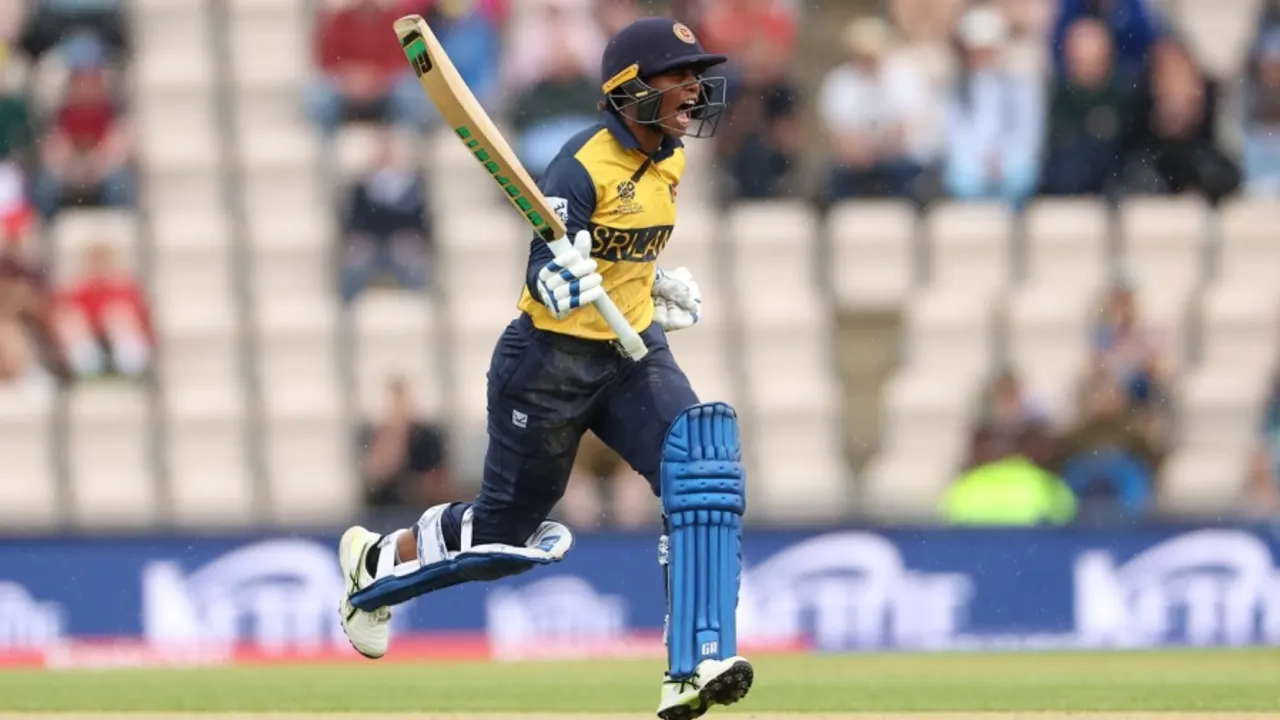
An outstanding fifth-wicket stand and an even better sixth-wicket partnership electrified a Sri Lanka chase and propelled them to a tight final-over win against New Zealand. Nilakshika Silva was the primary architect. Having arrived at the crease at 55 for 4, with the required rate soon climbing above nine, she produced her finest international innings – a perfectly-paced 54 not out off 37 that saw Sri Lanka to victory with two balls and five wickets to spare.
Nilakshika had serious support in the two partnerships she was involved in. Kavisha Dilhari joined her for a 50-run stand that repaired the innings, though New Zealand were still firm favourites when they were parted with 45 still needed off 30 deliveries. Kaushini Nuthyangana, who had already had a good game behind the stumps, then hit a nerveless 24 not out off 14, outpacing even Nilakshika during a stand that yielded 48 runs off 28 deliveries.
New Zealand were scuttled by their own poor catching again. Had Bree Illing held a sitter at short fine leg in the 10th over, Nilakshika would have been out for only 1, and New Zealand would have claimed five wickets in five overs. Their ground fielding also fell away during the last few overs, when Sri Lanka’s batters were beginning to reverse pressure effectively.
Their batting had also been reined in by a tight Sri Lankan bowling effort, in which the spinners imposed themselves. Sophie Devine and Melie Kerr hit 45 each, but 150 for 6 always seemed a little light on a Southampton surface that was a little slow, but remained largely good for batting.
The loss means New Zealand have lost their two opening matches, and must now treat games against England, Scotland, and Ireland as must-wins. Sri Lanka, meanwhile, are on the points table following their opening defeat at the hands of England. They will now prepare for the match against West Indies on Sunday. A victory there will set them up beautifully for a semi-finals push.
Nilakshika resurrects Sri Lanka
When Nilakshika arrived, Sri Lanka were down to their last three recognised batters, with 95 runs to get off 57 deliveries. It was clear she was timing the ball nicely from the outset, but she repeatedly had trouble piercing the infield and did not find her first boundary until the 13th ball she faced. Thankfully for Sri Lanka, Dilhari was buoyant through the early phase of this partnership, never allowing the required rate to climb too far out of reach.
After the 12th over, however, Nilakshika began to find the open spaces. There were fours through wide mid on and extra cover, and then a six over the head of Devine at deep midwicket, who could have pouched that catch had she stood closer to the rope.
A running mix-up, which perhaps was Nilakshika’s fault, cost Dilhari her wicket. But that only seemed to solidify the resolve within Nilakshika to see the chase through. She was magnificent through the last five overs, finding vital boundaries just as the pressure was mounting, while finding singles in between. With 28 runs needed off the last two overs, it was Nilakshika’s two boundaries off Melie in the 18th that swung the match more decisively in Sri Lanka’s favour. One was a bent-kneed square drive through cover point when Melie had hung the ball out wide. One was a sweep she blasted past Jess Kerr at fine leg.
Nuthyangana shines behind the stumps and with bat
Nuthyangana produced both Sri Lanka’s first piece of brilliance in this game, as well as their last. Her low catch to dismiss Isabella Gaze off the bowling of slinger Mithali Amodhya set the tone for a spirited Sri Lanka fielding performance. She would go on to claim two further catches – running hard towards fine leg to get under one high chance, plus an easier take to dismiss Brooke Halliday, though she did instigate the review that overturned the not out decision.
It will be for her batting that she will be remembered in this game, however. She’d had a high score of 19 not out in 10 T20I innings before this, but played a near-flawless finishing hand alongside Silva. Her first two boundaries came through wide long on, but crucially, she also found the singles and twos in between these bigger blows. With two required off three balls, she spanked one through square leg to spark beaming smiles and joyful celebrations in the Sri Lanka dugout.
Devine and Kerr hold NZ together
In the absence of Suzie Bates, Devine and Kerr were easily New Zealand’s most experienced batters, and they hit 45 apiece to keep the New Zealand innings above water. Kerr enjoyed a 49-run stand with Georgia Plimmer, though both batters failed to find frequent boundaries in the powerplay. Devine later led New Zealand through the middle overs, as Sri Lanka’s spinners found breakthroughs, striking at 150.
NZ’s four in four
New Zealand’s best passage in the game came between overs five and nine in Sri Lanka’s innings, in which they claimed four wickets for 10 runs. Offspinner Nensi Patel struck twice through this spell, eventually finishing with New Zealand’s best figures of 2 for 23. Bree Illing took the important wicket of Chamari Athapaththu, who made 27. The other wicket came from an excellent direct hit run out from Melie Kerr.
SCORES:
Sri Lanka Women 153 for 5 in 19.4 overs (Vishmi Guneratne 17, Chamari Athapaththu 27, Kavisha Dilhari 17, Nilakshika Silva 54*, Kaushini Nuthyangana 24*; Bree Illing 1-33, Nensi Patel 2-23) beat New Zealand Women 150 for 6 (Georgia Plimmer 18, Sophie Devine 45, Melie Kerr 45, Maddy Green 18*; Mithali Ayodya 1-24, Sugandika Kumari 1-28, Chamari Athapaththu 1-21, Nimasha Meepage 1-26, Kavisha Dilhari 2-35) by five wickets
[Cricinfo]
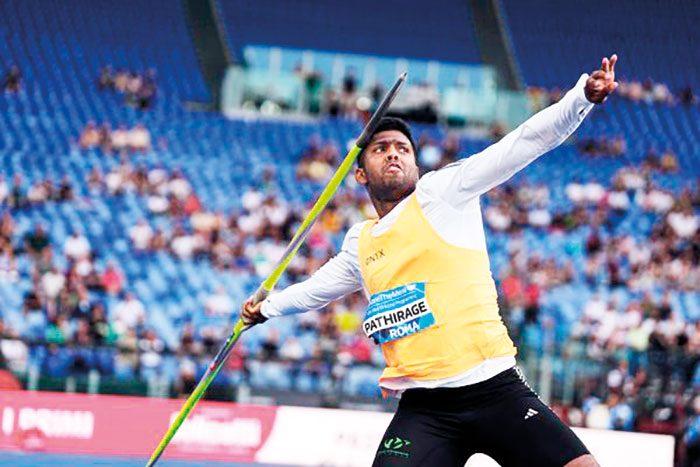
Rumesh Tharanga will head to the Doha Diamond League as the athlete to beat following a commanding victory at the Ostrava Golden Spike on Tuesday.
Fresh from his recent record-breaking exploits, Tharanga once again stamped his authority on the world stage, dominating the competition with three throws beyond the 85-metre mark. Remarkably, any one of those efforts would have been enough to secure victory.
The 23-year-old produced his best throw of 86.57 metres in the third round to claim top honours ahead of two-time world champion Anderson Peters, who finished second with a best effort of 84.27 metres.
Tharanga’s consistency throughout the competition underlined his status as one of the world’s leading javelin throwers. His latest triumph further strengthens his credentials ahead of the Doha Diamond League, where he is expected to be among the favourites alongside World champion Keshorn Walcott, two-time world champion Anderson Peters and world bronze medallist Curtis Thompson.
Tuesday’s victory continues a remarkable season for the former Peterite, who has emerged as a genuine contender on the international circuit with a string of world-class performances. [RF]

In the recent past, factors such as population growth, expansion of development activities, and deforestation in Sri Lanka have resulted in the loss of traditional migratory routes and the destruction of habitats of wild elephants.
Consequently, a continuous and rapid escalation of the human-elephant conflict has been observed over a long period, spanning 19 out of the 25 districts and 134 out of the 341 Divisional Secretariat Divisions in the country.
According to the wild elephant census conducted in 2024, the wild elephant population in the country is estimated to be approximately 7,450. It is reported that the human-elephant
conflict accounts for a significant number of human fatalities and wild elephant deaths annually.
Furthermore, over a thousand incidents of property damage caused by wild elephants are recorded each year.
Although a ‘National Action Plan to Mitigate Human-Elephant Conflict in Sri Lanka’ was formulated in 2020, the dynamics of the current human-elephant conflict have evolved substantially since then, necessitating the formulation of a new national action plan.
Accordingly, the Cabinet of Ministers approved the proposal presented by the Minister of Environment to take the necessary steps to draft a new National Action Plan for Human-Elephant Conflict Management.

Nilakshika, Nuthyangana stun New Zealand to seal famous win for Sri Lanka

Showers will occur in the Western, Sabaragamuwa and North-western provinces and in Galle, Matara, Kandy and Nuwara-Eliya districts.

Tharanga heads to Doha as athlete to beat after Ostrava victory

Complaint of custodial deaths and torture submitted to UN

India provides military stores worth USD 5.5 mn to SL

India promotes INR-LKR settlement mechanism

‘Dates have the highest sugar content to fight Coronavirus’

Sunday Island 27 December – Headlines

#SundayIsland 17th December – Headlines

Sunday Island – 28th March

Sunday Island Headlines – 21 March

Sunday Island – 21st February – Headlines
-

 News5 days ago
CIABOC summons Yoshitha over his participation in British Navy training programme
-

 Sports2 days ago
Tharanga set for high-profile javelin clash in Ostrava
-

 News5 days ago
Justice Minister responds to social media claims he represented Easter Sunday ringleader
-

 News4 days ago
Commonwealth lawyers urge Lanka to uphold rule of law
-

 Features3 days ago
Politics of protected species
-

 News2 days ago
Theft of USD 2.5 mn from Treasury: CoPF accused of complicity in NPP cover-up
-

 News1 day ago
Beijing Capital Airlines to resume flights to Colombo signalling boost to tourism
-

 Features3 days ago
Of Whales and Submarines: Sri Lanka’s Security Dilemma