
Midweek Review
Theatre and Anthropocentrism in the age of Climate Emergency


A few days ago, I was in a remote region of Sri Lanka, Hambantota, a dry zone area, where people mainly live on farming. The farming methods are still very primitive. I was engaged in a television series, titled Beddegama, directed by Priyantha Kolambage. The character I play is ‘Silindu’, a hunter. Silindu is a character created by Leonard Woolf, a colonial administrator, who lived in Sri Lanka in the early 20th century. In his widely read book, Village in the Jungle, Silindu, the hunter lives with his two daughters and his sister in a mud hut in the forest. They are one of the few families in this village struggling to survive amidst drought, famine and overbearing government authority.
Phenomenologically speaking, Silindu is an environmental philosopher. He believes that the jungle is a powerful phenomenon, a living entity. He thinks that the animals who live in the jungle are also human-like beings. He talks to trees and hunts animals only to dull the pangs of hunger. He is an ethical man. He believes that the jungle is an animate being and its animals are his fellow travellers in this world. His younger daughter, Hinnihami, breastfeeds a fawn. His sustainable living with fellow animals and nature is challenged by British law. He kills two people who try to dominate and suppress poor villagers by using their administerial powers. He is sentenced to death.
What I want to highlight here is the way our predecessors coexisted with nature and how they made the environment a part of their lives. Silindu’s philosophy of nature and animals is fascinating because he does not think that humans are not the centre of this living environment. Rather humans are a part of the whole ecosystem. This is the thinking that we need today to address the major environmental crises we are facing.
When I first addressed Aesthetica, the International conference on Performing Arts, as a keynote speaker, at Christ University, Bangalore, in 2018, in my keynote address, I emphasised the importance of understanding the human body, particularly the performing body as an embodied subject. What I meant by this term ‘embodied subject’ is that over the centuries, our bodies in theatre, rehearsal spaces and studios are being defined and described as an object to be manipulated. Even in modern dance, such manipulation is visible in the modernist approaches to dance. The human body is an object to be manipulated. However, I tried to show the audience that the performing body was not a mere object on stage for audience appreciation. It is a being that is vital for the phenomenological understanding of performance. The paradox of this objectification is that we objectify our bodies as something detached from the mind and similarly, we assume our environment, the world as something given for human consumption.
Performance and Sustainability
Just to bring the phenomenological lexicon to this discussion, I will draw your attention to one of the chapter in my latest book, titled, Lamp in a Windless Place: Phenomenology and Performance (2025) published by VAPA Press, University of Visual and Performing Arts, Colombo. This project is based on Sarah Kane’s famous play text 4.48 Psychosis. In this chapter I wrote phenomenological environmentalists explain the two ways that human beings interact and engage with the life-world. The one way of this engagement is defined as ‘involvement’ we involve with various activities in the world and it is one of the ways that we are being-in-the-world. The second way of being-in-this-world is that we ‘inhere’ in the world meaning that we are built with worldly phenomena or we are made out of the same stuff of our environment. (James cited in Liyanage 2025, pp. 98-99). This coupling and encroachment between our bodies and the environment occur mostly without our conscious interference. Yet, the problem with our human activities, and also our artistic practices is that we see our environment (human body) as an object to be consumed and manipulated.
Today, it is more important for us to change our mindsets to rethink our daily practices of performing arts and understand how human, nature, space and non-human species are vital for our existence in this world. Sustainable discourse comes into play with the United Nations initiative to make humans understand the major crises we are facing. In 2016, 195 parties agreed to follow the treaty of the Paris Agreement, which is mainly focused on climate change and the increase in the global average temperature to well below 2°C above pre-industrial levels. Major scientists are talking about the ‘tipping points’. Tipping points indicate the current crisis that humans and other-than humans are going to face in the coming years.
Among those sustainable goals, the most important and the urgent point to be focused seems to be the climate emergency. Leading scientists of environmental sciences have already warned that within a few years, global warming will increase up to the level that the consequences will be catastrophic and dangerous to all, human and non-human. Ice sheets are shrinking; sea water level is increasing, and coral reefs are dying. It is becoming increasingly evident that countries in our region, particularly in South Asia, have been experiencing major climate shifts over the past few decades. Recent Cyclone Ditwah and the catastrophic flood devastated parts of not only Sri Lanka but also Malaysia, Sumatra, India, etc. Professor Missaka Hettiarachchi and Devki Perera published a landmark book, titled Nature – based method for water resource management (2025). In this work Hettiarachchi and Perera clearly argue that flood, erosion, and landslides are a part of the geological evolution and transformations. They are inherent activities in nature, which form new landscapes and conditions in natural environments. But the problem is that we experience these natural events frequently and they abruptly occur in response to human-nature collisions.
Climate Emergency
Professor Jeffry Sachs stresses the importance of taking action to prevent future climatic change. For him, we are facing three mega environmental crises: 1. Climate crisis leading to greenhouse gas emission due to fossil fuel burning. We have already come to the 1.5 warming limit now. He predicts that humans will experience 2.0 degree Celsius within two decades. 2. Second is the ecological crisis. This is the destruction of rainforests in South East Asia, Amazon and other regions. He argues that Amazon has reached the tipping point, meaning that the rain forest is in danger and it would be a dry land in a few decades time. Because of ocean acidification, scientists have already warned that we are in the wake of the destruction of coral reefs. The process is that high carbon dioxide dissolves in the water and it creates the carbonic acid. It causes the destruction of the coral reef system. 3. The third ecological crisis is the mega pollution. Our environment is already polluted with toxic chemicals, our waterways, ocean, soil, air and food chains are polluted. Micro plastics are already in our blood streams, in our lungs and even in our fetuses to be born.
The climate crisis is not just a natural catastrophe; it is political in many ways. Greenhouse gas emission is still continuing, and the developed countries such as the United States of America, Canada, China and Germany produce more carbon than the countries in the periphery. As Sachs rightly argues, the US politics is manipulated by the biggest oil companies in the world and President Trump is an agent of such multinational companies whose intention is to accumulate wealth through oil burning. Very recently, the US invaded Venezuela not to restore democracy but to gain access to the largest oil reserves in the country. We have seen many wars, led by the US, due to greed for wealth and natural resources. The US has withdrawn from the Paris agreement. President Trump calls climate change a hoax! So, the world’s current political situation is directly linked to the future of our environment, our resources and climate change.
Anthropocentrism in Performance
Back to creative arts. In the modernist era of our artistic practices and culture, we mimicked and replicated proscenium theatre inherited from Europe and elsewhere and revolutionised the ways that we see performance and perceiving. Our traditional modes of performance practices were replaced by the modern technology, architectural structures, studio training methods and techniques. Today, we can look back and see whether these creative arts practices have been sustainable with the larger human catastrophes that we experience almost daily. Eddie Patterson and Dr. Lara Stevenson have recently published an important and influential book, titled Performing Climate (2025). Being performance studies scholars, Patterson and Stevenson’s book contains 14 chapters interconnected and explores the human and non-human or more than human elements in the world. Patterson and Stevenson write that ‘performance is a messy business; a bloody mess’. ‘Performance is a mess of matter, climate, things, actors, and affects: neither a dramatic or postdramatic theatre but a network of dramaturgical elements; a site of birth and death, decay and renewal’ (Patterson and Stevenson, 2025, p. 1). In this book, they further explore the new ways of reading performance, making performance and perceiving performance. They argue that ‘we are interested in analyzing performance not as an insulated, exclusive art form predicated on human centrality but as a process that celebrates the transformative properties of waste – bacteria, debris and breakdown – composting and mulching within a larger network of bacteria, fungi and microbes embedded in the skin, air, soil and interacting with cellular networks and atmospheric conditions’ (ibid).
Our modern theatre has always been anthropocentric. Even in Sri Lanka, the father of modern Sinhala theatre, Professor Ediriweera Sarachchandra adapted traditional dance drama and developed a modern theatre for middle class theatregoers. This modern theatre was anthropogenic, patriarchal and marginalised the subaltern groups such as women, non-human beings, environment and so forth. The traditional dance and dramas, nadagam and kooththu were much more embedded in rituals performed by communities for various social, cultural and spiritual purposes were uprooted and established in the proscenium theatre for the audience, whose aesthetic buds were trained and sustained by the colonial theatre and criticism. Even traditional dance was uprooted from its traditional setting embedded in the ecosystem and placed on the proscenium theatre for the sake of modernisation of dance for the modern theatregoers. A new group of spectators, theatregoers, were produced to watch those performances which took place in city theatre buildings, insulated architectural spaces where the black boxes were lit up with expensive lighting technology and air-conditioning. As Patterson and Stevenson argue, the Western theatre has been obsessed with the human drama or autobiography. This western history of theatre has been ‘blind to the non-human agency and the natural world has always been in the background to the human centred stories’ (Patterson and Stevenson 2025).
Carbon Emission theatre
The performance practice that we have inherited and is continuing even today is highly problematic in the ways that we centre human agency over the non-human and the environment. This anthropocentric performance practice, as German philosopher Peter Sloterdijk called it, is ‘biospherical’. The biospherical theatre sees human action in the artificially constructed atmospheres for artistic innovations (Patterson and Stevenson 2025). Biospherical theatre is proto-laboratories and human greenhouses – in which able-bodied actors are trained and perform within air-conditioned black boxes; or more tellingly white people in white cubes’ (ibid).
Patterson and Stevenson further assert that ‘biospherical theatre is an enclosed Western form it is labour intensive, carbon intensive, hierarchical, exclusive, inaccessible extractive rather than generative of new knowledge and different ways of being with the world (ibid, p. 10). We inherited this hierarchical, exclusive, and carbon-oriented performance space from our past; as a colonial heritage. This colonial heritage of labour intensive, carbon intensive theatre is the major practice of performance in our societies. I am currently the Chairman of the National Theatre Sub-Committee under the purview of the Arts Council of Sri Lanka. Theatre practitioners today in Colombo are highly critical of the Ministry of Cultural Affairs for not having quality enclosed theatres in major cities in the country. They do not see the problems pertaining to the performance practice that is not ecologically sustainable for island nations like us.
We are possessed with the model of Globe theatre, which has been the model for theatre and entertainment in our regions for centuries now. However, today, we are forced to revisit and rethink this model of Globe theatre in the wake of the climate emergency. Patterson and Stevenson remind us that ‘inside these globes, art develops in enclosed and air-conditioned bubbles (laboratories, rehearsal rooms, conservatories, and galleries). This kind of theatre is biospherical: a human centric endeavour, evolving inside the globe, largely upholding the fantasy of itself as disconnected from atmospheric and environmental interactions beyond the human’ (Patterson and Stevenson 2025, p. 16).
Conclusion
According to Jim Bendell, it is not enough for us to develop resilience towards the climatic emergency; we need to embrace relinquishment (Stevenson, 2020, p. 89). It is the letting go of certain assets, behaviours and beliefs. Grotowski articulated this concept many decades back in his actor training at the Polish theatre laboratory. Grotowski developed the idea of via negative, letting go, or elimination for actors. Letting go of all the acculturations as Eugenio Barba articulates, to tap into the pure impulses and action. Grotowski even rejected the audience participation in his later works, para theatre, like Antonin Artaud, who rebelled against the dialogic, bourgeoisie theatre in France at the time. So, the modernist theatre directors have shown us that the Globe theatre is no longer a sustainable pathway for performance practice. It is time for us to rethink the carbon intensive, labour intensive, hierarchical, exclusive, and class-oriented theatre and performance.
References
Hettiarachchi, M., & Perera, D. (2025). Nature-Based Methods for Water Resources Engineering. The Institution of Engineers, Sri Lanka.
India Today Global. (2025, September 24). “U.S. government is in an open war against the Sustainable Development Goals”: Jeffrey Sachs. YouTube. https://www.youtube.com/watch?v=qb4Jpqq4wvE
James, S. P. (2009). The Presence of Nature A Study in Phenomenology and Environmental Philosophy. PALGRAVE MACMILLAN IK.
Liyanage, S. (2025). Lamp in a Windless Place: Phenomenology and Performance. VAPA Press. (Original work published 2025)
SDSN. (2024, October 11). Sustainability Fundamentals with Jeffrey Sachs. YouTube. https://www.youtube.com/watch?v=dJR0Q8ueQpc
Stevens, L. (2019). Anthroposcenic Performance and the Need For ‘Deep Dramaturgy’. Performance Research, 24(8), 89-97.
Stevens, L., & Varney, D. (2022). The Climate Siren: Hanna Cormick’s The Mermaid. TDR, 66(3), 107-118.
Woolf, L. (2012). The village in the jungle. Forgotten Books.
Author wishes to thank Himansi Dehigama for proofreading this manuscript.
Professor Saumya Liyanage is a professor of Drama and Theatre Currently working at the Department of Theatre Ballet and Modern Dance, Faculty of Dance and Drama, University of the Visual and Performing Arts, Colombo. He is the chairman of the State Theatre Subcommittee.
by Saumya Liyanage


The ruling NPP is in a deepening dilemma over a hotly disputed move to extend the retirement age of superior courts judges. The party is also under heavy fire for delaying fresh appointments to the superior courts consisting of the Court of Appeal and Supreme Court.
A section of the Opposition wants Speaker Dr. Jagath Wickremaratne to take up the inordinate delay in filling vacancies in the superior courts. The Bar Association of Sri Lanka, Colombo High Court lawyers, Lawyers Collective, as well as the Commonwealth Lawyers’ Union have criticised the government’s move.
By Shamindra Ferdinando
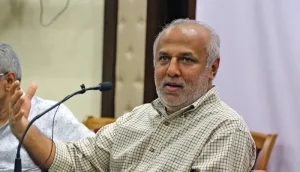
Sri Lanka Muslim Congress (SLMC) leader Rauff Hakeem, MP, recently expressed concern over the alleged way Balachandran Prabhakaran, 12-year-old son of LTTE leader Velupillai Prabhakaran was killed, in cold blood, on 19 May, 2009.
A section of the Tamil media highlighted Kandy District lawmaker Hakeem’s comments regarding the alleged way Balachandran, the youngest of the three children of Tiger Supremo, met his end. Prabhakaran himself was also killed on the same day.
What prompted MP Hakeem to raise a contentious but now largely forgotten issue! Both the Sinhala and English print and electronic media failed to report the SLMC leader’s comments. Some questioned the purpose in lawmaker Hakeem raising Balachandran’s death. Some even suggested a Tamil Diaspora hand in Hakeem’s unexpected interest in Balachandran’s death.
The Island obtained the video, released by the Parliament, of the SLMC leader’s 10-minute speech, delivered on 10 June. Reference to Balachandran’s killing had been made towards the tail end of his fiery speech that primarily dealt with President Anura Kumara Dissanayake’s continuing failure to fill existing vacancies in the Court of Appeal and the Supreme Court.
The deliberate and utterly contemptible holding up of judicial promotions, for whatever reasons, cannot be discussed without examining a disputed bid to introduce an amendment to the Constitution to increase the retirement age of the Judges of the Court of Appeal and the Supreme Court.
President Anura Kumara Dissanayake, the leader of two registered political parties, namely the Janatha Vimukthi Peramuna (JVP) and the National People’s Power (NPP), seems to be on a collision course with the Opposition. With a commanding 159 MPs in Parliament, meaning a 2/3 majority, Dissanayake can easily introduce the required amendment, regardless of protests. But, the electorate won’t like that dictatorial attitude. Those who exercised their franchise for Dissanayake and the NPP at the September 2024 and November 2024 national polls, respectively, wouldn’t expect them to adopt, what can be safely described as, a dogmatic approach.
Attorney-at-law and one-time Justice Minister Rauff Hakeem castigated the President and the ruling party, ahead of the joint Opposition action, to pressure the President to fill the vacancies. Their appeal to Speaker Dr. Jagath Wickremaratne in this regard can be also interpreted as a collective opposition to the proposed amendment to increase the retirement age of judges.
The SLMC group in Parliament consists of five MPs. Of them, three had been elected under the SLMC symbol (two elected and one on the National List) and two through the Samagi Jana Balawegaya (SJB), one of them on the latter’s National List.
Lawmaker Hakeem, who had served the Parliament for over 30 years, at the onset of his speech, questioned the sudden decision to bring in regulation to compel exporters to convert their export proceeds into USD. The SLMCer declared that such panic action was taken by the government in view of the rapid deterioration of the Rupee against the USD.
Commenting on the extension of the Emergency continuously, MP Hakeem alleged that it was done for the NPP’s own parochial purposes and the Opposition expected the government to discontinue the practice.
Then he dealt with the alleged move to extend the retirement age of top judges. Referring to Chief Government Whip Dr. Nalinda Jayatissa’s shameless declaration that the issue hadn’t been even discussed among the government. The ex-justice Minister, however, disputed Jayatissa’s claim made at the post-Cabinet media briefing, while highlighting the statements issued by the Bar Association, Colombo High Court Lawyers’ Association. In addition, the Lawyers’ Collective and the Commonwealth Lawyers’ Association strongly opposed the alleged move. In spite of the Cabinet spokesman’s denial, Justice Minister and Attorney-at-Law Harshana Nanayakkara, in his comments on the issue, indicated that the matter was under discussion. In fact, Nanayakkara mentioned a comparatively higher retirement age of top judges in other countries to support the NPP’s controversial and unnecessary move.
Obviously, the NPP is not talking in one voice.
Rauff takes a strong stand
Emphasising that he addressed the issue at hand as a member of the BASL, Hakeem pointed out that there were four vacancies, each in the Court of Appeal and the Supreme Court, for the past six months. The SLMC leader said: “The President has failed in his constitutional duty to nominate judges for promotion. From the High Court to the Court of Appeal and from the Court of Appeal to the Supreme Court. By denying the rights of the judges, undue pressure is being brought on them. What will happen? This very President, when he was in the Opposition, when the previous Presidents failed to gazette the names decided on by the Constitutional Council, he made a big protest. Several times he spoke about this very vociferously in the House. But, since becoming the President, he has not nominated any names. Very clearly, the 21 Amendment provision was made to prevent Presidents from delaying the decisions taken by the Constitutional Council. He is doing the reverse by not nominating anyone to the top two courts. This is much worse. As a consequence, even our fundamental rights are impacted. Because we as litigants or lawyers or public, our right for the expeditious disposal of cases is being impacted by the delay in appointing judges to the Superior Courts.
Moreover, you are frustrating the judges who served years in the judiciary. What happens to the minor judiciary and others? There are heavy concerns among the judiciary about extending the retirement age. That’ll block their path. That’ll deprive many suitably qualified individuals the right to get onto the bench or the superior bench. High court judges will now await their chances of being promoted. Undue pressure will be brought upon them.”
Hakeem alleged that the Constitution was being deliberately violated by the President. Having directed serious allegations at the President, Hakeem emphasised the responsibility on the part of the Speaker to take up this matter with the President on their behalf. Hakeem questioned as to why the President unduly delayed the promotions. The President’s deliberate failure has caused unnecessary frustration among the judicial ranks in the country and deprived those who served the judiciary of their due rights.”
Hakeem explained how even senior officers of the Attorney General’s Department had been affected by the President’s inaction. Those officials have been deprived of the opportunity to move onto one of the superior courts, Hakeem alleged, accusing the President of, what he called, deliberate inaction and a constitutional violation.
Then Hakeem made a very serious allegation. The ex-Justice Minister alleged that the NPP was delaying the process until a favoured person is eligible to get onto the bench, “You are picking and choosing people by that thereby undermining the judiciary.”
MP Hakeem also dealt with the vexed issue of the Prevention of Terrorism Act (PTA) that had been opposed by many political parties, civil society as well as organisations such as Amnesty International. The Sttorney-at-Law took up the issue in the wake of the controversial arrest of Maj. Gen. (retd.) Suresh Sallay, Director of the Directorate of Military Intelligence (DMI/2012-2016) and Director, State Intelligence Service/2019-2024) in terms of the PTA.
MP Hakeem chided the NPP for proposing to bring in a new anti-terrorism law, under a different title, to replace the existing PTA. Declaring that the new Act would be definitely far worse than the current law, the lawyer faulted the police and the Attorney General’s Department for abusing the PTA. The former Minister said so while alleging the continuous deterioration of the standards of the police and the Attorney General’s department, due to their dependence on the draconian PTA.
Killing of Balachandran
Referring to Tamil media reports regarding the new UK Channel 4 video that dealt with the killing of Prabhakaran’s 12-year-old son, lawmaker Hakeem discussed how the military dealt with the families of the LTTE leader and that of the JVP leader Rohana Wijeweera, killed on the night of 13 November, 1989.
Pointing out that Wijeweera who had been apprehended, along with his family, by the military, was killed, Hakeem stressed that the family members weren’t harmed. They lived under the protection of successive governments but in Prabhakaran’s case the situation was entirely differently.
Hakeem scorned the JVP/NPP government for conveniently forgetting its leaders, though an annual ceremony was held in Colombo in memory of those who perished during the insurgency. Hakeem said that even the daughter of Zahran Hashim, who led the 2019 Easter Sunday attacks, was spared. But, if Prabharatan’s daughter, Duwaraka, had been killed, as alleged, that should be investigated, Hakeem said. Hakeem ended his speech addressing the Parliament in Tamil.
Prabhakaran’s wife Mathivathani, too, had been killed during the final phase of the ground offensive. Prabhakaran’s eldest son, Charles Anthony, was killed in the Karayamullavaikkal area of the Mullaitivu district, the day before Prabhakaran, wife Mathivathani, daughter Duwaraka and younger son Balachandran were killed.
Acknowledging the SLMC leader’s right to rake up the controversy over the alleged manner the deaths of the LTTE leader and his family, while in government custody, took place. It would be pertinent to mention that Hakeem, in his capacity as the Justice Minister, from November, 2010, to December, 2014, could have pushed the Mahinda Rajapaksa government to inquire into the incident.
In fact, the writer once sought a meeting with the then Minister Hakeem to discuss accountability issues and the failure on the part of the government to address them. Although the Minister gave a patience hearing and acknowledged the urgent need to take remedial measures, the war-winning Rajapaksa government, instead of taking tangible measures, played politics. By late 2014, the SLMC switched its allegiance to the UNP-led coalition, formed with the US blessings to back the candidature of another political turncoat, Maithripala Sirisena, at the 2015 presidential election.
Hakeem received the Urban Development, Water Supply and Drainage portfolio in the succeeding Yahapalana government. The Tamil National Alliance (TNA), that had been an integral part of that alliance, served the Yahapalana interests well, though it refrained from accepting any Cabinet portfolio. The JVP, too, refrained from joining the Cabinet but their role in the Yahapalana operation is in the public domain.
The Yahapalana government betrayed the armed forces at the Geneva-based United Nations Human Rights Council (UNHRC), in October, 2015, but the extent of their treachery was highlighted two years later when that administration unceremoniously dismissed Lord Naseby’s revelations pertaining to the final phase of the war.
What made the SLMC leader Hakeem to compare three incidents – the killing of Wijeweera, and government protection for his family, in November, 1989; killing of Prabhakaran and his family on the banks of the Nanthikadal lagoon, in May, 2009; and the rescue of Zahran Hashim’s daughter, following the Sainthamaruthu blasts in April, 2019. Whatever the SLMC leader’s motive in highlighting the LTTE’s case now, the need for collective response on the part of the Parliament to address the concerns of the loved ones of those who engaged in terrorism cannot be overemphasised.
The circumstances of Prabhakaran, his wife and their daughter and youngest son remained mired in controversy. Like over 11,000 LTTE cadres, both men and women, including suicide cadres who surrendered to the advancing troops on multiple fronts, Prabhakaran and his family could have given themselves up to the Army on the Vanni front. They ignored that opportunity believing in a US operation to evacuate them.
Critically important combined stand
As mentioned by the SLMC leader during his 10 June speech in Parliament, a group of Opposition MPs handed over a letter expressing their concerns over the inordinate delay in filling the vacancies in the superior courts. Pointing out that the President, in his capacity as the Chairman of the Constitutional Council, had failed to fill those vacancies, the Opposition MPs stressed the responsibility on the part of the President to act in accordance with the provisions of the Constitution. They also reminded the Speaker that it would be his responsibility to protect the independence of the judiciary, which is an important part of the sovereignty of the people.
Kandy District MP Anuradha Jayaratne, represented the new Democratic Front (NDF) in the SJB-led effort, while NDF MP Ravi Karunanayake, too, joined, though he is in logger heads with the UNP over taking the National List slot won by the NDF at the last parliamentary election. Former President and UNP leader Ranil Wickremesinghe threw his weight behind the NDF, at the November, 2024, General Electio, but could not achieve the anticipated results. The NDF managed to secure just five seats, two of them National List slots.
All Ceylon Tamil Congress leader Gajendrakumar Ponnambalam, representing the Jaffna electoral district, signed the petition, along with the Sarvajana Balaya leader Dilith Jayaweera. Unfortunately, the SLPP hadn’t been part of that grouping. Responding to The Island queries, SLPP sources assured that though they didn’t sign the petition handed over to Speaker Wickremaratne, they wholeheartedly supported the initiative.
Whatever efforts by political parties/governments in power to interfere with the judiciary should be opposed at every level. The Rajapaksas went to the extent of impeaching Chief Justice Dr. Shirani Bandaranayake and removing her under the most despicable circumstances. Belligerent Rajapaksas reacted, as expected, following the Supreme Court rulings, including one against the then SLFP/UPFA strongman Basil Rajapaksa.
The ruling UPFA directed a series of unsubstantiated allegations against her, including financial impropriety and interfering in legal cases. SJB MP Dayasiri Jayasekera recently made reference to the impeachment of Dr. Bandaranayake when he censured the NPP move to extend the retirement age of judges of the superior courts. MP Jayasekera questioned whether the NPP wanted to retain Chief Justice Preethi Padman Surasena beyond the stipulated retirement age.
Although there had been a spate of interventions, the 2013 impeachment of CJ 43 was undoubtedly the worst case ever and the appointment of former Attorney General Mohan Peiris as her successor made matters worse.
The UPFA hit back hard at Dr. Bandaranayake following unprecedented controversy over The Town and Country Planning (Amendment) Bill and Divi Neguma, gazetted in 2011 and 2012, respectively. The UPFA abandoned the first Bill and then amended the second to avoid a referendum and the required 2/3 approval. By then, the cocky UPFA had decided to impeach Dr. Bandaranayake who stood up to outright political intimidation.
Ranil Wickremesinghe, during his tenure as the President (July, 2022, to September, 2024) reacted angrily to the Supreme Court ruling that he, in his capacity as the Finance Minister and the Election Commission, violated voters’ rights by arbitrarily delaying the Local Government polls in 2023. Wickremesinghe had been also angered by his failure to secure Supreme Court endorsement for his bid to appoint Dehabandu Tennakoon as the IGP in the run-up to the 2024 Presidential Election.
There had been so many other instances when the political party/coalition, in power, felt that the judiciary undermined its agenda. There cannot be better examples of the daunting challenge faced by the UPFA due to the Supreme Court stand during Dr. Bandaranayake’s tenure as the Chief Justice.
But post-Aragalaya period, no one expected President Dissanayake to pursue an agenda that compelled the BASL to issue hard hitting statements. Since May Day 2026, there had been two such statements from the BASL that should have triggered alarm bells. The NPP is obviously on the wrong path, believing that it can proceed with a 2/3 super majority unhindered in Parliament.
The first BASL statement dealt with President Dissanayake’s controversial May Day prediction of a court ruling in a high profile case. The second one responded to a move to extend superior court judges’ retirement age.
The government should rethink its strategy. With the national economy experiencing severe difficulties and the government under pressure to abolish fuel and electricity subsidies at the behest of the IMF, the NPP should concentrate on saving the economy instead of creating fresh issues that it cannot just brush aside just because of its steamroller majority in Parliament.

Gladdening was the sight at morn,
For the folk of the invisible village,
Of mirthful children trekking to school,
And refuge did they take in the thought,
That at least their young would be spared,
The crushing ordeals of tenant farming,
Since they would come by some erudition,
But our elders are now up against the truth,
That all is not well at the humble school,
Since even the morsel of education,
Painstakingly dished out there,
Comes with scary price tags attached;
Making dropping out the best thing to do.
By Lynn Ockersz
Ulugetenne
The Sri Lanka Navy, on 04 June, commissioned SLNS Samudravijaya, formerly United States Coast Guard Cutter Decisive. It is the fourth mothballed US Coast Guard cutter transferred to the SLN through the US Excess Defence Articles Programme. President Anura Kumara Dissanayake attended the ceremony at the Colombo Port. The US Embassy in Colombo, in a statement issued on the same day, quoted Defence Attaché Lieutenant Colonel Matthew House as having said: “Few partners have demonstrated the commitment to maintaining and operating these vessels as successfully as the Sri Lanka Navy. The outstanding condition and operational performance of SLNS Samudura, SLNS Gajabahu, and SLNS Vijayabahu are a testament to the professionalism and technical expertise of Sri Lankan sailors. Their stewardship of these vessels helped build the confidence that made this fourth transfer possible.” The first of the four vessels SLNS Samudura was commissioned on 19 February, 2005, during Chandrika Bandaranaike Kumaratunga’s tenure as the President. Milinda Moragoda, Economic Reforms and Science and Technology Minister of the previous UNP-led UNF government, played a significant role in acquiring that vessel. SLNS Samudura boosted SLN and participated in numerous operations, including the high profile hunt for LTTE floating warehouses, during the Eelam War IV. But, the US refrained from transferring any more big ships during the war though on the then Navy Commander Vice Admiral Wsantha Karannagoda’s request to provide intelligence and Washington obliging, made the successful hunt for LTTE floating arsenals in the last stages of the war possible. The transfer of the second vessel took place 19 years after the end of the war. Ex USCG Sherman was commissioned 06 June, 2019, as SLNS Gajabahu (P626). The third vessel was transferred to the Sri Lanka Navy on October 26, 2021, as the country was heading towards an unprecedented economic crisis. That vessel was commissioned as SLNS Vijayabahu at the Colombo Port with the participation of President Ranil Wickramasinghe and US Ambassador to Sri Lanka Julie Chung on November 20, 2022. Ironically SLNS Gajabahu, one of the ex-US vessels prominently figured in the contingency plan to save President Gotabaya Rajapaksa, but whose downfall was engineered by the US.
By Shamindra Ferdinando
The moment President Gotabaya Rajapaksa decided to take up residence at the President’s House (Janadhipathi Mandiraya), Fort, in the first week of April, 2022, the Navy had no option but to prepare a thorough contingency plan, in case the regime change project posed a realistic threat to the life of the President.
The President, in consultation with senior military officers, made his move within 48 hours after violence erupted outside his private residence at Pangiriwatte, Mirihana, on the night of 31 March, 2022. That decision seemed realistic and sensible at that time.
But, in the wake of the disastrous overall armed forces response to the coordinated violence unleashed by the regime change project on 09 May, 2022, in the aftermath of the Temple Trees ordered attack on Galle Face protesters, the top brass must have recognised the urgent need for total overhauling of security strategy. But, unfortunately, that hadn’t been the case. With violent crowds overwhelming the armed forces, deployed to block them, rapidly approaching the President’s House, those who had been at the makeshift Operations Room there were stunned.
In hindsight, the President’s decision to remain at the President’s House, regardless of the near failure on the part of the armed forces to repulse the raid on Temple Trees, on 09 May, seemed unwise. The rescue operation could have gone wrong and the war-winning President Mahinda Rajapaksa could have ended up in the hands of an angry mob.
Perhaps, the conspirators envisaged the President’s move, from Pangiriwatte to the President’s House, situated walking distance away from the Galle Face protest site, where they could draw additional strength.
The failure on the part of the government to take tangible measures, in the wake of the President’s House becoming the sole target on that fateful day, is a contentious issue that needs to be properly investigated. Don’t forget that the court case filed over the 09 May attacks on the residences and properties belonging to SLPP politicians, and some supporters ,was later withdrawn. The Wickremesinghe-Rajapaksa government never investigated the 09 May incidents.
Exactly two months after the mobs almost succeeded in breaking through defences at Temple Trees, on the night of 09 May/10, where Prime Minister Mahinda Rajapaksa was residing, they mounted the assault on the President’s House.
In the wake of the 09 May mayhem, President Gotabaya Rajapaksa named Lt. Gen. Vikum Liyanage as the Commander of the Army. He succeeded General Shavendra Silva who served as the CDS but was out of the country when all-out mayhem was unleashed by the Aragalaya mobs on 09 July, 2022, to oust the sitting government.
In spite of a direct and growing threat to the President’s House, on 09 July, 2022, the President felt confident in meeting the challenge. The President issued a directive to the Secretary, Ministry of Defence, General (retd.) Kamal Gunaratne, to shift the Operations Room from the Defence Force Headquarters, at Akuregoda, to the President’s House. Having shifted the Operations Room on 08 July, 2022, to the President’s House, as directed by the President, the top brass prepared to face the challenge.
Maj. General K.B. Egodawela, who served as an Additional Secretary (Administration) to the President, from the day the President moved to the President’s House, till he vacated on 09 July, 2022, in his memoirs ‘Aragalaya: Adarayen Prachandathwayata’ (From Love to Violence) revealed that though the top brass opposed the shifting of the Operations Room they carried out the directive. While the President felt that the top brass could collectively work at the President’s House to bring the situation under control, Gen Gunaratne proposed that the President should move to Akuregoda Defence Forces Headquarters, according to Egodawela. In fact, Gunaratne, who had been with Gotabaya Rajapaksa from the very beginning of the sinister campaign, strongly opposed the President’s decision to remain there.
Obviously, the President’s House pathetically failed to ascertain the scale of the protest and the rapidity with which protesters overwhelmed troops deployed outside the President’s House stunned the top brass. Had they swiftly reached consensus on Gen. Gunaratne’s suggestion, perhaps the 09 July regime change operation could have been thwarted. The armed forces could have resorted to tougher measures to prevent a march on Akuregoda Defence Forces Headquarters had the President agreed to move there.
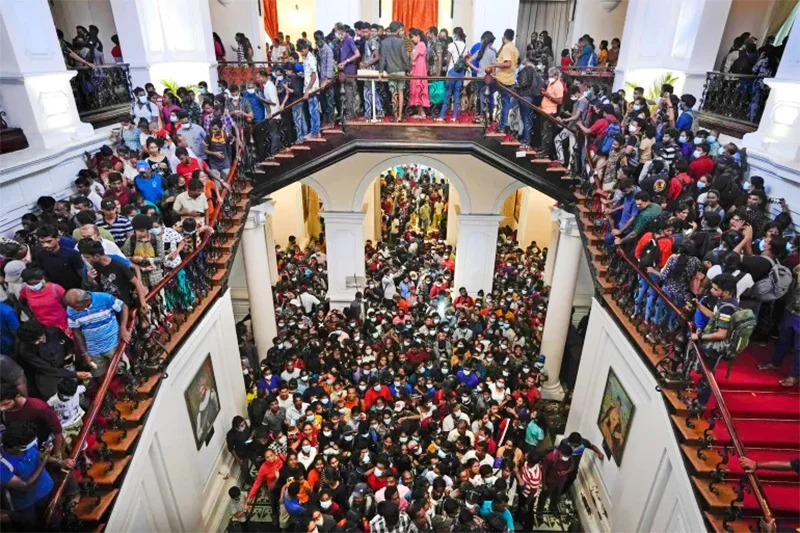
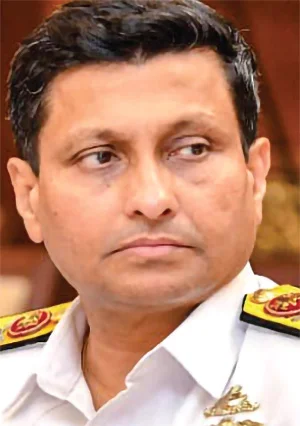
Within two hours after the protest, targeting the President’s House began, video footage provided by drones indicated that troops couldn’t hold the rampaging mobs any longer. According to Egodawela, the top brass had been prepared to remove the President, even without his consent, by landing a helicopter in the Colombo harbor or by ship. Finally, they resorted to the second option. As the President and First Lady Ayoma got into a vehicle and took the rear exit into the adjoining former Navy Headquarters, mobs entered the President’s House. Another vehicle carrying several other persons followed.
The then Navy Commander Vice Admiral Nishantha Ulugetenne who had been with the President at the President’s House got into the vehicle carrying the President. Had they stayed at the President’s House for 10 more minutes, the consequences could have been devastating. https://island.lk/gotabayas-escape-from-aragalaya-mob-in-rti-spotlight/
Egodawela, who had been with the President from the very beginning of the presidential term, alleged that the raiders planned to kill the President and several others and display their bodies. The author quoted an unidentified intelligence officer as having told him that the raiders wanted to display the bodies the way LTTE leader Velupillai Prabhakaran’s body was shown.
Perhaps shifting the Operations Room from Akuregoda Defence Force Headquarters to the President’s House had been a risky move that, in a way, facilitated the regime change operation. The rationale in bringing those who had been tasked with countering the impending threat to one place (President’s House) to be with the target (Gotabaya Rajapaksa) seems unbelievably a dicey move. The President had been influenced by what he described as inordinate and unforgivable delay on the part of the Akuregoda Operations Room to carry out timely evacuation of Prime Minister Mahinda Rajapaksa on the night of 09 May from Temple Trees. Most probably, the President wanted to oversee the 09 July counter operation personally. But, in hindsight, the decision to shift the Operations Room from Akuregoda to the President’s House obviously hadn’t been a clever move.
SLN preparations
When mobs threatened to overwhelm the President’s security at Pangiriwattta, on 31 March, additional police and STF contingents were brought in. They were followed by the Navy and Air Force. The Army arrived at the scene, subsequently.
As pointed out by the President himself, the situation at Temple Trees, on 09 May, had been far worse and the combined police and armed forces response revealed that they hadn’t taken precautionary/counter measures, even after the Pangiriwatta fiasco.
At the time of the incidents, the overall Temple Trees security deployment included about 60 elite Special Boat Squadron (SBS) personnel deployed within the premises and were supplemented by seven SLN platoons. The Army also moved in to strengthen Temple Trees defences but the mobs pressed on till troops fired blank ammunition.
The top brass, directing counter measures from Akuregoda Defence Force Headquarters, had to act swiftly and decisively to evacuate those at the Temple Trees or face the consequences. As there hadn’t been any other alternative place of living proposed, Prime Minister Mahinda Rajapaksa, wife Shiranthi and their eldest son Namal were escorted to nearby former Air Force Headquarters and from there flown to the Trincomalee Navy base. VA Ulugetenne, over the phone, issued instructions to the relevant officer in Trincomalee to make arrangements as two helicopters carrying the group took off from the helipad on the top of the former Air Force Headquarters. The helicopters departed around 04 in the morning.
They had stayed at Trincomalee Navy House for about a week and, as requested by the Navy, paid for their stay because by then Mahinda Rajapaksa had resigned. Perhaps, they could have taken refuge at the Panagoda Army cantonment or at Saliyapura, home to the Gajaba Regiment, but, at the end, sought the protection at the Trincomalee Navy base.
Ironically, President Gotabaya Rajapaksa, too, had to take refuge at the Trincomalee Navy base, exactly two months later. Ever since the President moved into the President’s House, Fort, the Navy had been on their toes to meet any eventuality. The daunting task of arranging evacuation by sea fell on the shoulders of VA Ulugetenne, who, meticulously, planned the operation with his staff.
Having informed the President of the contingency plans, VA Ulugetenne stationed two Advanced Offshore Patrol Vessels (AOPVs), namely SLNS Sindurala and SLNS Gajabahu and four Fast Attack Craft (FACs), at the Colombo Port. It would be pertinent to mention that SLNS Sindurala, built at the Goa shipyard, in terms of an agreement signed at the tail end of the Mahinda Rajapaksa government, was adjudged the best vessel in the SLN fleet in 2022.
Additional SBS personnel and snipers, too, had been brought in to Colombo though none of them knew exactly what their task would be. The OPV and FAC crews most probably felt that they were awaiting orders for a major anti-drug operation in the high seas.
As the decision was made to evacuate the President and the First Lady, the Chief alerted the vessels and quickly deployed tugboats to pull SLNS Sindurala and, shortly thereafter, SLNS Gajabahu, formerly of the US Coast Guard, carrying the President and the First Lady. By the time the two AOPVs moved in different directions, on the instructions of VA Ulugetenne, the hand phones of SLNS Gajabahu crew were collected to prevent them from revealing what was happening. Along with the AOPVs, two pairs of FACs had moved out to sea. (https://island.lk/ranil-reveals-bid-to-get-rid-of-him-while-gr-was-fleeing-to-trinco-on-board-slns-gajabahu/)
Nearly 12-hour journey to Trinco
The SLNS Gajabahu, formerly of the US Coast Guard, had a crew consisting of over 100 officers and men. Someone, most probably a port employee, posted a short clip of some unidentified persons taking large travelling bags into the ship but the President, First Lady and VA Ulugetenne going in were never captured on a camera.
As the vessel began its journey towards Trincomalee, it remained approximately 12 nautical miles from land and the President received many calls, some of which weren’t answered. VA Ulugetenne, too, received quite a number of calls. Those familiar with the developments at that time said that some felt that SLNS Gajabahu should move out of Sri Lankan waters. There had been suggestions that the destination should be the Maldives, India or Singapore. Regardless of such suggestions, SLNS Gajabahu proceeded towards Trincomalee where the Navy made necessary arrangements to host them.
Captain Marlon Perera, who still serves the Navy, had been the Commanding Officer of the vessel. Perera now holds the Commodore rank.
During the journey precautions were taken to ensure the safety and security of the President and the First Lady. Although the crew hadn’t been aware that they would be entrusted with such a sensitive task at a time the country was in crossroads against the backdrop of an economic collapse and sovereign default, there were fears of the crew being affected by propaganda in support of regime change operation.
The attempt made by sailor Wijemuni Vijitha Rohana de Silva to cause harm to Indian Prime Minister Rajiv Gandhi, way back in July, 1987, underscored the necessity to take precautions during the Colombo-Trincomalee journey as the possibility of anti-Gotabaya campaign having an impact on at least some members of the ship crew couldn’t be ruled out.
On July 30, 1987, during a guard of honor in Colombo, the 21-year-old naval rating struck Gandhi on the shoulder and back with the butt of his rifle. Gandhi narrowly avoided the full impact of the blow by evasive ducking.
On the invitation of VA Ulugetenne, Gotabaya Rajapaksa attended all the formalities in respect of a visit undertaken by the President to the Trincomalee Navy base. The President participated in those formalities knowing that he couldn’t attend the commissioning parade that was scheduled to be held on 15 July, 2022. The Navy was not in a position to put off the commissioning parade hence the decision to invite Defence Secretary Gunaratne as the Chief Guest.
Ulugetenne retired from active naval service on 18 December, 2022, following a distinguished career, spanning over 37 years. He received the appointment as the 24th Commander of the Navy in July, 2020, just a couple of months after Gotabaya Rajapaksa’s election as the President.
Wickremesinghe, in his capacity as Gotabaya Rajapaksa’s successor, appointed Ulugetenne as Sri Lanka’s Ambassador to Cuba. The appointment was made in late 2023 and the retired Navy Chief presented his credentials to Cuban President Miguel Díaz-Canel on 13 February, 2024 (https://island.lk/from-fonseka-convictions-to-arrest-of-ulugetenne/)
However, within weeks after the last presidential election held in late November, 2024, the NPP government recalled over a dozen top envoys appointed by the previous administration. Admiral Ulugetenne was among them. The government deprived a decorated officer, who had served the country for nearly four decades, from completing his term in Havana. Within months after his return, he became the target of a murder investigation.
Then out of the blue the retired Navy Chief became the focus of a murder investigation, that, too, post-war. The Criminal Investigation Department (CID) arrested him on 28 July, 2025, over the disappearance of a person reported in July, 2020.
Kurunegala High Court Judge Tikiri Jayatilleke, on 14 October, 2025, granted him bail. Jayatilleke declared that the CID acted in an illegal manner in respect of the former Navy Commander. His counsel Kalinga Indatissa, PC, alleged in court that his client had been apprehended only on the basis of an ex-LTTE cadre’s allegation in the absence of any evidence
The next hearing is scheduled for 08 July, 2026. Ulugetenne was held at the Kegalle Prison for four days and then transferred to the Dumbara (Pallekale) Prison. Altogether, he was in prison for 80 days, like a common criminal, despite him being a former Navy Commander with an unblemished career record.
Wartime Chief of Naval Intelligence, Rear Admiral (retd) Sarath Mohotti, who had been also arrested in connection with the same investigation, was also granted bail, a few weeks later.

Spinners make it two in two for England

Messi hat-trick fires holders Argentina to win over Algeria at World Cup

UNDP, Central Bank deepen financial literacy drive to build economic resilience

‘Dancing girl’s’ bare torso restored in Indian textbook after backlash

Tehran selling deal with US as victory – but for Iranians it was necessity

Plans to open underutilised state land for new investment opportunities

‘Dates have the highest sugar content to fight Coronavirus’

Sunday Island 27 December – Headlines

#SundayIsland 17th December – Headlines

Sunday Island – 28th March

Sunday Island Headlines – 21 March

Sunday Island – 21st February – Headlines
-
 News5 days ago
CIABOC summons Yoshitha over his participation in British Navy training programme
-

 Sports2 days ago
Tharanga set for high-profile javelin clash in Ostrava
-

 News5 days ago
Justice Minister responds to social media claims he represented Easter Sunday ringleader
-

 Features3 days ago
Politics of protected species
-

 News4 days ago
Commonwealth lawyers urge Lanka to uphold rule of law
-

 News2 days ago
Theft of USD 2.5 mn from Treasury: CoPF accused of complicity in NPP cover-up
-

 News2 days ago
Release of 2025 O/L results likely to be delayed
-

 News1 day ago
Beijing Capital Airlines to resume flights to Colombo signalling boost to tourism