
News
Suspenstion of Deputy Secy. Gen., Parliament flawed, unlawful and violated established parliamentary traditions – SJB

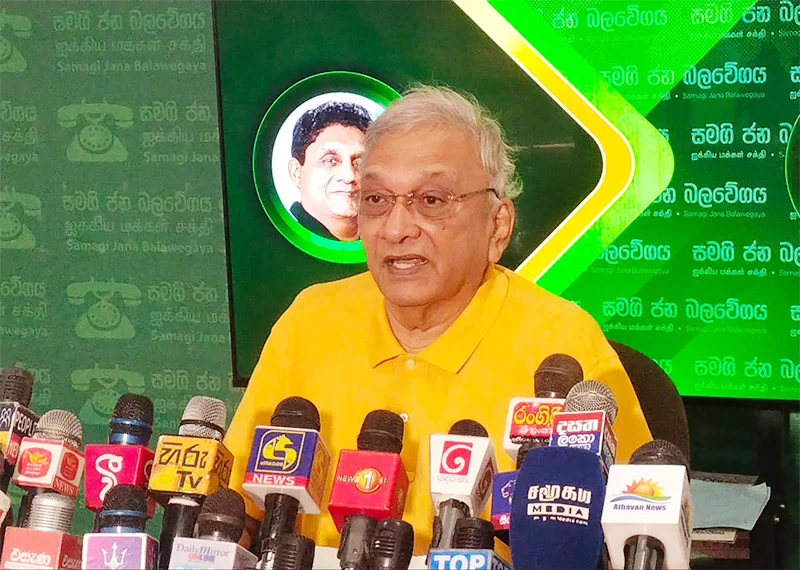
The main Opposition SJB yesterday strongly criticised the government over the suspension of Deputy Secretary General of Parliament Chaminda Kularatne, alleging that the procedure adopted was flawed, unlawful and in violation of established parliamentary traditions.
Addressing a press conference at the SJB headquarters in Ethul Kotte, former Chief Opposition Whip and Kandy District MP Lakshman Kiriella said the Speaker had no authority, under Parliamentary practice, to remove or suspend a senior parliamentary official without first reporting the matter to the House.
Kiriella said Sri Lanka’s Parliament was governed by two primary sources — Standing Orders and long-standing British parliamentary traditions and precedents — both of which must be adhered to in the absence of explicit statutory provisions.
“The Standing Orders derive their authority from the Parliament Powers and Privileges Act, which is silent on the procedure for removing parliamentary officials. In such circumstances, Parliament is bound by British traditions and precedents, as outlined in Erskine May’s Parliamentary Practice, which is regarded as the bible of parliamentary procedure,” he said.
According to Kiriella, Erskine May makes it clear that the Speaker does not possess unilateral powers to remove a parliamentary official, particularly one holding a senior and “exalted” position, such as the Deputy Secretary General.
He said that where allegations warranting removal are made against a parliamentary official, the Speaker is required to submit a detailed report to the House outlining the charges, supporting evidence and reasons for initiating such action. Only, thereafter, could the House decide on the matter, in keeping with British parliamentary precedent.
Kiriella said the recent decision to suspend Kularatne had instead been taken by the Staff Advisory Committee (SAC), which he described as an administrative body lacking the powers and privileges vested in recognised parliamentary oversight committees such as COPE, COPA and COPF.
“The Staff Advisory Committee does not enjoy the powers of the House and, therefore, has no authority to suspend a parliamentary official,” he said.
While stating that he did not place personal blame on the Speaker, whom he said had limited experience in parliamentary procedure, Kiriella faulted senior officials and members of the SAC for failing to properly advise him on the legal and procedural implications of the decision.
“This is the first time in parliamentary history that a Deputy Secretary General has been removed or suspended. While MPs and officials are familiar with impeachments and no-confidence motions, they are not sufficiently versed in the procedural propriety required for the removal of parliamentary officials,” he said.
Kiriella further alleged that Kularatne had not been served with a formal charge sheet, nor had he been given an opportunity to respond to the allegations or be heard, in violation of the principles of natural justice.
“He has not been informed of the charges against him, no inquiry has been conducted and he has been denied a fair hearing. This alone raises serious questions about the validity of the suspension,” he said.
He also said British parliamentary tradition required that an accused parliamentary official be afforded protection and legal assistance by the “Law Officers of the Crown,” noting that in Sri Lanka this responsibility rested with the Attorney General’s Department.
“As such, Kularatne is entitled to legal assistance from the Attorney General in this matter,” Kiriella said.
The former Chief Opposition Whip warned that the controversy could have wider repercussions, including reputational damage to Sri Lanka’s parliamentary democracy.
“The inexperience and ignorance of parliamentary practice on the part of the government has created this mess. It risks creating the impression internationally that our Parliament does not adhere to democratic principles,” he said.
Kiriella added that those who opposed the move within the SAC should have formally recorded the legal grounds for their objections, rather than merely expressing dissent for the record.
“Now that the process has been set in motion, it is likely to bring ill repute to the country,” he said.
By Saman Indrajith

Latest News
Landslide Early Warnings issued to the districts of Kalutara, Kandy, Nuwara Eliya and Ratnapura


The National Building Research Organisation [NBRO] has issued landslide early warnings to the districts of Kalutara, Kandy, Nuwara Eliya and Ratnapura effective from 0400hrs on 12th June 2026 to 0400hrs on 13th June 2026
Accordingly,
LEVEL I [YELLOW] landslide early warnings have been issued to the Divisional Secretaries Divisions and surrounding areas of Palindanuwara in the Kalutara district, Doluwa in the Kandy district, Ambagamuwa in the Nuwara Eliya district and Pelmadulla, Ayagama, Ratnapura, Godakawela, Kalawana and Nivitigala in the Ratnapura district
News
Wife, counsel seek regular access to ex-Spy Chief Sallay held under President’s detention order

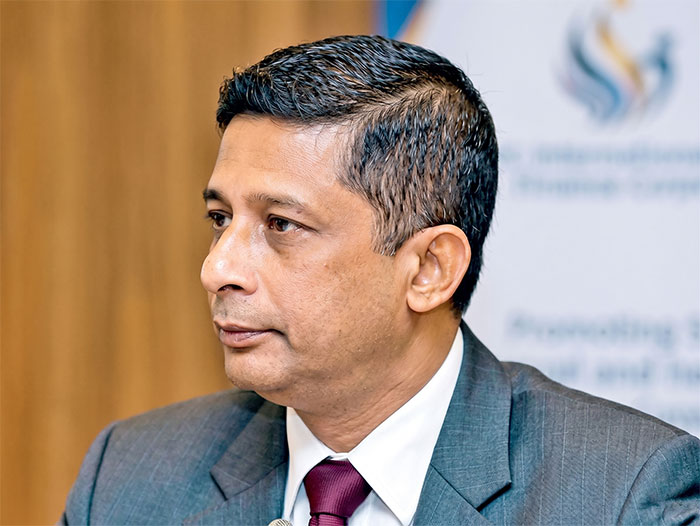
Wife of former State Intelligence Chief Maj. Gen. (Retd.) Suresh Sallay has asked CID Director retired SSP Shani Abeysekera to allow her, her family members and lawyers to visit her husband in the National Hospital, Colombo. Sallay’s counsel has also written to Abeysekera, asking for permission to visit the former spy held on a detention order signed by President Anura Kumara Dissanayake.
The text of Manori’s letter: “I respectfully request your assistance in granting me, and my daughter or alternatively my son, permission to visit my husband, Rtd. Major General Suresh Sallay, who is currently at the National Hospital, Colombo.
“As you are aware, my husband is presently engaged in a fast-unto-death campaign. His physical condition and emotional well-being are of deep concern to our family. During this difficult period, the presence and support of his immediate family are extremely important to him.
“I firmly believe that regular visits from me with our daughter or our son would help uplift his spirits, provide him with much-needed emotional strength, and may encourage him to reconsider continuing this course of action. Family support can play a vital role in preserving his mental and emotional health while he remains hospitalised.
“In view of these exceptional circumstances, I kindly request that permission be granted for either me and my daughter or my son to visit him daily during the period of his hospitalisation.
“I would be most grateful for your compassionate consideration of this request.”
“The text of the counsel’s letter: “I write in my capacity as Counsel for Rtd. Major General Suresh Sallay, who is presently under detention and admitted to the National Hospital, Colombo.
As you are aware, Major General Sallay has embarked on a fast-unto-death campaign, giving rise to serious concerns regarding his physical and mental well-being. In these circumstances, it is imperative that I be granted reasonable and regular access to my client during his hospitalisation.
As his legal representative, I have a professional obligation to monitor his condition and obtain instructions from him so that I may accurately apprise the relevant courts of his health status and any developments affecting his rights and welfare. Effective legal representation requires continuous communication with my client, particularly in light of the grave circumstances presently confronting him.
I also wish to respectfully highlight that Major General Sallay has placed explicit trust and confidence in me as his counsel. Indeed, I was the first person he contacted following his arrest.
Given the trust he reposes in me, I believe I am uniquely positioned to engage with him constructively and persuade him to discontinue this campaign and instead place his confidence in the legal remedies and judicial processes available to him.
For these reasons, I respectfully request that I be granted permission to visit my client on a daily basis during the period of his hospitalization.
Such access would not only facilitate the discharge of my professional responsibilities but may also contribute meaningfully towards safeguarding his health and encouraging a resolution through lawful and institutional means.
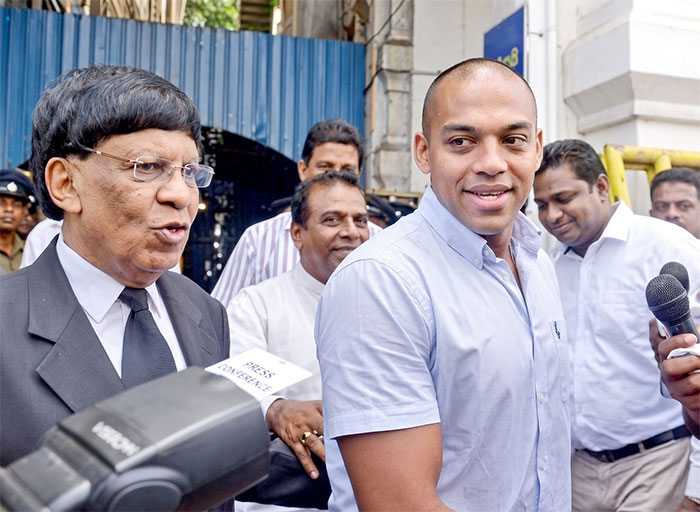
Yoshitha Rajapaksa, who served as a Lieutenant in the Sri Lanka Navy, has now been summoned to the Commission to Investigate Allegations of Bribery or Corruption next Tuesday (16) for questioning over his participation in a Royal Navy training programme in the United Kingdom outside established procedures.
The Commission is expected to record statements in relation to several complaints received regarding his recruitment and subsequent service in the Navy after he enlisted on December 14, 2006.
According to sources, the investigation focuses on allegations concerning the educational qualifications considered at the time of his enlistment, as well as foreign training opportunities he is said to have received while in service, which are suspected to have been granted in violation of due process.
The Bribery Commission has launched the inquiry under the provisions of the Anti-Corruption Act, officials said.

Landslide Early Warnings issued to the districts of Kalutara, Kandy, Nuwara Eliya and Ratnapura

Showers expected in the Western, Sabaragamuwa and North-western provinces and in Galle, Matara, Kandy and Nuwara-Eliya districts

Wife, counsel seek regular access to ex-Spy Chief Sallay held under President’s detention order

CIABOC summons Yoshitha over his participation in British Navy training programme

Communist Party condemns ill-treatment of Sallay, calls for review of PTA

Justice Minister responds to social media claims he represented Easter Sunday ringleader

‘Dates have the highest sugar content to fight Coronavirus’

Sunday Island 27 December – Headlines

#SundayIsland 17th December – Headlines

Sunday Island – 28th March

Sunday Island Headlines – 21 March

Sunday Island – 21st February – Headlines
-
 News5 days ago
Women’s T20 World Cup 2026 warm-up: Chamari Athapaththu’s 94 helps Sri Lanka beat Pakistan
-

 News6 days ago
Asst. Manager, security officer arrested over Rs 30 mn snatch at Horana PB branch
-

 Editorial4 days ago
Probe Sallay’s complaint
-

 News5 days ago
Lankan-Canadian inducted to Toronto Sports Hall of Fame
-
 News2 days ago
Local firms move millions of dollars overseas for phantom imports: Govt.
-

 Editorial5 days ago
Prez in the dock
-

 Features5 days ago
Entering MIT for my Ph.D program, coping with harsh Boston winter and breasting the tape
-

 News6 days ago
No blanket ban on musical performances; only those promoting LTTE