
Latest News
US seizes two ‘shadow fleet’ tankers linked to Venezuelan oil


The United States says it has seized two tankers linked to Venezuelan oil exports in “back-to-back” operations in the North Atlantic and the Caribbean.
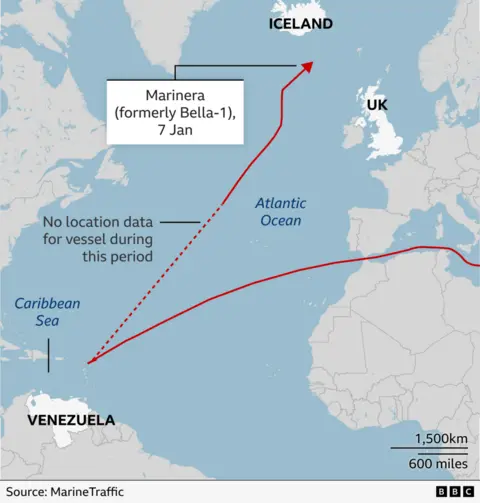
US forces boarded the Russian-flagged Marinera after a pursuit lasting almost two weeks as it travelled through the waters between Iceland and Scotland. The UK Royal Navy gave logistical support by air and sea.
A second tanker – the M/T Sophia – was accused by the US of “conducting illicit activities” and boarded in the Caribbean.
The moves come as the US seeks to choke off most exports of Venezuelan crude oil, and just days after its special forces seized Venezuelan President Nicolás Maduro in a lightning raid on his residence in Caracas.
Venezuela’s leadership is co-operating with the US on the second tanker seized in the Caribbean, US Secretary of State Marco Rubio said.
“They understand that the only way they can move oil and generate revenue and not have economic collapse is if they co-operate and work with the United States,” he told reporters.
Earlier, US President Donald Trump had said that Venezuela – which has the world’s largest proven oil reserves – “will be turning over” up to 50 million barrels of oil worth some $2.8bn (£2.1bn) to the US.
Rubio, who briefed US lawmakers on the ongoing operation in Venezuela on Wednesday, said that the US would sell oil that is in Venezuela “in the marketplace at market rates” and that the US would control how the proceeds were dispersed “in a way that benefits the Venezuelan people”.
He said the US had a considered plan for the future of Venezuela, and that the administration was “not just winging it”.
Rubio said the Trump administration’s plan in Venezuela was stabilisation, recovery and then transition.
But the discussions surrounding oil were only one component of concern US lawmakers had over the escalating conflict.
Senate Majority Leader Chuck Schumer said lawmakers needed answers to lingering questions of how many US troops could be involved and how much money the US involvement in Venezuela will cost.
Republicans largely appeared to back the administration’s moves in the region, though some expressed concern about what kind of say Congress had.
The Senate is expected to vote next week on a bipartisan war powers resolution – an attempt to block continued military action in Venezuela. A war powers resolution – created in the wake of the Vietnam War – limits a president’s power to involve US armed forces in hostilities without congressional approval.
“If we’re going to have continued engagement in the next phase, I think it has got to be subject to war powers,” North Carolina’s Thom Tillis said.
Meanwhile, Missouri’s Josh Hawley said that if the administration’s actions were a law enforcement operation, then it does not require congressional approval, but “if it’s a military operation involving a foreign head of government, even one we don’t recognise officially, that’s a very different situation”.
China – the biggest buyer of Venezuelan oil in recent years – has condemned the US moves and accused it of threatening global energy security.
The seizure of the two tankers was announced by the US military in separate posts on social media on Wednesday.
The US European Command said the M/V Bella 1 – using the former name of the Marinera – was boarded “for violations of US sanctions”.
“The vessel was seized in the North Atlantic pursuant to a warrant issued by a US federal court after being tracked by USCGC Munro”, a Coast Guard cutter.
Britain’s Ministry of Defence said RAF surveillance aircraft and a naval support vessel, the RFA Tideforce, were among the UK military assets that took part in the operation, following a US request for assistance.
Defence Secretary John Healey said the action was “in full compliance with international law”, and “formed part of global efforts to crack down on sanctions- busting”.
The vessel has been accused of breaking US sanctions and shipping Iranian oil.
Images published by Russian state broadcaster RT show a helicopter close to a ship that appears to be the M/V Bella 1.
The Russian Maritime Register of Shipping shows that the tanker had changed its name to Marinera, and was sailing under the Russian flag. Its home port stated as the southern Russian city of Sochi on the Black Sea.
The Russian transport ministry said US forces boarded the Marinera at about 15:00 Moscow time (1200 GMT), after which communications with the vessel were lost.
US officials said that Marinera was falsely flying the flag of Guyana last month, which made it stateless.
Experts told BBC Verify that the US called the ship Bella 1 as a vessel cannot change its flag during a voyage unless there was a real transfer of ownership or change of registry.
The experts also said that under UN international maritime law, a stateless vessel can be boarded by authorities.
Separately, the US Southern Command announced on Wednesday that the defence and homeland security departments “apprehended a stateless, sanctioned dark fleet motor tanker without incident”.
“The interdicted vessel, M/T Sophia, was operating in international waters and conducting illicit activities in the Caribbean Sea. The US Coast Guard is escorting M/T Sophia to the US for final disposition.”
The US Southern Command also posted a video showing a helicopter circling over a vessel.
Homeland Security Secretary Kristi Noem said that “in two pre-dawn operations today, the Coast Guard conducted back-to-back meticulously co-ordinated boarding of two ‘ghost fleet’ tanker ships”.
She said both seized vessels “were either last docked in Venezuela or en route to it”.

Latest News
Landslide Early Warnings issued to the Districts of Kandy, Kegalle, Matale and Ratnapura

The Hational Building Research Institute (NBRI) has issued landslide early warnings to the Districts of Kandy, Kegalle, Matale and Ratnapura valid from 2200 hrs on 03rd October upto 2200 hrs on 04th October 2026.
Accordingly,
LEVEL II (AMBER) landslide early warnings have been issued to the Divisional Secretaries Divisions and surrounding areas of Udu Dumbara and Minipe 8n the Kandy district, Dehiowita in the Kegalle district, and Ambanganga Korale and Matale in the Matale district.
LEVEL I (YELLOW) landslide early warnings have been issued to the Divisional Secretaries Divisions and surrounding areas of Rambukkana in the Kegalle district, Rattota in the Matale district, and Eheliyagoda in the Ratnapura district.
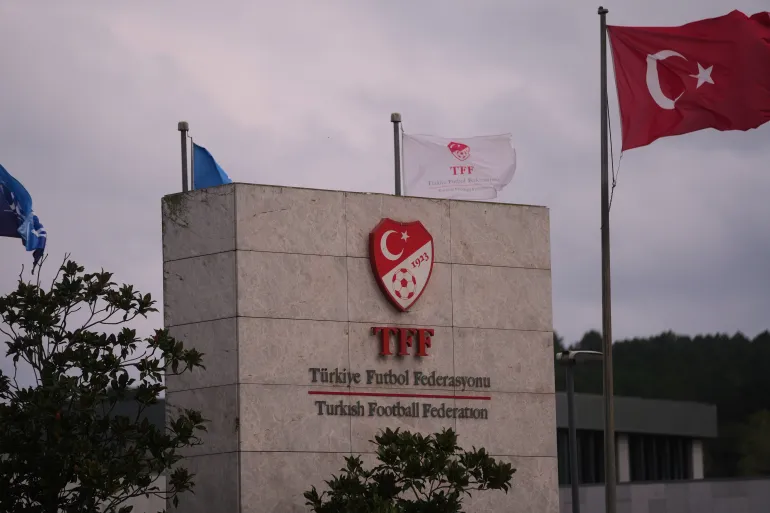
The head of Turkiye’s football refereeing body and four other officials have been placed in pretrial detention by a court as part of a corruption investigation, the state news agency Anadolu reports.
Ferhat Gundogdu, head of the Central Referees Committee, and six others appeared before a judge over allegations of manipulation of the referee administration process, Anadolu said on Saturday.
They appeared on Friday before a judge at Istanbul’s Caglayan courthouse on several charges, including forgery of official documents, breach of trust and illegal acquisition of personal data, the report said.
The judge remanded five people in custody and granted the other two conditional release, Anadolu said.
It was the latest scandal to shake football in Turkiye, coming exactly a year after the Turkish Football Federation (TFF) suspended 149 referees on charges of illegal betting.
On Thursday night, police from the illegal betting and sports crime unit also detained Yasin Kol, a referee from Turkiye’s top-flight Super Lig, as well as an assistant referee, media reports said.
Justice Minister Akin Gurlek said prosecutors are examining claims about “interference in the processes of referee classification, assignments, scoring and appointments as well as the exams on rules”.
During raids on Tuesday, police searched the VAR room at TFF’s headquarters in Istanbul. Observers said the investigation was likely linked to last year’s betting scandal and would have implications for the federation.
“It does seem to be a continuation of 2025, and it looks like it will continue further,” sports journalist Ayhan Sensoy told the AFP news agency.
Sensoy, who wrote a 2024 book on the issue called The Gambling Pit, said it was unlikely that federation bosses “have any chance of staying in office”.
So far, the TFF has not directly addressed the arrests as its top officials are due to fly home on Saturday after attending Friday night’s Belgium-Turkiye UEFA Nations League clash in Liege, which Turkiye lost 3-0.
[Aljazeera]
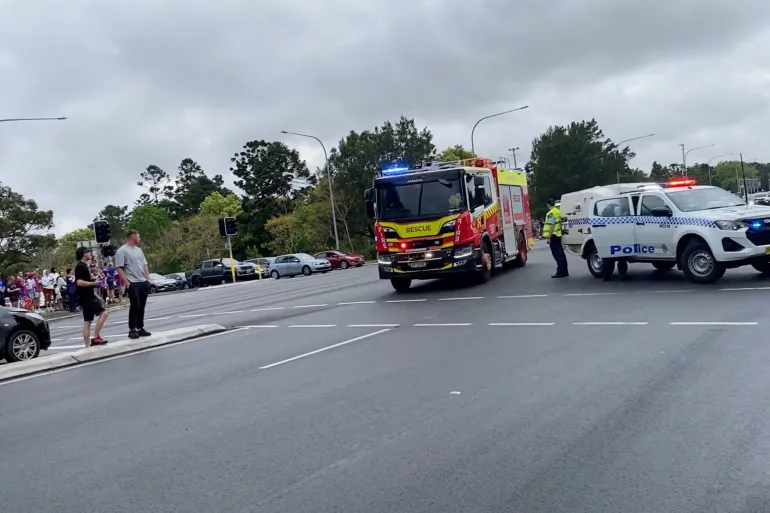
A car has crashed into a crowd of rugby league supporters in the eastern Australian city of Newcastle, injuring 10 people, including three children.
New South Wales police said on Saturday that two of the injured – a five-year-old girl and a 67-year-old man – were in a critical condition and the other eight were in stable condition in hospital.
Police said they had arrested the 18-year-old man driving the vehicle and were investigating what happened. They said the crash was not believed to be related to “terrorism”.
The crowd had gathered to farewell the local rugby league side, the Newcastle Knights, ahead of their grand final against the Sydney Roosters on Sunday.
Newcastle Lord Mayor Gavin Morris said the driver, a rugby league fan, had lost control of his vehicle and had been taken into custody.
“He was revving the car, he was excited, he was a supporter, he was there for the joy of the moment,” Morris told the national broadcaster ABC.
“Somehow he lost control of the car … and he’s gone into the crowd,” he added.
Prime Minister Anthony Albanese said: “My thoughts are with everyone injured or involved in the horrible incident this morning in Newcastle.”
“Rugby league brings people together, and this should have been a weekend of excitement and pride for Newcastle fans,” he wrote in a social media post.
[Aljazeera]

Showers above 75 mm are likely at some places in the Western, Sabaragamuwa, Central, and Southern provinces after 1.00 pm

Govt. urged to halt ‘illegal’ presidential pardons

GL urges cautious handling of Saudi death row case, blasts govt. over BRICS affair

Shiranthi files anticipatory bail application

Sri Lanka renews Honorary Consul appointment in Mombasa

Govt. plans to amalgamate NDF and ‘Api Wenuwen Api’ Fund

‘Dates have the highest sugar content to fight Coronavirus’

Sunday Island 27 December – Headlines

#SundayIsland 17th December – Headlines

Sunday Island – 28th March

Sunday Island Headlines – 21 March

Sunday Island – 21st February – Headlines
-

 Latest News6 days ago
Gold winner Tharanga gets brand-new Honda Vezel from SLAAJ
-

 Features6 days ago
Why Sri Lanka needs an Inclusive Civic Nationalism – urgently
-

 News5 days ago
US-assisted ‘Ice’ detection: NPC to examine IGP’s move to transfer drug-busting team
-

 Editorial4 days ago
Colombo Port drug bust: The plot thickens
-

 News6 days ago
Civil society activist accuses govt. of favouring Ven. Gnanasara
-

 Editorial6 days ago
When crime bosses rise above law and shrines
-
 Midweek Review6 days ago
Dappula’s Easter Sunday ‘grand conspiracy’ claim demolished
-
Editorial5 days ago
Drug busting, transfers and trust deficit