
News
Let us unite with unwavering determination to rebuild the nation – President


President Anura Kumara Dissanayake stated that the recent disaster dealt a severe blow to an economy that was being rebuilt steadily and systematically and that in the face of such a challenge, It is the duty of every citizen not to withdraw or remain in hopelessness, but to come together with unwavering determination to restore the nation.
President Dissanayake paid heartfelt tribute to the Sri Lanka Navy for its immense contribution during the disaster, particularly commending its courageous rescue operations at the Kala Oya, where naval personnel risked their own lives to give hope to those trapped by fear of death and saved a large number of lives. He expressed deep gratitude for the Navy’s selfless service and honoured the naval personnel who made the supreme sacrifice while rescuing others.
President Anura Kumara Dissanayake made these remarks while addressing the commissioning and passing-out parade held Saturday (13) afternoon at the Trincomalee Naval and Maritime Academy.
Upon his arrival at the Trincomalee Naval and Maritime Academy, the Commander-in-Chief of the Armed Forces, President Anura Kumara Dissanayake, was received with full naval honours.
At the ceremony, eight directly commissioned officers of Intake 2024/03, thirty-three officers of the 40th intake of the General Sir John Kotelawala Defence University and twenty-five officers of the 65th cadet intake of the Trincomalee Naval and Maritime Academy were commissioned.
Awards were presented to senior sailors who demonstrated outstanding performance during training and ceremonial swords were presented to the newly commissioned officers by the President.
The President paid tribute to the naval officers who made the ultimate sacrifice while saving lives in the face of the disaster.
The President also commended the Sri Lanka Navy for its vital role in combating the drug menace, which he described as one of the greatest challenges facing the country today. He reaffirmed the Government’s firm commitment to take every necessary measure to protect the nation from drug trafficking and called upon all citizens to unite in safeguarding the motherland from this threat.
Emphasising the importance of responsibility and duty, President Dissanayake stated that although he himself as the President, the Commander of the Navy and all other officers bear different responsibilities according to their positions, each responsibility is equally vital for a stable and strong state. The President stressed that the nation can move forward only when everyone faithfully discharges the duties entrusted to them and that no profession or responsibility should be regarded as secondary, as each contributes to nation-building.
Expressing appreciation to those who chose to join the Sri Lanka Navy an institution known for its discipline, courage and honour, the President urged the newly commissioned officers to carry out the responsibilities placed upon their shoulders with dedication from today onward. He extended his best wishes to all officers for a successful and distinguished professional career.
The event was attended by Governor of the Eastern Province, Jayantha Lal Ratnasekera, Deputy Minister of Defence, Major General Aruna Jayasekara (retired), Secretary to the Ministry of Defence, Air Vice Marshal Sampath Thuyacontha (Retd), Army Commander Lieutenant General Lasantha Rodrigo, Navy Commander Vice Admiral Kanchana Banagoda, Air Force Commander Air Marshal Vasu Bandu Edirisinghe, Inspector General of Police Attorney Priyantha Weerasuriya, senior officers of the Navy and the parents of the newly commissioned officers participated in this event.

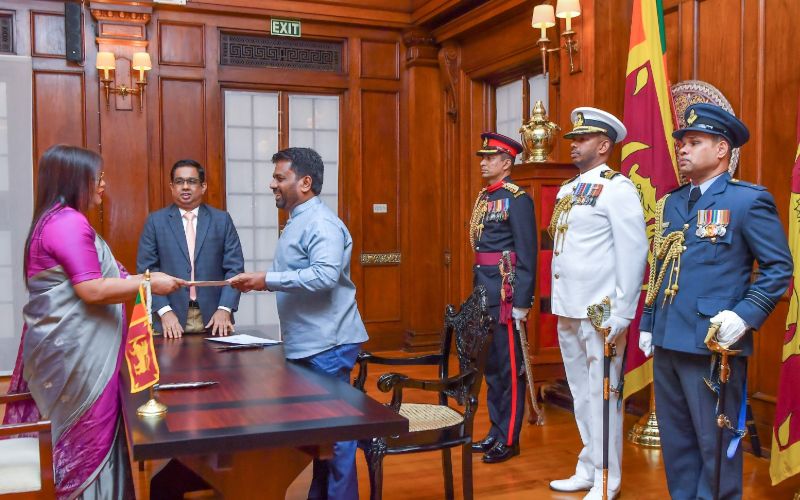
Ms Sajeewani Dilka Lakmali Karunannayake was sworn in as a Judge of the Court of Appeal before President Anura Kumara Dissanayake at the Presidential Secretariat this afternoon (03).
She previously served as an Additional Solicitor General at the Attorney General’s Department.
The appointment has been made to fill a vacancy on the Court of Appeal.
Secretary to the President Dr Nandika Sanath Kumanayake was also present on the occasion.
(President’s Media Division)
Latest News
Sun directly overhead Madampe, Thorayaya, Thotagamuwa, Rattota and Kalavanchikudy about 12.09 noon today (03)

The sun is going to be directly over the latitudes of Sri Lanka from 28th of August to 07th of September due to its apparent southward relative motion.
The nearest places of Sri Lanka over which the sun is overhead today (03) are Madampe, Thorayaya, Thotagamuwa, Rattota and
Kalavanchikudy about 12.09 noon.

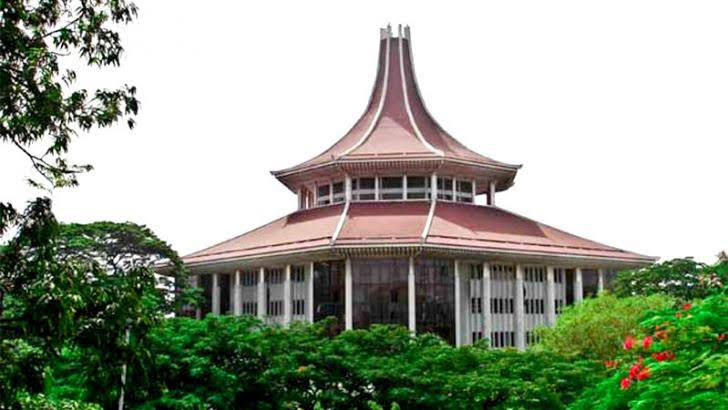
Attorney-at-Law Sugandhika Fernando, on behalf of the Vinivida Foundation, petitioned the Supreme Court yesterday (02), seeking a full bench, excluding Chief Justice Preethi Padman Surasena, to hear the petitions challenging the 22nd Amendment Bill. She also requested that the hearing be suspended immediately until the matter was fully heard and determined.
Among the respondents are Chief Justice Surasena, the first respondent, and Attorney General Parinda Ranasinghe. Justices Yasantha Kodagoda, Shiran Gooneratne, Achala Wengappuli and Priyantha Fernando have also been named as respondents.
The petitioner has sought to have quashed the decision of the first respondent to appoint a five-member bench, which she alleged was made in violation of the norms of public law. She also sought a bench comprising all Supreme Court judges, excluding those cited as respondents, to hear the special determination applications on the 22nd Amendment.
The petitioner further contended that Chief Justice Surasena, who is due to retire on December 1, 2026, would be the main beneficiary of the 22nd Amendment.
The hearing of the petitions continued for a second day yesterday (02) before a five-member Supreme Court bench comprising Chief Justice Preethi Padman Surasena and Justices Achala Wengappuli, Arjuna Obeyesekere, Sampath Abeykoon and Gihan Kulatunga.
The hearing, which commenced on Tuesday morning, continued for nearly 12 hours, until 10:30 p.m.
Solicitor General Viraj Dayaratne, appearing for the Attorney General, submitted yesterday that the Government had presented the 22nd Amendment Bill to the Constitution and the Judicature (Amendment) Bill with the objective of expanding and streamlining the country’s judicial system.
After the Solicitor General’s submissions concluded, counsel representing the petitioners requested an opportunity to respond to the Solicitor General and the intervening petitioners. However, the Chief Justice declined to allow the petitioners’ counsel to make further oral submissions, concluded the determination hearing and directed them to file written submissions instead.

New Court of Appeal Judge Sajeewani Dilka Lakmali Sworn In

India to host inaugural Women’s Champions Trophy in February

Sun directly overhead Madampe, Thorayaya, Thotagamuwa, Rattota and Kalavanchikudy about 12.09 noon today (03)

Afternoon thundershowers in the Northern, North-central, Eastern and Uva provinces in next few days, starting from today (03).

22A: SC urged to suspend hearing, appoint full bench

Govt. seeks NATO assistance

‘Dates have the highest sugar content to fight Coronavirus’

Sunday Island 27 December – Headlines

#SundayIsland 17th December – Headlines

Sunday Island – 28th March

Sunday Island Headlines – 21 March

Sunday Island – 21st February – Headlines
-

 News7 days ago
Eight politicians in drug kingpin probe
-

 Features5 days ago
“Wrap Me Up in My Blazer”— A Gentlemanly Bradby Reminiscence
-

 Business7 days ago
Sri Lanka opens up: A new season of direct connectivity
-

 Features4 days ago
When Sri Lankan stories find their own voice
-

 Features7 days ago
Redefining ageing in Sri Lanka
-

 Editorial7 days ago
The toxic legacy of two lakes
-
 Business7 days ago
Jaffna Teaching Hospital secures lifeline water supply via ADB-funded Thalaiyadi sea water desalination plant
-
 Features5 days ago
JVP/NPP government as seen from outside by Lionel Bopage now domiciled in Australia