
News
“Our people have shown extraordinary resilience.” – PM


Prime Minister Dr. Harini Amarasuriya said that despite the recent devastation caused by severe flooding and landslides, Sri Lanka continues to recover rapidly due to the exceptional strength and solidarity demonstrated by the people. “We have taken a blow, but we are far from fallen. Our people have shown remarkable resilience, and that spirit has carried us through every crisis we have faced,” she stated while addressing the visiting NASSCOM Executive Committee and SLASSCOM leadership during their interaction held on 4th December at ICT Rathnadeepa Hotel, Colombo.
The meeting brought together NASSCOM—the apex body of India’s technology industry representing over 3,000 companies—and SLASSCOM, Sri Lanka’s national chamber for the IT and BPM sector with more than 350 member companies, to discuss digital-economy collaboration, investment opportunities, and the path forward for Sri Lanka’s ICT landscape.
The Prime Minister thanked the NASSCOM delegation for proceeding with their annual visit to Sri Lanka despite the country’s recent challenges, noting that their presence sends a strong message of confidence in Sri Lanka’s stability and recovery. She explained that the government, together with the World Bank and the United Nations, is conducting short- and long-term assessments to guide reconstruction efforts, which will include resettlement, improved disaster preparedness, flood control, and major infrastructure restoration.
During the discussion, the Prime Minister highlighted that Sri Lanka’s economic recovery plan remains firmly on course. She noted that the government has set a medium- to long-term target of 7% economic growth and emphasized two key priorities relevant to the visiting technology leaders: export diversification and accelerating the digital economy. “We are committed to developing a strong digital economy. This is an area where we look forward to India’s continued collaboration and partnership,” she said.
Responding to questions on how digital transformation is progressing within government institutions, Prime Minister stated that the Ministry of Education has already begun implementing a National Education Management System, which is expected to be launched in January. She also noted that other ministries have commenced their own digitalisation work and will be ready to introduce their systems in the coming months.
The Prime Minister also welcomed an offer of support from an Indian technology company specialising in drones for disaster response, mapping, and geospatial data. The representative proposed extending technical assistance to improve Sri Lanka’s disaster-management capabilities, including documentation and real-time monitoring. In response, Prime Minister acknowledged that Sri Lanka must strengthen early-warning systems and invest in modern technologies to better manage future disasters, noting that inadequate systems had limited the ability to predict this year’s extreme rainfall.
Detailing the government’s broader reform agenda, the Prime Minister explained that regulatory frameworks, governance reforms, and digital transformation initiatives are underway to make Sri Lanka an attractive destination for major IT and BPM investments. She stressed that Sri Lanka aims to reach USD 5 billion in export value in the IT and BPM sector by 2030, supported by improved human-resource development, education reforms, and a national plan to expand skilled employment. She further highlighted that the government is working closely with India on digitising the public sector, implementing a universal digital ID system, and introducing integrated platforms such as the National Education Management System.
The NASSCOM delegation’s visit forms part of a long-standing collaboration between NASSCOM and SLASSCOM, aimed at strengthening Sri Lanka’s ICT sector and positioning the country as a strategic extension market for leading Indian and global technology industries. Their visit also coincides with SLASSCOM’s preparations for the 2026 NASSCOM Technology & Leadership Forum.
Deputy Minister of Digital Economy Eranga Weeraratne, Chief Advisor to the President on Digital Economy Dr. Hans Wijesuriya, Indian High Commissioner Santosh Jha, and representatives from SLASSCOM and NASSCOM attended the event.

[Prime Minister’s Media Division]


COPF final report on USD 2.5 mn cyber fraud recommends action against all responsible
The US$2.5 million loss incurred during Sri Lanka’s foreign debt repayment to Australia was a clear case of a cybercrime and theft, Committee on Public Finance (COPF) Chairman Dr. Harsha de Silva told Parliament yesterday.
Presenting the COPF final report on the cyber fraud, Dr. de Silva said the incident amounted to a serious financial crime and called for a comprehensive investigation, by law enforcement authorities, to identify and prosecute all those responsible.
The report revealed serious governance, procedural and operational failures that enabled the fraudulent transfer of public funds, while recommending sweeping reforms to strengthen cybersecurity, financial controls and public debt management systems.
According to the report, officials of the Treasury and the Central Bank bore responsibility for governance lapses that contributed to the failures. It also highlighted the fact that the Ministry of Finance was operating an outdated Microsoft Exchange Server after security support had ended, while basic safeguards, such as multi-factor authentication, had not been implemented.
The COPF said suspicious payment instructions linked to debt repayments involving India, the United Kingdom, Germany and Belgium had also been detected, preventing further losses. However, the US$ 2.5 million fraud materialised only in the repayment transaction involving Australia.
The report has noted that officials had failed to verify lender email domains, relied on unverified email communications and lacked adequate internal controls, allowing the fraud to continue for months.
Although the investigation uncovered system-wide weaknesses across several institutions, only four mid-level Finance Ministry officials had been suspended so far, the report said.
The COPF has recommended a special audit of the foreign debt repayment process, strengthened cybersecurity measures across state institutions, updated financial regulations and improvements to public debt management systems.
by Saman Indrajith
News
Opposition signs no-confidence motion against Justice Minister for dereliction of duty over Negombo Prison deaths

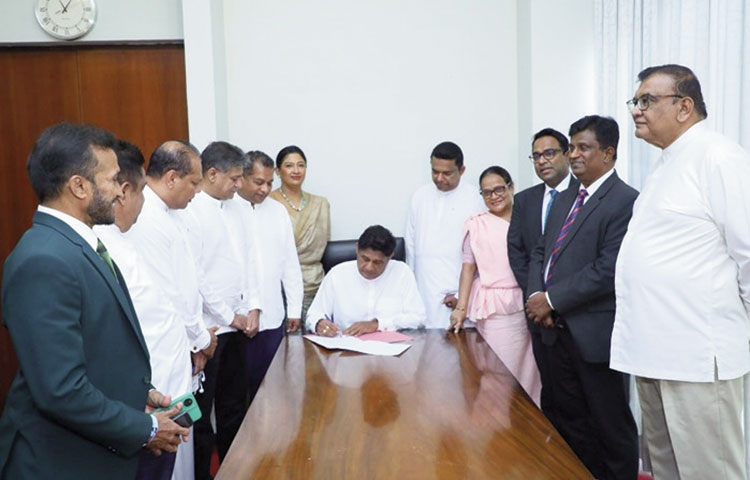
Opposition Leader Sajith Premadasa, together with Opposition MPs, yesterday signed a No-Confidence Motion (NCM) in Parliament against Justice Minister Harshana Nanayakkara.The move comes in response to the unrest at the Negombo Prison, where both prison officers and inmates were killed.
Opposition members said the Minister had failed to fulfill his responsibility and accountability regarding their safety.According to the Opposition group, the NCM seeks to hold the Minister directly accountable for lapses in ensuring protection within the prison system.

The Attorney General yesterday informed the Supreme Court that the government has decided to review the legality of agreements entered into by the previous administration to hand over the country’s electronic visa issuance operations to private companies.
Additional Solicitor General Viveka Siriwardena, appearing for the Attorney General, made the submission when the Supreme Court took up the fundamental rights petitions filed by former MPs President’s Counsel M.A. Sumanthiran, Patali Champika Ranawaka, and Rauff Hakeem, challenging the previous Cabinet’s decision to outsource the e-visa system.
The petitions were heard before a three-judge bench, comprising Chief Justice Preethi Padman Surasena and Justices Achala Wengappuli and Arjuna Obeyesekere.
The Additional Solicitor General informed court that the current Cabinet had appointed a subcommittee to examine the legality of the agreements with the private companies and requested time to report on its findings, stating that the review was still underway.
President’s Counsel Sumanthiran, appearing as one of the petitioners, told the court that although the present government had indicated its intention to cancel the transaction, the petitioners wished to proceed with the case.
He noted that members of the current Cabinet had been named as respondents in the petitions.The Supreme Court directed the petitioners to issue notice on the members of the current Cabinet, named as respondents, and fixed September 29 for further proceedings.

History takes centre stage as Mandhana, Harmanpreet fifties steer India

Spain leave it late to book semifinal date with France

Showers will occur in the Sabaragamuwa, Western and North-western provinces and in Galle, Matara, Kandy and Nuwara-Eliya districts

US$ 2.5 mn cyber heist exposes system failures

Opposition signs no-confidence motion against Justice Minister for dereliction of duty over Negombo Prison deaths

AG informs SC of e-visa agreement review

‘Dates have the highest sugar content to fight Coronavirus’

Sunday Island 27 December – Headlines

#SundayIsland 17th December – Headlines

Sunday Island – 28th March

Sunday Island Headlines – 21 March

Sunday Island – 21st February – Headlines
-

 News6 days ago
Singapore-based Buddhist monk marks nearly four decades of humanitarian service
-
 News1 day ago
Herath warns prospective migrant workers not to get fleeced by racketeers
-

 News5 days ago
AI concerned over proposed SL military deployment in Haiti
-

 Midweek Review3 days ago
Unexpected focus on ‘pieces of tin’ worn by military men
-

 Latest News4 days ago
Nyamhuri and Ngarava stun Bangladesh by defending 141
-

 Features6 days ago
The NPP’s New Challenge: Balancing Easter Lawfare and Economic Welfare
-

 News2 days ago
Negombo Prison riot: Ensuring protection of prisoners fundamental responsibility of the state – UN
-

 Editorial3 days ago
Prison riots and political battles